
Worcestershire Record No. 23 November 2007 pp. 4-5
INTERESTING RECORDS FROM THE RECORDERS’ COMMITTEE 2007
Geoff Trevis
At the end of each committee meeting we have a round table report which gives the opportunity for each member to report any interesting records they have had since the last meeting. Many important things come to our attention and I thought it might be of interest to the members generally to pass on some of the data obtained. Records have come from every member of the committee and are too numerous for all to be listed here but I have tried to extract the most notable ones to give a flavour of what goes on. In bringing them together perhaps the most outstanding thing is the sheer range of expertise on the committee.
At most meetings the invertebrate records tend to be the most numerous so I will begin with these. The main points of interest have been the spread of the Harlequin Ladybird Harmonia axyridisand of Long-winged Conehead Conocephalus discolour and Roesel’s Bush Cricket Metrioptera roeselii. Harry Green counted 123 sites with Long-winged Coneheads and 62 with Roesel’s Bush Cricket. Records of Noble Chafer Gnorimus nobilis continue to increase from old plum orchards, emphasising the importance of Worcestershire for this species. Other notable records include:
Ladybirds: Cream-streaked Ladybird (Harmonia 4-punctata) and Eyed Ladybird Anatis ocellata.
Hymenoptera: Lasius fuliginosus (an ant found mainly in old trees but one nest has been found in an old beehive at Norchard Farm); Formicoxenus nitidulus (the Guest Ant), found in many Wood Ant nests in Wyre Forest); Formica sanguinea ( the Blood-red Robber Ant, a slave maker re-found in Wyre Forest); Myrmica scabrinodis (an ant, Cleobury Wood); Crossocerus styrius (a solitary wasp, 1st county record at Rough Hill Orchard); Nomada fulvicornis (a solitary bee at Upper Blackstone Farm); Dasyoda hirtipes (Nb, solitary bee at Upper Blackstone Farm and Burlish Top); Andrena bimaculata (Nb, mining bee at Upper Blackstone Farm); Lasioglossum xanthopus (Nb, mining bee at Hollybed Common); Eucera longicornis (Nb, mining bee at Joan’s Hole, 1st record since 19th century); Andrena nigrospina (RDB2, at Upper Blackstone Farm, record yet to be confirmed by DNA analysis).
Lepidoptera: An important observation is the increasingly early records for some species. These included February records for the Brimstone butterfly and a March record for Humming Bird Hawkmoth.
Regular reports come from the butterfly Transect Recording Scheme and good numbers of most species were recorded in the early part of the year including Green Hairstreak, Grizzled Skipper and Brown Argus. Several members were lucky enough to see the Six-belted Clearwing moth at Hollybed Common. Other notable records included Great Brocade (a rare migrant); Assura terebrella (a pyralid moth, 1st county record); Camera ohridellaria (a leaf-mining moth on Horse Chestnut); Phyllonorycter platini (a leaf-mining moth on London Plane, relatively6 new to Britain).
Coleoptera, Hemiptera, Homoptera: There have been many additions to the county lists during the year amongst them 12 species of leaf-hopper (most notable Graphocephalus fennatii, the Rhododendron leaf-hopper); Ceutorhyncus campestris (Nb beetle); Rhagonycha translucida (Nb beetle); Nysius gaminicola (RDB3 bug); Cassida hemisphaertoa (beetle, 2nd county record). Great Willow aphid has been reported as frequent this year. A further report was of thousands of red Gorse Mites (Tetramychus lintearius) covering a bush on Castle Morton Common with silk.
Diptera: Generally we have records of hoverflies, particularly Volucella inanis and V. zonaria, but now that Mick Blythe has been co-opted to the committee we have had records of other rare species including Cordilura albipes, Lycoriella vanderweili (from a Wood Ant nest), Leptocera oldenbergi and Coenosia stigmatica. These were from Wyre Forest.
Snails: Hygromia limbatare-found at a known site on the Malvern Hills and Hygromia cinctella continues to invade gardens.
Mammals: Serotine and Barbastelle bats.
Birds: Regular records are reported from the red and amber listed bird survey. Additionally, there has been anecdotal evidence of increased numbers of Turtle Doves in 2007.
Vascular plants: There have been records of 10 new species of dandelion Taraxacum sp.; a 3rd county record of Poa infirma; Iva xanthifolia (a North American species);a 3rd post 1987 record of Misoplates orontium (Weasel’s Snout); 4th county record of Bassia scoparia ( Summer-cypress).
Bryophytes: There have also been additions to the records of bryophytes including Leucobryum juniperoideum, Tortella Bamberger, Sphagnum denticulatum and Aphanorhegma patens.
Fungi: We do not get many records of fungi but of those we did receive the most notable were Geastrum rufescens (an earth star) and Hygrocybe ingrata (a waxcap).
However, among the records I think pride of place must go to John Day for unearthing a record of a beetle Airaphilus elongates excavated from a Roman well dug between 289 AD and 360 AD!
Worcestershire Record No. 23 November 2007 p. 5
THE HARLEQUIN LADYBIRD HARMONIA AXYRIDIS
Harry Green
In Worcestershire Record No 22 April 2007) I guardedly predicted that 2007 could be the year of the Harlequin in Worcestershire following the great national spread in recent years. This is probably true as we have received a regular but small flow of records from sites right across the county. Recent records of Harlequins coming indoors in October reinforce its pet name of The Halloween Beetle. The records that reach us are probably just the tip of the iceberg! We hope to produce a distribution map in the April 2008 issue of Worcestershire Record so if you have any records please send them into the WBRC in the near future. Many thanks to those who have already sent in records. For further information see Worcestershire Record No. 21, November 2006
Brett Westwood found a colony in his garden and was able to see the larvae and pupae. They are very characteristic (see Roger Umpelby’s article on Aphids in this issue). Pictures of those in Brett’s garden follow. When these eventually reach our web site they can be seen in colour.
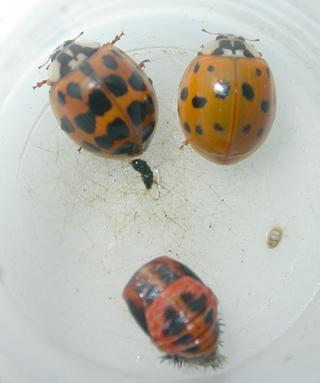
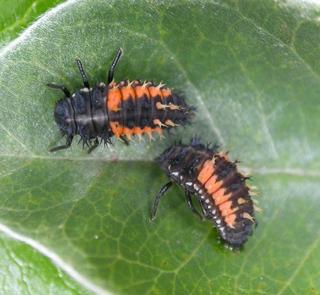
Two adults and a pupa Two larvae
Worcestershire Record No. 23 November 2007 p. 21
OTTER AT BROUGHTON HACKETT
Harry Green
On 23rd July I received a phone call from Pauline Wilson who lives at Broughton Hackett not far from the Bow Brook. In this and in her subsequent emails she explained how every time the Bow Brook flooded an otter visited a nearby pool on fishing expeditions. The flood a few days before had left patches of soft sand which recorded clear footprints, and nearby were the remaining parts of the fish that had been eaten. She kindly sent the following series of pictures (© Pauline Wilson). They form a very nice record of otter activity.


Otter footprint in sand – Broughton Hackett. Leftover carp head (from pool) after an otter had dined


Dirty feeder! – scattered fish scales after otter had eaten fish. Leftover pike head (probably from Bow Brook) after an otter had dined
Worcestershire Record No. 23 November 2007 p. 22-23
WORCESTERSHIRE ANCIENT TREE PROJECT NOVEMBER 2007 UPDATE
By Project Officer Becky Lashley
In the April 2007 issue of Worcestershire Record Harry Green reported the exciting news that the Worcestershire Recorders had been awarded a grant of £50,000 from the Heritage Lottery Fund to build on the work that he and John Tilt had begun in developing a Worcestershire Register of Ancient Trees.
I have now been in post for just over four months, based at the WBRC, and the project is beginning to take off in spectacular fashion. I would like to take this chance to say that the successful start is down in no small part to the support and encouragement that continues to come from Harry, John and other members of the project steering group. Their efforts, and those of other volunteer recorders, have so far resulted in a database containing just over 1000 tree records. These are patchily distributed across the county with a focus very often on high-profile sites such as Hanbury Park or Croome. One key aim of the project was therefore to recruit and train new volunteers and support them in carrying out more systematic survey of the county on a parish-by-parish basis.
Over the last month two very successful training courses have been held, the first at Little Malvern and the second at Martley, and so far 33 new volunteers have received training and signed up to hunt down and survey the ancient trees in their local area. Records from those attending the first course are already starting to come in. Another significant step forward for the project is that several volunteers have also come forward to help with validation of existing data – re-visiting trees to take photographs, check grid references and fill in other bits of missing information. This is an extremely important endeavour and all those who are computer-literate and keen to help ‘get the project’s house in order’ are encouraged to contact either John Tilt or myself to discuss helping with this (contact details below).
Over the next few months work will take place to develop a website for the project, linked to the WBRC website, which we hope to be quite interactive with current records available for viewing. All data collected through the project will be shared with the national Ancient Tree Hunt, coordinated by The Woodland Trust, and data agreements are in the process of being drawn up. We are also liaising with the important GROW WITH WYRE project which contains within it an ancient tree recording scheme, also funded by HLF. All groups recording ancient trees in Worcestershire are working together.
Please get in touch if you have some time over the coming year to get involved in the project. Full training and support will be given and we have bits of equipment including GPS units and measuring tapes that can be lent out. To inspire all budding tree recorders and give you something to aim for, our latest addition to the database turned out to be the third biggest tree found so far in the county: an oak with a girth of 10.4m was found just outside Bromsgrove by Tree Warden Rob Deri (figure 1). Do you know of a bigger one?!
 |
Figure 1. The third largest oak (by girth) in Worcestershie, found near Bromsgrove. The trunk is divided, reminescent of our largest oak near Great Witley. Photo: John Tilt |
| The course at Martley was enlivened by the enthusiasm of those who attended (Figure 2) |  |
TAIL PIECE FROM WICHENFORD. Harry Green.
We were very pleased to be able to show the group some of the pollarded oaks recorded in Wichenford parish by Jane Field (article promised for Worcestershire Record!). Her fellow enthusiast Heather Rendall has an eye for the unusual and sees faces and other things in the knobs, burrs and scars of old trees (I know, it’s worrying!). Here are a few of her pictures. I must add that she and others are undertaking fascinating and important research in to the history of trees in Wichenford. I am sure we shall hear more of this important study.


Top Left: Bull
Top Middle: One of Wichenford’s pollarded oaks (Harry Green)
Top Right: Skull
Bottom Left: Uruk-hai
Bottom Right: Skekzic


Worcestershire Record No. 23 November 2007 p. 27
BIRDS IN WORCESTERSHIRE – May to October 2007
by Gavin Peplow
The summer of 2007 will go down on record as one of the wettest ever, with the County being subjected to torrential rain in both June & July. On both occasions this lead to extensive flooding of the Severn and Avon River valleys – something that is virtually unprecedented for this time of year. The full impact on breeding birds has yet to be assessed, though early starters enjoyed good conditions through April and May. Migrant passage though, in both May and September, through into October has yielded some excellent birds, some of which lingered long enough to be enjoyed by many.
May began with a Hoopoe being seen by a few observers at Upton Warren, whilst a Marsh Harrier drifted over Grimley New Workings. Further individuals of this last species were later seen near Hollywood and again at Grimley mid-month. Ring Ouzel passage was atypically protracted this year with birds remaining on Bredon Hill, Clent and the Malverns through until 10th. Tern passage though was very poor, with just a couple of Black’s and one Arctic reported.
Several un-seasonal records mid-month included a Snow Bunting on Worcestershire Beacon, an Iceland Gull at Kinsham and a Jack Snipe at Upton Warren Flashes. Grimley attracted a Temminck’s Stint, four Sanderling, two or three Garganey, an Osprey and then two drake Red-crested Pochard. What would have been the highlight for all if it had lingered, was a dazzling Bee-eater at Upton Warren. A new bird for the reserve and only the third County record, it sat out a period of heavy rain and then promptly flew off high to the east as soon as there was a break in the weather, having only been enjoyed by a few fortunate observers.
A couple of Quail were heard calling at Longdon Marsh in early June whilst Upton Warren attracted two Little Terns briefly, a migrant Osprey and then a cracking female Red-necked Phalarope mid-month. Two Avocet families here included eight juveniles and they continued to do well, thankfully being quite well grown and therefore able to survive the torrential rain later in the month. Other highlights for the month included a Wood Sandpiper and a pair of Garganey at Grimley New Workings, but all of these records were significantly over-shadowed when it was belatedly reported that a Squacco Heron had visited a small Fishing Pool near Hanley Swan on two separate dates. This is the first record for Worcestershire and only the third ever in the West Midlands Bird Club area.
July was also dominated by wet weather, though this was seemingly enjoyed by an increasing number of Little Egrets at several sites. A Quail called at Grimley during the first week and was followed by a Little Gull and then a Black Tern. An Osprey was seen near Barnt Green and early returning waders included a couple of Wood Sandpipers and a party of 20 Black-tailed Godwits at Upton Warren.
Little Egret numbers continued to increase during August, with a new County record total of ten being seen at Grimley New Workings. The now expected run of juvenile Mediterranean Gulls appeared and as usual, mainly favoured the Upton Warren roost, with a peak of three birds early in the month. Several eclipse Garganey were found, but perhaps the most interesting wildfowl record was of six juvenile Ruddy Shelduck that visited Kinsham and Bredon’s Hardwick. Although normally passed off as ‘presumed escapes’, young birds at this time of year could conceivably have originated from further east in Europe. It will probably though take the observation of a ringed bird at some point to prove this as the source of this attractive species.
Two or three Marsh Harriers were seen at Upton Warren, with a single through Lower Moor, whilst an adult Sandwich Tern was accompanied by a juvenile as it commuted between Bittell and Upton Warren during the last week.
September proved to be an exceptional month for rare and unusual birds. It began with a Great White Egret at Grimley, though sadly it moved on after only a couple of hours of active feeding alongside several Little Egrets. This species is becoming more regular in the UK with an increasing population on the near continent, so this second record was much anticipated, but nonetheless widely enjoyed.
A good selection of waders were seen during the month, with a muddy flash pool at the Trust’s newly created Longdon Marsh reserve attracting a Little Stint and then two Spotted Redshank as well several commoner species. Three Knot visited Bittell, whilst several Curlew Sandpipers stopped for a few days at this site and also at Upton Warren. The star bird though was a juvenile Wilson’s Phalarope that spent four days on the Upton Warren flashes. It performed very well for an extensive and appreciative audience and again constituted the second record for the County – 22 years after the first !
A selection of other notable species included a Wryneck at Stoke Prior, juvenile Gannets over Bittell and Upton Warren, an Osprey over the Gwen Finch Reserve and both Scaup and Common Scoter at Grimley.
Remarkably, the third Phalarope species of the year for the County, a Grey, visited Bittell at the end of the Month, though it only paused briefly. To round off a ‘red-letter’ month, a juvenile Sabine’s Gull (only the fifth for the County) also passed through Bittell whilst the fortunate observers were watching the previous species!
October continued in much the same rich vein as September, with another (or perhaps the same ?) Great White Egret visiting Upton Warren briefly on the opening day. A Richard’s Pipit was then seen briefly at Grimley New Workings one late afternoon at the end of the first week, before being disturbed by a Sparrowhawk, sadly not to be seen again. Remarkably, the same observer found the County’s first confirmed Lapland Bunting at the same site a few minutes later! It roosted overnight and was heard calling as it flew of high to the south-east the following morning. In what has turned out to be a good autumn for this species nationally, another bird of this species was heard over the North Malverns a week or so later, with a possible further two birds glimpsed flying off from the slopes of Worcestershire Beacon.
A late Marsh Harrier was seen over Upton Warren, before a ‘ringtail’ Hen Harrier also flew through the Moors, later being viewed near Hanbury Hall. Other birds of prey included a Red Kite over Abberley, Short-eared Owl at three sites and a late Hobby at Lower Moor.
Winter migrants arrived and included two Brent Geese that spent a short time at Upton Warren, whilst six Pink-footed Geese were seen flying over Malvern Link. A Bittern returned to Upton Warren mid-month and unexpectedly, another juvenile Sabine’s Gull passed through Upper Bittell. Black Redstarts were found on the edge of Kempsey Common and near British Camp, with a Snow Bunting on North Hill rounding off an excellent autumn for birds in the County.
Davies, Steve - HOW MANY MALE CORN BUNTINGS EMBERIZA CALANDRA HOLDING TERRITORY ON WICK GRANGE FARM?
Worcestershire Record No. 23 November 2007 pp. 28-30
HOW MANY MALE CORN BUNTINGS EMBERIZA CALANDRA HOLDING TERRITORY ON WICK GRANGE FARM?
Steve Davies
Introduction
On the 9th June 2007 I attended a field meeting of the Worcestershire Recorders at Wick Grange Farm near Pershore. As many readers will know Tom Meikle runs this intensive farm and takes a keen interest in the wildlife which occurs there.
The main crops present were runner beans and cereal with smaller fields being given to spring onions. Grants from the Countryside Stewardship Scheme have been used to replant and restore hedgerows, and to plant field margins to reintroduce wildflower meadow habitats and rough grassland, hoping this would be conducive to supporting bird species that rely on the invertebrates and seeds found in the crop and field margins to feed their offspring (O’Connor & Shrubb1986). Weed seeds are also a vital winter food for farmland birds, while the bases of the hedgerows and crops provide nest sites for birds such as Corn Buntings (British Agrochemicals Association 1997).
The farm has in previous years been said to have held good numbers of Corn Buntings. However, it should be noted that there have been no prior surveys undertaken to ascertain exact numbers against which to identify population trends. Since the cessation of sugar beet as a crop Tom was concerned about the effect this might have had on the breeding population of Corn Bunting at Wick Grange Farm.
An appropriate survey methodology was required to identify the number of male Corn Buntings holding territory this year. Owing to polygyny in this species with males being known to have harems of up to 10 females (Donald 1997) it would be difficult to estimate the numbers of females present without more intensive study involving time consuming and disruptive nest finding.
Method
Following discussion with Harry Green it was decided that territory mapping using song registrations of male Corn Buntings was the methodology to be used to identify individual territories, with simultaneous registrations the key to separating each male territory.
All other Corn Bunting activity was also to be recorded on a simple map of the farm according to Common Birds Census (CBC) methodology which requires five visits (five for a single target species, 7-9 visits for multiple target species) made during the breeding season (Bibby et.al 2000). The route followed is shown on Figure 1 (at the end of this web page).
Recording visits were made between 7am and 11am in the morning during the peak period of bird activity. One evening visit is allowed in this methodology. Each visit consisted of a walk around the farm following the same route which gave good audio and visual acuity and also ensured that all areas of the farm were covered. Consistency is the key to recording good quality data. Each visit was of around two and a half hours duration. Windy, wet weather was avoided, as this reduces bird activity.
The pilot survey visit was made on 9th June and the five survey visits were to continue, if necessary, until the middle of August. CBC fieldwork methodology recommends visits to be no later than the end of July, but due to the late breeding of our target species the survey model was adjusted to take account of this aspect of their breeding biology.
Additionally, the type of song-post from which the song was delivered was also recorded eg-telegraph wire, hedgerow etc., this would prove to be useful in defining territory.
|
Visit |
Date |
Time (hrs BST) |
| A | 9th June 2007. | 11.00 to 13.00 |
| B | 24th June 2007. | 07.40 to10.10 |
| C | 3rd July 2007 | 09.50 to 11.10 |
| D | 12th July 2007. | 18.30 to 20.30 |
| E | 25th July 2007. | 08.00 to 10.10 |
Table 1. The dates and times of the recording visits.
Identification of Corn Buntings
Harry Green (2007) gave a pretty accurate description of a Corn Bunting:
Its song is like a short, rapid jangling of a bunch of rusty keys,
It is bigger than a Yellowhammer, around lark size,
streaky, brownish and dull, with a big conical bill.
When taking off it flies with its legs dangling down.
All I would add to this would be the lack of white in the tail feathers to avoid confusion with Skylark Alauda arvensis (Mullarney et.al 1999). Mullarney et.al (1999) describe the song of male Corn Bunting thus: tuck tuck-zick-zik-zkzkzkrississss. Whichever rendition you prefer, the song is unlikely to be confused with that of any other species when heard in the field. It is normally delivered from a prominent song-post making location of the source of the song an easy task.
Results
It was fortunate that all five visits were undertaken before the end of July due to the heavy rainfall which occurred in the latter part of the breeding season. Indeed, visit E found many parts of the farm waterlogged. I was unable to make the fifth survey visit due to heavy precipitation in the latter part of the breeding season. Therefore I have used the data collected on the pilot survey to give me the five visits required.
The majority of song registrations were recorded in close proximity to areas where the principal components were cereal crop, hedgerows, and field margins. The only song registrations recorded from areas planted with runner beans at any stage of growth were observed from birds perched on overhead telegraph wires.
A variety of song posts were recognised: telegraph wires, isolated trees ,hedgerows, hedgerow trees, cereal crops and weed seed heads that were taller than the surrounding cereal crop.
The data from all five mapped visits were transferred onto a master copy for analysis. Each Corn Bunting song/activity was designated a visit letter A,B,C,D or E. Once transfer was completed clusters of registrations were used to define territories (see Figure 2 at the end of this web page).
Based on these clusters of registrations I suggest there were eight male Corn Buntings holding territory on Wick Grange Farm, including one male that favoured an isolated tree as a song-post and whose territory may have been on the periphery of the study area. Interestingly, a male territory was identified on neighbouring Glenmore Farm in a cereal field bisected by a weedy strip.
Discussion
The key factor to consider when determining territoriality in this study was the incidence of simultaneous registrations. The maximum number of males recorded singing simultaneously was four. The other four territories were designated by the following criteria:
a. those birds that were of sufficient distance from other singing males as to be considered holding separate territory.
b. those males recorded singing from a particular song-post on more than one occasion.
c. the consistency of route taken on each visit.
Lilleor (2007) stated that in a study on a farmland area in Denmark he found a mean territory density of between 8.8 and 23.9 per km² in suitable habitat
A future study may benefit from a program of capture of Corn Buntings and the fitting of individual colour ring combinations that could be identified in the field. The value of the data this could yield cannot be overestimated as individual males could be identified with a high degree of confidence and territory density could be more accurately measured.
Conclusions
The managed habitat at Wick Grange Farm appears to be good for Corn Buntings, a species with a patchy distribution (Shrubb 1997) and generally in decline perhaps due to changes in modern agricultural practices (Shrubb 2003).
With this study we have a datum point by which to measure Corn Bunting territory density at Wick Grange Farm in future breeding seasons and will be able to monitor any changes that occur.
However, counting the birds is the easy bit!
To identify the mechanisms that allow Corn Buntings to thrive at this site we must make further study using Principal Component Analysis (PCA) and linear multiple regression as used in the Danish farmland study by Lilleor (2007).
I look forward to recording Corn Buntings in 2008.
Acknowledgements
I would like to thank Tom Meikle for allowing me to carry out this study on his farm and Harry Green for his advice on analysing song registration data.
References:
 |
BIBBY, C.J et.al (2000)Bird Census Techniques. Academic Press. London |
|
BRITISH AGROCHEMICALS ASSOCIATION (1997) Arable Wildlife: Protecting Non-target Species. The British Agrochemicals Association. |
|
DONALD,P.F (1997) The Corn Bunting Millaria calandra in Britain: a review of current status patterns of decline and possible causes. In The ecology and conservation of Corn Buntings Millaria calandra. JNCC |
|
GREEN,G.H (2007) The Corn Bunting. Worcestershire Wildlife News, No. 108. April 2007. Worcestershire Wildlife Trust |
|
LILLEOR,O 2007 Habitat selection by territorial male Corn Buntings Emberiza calandra in a Danish farmland area. Dansk Ornitologisk Forenings Tidsskrift. 101, 79-93. |
|
MULLARNEY K, SVENSSON L, ZETTERSTRÖM D & GRANT P. (1999 ) CollinsBird Guide. HarperCollins. |
|
O’CONNOR,R.J & SHRUBB, M (1986) Farming and Birds. Cambridge University Press. |
|
SHRUBB, M (1997) Historical trends in British and Irish Corn Bunting Millaria calandra populations – evidence for the effects of agricultural change. in The ecology and conservation of Corn Buntings Millaria calandra. JNCC. |
|
SHRUBB,M (2003) Birds, Scythes and Combines: A History of Birds and Agricultural change. Cambridge University Press. |
Figure 1. Route followed at Wick Grange Farm while surveying Corn Bunting Territories

Figure 2. Map of registrations of singing male corn buntings assigned to probable territories

Worcestershire Record No. 23 November 2007 pp. 31-32
ACULEATE HYMENOPTERA 2007
Geoff Trevis
This very short article briefly reviews the aculeate hymenoptera records for the year. Brevity is largely due to a poor season for this group caused, one suspects, by the very adverse weather conditions during the peak breeding period in June. The problem may have been due directly to flooding and heavy rain making nesting impossible or very difficult for many species or to the paucity of pollen and nectar resources in many places. However, though the number of records was substantially down the quality of species recorded has been high.
Most people will have heard of the finds on and near the north-western heathlands. Record of the year must go to Upper Blackstone Farm where a large, black mining bee of the genus Andrena was found by a number of recorders. This is almost certainly Andrena nigrospina though there is an outside chance that it is the less rare, though nonetheless uncommon, bee A. riparia from which morphological distinction is difficult. Even national experts were not prepared to commit 100% and next year we hope to collect another specimen for DNA analysis. A. riparia is mainly coastal in distribution and its peak breeding season is different to that of A. nigrospina (though they do overlap). Hence, on grounds of location and date we felt that A. nigrospina is the most likely. The first specimen identified was sent to me by Harry Green and I did have an initial false start on the identification of such a rare specimen, but priority goes to Rosemary Winnall who had collected one earlier in the year. Dave Barnett added further records from farmland adjacent to Upper Blackstone farm. A. nigrospina has been found at only four or five sites nationally, the nearest being in south Staffordshire, and it is an RDB species.
 |
 |
| Andrena nigrospina pictures by Rosemary Winnall | |
The second important find was Dasypoda hirtipes, another mining bee. A substantial colony is breeding at Burlish Top and several good photographs were taken of the females digging their nests during the Worcestershire Recorders meeting on 4th August. There was an additional record sent by Nigel Jones who photographed a female at Blackstone Country Park. A number of other hymenoptera were also collected at Burlish Top, among them three D. hirtipes males. This species is distinctly uncommon and is nationally notable b (Nb). Incidentally, there seems to be some slight uncertainty about nomenclature. Most current authorities use D. hirtipes but one article I was reading implied that D. altercator has priority and should be the name used. I will stick with the majority for the present.
 |
 |
| Dasypoda hirtipes (female) pictures by Rosemary Winnall. Note the extremely hairy back legs | |
On 25th August members of the Wyre Forest Study Group spent a day looking at ants and, in particular, assessing the status of the slave maker ant Formica sanguinea. It is pleasing to report that the search was successful and several F. sanguinea nests were found along the old railway track. Others were found over the county boundary in Shropshire but it as good to know that this uncommon ant is still present and breeding in the forest. F. sanguinea is a slave maker on Formica fusca and this latter species was found in association with F. sanguinea at the nest sites.
 |
 |
| The two pictures above by Harry Green show the characteristic clypeal notch of Formica sanguinea which distinguishes the species Formica rufa from the commoner Wood Ant . This is a tricky character to use in the field when examining live ants as shown in the picture below right by Rosemary Winnall | |
 |
 |
| The picture above left by Rosemary Winnall shows members of the Wyre Forest Study Group in search of Formica sanguinea | |
During the year I have received specimens or records of 89 species of aculeate. Most, as expected, were of relatively common species but, in addition to the those mentioned above there were records of Andrena bimaculata (Nb, Upper Blackstone Farm), A. congruens (Na, Tiddesley Wood), A. humilis (Nb, Wimperhill Wood), A. labiata (Na, Little Comberton), A. tibialis (Na, Upper Blackstone Farm), A. trimmerana (Nb, Kemerton Lakes), Chrysura radians (Na, near Bliss Gate), Eucera longicornis (Na, Joan’s Hole, Heightington), Lasioglossum malachurum (Nb, Kemerton Lakes), Lasioglossum pauxillum (Na, Tiddesley Wood, Wick Grange Farm, Roxel Site Summerfield), Lasioglossum xanthopus (Nb, Hollybed Common), Microdynerus exilis (a mason wasp, Nb, Broadway Gravel Pit), Nomada integra (Na, near Bliss Gate) and N. lathburiana (currently RDB but due to be down graded), Tiddesley Wood.
 |
 |
| Eucara longicornis pictures by Rosemary Winnall | |
I would like to thank everybody who sent me specimens or submitted records.
Worcestershire Record No. 23 November 2007 pp. 33-34
APHIDS – A NEGLECTED GROUP?
Roger Umpelby
Given the number and diversity of different invertebrate groups and types, it is not surprising that some are rarely mentioned by naturalists. Looking back through the previous editions of Worcestershire Record I have not found a single article on aphids; this does not do justice to the significance of the group to a lot of our local wildlife. Even nationally aphids rarely get a mention, except when something ‘big’ is reported, such as the large oak aphid, Stomaphis quercus, ‘the biggest aphid in the world – the size of a coffee bean’.
There are about 4000 aphid species world-wide, with over 500 in the UK. Despite the relative lack of information from naturalists about aphids, the group is well studied. Aphids are of great interest to applied entomologists because of their economic role in agriculture and horticulture; consequently many of the pest species are well researched and studied. Apart from weakening plants due to feeding, and the contamination by honeydew, aphids transmit plant viruses, and some produce galls or other growth distortions. An example of an aphid induced gall is the elm balloon-gall aphid, Eriosoma lanuginosum, where the aphids feed inside the gall protected from predators, photos below.
 |
|
| Elm leaf balloon gall caused by aphid Eriosoma lanuginosum. Pictures Roger Umpelby | |
Role in the food chain
Aphids probably provide food for a wider range of animals (in the broadest sense) than any other invertebrate group. They are prey for many other invertebrates, a number of bird and small mammal species, and even for some amphibians and reptiles. Additionally the copious quantities of honeydew they produce provide food for many invertebrates, plus they are hosts to a range of invertebrate parasites.
To quantify the amount of food aphids provide we need to use a real example:-
The damson-hop aphid, Phorodon humuli; under ideal conditions its size and reproductive details will be:-
Adult body length – about 1.8mm
Adult body weight – about 500μg
Offspring per day – 20 for the first 21 days, then about 12 per day for a further 10 days
Each larva weighs about 15μg at birth
The larvae mature at 11 days, and immediately start to produce young – back to the top.
After one month approximately 725,000 aphids could be descended from our original one aphid. This works out at 725,000 x 500μg = 360g of aphid ‘meat’ in one month.
Honeydew production is estimated to be up to 3x the aphids body weight per day, so the total honeydew produced in a month by this colony could well be several kilogrammes. (I haven’t time to do the calculation!)
Life cycle
Aphid life cycles can be very complex and varied. All aphids reproduce asexually, by parthenogenesis, for at least part of their life cycle (see photo). Some species have no sexual stage; others may go for several years before having a sexual phase. The sexual phase is normally triggered by environmental factors such as day length and temperature, but it may be triggered by the health or seasonal status of the host plant. Most aphid species live on one host plant type (monoecious). About 10% of aphid species have two very different hosts, one in the summer and another in the winter (heteroecious). In heteroecious species, the sexual phase only occurs on one host, normally the winter host where hardy winter eggs are laid (see photo), but asexual reproduction occurs on both hosts. Most aphid species are host-specific, at least to plant family, but sometimes to genus. A few species are polyphagous but even this is limited; Myzus persicae, the most polyphagous of UK species, can feed on <1% of our flowering plant species.
 |
 |
| Hardy winter eggs | Silver Birch aphid giving birth |
| Pictures by Roger Umpelby | |
Aphid highlights in 2007
The very wet summer certainly slowed the population build-up of some species and infestation levels on grasses and low-growing herbaceous plants were considerably lower than average. However some of the larger aphids, particularly some of the tree aphids, thrived.
In May Harry Green passed me a query from a lady near Upton on Severn about problems with her blue spruce tree Picea glauca. The problem proved to be a heavy infestation of Cinara piceae, the greater black spruce bark aphid. This large aphid feeds on the stems, branches and trunk in dense colonies producing copious quantities of honeydew. The tree in question was almost completely covered in honeydew, much of it colonised by sooty mould. Despite the density of the aphids, the aphids would have disappeared by the end of the summer and the tree would show no long-term ill-effects, except for the sooty mould blackened bark and needles; and, re-assuringly for the lady, the aphids are very unlikely to re-appear next year. In contrast if the tree had been infested with the green spruce aphid, Elatobium abietinum, the needles would have gone brown and dropped and the tree would take many years to recover. C. Piceae is just one of 22 Cinara species in the UK.
In September Rosemary Winnall sent some pictures and observations about the large willow aphid, Tuberolachnus salignus, and I warmed to her description of them:- ‘They are distinctive and splendid beasts!’. Over the next couple of months we corresponded, exchanging observations, opinions and photographs, particularly relating to predation and where they go to in late winter. According to some authors predators and parasites are rarely seen attacking T. salignus. However Rosemary photographed the larva one of the Dasysyrphus species hoverflies feeding on T. salignus, and one of the colonies I watched was closely attended by harlequin ladybird adults, larvae and pupae (see photos).
This is a story that is sure to run – watch this space!
Perhaps now aphids will not be a neglected group.
Figure 4 and 5. The Large Willow Aphid, Tuberolochnus salignus, Pictures Rosemary Winnall.


Worcestershire Record No. 23 November 2007 pp. 35-36
AN ANT HIVE. AN UNUSUAL NEST SITE FOR THE SHINING BLACK ANT LASIUS FULIGINOSUS
Harry Green
The following edited extracts from a series of emails tell a story. The first to me from Mike Southall is dated 16th October 2007.
[from Mike Southall to Harry Green] I noticed the black ants climbing the tree on my visit [The Mitre Oak]. We have a nest of them in an old abandoned bee hive, here on the farm. [Harry Green to Mike Southall] I am interested to know if the ants in your old bee hive are definitely Shining Black ants Lasius fuliginosus as it would be a quite unusual record. They are bigger than the commoner Black Ants of course. If you are not sure please send me a few to check! [from Mike Southall to Harry Green] I will try and bring some to Heightington on Saturday. [Harry Green to Mike Southall] I have looked at the ants and both those from the Mitre Oak and from your beehive key out easily to the Shining Black Ant Lasius fuliginosus. I should very much like to see the nest in the beehive quite soon if we can fix a date. This species normally builds a carton nest underneath the base of a tree and in summer the ants forage up the tree to aphids. You can see them streaming up and down the tree. The colonies do seem stable over a very long time – years. I guess we know of about ten colonies in the county and this includes the Mitre Oak which I found when the tree work was being done. According to the books, in the beginning the nest is founded in that of another species Lasius umbratus which in turn founds its colonies in Lasius niger/flavus species complexes! The chances of a founding queen hitting these circumstances must be slim and I wonder how anybody worked out an understanding of the system! Occasionally the black fuliginosus and the yellow umbratus can be seen moving about the tree together! I have never seen this. I have seen one colony apparently based in the brickwork by an old disused railway bridge near Honeybourne but all the others have been in trees. So you can see why I’m keen to see your colony. Perhaps you could suggest some dates for me to visit??I visited Mike at Norchard Farm, Crossway Green on 21st November 2007 and he showed me an old disused bee-hive in the corner of an asparagus field. On carefully lifting the lid portions of hard brownish constructed ant nest could be seen amongst the remaining bee combs. No ants were seen in this part of the hive. Two further sections of the hive were carefully lifted showing a few Shining Black Ants certainly Lasius fuliginosus. Finally careful lifting of a flat board under the hive showed quite large clusters of ants and the entrances to many holes leading underground. The soil was bare under the hive apart from a grass stolons crossing here and there. At intervals on the stolons were small clusters of greenish aphids, visited occasionally by rather sluggish ants. The whole structure was carefully re-assembled.
 |
 |
 |
| The old bee hive amongst tall grass | The ant nest carton near the top of the frames with an old honeycomb inside. | |
 |
 |
| Lasius fuliginosus visiting aphids on a stolon, and in a dense cluster beneath the hive | |
 |
 |
| Aphids on Argyron repens stolons beneath the hive. Probably Anoecia corni – see text | |
The number of ants associated with a given species of aphid and the number of aphid species associated with a given species of ant varies from place to place, up to 17 different aphid species have been found in Lasius niger nests. Sometimes different ant species which live in similar habitats will foster different aphid species, i.e. Lasius niger with Anoecia corni and Lasius flavus with Anoecia nemoralis.
[to Roger Umpelby from Harry Green] Many thanks for your reply re ants and aphids. Mike checked the nest and confirmed your suggestion re the grass (I thought that would be the answer!). I have sent you separately a press release Brett Westwood sent me some time ago. I may have sent it to you when we were discussing the Willow aphidsThe Press release from Buglife follows! The converse of its story is not true! However it provides an amusing aside to the paragraphs above and to Roger Umpelby’s article elsewhere in this issue of Worcestershire Record.
It’s the world’s largest aphid, fiercely guarded by ants and milked like a dairy cow. Now the public is being asked to take part in the first ever Giant Aphid Hunt.
There are almost six hundred species of aphids in Britain. Most of them are harmless to gardeners, and many are extremely rare. The Giant oak aphid (Stomaphis quercus) is one such aphid. The size of a coffee bean, the aphid feeds solely on the trunk of the English oak tree. Now wildlife charity Buglife is asking the public to look for this elusive insect.
The Giant oak aphid lives in a fascinating mini-world: it has its very own bodyguard, the Jet black ant Lasius fuliginosus, and is never found without it. The ants protect the aphids from predators such as birds in return for drops of honeydew – they literally milk the aphids as protection money. They even take the aphids into their nest in the winter. Experts believe that the ants carry the aphids high up the tree in spring and down to the base of trunk in autumn, rather like Alpine shepherds with their flocks of sheep.
Like many invertebrates the Giant oak aphid is very rare and therefore may be in danger of disappearing altogether. The aphid is only known from five sites in the UK, with a stronghold in the east of England, particularly the Norfolk Brecks. It has also been found near Colchester and Exeter, and may occur in other areas.
According to Buglife’s Jamie Roberts, ‘This survey will enable us to discover just how rare the Giant oak aphid is. When we have a comprehensive map of sites we will be able to develop measures to conserve this world-beating insect.’
Bugs are critically important to the planet, and without them life on earth would collapse. At least 65% of all species are bugs, providing us with food and ecological, agricultural, medical and technological benefits. Bugs are essential food to birds and mammals, they pollinate our crops and they help to purify our water.
Worcestershire Record No. 23 November 2007 pp. 38-41
A GREAT CRICKETING SUMMER: THE INVASION OF WORCESTERSHIRE BY LONG-WINGED CONEHEADS CONOCEPHALUS DISCOLOR AND ROESEL’S BUSH-CRICKETS METRIOPTERA ROESELII.
Harry Green
It started on the 8th August 2007. My daughter Rachel and grandson Ruben took me to look at a small rough grassland on Chapel Farm, Netherton, near Elmley Castle, where they thought we might find some interesting insects. We wandered slowly through the field and I caught a few hoverflies. Rachel called “What’s this green grasshopper?” Another Meadow Grasshopper I thought but when I went to look, there, perched on her hand, I saw, much to my astonishment, a Long-winged Conehead Conocephalus discolor. No more were seen that evening but a plan was laid to visit next day. I went home and rummaged around to find my electronic orthoptera detector, a modified Mini-3 Bat Detector by Ultra Sound Advice bought several years previously. I also listened to the excellent CD (Ragge & Reynolds 1998) of orthopteran sounds to remind myself of cricket and grasshopper songs. Because I can’t hear most of them (ageing ears) this involved pointing the detector at the loudspeaker of the CD player! Next day we set off to walk to the meadow. On the way I switched on the detector. There were crickets all over the place! It dawned on me they were Roesel’s Bush-crickets Metrioptera roeselii. They were calling at regular intervals along a fence line with rough grass verges and also in the meadow. In all we estimated at least 100 individual singing males. No Long-winged Coneheads were found. The next lesson was that it is extremely difficult to see these animals even when pointing a vibrating detector straight at where they should have be! And if a sweep net is passed through the grass where they are calling they simply drop to the ground! However, we did catch a big female Roesel’s with very long wings (macropterous form). The significance of this did not strike me at the time: female Roesel’s are normally flightless.
Over the next couple of weeks I found both species in rough grassland at the north end of Tiddesley Wood near Pershore, at Rough Hill Orchard near the south end of Tiddesley Wood, and in rough grassland adjacent to the Worcestershire Wildlife Trust headquarters at Lower Smite Farm, near Worcester. It was about this time I started to get excited! As it happened there was a visit planned to Kemerton Lake and environs looking for late summer bees. Naturally I took the detector and soon found coneheads in the rushy margins of the lake. This seemed the wrong habitat for Long-winged Coneheads so my beginner’s confidence level dropped and I wondered if I was hearing Short-winged Coneheads Conocephalus dorsalis. After a few sweeps with the net I caught a female conehead and it had short wings! Eureka moment! I knew we only had records from two other Worcestershire sites of Short-winged Coneheads. I took it home in a large jar and left it on one side for the night. By morning it had moulted … … and turned into a Long-winged Conehead! Later I found a perfect picture of a last instar nymph of Long-winged Conehead which explained my error (Evan & Edmondson 2007). By this time my naturalist friends were being bombarded with emails suggesting they got out more and looked for these crickets. Worcestershire Orthoptera Recorder Gary Farmer unfortunately had little time to look (he had to go to work, unlike us idle retired folk!) but he did find them near Solihull where he worked and we arranged for him to visit Kemerton Lake in early September. Fortunately he confirmed there were no Short-winged Coneheads at that site but we found lots of Long-winged.
By the time Gary visited Kemerton on 9th September I had been rampaging round the county searching for crickets and my level of expertise had risen greatly. By then I had found one or both species at 83 sites in Worcestershire. Most of these were fairly open roadside verges with tall coarse un-cut grasses and this turned out to be a favoured habitat. Once my eye was in for the habitat I was able to drive around the county with the detector pointing out of the window and every so often the gadget buzzed to confirm another record! It is best to have a passenger to help with this technique! Grandson Ruben was a great asset, mainly because he could hear the crickets himself without the detector – eleven-year-old-ears are remarkably sensitive! Driving along he would simply chant “Roesel’s” … … Long-winged … … dark bush cricket … … Roesel’s! A never-ending stream of records.
Meanwhile several other naturalist friends had found their dusty old bat detectors. John Tilt found both species round Grafton Wood and at Croome Park and in Herefordshire! Tony Simpson found both on road verges near Stoulton. Gary Farmer found them near Inkberrow. I set out to try and discover how much of Worcestershire had been invaded. On warm days I took advantage of any journey round the county to look for them and made several extensive loops along little-frequented country lanes on the hunt. In suitable habitat I found them throughout SE Worcestershire and over the county boundary into nearby Warwickshire; right across south Worcestershire to the Malvern Hills; and throughout the countryside north of Pershore. Records petered out in central Worcestershire though I found both near Tardebigge. Numbers also seemed smaller west of the Severn, especially north of the River Teme. Brett Westwood and I found a solitary Long-winged in a small patch of rushes near the Severn at Shrawley (actually the 100th site for the season for the species!) and by a nearby pool. The A449 from Worcester to Crossway Green had good-looking verges but was disappointing and forays to either side produced only occasional records. None were found near Stourport, Kidderminster and in Wyre Forest. Northern parts of the county were not searched properly – no time. Both species may continue singing into the autumn if the weather remains warm although the males become very thin and weak and the speed of stridulating drops considerably as the temperature drops.
By 30th September I had records for one or both species on 150 occasions, most at different sites. Ruben found the 151st site near Kemerton on 6th October. In all I recorded Long-winged Coneheads at 123 sites, Roesel’s Bush-crickets at 62 sites and both were recorded together on 34 sites. I became ill on 3rd October which brought the 2007 great cricketing season to a sudden end for me!
The plan is to produce a distribution map of all the 2007 records for Worcestershire Record in April 2008. By then all records should be on the Worcestershire BRC database. I am aware of several records that are not on my own list. Gary Farmer tells me of a Roesel’s Bush-cricket found in a garden in Evesham – maybe the first garden record! He has several records himself including nymphs of both species found at Wick Grange Farm on the Recording Field Day 9th June 2007. At the time of this last I did not see the nymphs myself and the significance of the records completely passed me by!
Historical Records.
Long-winged Conehead Conocephalus discolor.
Ragge (1965) states that Long-winged Coneheads are known only from Dorset, parts of Hampshire, Sussex and Kent, and the Isle of Wight, bur he does not even present a distribution map, and writes that the species is mainly coastal. According to Marshall & Haes (1988) Long-winged Coneheads probably settled in England sometime early in the 20th century. They report two population explosions following hot summers, one in the 1940s, another in the early 1980’s. Nevertheless the species remained restricted to a few southern counties in southern England and a distribution map in their book is similar to Ragge’s description. In the 1990s the range again expanded and a map accessed via the NBN Gateway shows a very considerable inland invasion and also to SW English counties. It is apparent that few records have been added to the NBN site since 2000. Peter Sutton, in a series of reports in British Wildlife, has drawn attention to a continuing expansion of range. The most modern distribution map I have seen in Evans & Edmondson (2007) which shows the species throughout southern England roughly south of a line running from south Wales to central Norfolk with extensions north into Leicestershire and Gloucestershire. Widgery (2007) in a report on Gloucestershire Orthoptera 2006 reports many records and suggests that Long-winged Coneheads occur throughout the county. He (in lit 2007) reported a continuing expansion in 2007 and indeed I found the species in many places on the verges by the A38 between Tewkesbury and Twigworth in 2007.

Modified from Haes & Marshall 1988. Distribution of Long-winged Conehead Conocephalus discolor in Britain prior to 1988.
Click on this link:
http://www.searchnbn.net/gridMap/gridMap.jsp?allDs=1&srchSpKey=NBNSYS0000006823
for Long-winged Conehead Conocephalus discolor distribution in Britain & Ireland according to the NBN Gateway. Records to around 2000.
The first record for Worcestershire was reported by John Meiklejohn from a road verge south of Upton-on-Severn 8th September 2003 (Worcestershire Record No 15 November 2003). Gary Farmer reported a small colony in Redditch in 2005 (Worcestershire Record No 19 November 2005) and reported that it was spreading in the NE of the county in 2006 (Worcestershire RecordNo.21 November 2006). 2007 has seen a further great extension in range although the species may have been present in larger numbers previously and unrecorded because many people cannot hear the high-pitched song and the species is good at eluding sweep nets.

Female Long-winged Conehead Conocephalus discolour. Picture Kevin McGee
Roesel’s Bush-cricket Metrioptera roeselii.
Ragge (1965) gives the distribution of this species as coastal and mainly estuarine in Hampshire, the counties round London and near the Humber. Marshall & Haes (1988) consider the species to be a last post-glacial arrival and their distribution map reflects Ragge’s comments together with additional isolated colonies in southern Ireland and on the central Welsh coast. A distribution map accessed via the NBN Gateway shows a great expansion of range round London with more distant records on the central Welsh coast, Lancashire, Southern Ireland and an amazing dot in the northern Hebrides. These records, like those for Long-winged Coneheads, all appear to be before 2000. Peter Sutton has since added information on an increasing range in his British Wildlife reports. Evans & Edmondson (2007) show a further great extension of range covering the whole of SE England to the Midlands, and with records in West Wales. Widgery (2007) mentions a continuing spread in Gloucestershire and notes that both this species and Long-winged Coneheads may be found in similar habitats and that generally the latter arrive before the former.

Distribution of Roesel’s Bush Crickets Metrioptera roeselii in Britain & Ireland according to Ragge 1965 plotted by Vice county (Worcs VC 37).

Distribution of Roesel’s Bush-cricket Metrioptera roeselii in Britain & Ireland according to Marshall & Haes 1988
Click on this link:
http://www.searchnbn.net/gridMap/gridMap.jsp?allDs=1&srchSpKey=NBNSYS0000006822
for Records of Roesel’s Bush-cricket Metrioptera roeselii according to the NBN. Records before about 2000.
The first records for Worcestershire were reported by Gary Farmer (Worcestershire Record No. 19 November 2005) and I quote “In 2005 during a ‘Recorders’ meeting I found a large colony in Arrow Valley Park in Redditch. This colony must have been overlooked for a year or two to have built up such numbers. A week later Roesel’s Bush-crickets were found in the south of the county on Bredon Hill (P. Taylor and J. Hardy). At the same time J. Day found this species in West Gloucestershire, so there must be more to find in Worcestershire”. Interestingly Roesel’s were next found during the 2007 Recorders meeting at Wick Grange farm near Pershore on 7th June as nymphs. This finding should perhaps have alerted us to the possibility of things to come later in the summer!

Macropterous Roesel’s Bush-cricket Metrioptera roeselii. Ready to fly and invade new pastures! Picture Ruben Poloni
Life history
Both these species have a somewhat similar life history. Using large ovipositors the females insert eggs into grass stems and these over-winter and hatch the following May. By successive moults the nymphs pass through five (coneheads) or six (Roesel’s) instars. Adults start to appear in July and may survive to November in warm weather conditions. In years when good survival produces dense over-crowded populations larger numbers of free-flying macropterous forms occur. Female Long-winged Coneheads develop even longer wings than usual and normally flightless female Roesel’s Bush-crickets develop long wings. Following fertilization these free-flying females appear to disperse to new habitat so extending the range. One can speculate that warm winters lead to better over-winter survival of eggs. Over-crowding in the following summer induces the development of macropterous forms. Good summer survival and good weather perhaps increases the dispersion of females. New colonies also tend to produce more macropterous forms and Thomas et al (2001) suggest that dispersive forms which survive well may be more generalist in selection and use of habitat and more inclined to disperse in the future. This may explain the change of apparently coastal species becoming wide spread inland in drier more grassy habitats.
2008 and beyond.
I regret that my Great Cricketing Summer did not start earlier! It was sheer chance that it started at all. I also regret that it did not continue into October although poorer weather conditions probably finished off most of the crickets quite early on in the month. A further regret is that there just was not enough time to explore central north Worcestershire, the Teme Valley, and over the Malvern Hills into Herefordshire. And how many crickets were there off-road? I hope readers will be encouraged to search for these crickets in summer 2008 and to send records into the WBRC and perhaps let me know if they find any and would like identity checked. It is not often we get the chance to document the invasion of our county by a new species!
Crickets and Grasshoppers do not of course start singing until later in the summer after they have passed through the nymphal stages. Detection of crickets is not easy. Most people over 40 cannot hear them and neither can quite a few younger ones. A bat detector or a keen naturalist aged about eleven years are both great assets! Simple bat detectors are quite adequate as the frequency of cricket sounds are nor far above the sensitivity of human hearing. Recognising the sounds is another matter but help can be found using the Ragge & Reynolds CD and book. There are also several web sites that are helpful. I wished to record the sounds I heard and John Tilt recommended a Samsung YH-925 MP3 Player with a line-in input socket which could be connected directly to the detector. This MP3 player is somewhat elderly in modern gadgetry terms but again my daughter found one on eBay at a very reasonable price! Using this and free software AUDACITY downloadable via the internet enables you to look at simple oscillograms which can usefully compared with the diagrams in Ragge & Reynolds (1998).
Acknowledgements
In writing this article I almost have a feeling of guilt towards Gary Farmer, our very able Orthoptera Recorder for Worcestershire. During the excitement of finding the crickets his advice and comments were very helpful and I am sorry that restraints of family and work prevented him from getting out more! Similarly my friends Brett Westwood and John Tilt took the sudden outbreak of orthopteran madness in their stride and joined in as far as they could. Brett’s influence led to an interesting Radio 4 broadcast on Shared Earth (you can probably find it somewhere on the Radio 4 website) with Dylan Winter when he accepted the challenge that “he wouldn’t be able to find one”, got down on his knees and did so! Robert Homan kindly sent me information from The Gloucestershire Naturalist and John Widgery also sent information from that county. And Ruben got his picture of Roesel’s Bush-cricket on the Radio4 web site as well as helping find innumerable crickets. Truly a Great Summer Cricketing!
References.
|
EVANS M & EDMONDSON R. 2007. A Photographic guide to the grasshoppers & crickets of Britain & Ireland. WGUK |
|
MARSHALL JA & HAES ECM. 1988. Grasshoppers and allied insects of Great Britain and Ireland. Harley Books. |
|
RAGGE DR & REYNOLDS WJ. 1998. The Songs of the Grasshoppers and Crickets of Western Europe. Harley Books. |
|
RAGGE DR & REYNOLDS WJ. 1998. A sound guide to the grasshoppers & crickets of Western Europe. Two CDs published by Harley Books in association with the Natural History Museum, London. |
|
RAGGE DR. 1965. Grasshoppers, crickets and cockroaches of the British Isles. Frederick Warne & Co. London. |
|
THOMAS GD, BODSWORTH EJ, WILSON RJ, SIMMONS AD, DAVIES ZG, MUSCHE M & CONRADT L. 2001. Ecological and evolutionary processes at expanding range margins. Nature, 411:577-581. |
|
WIDGERY J. 2007. Orthoptera Report 2006. The Gloucestershire Naturalist No 18:104-105. |
References to Worcestershire Record in text.
Worcestershire Record No. 23 November 2007 p. 41
KEMERTON CUTTINGS – APRIL 2007 – SEPTEMBER 2007
John Clarke
Kemerton Lake:
After reporting in the last issue that it was now more than four years since the lake filled to capacity, the summer weather saw the lake overflow and indeed, the surrounding areas all subjected to major flooding.
Both Snipe and Jack Snipe were seen in April – the snipe record on 15th May being particularly late.
Of 10 Barnacle Goose reported 2nd April seven had darvic rings – traced to a ringing programme in East Anglia (ringed 24/7/05). A Peregrine was hunting there on the same date (far fewer records this year).
Very few Yellow Wagtails reported on passage. In late March/early April a pair of Red-crested Pochard were seen mating but did not stay to breed.
A pair of Oystercatcher reported on 6th April stayed and bred successfully at second attempt.
More than 40 Toads were rescued from a sluice on 18th.
A first summer Iceland Gull seen 21st April (with another sighting 17th May), a Cuckoo was calling on 22nd, 6 Swift, a male Wheatear and 3 Common Sandpiper on 23rd. By this date the first Lapwing clutches had been laid with up to 5 pairs attempting to breed but all failed due to predation by corvids and gulls.
In May a pair of Shelduck attempted to breed but were harassed by gulls. A brood of 9 Pochard ducklings were predated by gulls within 24 hours. The gull problem increased with up to 500 birds resting/bathing at times.
Other birds recorded on passage – a Whimbrel on 18th May, two Dunlin on 19th, a Turnstone on 23rd.
Highest counts of – Sedge Warbler five singing males, Reed Warbler 27 singing males and Reed Bunting three territories.
A Snipe is believed to have summered – only rare sightings of Redshank with no breeding attempt this year.
A pair of Great-crested Grebe fledged one – then two young. A post-fledging flock of c150 Lapwing in mid-July may have included birds from farther afield (although a part count found 20 pairs in the Carrant Catchment Area.
Six Ruddy Shelduck were seen on 12th August.
Hobby was a common visitor throughout the summer (final record 14th September) and Raven was reported regularly from the area.
10 Snipe arrived 4th Sept and as the month progressed other sightings included six Meadow Pipits, five Shoveler, Pochard, Wigeon and Teal. A late Reed Warbler was seen on 20th, when a Chiffchaff was calling. On 24th five juvenile Ruff dropped in briefly. Coot numbers rose rapidly in September, peaking at around 175.
Elsewhere around Kemerton:
There were several sightings of Slow-worms and numerous reports of Grass Snake this year.
The first Swallow arrived in territory 6th April (see also late breeding). A Cuckoo was calling at Bredons Norton Meadows on 21st.
On 8th May a pair of Water Shrews were watched as they collected nest material in Kemerton. On 12th a pair of Grey Wagtails were feeding three fledged young in Kemerton with a possible second pair in the area. Also in May, a Cetti’s Warbler was reported singing near Kemerton. During wider surveys of farmland birds in the area, Whitethroat, Linnet and Yellowhammer were very common. So too were Skylark (occasionally in high density) and Meadow Pipit. A pair of Wheatear bred successfully.
A Barn Owl chick was seen at one site 29th June.
A local volunteer carried out a trial survey of Glow-worms on Bredon Hill.
Late breeders – A song Thrush was feeding a young fledgling 21st August, a brood of 3 Swallows fledged 17th September and stayed around the nest area until 25th.
On 28th August a Red Kite was watched for some time as it drifted over farmland between Kemerton and the Lake.
A dead Water Shrew was found near the Lake 22nd September.
Kemerton Conservation Trust is particularly grateful for the records provided by contributors to the recording scheme.
Worcestershire Record No. 23 November 2007 p. 47
THE MULLEIN MOTH Cucillia verbasci
Keith Barnet
Last summer (2007) I noticed that the leaves and flowering spike of a Hoary Mullein Verbascum pulverulentum being cultivated in my Malvern garden were being devoured by caterpillars of the Mullein Moth Cucillia verbasci. Whilst such attacks on the Great Mullein or Aaron’s Rod V. thapsus are not infrequently seen, and particularly bad ones can completely defoliate a plant, I do not know how often the Hoary Mullein (a native of East Anglia, mostly Norfolk) falls victim.
 |
Mullein moth larva on Verbascum pulverulentum
Photo by Keith Barnett |
The Mullein Moth is a noctuid (nocturnal) moth that flies between April and June but is rarely seen as an adult. It is well disguised, having streaky brown front wings and a tuft of hair on the thorax, which give a striking resemblance in daylight to a broken twig. One brood is produced each year. During late April and May the adult moth emerges and lays eggs on the host plant, the caterpillars (larvae) being active between late May and mid-July. It reportedly feeds not only ‘mulleins’ but also on Common Figwort Scrophularia nodosa and Orange-ball-tree Buddleja globosa. When fully fed, they go into the soil where, in a process that can take up to four years, they pupate inside silk cocoons. The caterpillar is up to 5 cm long, greyish-white with bold, prominent black and yellow eye-like spots (photograph) which probably warn predators of its unpleasant taste. They are nevertheless parasitised by the larvae of the ichneumon wasp Option luteus.
Although the plant in my garden looked a sorry specimen after the caterpillars’ attention, it was not killed and recovered after their apparently overnight departure to produce several new flowering spikes.
Worcestershire Record No. 23 November 2007 p. 52
WORCESTERSHIRE BRYOPHYTE RECORDING
Ann Hill
This has been a busy year for Worcestershire bryophyte recording. The Worcestershire Bryophyte group has held five outdoor and one indoor meeting during the year and has recorded more than 200 species (41 liverworts and 160 moss species) in the VC37 during 2007. After our annual indoor microscope session held in February at Lower Smite Farm we had a number of successful field trips to a variety of habitats around the county.
Field Trips
28 April 2007 – Broadway Tower. We had an excellent and rewarding field trip to Broadway. The site was well worth a visit and we recorded 61 bryophytes. No rare species were noted but the delights for the day were Calypogeia fissa, Fissidens pusillus, Metzgeria fruticulosa, Syntrichia ruraliformis and Tortula subulata. All species typical of their habitat and this area of the county probably holds other bryophyte species that have not yet been discovered in the county.
23 May 2007 – Feckenham Wylde Moor Worcestershire Wildlife Trust Reserve. The Reserve was a very interesting habitat to explore and different from the usual woodland habitats we visit. None of the species recorded were rare or unusual for the habitat (Drepanocladus aduncus was locally abundant) but the 29 species recorded was quite a good total for a small reserve.
24 June 2007 – Park Wood, Malvern. Despite the weather we had an amazing field day and recorded an impressive total of 65 bryophytes. Remarkable species found on the day included Campylophyllum calcareum, Campylium stellatum var. protensum, Taxiphyllum wissgrillii, Trichostomum brachydontium, Trichostomum crispulum and the liverwort Chiloscyphus pallescens. As always, it was a most enjoyable day with superb timing, so that the field trip ended just a few hours before the start of “The Great Deluge”.
17 October 2007 – Clent Hills. The Group had a very successful field day to the Clent Hills and the weather was kind to us – bright sunshine after heavy rain. We recorded 49 bryophytes of which Scapania nemorea and Platygyrium repens were notable records. Paul Reade found P. repens on a tree trunk. The species is possibly a recent arrival to the country but as it often persists only as a single colony for a short time its occurrence in Britain may be of longer standing. P. repens has previously been recorded in the vice-county in the Wyre Forest, Teme Valley woodlands and Hunthouse Wood. On the same day Lorna Fraser found S. nemorea growing on a log by a pool. The species is locally common throughout much of the British Isles but rare or unrecorded in many central counties of England and we only have a few records of this species in VC 37.
11 November 2007 – Wilden Marsh. The Worcestershire bryophyte group recorded 72 bryophytes in this diverse habitat – our best effort of the year. The two notable records of the day were both found by Mark Lawley. Mark found Syntrichia amplexa on the bank of the River Stour, this species is new to the county and is a very exciting find. It is a tiny species growing in dense green tufts just a few millimetres tall. The riverside habitat fits well with S. amplexa having made its way out of disturbed clay pits and into the wider countryside. Mark also found Aphanorhegma patens which is a de-bracketing for VC 37 (the species has not been recorded in the county since 1950). It was locally abundant in the mud around the dried out ponds to the north of the site. It is a minute plant that appears as an ephemeral green patch in dried out ponds.
Smaller groups of keen individuals and enthusiasts made additional field visits to Broadway, Wyre Forest, Bournheath, Grange Farm, various sites around the Malvern Hills, Ribbesford, Burlish Top, Rock Coppice, Hawkbatch Valleys and Sapey Valley. Species of note found on these trips include Tortella bambergeri, a new record for VC 37 that was recorded by Mark Lawley beside Dowles Brook not far from Knowles Mill, Wyre Forest. All British records for this species to date come from upland areas in the north and west. However, our knowledge of the ecology of this species is incomplete at the moment. Mark also found Sphagnum denticulatum in the Wyre Forest. This species is common throughout the British Isles but is a de-bracketing for VC 37.
Recording for the British Bryological Society (BBS)
I am currently the Regional Recorder for VC37 for the British Bryological Society – all records to be submitted to them should be done so via me, please. Dr Ann Hill, 114 Battenhall Road, Worcester, WR5 2BT. Tel: 01905. 359554. email Ann@GAEHill.f9.co.uk
Recording cards for Middle Britain are available to those who would like to record, either from the BBS website (http://www.britishbryologicalsociety.org.uk/) or from me. I will send a copy of the records to the BBS and a copy to the WBRC.
If species are “rare” or if you wish to have confirmation of a specimen, please enclose a voucher.
If species are new or need de-bracketing for VC37 then a voucher specimen MUST be enclosed with sufficient material for the species to be checked first and then confirmed/determined/lodged with the BBS.
2008 field trips
We are a small informal group that goes out to Worcestershire sites to record and learn about bryophytes. Our broad aim is to assist everyone, especially those who are new to mosses and liverworts, to become more experienced and confident at identifying bryophytes. We have no formal membership or constitution and each person goes out at his/her own risk. Beginners are always very welcome, the only equipment needed is a hand lens (x10 or x20) and some paper packets for collecting specimens. Whilst we usually spend the morning concentrating on bryophyte identification, during the afternoon our attention tends to wander towards more general natural history, dependent on the interests of the individuals present on the day. Some people stay all day whilst some people leave at midday. Next year we have the following days booked:
Saturday 26 January 2008 at 10:00am Worcs Wildlife Trust HQ, Lower Smite Farm: Indoor microscope session (Booking is essential if you wish to attend)
Saturday 16 February 2008 at 10:00: Grafton Wood Ancient semi-natural broad-leaved woodland
Wednesday 19 March 2008 10:00: Malvern Hills Acid grassland and woodland
Worcestershire Record No. 23 November 2007 p. 53
WHICH SPECIES ARE REALLY STILL PRESENT AT HARTLEBURY COMMON SSSI?
Dr Joy M Rooney
(written 30th October 2007)
Hartlebury Common is an ancient site of global importance being the largest natural heathland in Worcestershire (91 hectares) with a habitat similar to costal regions without the salt. It consists chiefly of heathland but there is also mixed woodland, planted woodland, a large bog area and a large pool.
The flora and fauna is widely recorded and botanical records can be found in Amphlett and Rea (1909). During the 1980’s Tucker (1980, 1981) and others (1986) recorded what they could find and Scott (unpublished) updated records until his retirement in around 2000 and continues the BTO breeding bird survey annually since 1988.
Worcestershire County Council holds databases containing all species recorded on Hartlebury Common which are also partly or fully held by The Worcestershire Biological Record Centre (Wood, unpublished).
However, since the 1990’s, as far as I know, no concerted recording has occurred by biological recorders on Hartlebury Common for most species.
With the successful BBC Breathing Places grant from The Big Lottery Fund conservation work is about to begin (October 2007 – February 2008) for the first time for many years due to lack of funding. The site is classified as an SSSI failing but not irrecoverable.
More recently, (Anstey, 2007), the Worcestershire Moth Group and Hartlebury Common Local Group had two live moth trapping nights in July and August and 200 species were recorded including a number of rarities. A late fungus foray was held last November and several interesting species were recorded (unpublished).
I would urge you as Worcestershire Biological Recorders to undertake regular visits during the next years to Hartlebury Common to determine which species are really now present there with the aim of producing an up to date species list which could be published or at least made user friendly for the visitors to the common to buy.
Since November 2007 I have been organising monthly talks of natural history interest in Stourport Workingmen’s Club on Mondays near the beginning of the month and these are set to continue through the Winter with the next talk being on November 10th with Dave Scott talking about the BTO Breeding Bird Survey, all are welcome. There is a website at www.hartleburycommonlocalgroup.org.uk and I can be contacted on 01299 877275 should you have the need or interest.
References
|
ANON 2000. The 2000 – 2010 Management Plan for Hartlebury Common |
|
ANSTEY C. 2007 Five rare species of moth seen on county common. Worcester News 1 September 2007 |
|
AMPHLETT J & REA C 1909. The Botany of Worcestershire. Cornish. Birmingham. |
|
TUCKER J J (1980) The Management Plan for Hartlebury Common |
|
TUCKER, J J (1981) Annotated check-list of the vascular plants and ferns of Hartlebury Common LNR |
|
TUCKER, J J, ZALUCKYI, S & ALMA, P J (1986) Hartlebury Common A Social and Natural History. County Council of Hereford and Worcester, County Hall, Spetchley Road, Worcester WR5 2NP |
|
WOOD, S (unpublished) Species list for Hartlebury Common & Hillditch Coppice. Worcestershire Biological Record Centre |
|
WORCESTERSHIRE COUNTY COUNCIL COUNTRYSIDE SERVICE. (unpublished) Species lists for Hartlebury Common. |
ADDENDUM
Joy Rooney emailed me shortly before Christmas and amongst other things wrote:
We have finished clearing trees from the bog land area now and have moved onto the lower common clearing and burning dense scrub. We have held six weekend work parties and also meet every Friday morning with Stourport High School.
It would be lovely to have the experts’ view on what is really still there and how our clearance work may increase biodiversity of this lowland heathland.
It is probable that we shall hold the Field Recording day at Hartlebury Common in August in 2008. Full details will be circulated with booking forms in February 2008.
Apart from that we do encourage all recorders to make some visits to Hartlebury Common during the summer and send the records in to the WBRC. It is one of our most important heaths and it will be very interesting to follow the impact of management on the flora and fauna.