
Issue 27 November 2009
Worcestershire Record No. 27 November 2009 p. 18
TIPHIA FEMORALIS IN WORCESTERSHIRE
Mike Bloxham
Whilst surveying an area of wasteland in Warley Woods, (northern Worcestershire SP010 862) on August 6th 2009 in warm sultry overcast conditions, I swept a small wildflower area and on examination of assorted debris in the net, noticed a slender blackish wasp which burrowed into the assorted leaves & vegetable remnants with great agility. This was a little unusual but I eventually cornered and tubed it. On examination it was discovered to be a female Tiphia femoralis. The insect is probably associated with scarabaeid beetle larvae in which it lays its eggs. Tiphia species are infrequently seen in the British Isles- we have only two representatives, the smaller Tiphia (T.minuta) having been found in Worcestershire on several occasions. This find is of additional interest because the insect is normally associated with the southern counties of England and Wales where it can be locally common. It may now have joined a considerable band of insects increasing their range northwards during recent years. The site where it was found adjoins a golf course. It may be significant that several owners of grassland sites in Birmingham have reported turf damage caused by Phyllopertha horticola (Garden Chafer) during 2009. It is not impossible that Typhia femoralis might be using larvae of this chafer as host and therefore be present in sufficient numbers to have come to the attention of local entomologists.
 |
Typhia femoralis |
Worcestershire Record No. 27 November 2009 p. 32
BUZZARD CLEANING MUD FROM TALONS
Steve Davies
On the morning of 24th October 2009, I observed a Common Buzzard Buteo buteo feeding on earthworms in a field of autumn sown cereal opposite my house at SO923824, Pedmore on the boundary of West Midlands and Worcestershire. After approximately 10 minutes the Buzzard took off. I could see through my binoculars that its talons were heavily laden with mud from the surface of the field. Hardly surprising since the area had experienced a good deal of rain during the previous 24 hours. No prey item was carried. The bird flew 30 metres to an isolated group of Oak trees Quercus spp. near the centre of the field. As it appeared to be about to alight on one of the lower outer branches it extended its talons and grasped the branch alternately with each talon whilst flapping its wings to maintain this talon extended posture. At no time did this individual attempt to achieve a perched position even though there appeared to be no obvious impediment to this end. After 10 seconds of this behaviour the Buzzard returned to the previous feeding position in the cereal field and continued to forage.
From my observations I would suggest that this Buzzard was cleaning the clinging mud from its talons which could possibly have been a hindrance to its locomotion while foraging on the ground. The human equivalent of which would be walking through a field in a pair of “claggy” wellington boots!
Worcestershire Record No. 27 November 2009 p. 34
BUZZARD CAPTURES MAGPIE
Brian Druce wrote:
Saturday 4th July 2009
Near Little Comberton a large bird of prey – Buzzard – was making hard work of a climbing flight holding in its claws a magpie. About two seconds to observe this as I was driving in the opposite direction.
Comment in reply: I have heard of buzzards attacking magpies before – there are quite a lot of juveniles (shorter tails) about at the moment and they are less skilled at getting away!
Worcestershire Record No. 27 November 2009 pp. 19-20
APHELOCHEIRUS AESTIVALIS (HEMIPTERA, HETEROPTERA, FAM APHELOCHEIRIDAE), A CASELESS CADDIS AND A COUPLE OF BIVALVES FROM THE RIVER SEVERN AT BEWDLEY
Harry Green
Don Goddard described finding the River Bug Aphelocheirus aestivalis in the River Teme in March 1997 in Worcestershire Record No 4, May 1998. This carnivorous bug is wholly aquatic with a plastron gill system enabling it to remain permanently under water unlike other aquatic bugs which periodically must rise to the water surface to collect air. It is usually found in medium-fast flowing rivers where the river bottom is of gravel or shingle with some silt and little vegetation. It hunts by swimming close to this substrate searching for small crustaceans. Its mouthparts consist of a long sharp sucking rostrum which it uses to impale its prey (or a finger if carelessly handled). The species occurs mainly in rivers in the southern half of England, throughout Wales, with scattered records further north.
On 28th August and 3rd of October 2009 five members of the Wyre Forest Study Group (who are all Worcestershire Recorders as well!) made their way down the River Severn, from Arley footbridge through Bewdley to Blackstone Rock. Our main objective was to get Mark Lawley to otherwise unreachable places in search of Bryophytes. Our transport, kindly arranged by Mike Averill, was an inflatable dingy; our power, four completely differently shaped paddles used out of unison by naturalists busy looking elsewhere. This proved an ideal craft for these two expeditions as water levels were so low we often grounded on mid stream rocks and shingle banks. However, we were hopeless at directing the boat in a straight line! While Mark searched for Bryophytes we took the opportunity to search for other wildlife.
Shortly before the first trip Brett Westwood had remembered Don Goddard’s report of Aphelocheirus in the River Teme and came up with the idea of searching for it in the Severn. Poking about with suitable nets didn’t reveal much until we stopped for a picnic on the large shingle bank by Trimpley Reservoir. Here we attempted kick sampling along the edge of the shingle bank and, much to our surprise, found the River Bug! Coincidentally, Don Goddard had found his specimens in the Teme during a family picnic! On our second boating expedition we parked on a shingle bank almost beneath the Bewdley by-pass bridge and again collected kick samples. Here were Caseless caddis larvae, mayfly nymphs, freshwater shrimps, but, we thought, no Aphelocheirus. However, I took a small sample of invertebrates home to identify and much to my astonishment amongst them was a rather less than full-grown nymph of Aphelocheirus aestivalis.
When fully developed Aphelocheirus is 8-12 mm long, brownish in colour, elliptical in shape, and very flattened top to bottom. The rostrum is long and usually held under the body. The tip reaches back to the bases of the middle legs. The wings are usually vestigial although winged forms may occur. In British waters the only similar animal is the Saucer Bug Ilyocoris cimicoides and this is usually an animal of weedy ponds or sluggish waters. It is also bigger, fully winged and with a shorter rostrum.
Following our expeditions we at first thought that Aphelocheirus was very scarce in Worcestershire and that our records and those of Don Goddard were the only ones. However, by accessing the NBN Gateway and drilling down into the data I found it had been recorded in 13 10x10km squares in Worcestershire (VC37). These comprise the whole of the River Severn from Tewkesbury to Arley, parts of the River Teme, one record from the River Avon above Evesham and another two near Redditch, presumably in the River Arrow. However the number of records is probably quite low and this animal is a scarce bug. Viewed at tetrad level the NBN maps show very few records in each 10×10 km square. While searching for Don Goddard’s original article on the WBRC web site www.wbrc.org.uk using the search engine now installed by John Partridge I found another record! On a Worcestershire Recorders field recording day on 6th August 2005 to Arrow Valley Park in Redditch John Meiklejohn had found the species and the search engine found it in the published list of records …
The distribution shown in the Provisional Atlas of British Aquatic Bugs (Huxley 2003) is very similar to that on the NBN Gateway. Further examination of the NBN data shows that it is mainly derived from data provided by The Environment Agency.
 |
Aphelocheirus aestivalis underside. |
|
Aphelocheirus aestivalis |
 |
Caddis and bivalves
Although all the aquatic invertebrates found on these boat journeys have not been identified the larvae of a Caseless web-spinning Caddis Hydropsyche pellucidula were found at the shingle banks. Also two large bivalve molluscs Anodonta anatina and Unio pictorum and a freshwater sponge not yet identified with certainty.
 |
Unio pictorum |
|
Anodonta anatina |
 |
 |
Hydropsyche pellucidula |
Acknowledgements:
Expedition personnel were Mike Averill, Mark Lawley, Brett Westwood, Harry Green and Rosemary Winnall assisted by Phil Rudlin and Tony Winnall.
References and bibliography:
 |
EDINGTON JM & HILDREW AG 1995 Caseless Caddis larvae of the British Isles. Freshwater Biological Association (Key used to identify caddis larvae) |
|
GODDARD, DON, 1998 An unusual Water Bug From the River Teme: Aphelocheirus aestivalis (F). Worcestershire Record. 4:11, May 1998. |
|
HUXLEY, T, 2003. Provisional Atlas of the British aquatic bugs (Hemiptera, Heteroptera). Huntingdon, Biological Records Centre. |
|
KILLEEN I, ALDRIDGE D &OLIVER G, 2004. Freshwater Bivalves of Britain & Ireland. Field Studies Council. (Key used to identify bivalves) |
|
MEIKLEJOHN JW, 2005. Worcestershire Recorders & Worcestershire Biological Records Centre Field Recording Days 2005 (Record of Aphelocheirus aestivalis in list of records from Arrow Valley Park, Redditch). Worcestershire Record. 19:68 et seq. November 2005.Gree |
Worcestershire Record No. 27 November 2009 p. 34
BIG BUZZARD FLOCKS
Reported on the Malvern Birds eGroup. If anyone has similar records for Worcestershire it would be interesting to hear from you.
Recent records in Gloucestershire.
|
30 November 2009. 34 buzzards today on a recently ploughed and sown (possibly winter wheat) field on the right-hand side of the road leading to Deerhurst. |
|
18th October 2009. Churcham House, An amazing gathering of 56 Buzzards in a single field. |
|
1st October 2009. Newport, Greenways, 23 Buzzards in one field today, including two birds that have almost completely white heads and underparts |
|
30th September 2009. Newport, Greenways, 29 together in one field. |
These reports are probably of birds hunting earthworms and other soil invertebrates and perhaps indicate a successful 2009 breeding season. Data being gathered for the BTO Atlas project shows that the spread of buzzards eastwards across England is still proceeding.
Worcestershire Record No. 27 November 2009 p. 21
HARLEQUIN LADYBIRDS HARMONIA AXYRIDIS IN WORCESTERSHIRE
Harry Green
The Harlequin Ladybird arrived in Britain in 2004 and soon started to spread throughout the country. In May 2005 it was found in Stourbridge, in Old Worcestershire VC37, and other records soon followed and it has now been recorded in locations scattered over the whole of Worcestershire. We have encouraged people to send records to the WBRC so we could track the spread throughout the county but even amongst avid recorders “recording fatigue” develops into “Oh, another one, somebody must have recorded it here before” when they probably haven’t done so! So if you do have records from the last few years please send the in with the usual data: species, date of record, grid reference, place name, your name and contact details. Hopefully we can then build up a picture of the spread and consolidation of the species in the county.
From September 2009 one striking feature of note is that Harlequin Ladybirds are appearing in swarms and we should very much like records of these. For example at the end of August I saw perhaps one hundred crawling over a wooden park seat in Pershore and the phenomenon seems to have increased since then. The Pershore ladybirds were beneath lime trees and they may well have been feasting on aphids in the trees above the bench. Pride of place goes to Rosemary Winnall’s report from Bewdley where, on the 20th October, she found many larvae, pupae and adults on a wall. She wrote:
I’ve been down to Bewdley this morning (22nd October 2009) to try to count the Harlequin Ladybirds on the pillars and railings near the bridge. I could only access the side along the pavement and my counts will be the very basic minimum! Larvae – 1317, occupied pupae – 305, adults – 182, total – 1804. This wall is under the sycamore trees and there were plenty of aphids on the stonework – at least two species – fallen from the sycamores. Many of the sycamore leaves are falling off, so the aphids are obviously moving around. I was particularly looking for other insects present and found one Pine Ladybird, two 2-Spot Ladybirds, one tiny shieldbug nymph and two individual larvae of two different species of hoverfly. There were plenty of aphids caught in spiders webs underneath, but no ladybirds”.
 |
Harlequin ladybird consuming an aphid |
On the 1st November 2009 I received a report of “a great black swarm” of Harlequin Ladybirds inside Little Comberton church tower near the bell-ringing chamber. I’ve heard of people ringing a handbell to get a swarm of bees to settle but one wonders how ladybirds will settle in a belfry!
It is well-known that Harlequin Ladybirds enter houses in autumn in search of hibernating sites so if you get invaded please send in the record. Be sure your identification is correct of course because 2-spot Ladybirds often for large hibernating groups in houses and the 7-spot ladybird which is about the same size as the Harlequin also frequently comes indoors. Pictures and information have been published in earlier issues of Worcestershire Record and appear on the our web site www.wbrc.org.uk. An internet search will reveal a great deal of information!
There has been considerable worry that Harlequin Ladybirds will attack and eat other insects and their larvae if they are short of aphid food although more recently there have been suggestions that the species will settle simply as another aphid predator amongst our native insects.
 |
Harlequin ladybirds in Bewdley – |
|
Harlequin ladybirds in Bewdley – |
 |
References:
|
GREEN H. 2004 The Lily Beetle Lilioceris lilii and the harlequin ladybird Harmonia axyridis: two species worth looking out for. Worcestershire Record 17:26-27. |
|
GREEN H. 2007 The Harlequin Ladybird (Harmonia axyridis) Worcestershire Record 21:10-11. |
|
GREEN H. 2007. 2007 – The year of the Harlequin in Worcestershire. Worcestershire Record 22:31 |
|
GREEN H. 2007. The Harlequin Ladybird Harmonia axyridis. Worcestershire Record 23:5. |
|
ROY H, ROWLAND F, BROWN P, WARE R, & MAJERUS M. 2005. Ecology of the Harlequin Ladybird – a new invasive species. British Wildlife 16, no. 6, pages 403-407 |
Worcestershire Record No. 27 November 2009 pp. 31-32
THE BTO ATLAS, BREEDING AND WINTER SEASONS, 2007-2011
Harry Green
BTO Regional Representative Worcestershire. Tel: 01386 710377 or email zen130501@zen.co.uk
The collection of data for this project is going well. By 13th November 2009 88533 records had been entered on the BTO Atlas web site for Worcestershire: 46970 Breeding season records and 41563 winter records. 267 observers have contributed towards these excellent totals averaging 331 records each, ranging from literally one record to 6004! 10 observers contributed over 1000 records.
As a reminder, the atlas records are collected for the Breeding season (beginning April to end July) and winter season (beginning November to end February) in two ways. Roving Records are literally observations made anywhere and the main aim is to build a complete list of species in each 10×10 km square of the National Grid for both winter and summer. Timed Tetrad Visits (TTVs) are recording visits to 2×2 km squares within a 10×10 km square, according to the standard grid, and counting the birds seen during either a one hour or a two hour visit. . The TTVs entail two visits to each tetrad in winter (early November & December, late January & February) and two in summer (early April & May, late June & July). These records are of course added to the 10×10 km species list but they also enable BTO to make population estimates for each species. The aim is to cover all 450 tetrads in BTO Worcestershire if possible, both winter and summer.
In addition, observers are encouraged to make evening or nocturnal visits in the breeding season to records owls, nightingales, water rails and maybe nightjars and quail)
Observers can submit records either on paper forms or on the Atlas web site (http://www.bto.org/birdatlas/). The use of the internet is making this an outstandingly efficient project as it is easy to submit records through the web site so they go directly on to the database. Paper records are still of course essential and valuable but these take longer to be entered. The web site also shows which tetrads are not surveyed and enables an observer to select those they would like to survey. As Regional Representative this information is sent to me so I can allocate the tetrads and confirm this with the observer.
One important part of the Breeding summer survey is to confirm breeding. Observations are allocated as either present with no evidence of breeding, or possible, or probable, or confirmed breeding. As the survey progresses the aim is to continually upgrade these categories, preferably to reach “confirmed” status. Instructions are given on the recording forms or the web site on the rules for allocating each category. These categories are of most interest on a 10×10 km square basis. As a plea can any reader who confirms breeding (nest, eggs, newly fledged young etc) please enter this as Roving Record on the web or paper form. Please don’t assume that somebody else has confirmed breeding of a common species
A FEW NOTES ON CURRENT RECORDS FOR WORCESTERSHIRE
Willow Tit
This species is declining rapidly both in Worcestershire and nationally. So far breeding has been suspected in six 10x10km squares, five with evidence of breeding: SO76 probable, SO86 probable, SO77 possible, SO87 possible, SO93 possible, none confirmed
Lesser spotted woodpecker
Another declining species. Breeding suspected in only four 10×10 km squareS: SO77 confirmed, SO75 confirmed, SO84 confirmed, SP04 probable.
Turtle Dove
Turtle Doves are in serious decline nationally and locally. So far they have been recorded in summer in seven 10×10 km squares with possible breeding in SO84, SP04 and SP05 but no higher breeding status confirmed
Cetti’s Warbler
This species is slowly increasing and spreading in England. So far it has been recorded in winter in four 10x10km squares: SO94, SO95, SO96 and SO83, and as probably breeding in SO83, SO94 and SO96. Full confirmation of breeding would be useful eg newly fledged young?
Snow Bunting
I know this species occurs regularly in winter on the Malvern Hills but so far only one winter record has been entered on the database for SO74, Malvern Hills, in November 2007. Additional records throughout the winter at tetrad level Could be usefully be entered as Roving Records.
Meadow Pipit
In winter this species has been recorded in all Worcestershire 10x10km squares. There are few breeding records and only in three 10x10km squares as might be expected with confirmed breeding only in SO74.
COVERAGE
The table shows the numbers of both species and of records for each 10x10km square. The highest figures for both are in SO96 which of course contains Upton Warren Wetland Reserve. This is a well-watched site and I am most grateful to see all the records logged. Because the site attracts early and late passage migrants within the Atlas recording months the species numbers are high. Interestingly the adjacent square to the north SO97 is one of the poorly covered squares along with SO66 way out west! Records from these two squares would be particularly useful. The final number of species eventually recorded per square will of course be boosted if there are good wetland habitats..
Owl recording at 10x10km square level is surprisingly good (see table) although breeding confirmation is scarce. Please consider dusk or night visits. Nightingales have nearly vanished from Worcestershire (14 records in two southern squares so far) so any records will be useful. And we may have a Quail year – 11 records so far at opposite ends of the county in SO83 &SO87 – and these are often heard most clearly in late evening.
FURTHER RECORDING
Help is still needed to complete Atlas work in Worcestershire. Filling in gaps in less well-covered squares is useful. Boosting breeding status is important. If you are web-savvy the species lists for each 10x10km square and each tetrad can be viewed on the Atlas web site together with breeding status for summer records. If you look at these you can see where records are missing and hopefully help plug the gaps by taking on a TTV or adding records through Roving Records. Please try to help make Atlas coverage for Worcestershire as complete as possible.
| 10 km square | No. Breeding species recorded (no. of records) | No. Winter species recorded. (No. of records) | Nocturnal – owls – recorded (y) or not (0)
Tawny Owl (TO), Barn Owl (BO), Little Owl (LO) |
|||||
| Breeding | Winter | |||||||
| TO | LO | BO | TO | LO | BO | |||
| SO66 | 65 (796) | 74 (939) | y | 0 | y | 0 | 0 | 0 |
| SO74 | 89 (2105) | 82 (1671) | y | y | y | y | y | 0 |
| SO75 | 82 (1150 | 71 (1020) | y | y | y | y | y | y |
| SO76 | 84 (1913) | 70 (2307) | y | y | y | y | 0 | y |
| SO77 | 108 (6789) | 99 (3013) | y | y | y | y | y | y |
| SO83 | 99 (1285) | 80 (1077) | y | y | 0 | 0 | 0 | y |
| SO84 | 105 (2208) | 99(2368) | 0 | y | 0 | y | y | y |
| SO85 | 102 (1452) | 99 (1311) | y | 0 | y | y | y | y |
| SO86 | 116 (4367) | 111 (3335) | y | y | y | y | y | y |
| SO87 | 107 (3253) | 94 (3670) | y | y | y | y | 0 | y |
| SO93 | 99 (3429) | 98 (3471) | y | y | y | y | y | y |
| SO94 | 103 (2327) | 112 (2407) | y | y | y | y | y | y |
| SO95 | 65 (581) | 79 (861) | y | y | 0 | y | 0 | y |
| SO96 | 135 (6168) | 116 (5009) | y | y | y | y | y | y |
| SO97 | 76 (759) | 70 (1279) | y | y | 0 | 0 | 0 | 0 |
| SP04 | 105 (3265) | 96 (2298) | y | y | 0 | 0 | y | y |
| SP05 | 100 (1498) | 93 (1705) | y | y | y | y | y | y |
| SP06 | 96 (3627) | 96 (3804) | y | y | y | y | y | y |
Table showing the number of Bird Atlas records for each 10×10 km square in Worcestershire.
Worcestershire Record No. 27 November 2009 p. 30
THE GIRDLED SNAIL HYGROMIA CINCTELLA
Harry Green
Following my note in Worcestershire Record 26 this is an appeal for records. Since then several reports have indicated that this snail is gradually spreading through Britain, probably via potted plants sold at garden centres and possibly on cars. It would be interesting to assess the current Worcestershire distribution so if you have any records for the last ten years which have not been sent to WBRC I should be glad to receive them. Please send the either to me or the WBRC through email to zen130501@zen.co.uk or to records@wbrc.org.uk or write or phone – see contacts. Many thanks.
Hygromia cinctella is a very distinctive snail and easy to identify. David Green’s description is useful and follows:
Shell brown to very pale brown, except usually for a single thin pale (often pale yellow) band around the outer rim of the shell. The outer whorl often appears generally darker owing to blackish splodges. A careful look from different angles reveals (a hand lens is useful) that the outer rim is also strongly keeled (the rim is a pale outward ridge, not a more rounded shape like other snails in the garden). Size much smaller than the garden snail and hedge snails. Shell widest width about 10-12mm adult, but you might find a smaller juvenile. Shell height 7mm. Despite being smallish, Hygromia cinctella is quite distinctive with the rounded pyramidal shape above, the somewhat flattened whorl below the rim, and lighter coloured keel at the rim. Mouth viewed-head on is oval as a general shape, not round. Underneath, the umbilicus (hole in centre) is minute, partly covered by lip. The big pair of antennae are particularly long when fully extended.
References:
|
GREEN David M 1998 New snail to Worcestershire – Hygromia cinctella. Worcestershire Record No. 4 May 1998 p.5 |
|
KERNEY M 1999. Atlas of the land and freshwater molluscs of Britain and Ireland. Harley Books |
|
WESTWOOD B & GREEN H. 2009. Two slugs and a snail. Worcestershire Record 26:19-21 |
Worcestershire Record No. 27 November 2009 pp. 33-34
BUZZARD ATTACKS MAN!
Compiled by Harry Green
On 10th June 2009 I received the following email from a neighbour:
“Dangerous buzzard!! My son-in-law, was out jogging this morning between Elmley castle and Kerso when a buzzard attacked him six times. It swooped down at first and then sat on a tree branch to come near and mob him. He looked up this type of attack on the web and found that there had only been about five occasions of this happening to a grown man. He was quite shattered and could not defend himself.”
I then heard from the man who had suffered the attack:
“The buzzard first swooped from behind flying up at the last second! Several further stoops followed until I had run a few hundred yards.”
This report was soon followed by an email from Roger Umpelby, who lives not far from the site of the attacks, dated 28th June 2009
“I am checking out stories that two runners have been mobbed, completely separately, by a buzzard on the road between Ashton and Kersoe. One of the runners works for the RSPCA so he should be a very reliable witness/observer – I’ll keep you posted – have you heard of this sort of thing before?”
Later he wrote:
“I have spoken to the RSPCA man and got the full story from him. Basically it was between Kersoe and Elmley, so it ties in exactly with your neighbour’s experience. He had run from Ashton and the bird attacked from behind three times on his way to Elmley and twice on the way back – about 8pm in the evening. I have yet to speak to the other chap but he has been attacked twice in the same place, the last one as recently as Fri 26 June”.
Later he wrote again:
“I have been to check out the site and sure enough the/a buzzard was in the tree, but it didn’t like the look of me and flew off – well I’m not into running anyway!!”
Later still 30th June 09
“Harry
The saga goes on – RSPCA man was attacked/mobbed again this morning. He normally wears a white top, but the other chap wears various colours and will not run along there now”.
We thought – it would be nice to get a photograph of an attack and the victim volunteered!:
He wrote:
Roger,
Yes that is the tree. I ran past it yesterday morning and no bird in sight then it flew over my head from behind, grazing my hair! It then flew up into that tree and joined another one. It’s a fantastic experience! Perhaps you should be there [with a camera] when I run past.”
 |
 |
| The buzzard in the tree – two views © Roger Umpelby | |
Much later from Roger Umpelby
“I have nothing else to add on the buzzards, the two runners from Ashton have nothing extra and the attacks stopped soon after my last email (30th June). Interestingly yesterday (10th November) when I drove past the tree, a buzzard was perched on the same branch as the one I photographed in June. Did you pick up the bit in the email that when a victim was attacked on 1st July there were two buzzards in the tree, only one of which attacked, probably the female and one of her young”.
Sadly, or perhaps for the best, we didn’t get a picture of Buzzard attacking man!
At the time I emailed various acquaintances as follows: “I am trying to remember another incident like this a few years back when a buzzard regularly attacked – a Car? or a man on a bike? In Worcestershire? I seem to remember talking about it on local radio. Can anyone remember?” This brought one response:
“Yes I can remember. It was just over the other side of the motorway from High Green. It had a go at a guy on a push bike and walkers I think. It was supposed to have come out of the sun to attack … …. Calls for it to be removed were heard but presumably ignored. Safety notices went up at each end of the danger area”
I also discovered the report in the Worcester Evening News archive. This edited extract was published on 31st July 2003.
“TERRIFYING buzzard attacks along a quiet country lane have finally come to an end as their nesting season has ended for another year. Walkers through Kerswell Green, between Kempsey and Kinnersley, near Worcester, had been hit by a series of four separate swooping attacks in the last six weeks. Parish councillors put up posters warning residents after Group Capt Richard Bridges, a 69-year-old RAF veteran, was knocked to the ground and badly cut in one attack. And a fifth incident, when an aggressive bird “dive-bombed” a car and tried to grab its aerial, was also recorded some weeks before.”
I also found the following on a web search. The article was illustrated with a picture of a man with blood running down his face
A tourist suffered slash wounds to his head when he was attacked by a buzzard while jogging in Cornwall.
He said: “I was jogging along a very quiet lane near the river at about 9am when I suddenly felt something on the back of my head. I thought somebody had thrown some heavy sacking or carpet at me but I couldn’t see anyone. I carried on a few paces and then saw blood running down me and noticed a buzzard flying off into the trees.”
The victim suffered three 6cm (2in) long gashes on his scalp from the bird’s claws. However, despite his injuries, he was not put off from jogging and bought a sun hat to wear for his next run. He said “I have brown hair and I wasn’t sure if the buzzard had mistaken me for a big, slow rabbit so I decided not to take any chances and invested in a hat. I had wanted to get a bicycle helmet but thought I’d look a bit stupid in that so I went for a sun hat instead.”
If readers have heard of anything similar in the past please let me know. Look out in 2010!! Basic lesson is … don’t go jogging!
Worcestershire Record No. 27 November 2009 p. 34
RAVENS NESTING IN CEDAR OF LEBANON TREES
Following John Clarke’s note in the April 2009 Worcestershire Record suggesting that Raven may like nesting in Cedar of Lebanon the following notes have come to hand. Please continue to look out for proof of ravens nesting in 2010, especially in Cedar of Lebanon
John Hodson wrote
“A pair nested successfully in a Lebanon Cedar at SO882446 in Croome Park during 2008 and 2009 fledging at least three young on both occasions. I attach a couple of photos of nest and location in tree”.
 |
 |
| Two picture of a Raven’s nest in a Lebanon Cedar tree © John Hodson | |
Rob Prudden wrote:
“Re Breeding Ravens in Worcestershire
Saw a piece somewhere by Harry Green in which he was asking for confirmed nesting records within Worcestershire. They have in fact nested successfully in Tunnel Hill/Swines Hill Wood at Wood Norton (near Evesham) SP021476, in years 2003 to 2009 inclusive. Unfledged juveniles seen being fed by adults in tree tops with food obtained on regular sorties to nearby Hill & Moor Landfill site”.
Worcestershire Record No. 27 November 2009 p. 17-18
ELEPHANT HAWKMOTH LARVAE EATING BOGBEAN IN GARDEN POND
Wendy Johnson wrote (on 4th August 2009):
“We have just found four presumably some sort of hawkmoth caterpillars feeding on bog bean Menyanthes trifoliata in our pond – are they elephant hawk moth? I can only think they crawled across the water lily leaves to get there!” The caterpillars were identified as those of Elephant Hawkmoth Deilephila elpenor. The usual food plants are Willowherbs and bedstraws, also Fuchsia and other plants (Porter 1997) and locally they are seen most often on Rosebay Willowherb Chamerion augustifolium and garden Fuchsias.
 |
 |
 |
 |
| Elephant hawkmoth caterpillars feeding on Bog Bean Menyanthes trifoliata in pond Pictures © Wendy Johnson |
|
Reference:
|
PORTER J. 1997 A colour identification guide to the caterpillars of the British Isles. Viking. |
Worcestershire Record No. 27 November 2009 p. 42
PICTURES FROM SHRAWLEY WOOD
Wendy Larmour
 |
Wood anemones beneath Small-leaved Lime in spring |
|
The screaming lime – old coppice stool |
 |
Worcestershire Record No. 27 November 2009 pp. 12-13
BUTTERFLIES AT KNAPP AND PAPERMILL RESERVE 2009
Garth Lowe
This year finally bucked the trend of very poor summers even though two of the summer months June and July produced figures of 91.3 and 106.3 millimeters of rain! The short spells of warmer weather allowed most species to increase their numbers compared with previous years. Total sightings were 2564, but to find a better year we have to go as far back as 1996 with 3507!
Although butterflies fared better this year, one species the Meadow Brown, did show a fall, dropping back to a similar figure found in 2006. The wet July did delay hay making in Big Meadow, but with a much lower rainfall in August and September this was then made possible, unlike last year when the meadow was left untouched. Another change in the grazing regime was the introduction of the small Dexter cattle. These went into Papermill Meadow first, and then into Big Meadow shortly after removing the hay. It is now thought light grazing should take place over a longer period on the various pastures, so its effect will have to be assessed over the next few years. On the surface, management of the meadows has hardly changed over the period of monitoring, but sightings of Meadow Browns over the flight period have now halved.
Another big disappointment was the absence of the Dingy Skipper, which now looks as if it will join the Small Heath as another species that may never be seen here again. The Orange Tip also did quite badly, and only appeared in small numbers compared with other years, when three and four times this figure have been recorded. The Red Admiral and Small Tortoiseshell were only seen in single figures but the latter did show a small increase. In late summer it is the fallen crop of fermenting apples that usually brings in the red admirals, Commas and Speckled Woods to take advantage of natures free tipple! Why do these species get intoxicated and not the Green-veined or Large Whites that are also still around?
On a more positive note it was good to see many more of the 24 species having a much better year. The large invasion of Painted Ladies earlier in the year was also reflected here, with the largest number seen since 1996, when a similar occurrence took place. The increase of the White Admiral was rewarding, having now been seen in five consecutive years, after an absence from 1997 to 2002. The Speckled Wood and Green-veined White numbers were the highest since 1998, making this a very long period in which to recover.
It was the Ringlet that had a very productive year, and had the highest total sightings since records started. The reasons for this might be that it seems to cope with damper summers better than most of the others, so that given an ideal summer, such as the one just gone, it was able to substantially increase its numbers. The Small Skipper also did very well and was seen in increasing numbers, but can also be seen to have rather fluctuating figures from year to year.
The Large Skippers, seem to be an anomaly as their numbers have been fairly small whatever the weather, with a highest figure of 43 in 1989 and a lowest of five in 2008. The Marbled Whites this year were still present showing a small increase, but only a third of that for 2006. This is one species that may change with extra grazing, as it mainly occurs in the Papermill Meadow where the cattle will spend more time.
Altogether it was a pleasure to see an increase in a lot of species in the reserve, with the hope that the warmer drier climate change will reach us eventually, and not just parts of the rest of the world!
| SPECIES/YEAR | 1992 | 1993 | 1994 | 1995 | 1996 | 1997 | 1998 | 1999 | 2000 | 2001 | 2002 | 2003 | 2004 | 2005 | 2006 | 2007 | 2008 | 2009 |
| Brimstone | 17 | 33 | 10 | 16 | 10 | 9 | 21 | 6 | 9 | 14 | 19 | 7* | 4* | 7 | 9 | 21 | 7 | 12 |
| Common Blue | 178 | 79 | 101 | 88 | 823 | 144 | 44 | 37 | 120 | 105 | 215 | 82* | 87 | 59 | 131 | 35 | 41 | 77 |
| Gr. veined White | 315 | 165 | 197 | 340 | 173 | 240 | 324 | 125 | 246 | 84 | 170 | 103* | 169* | 131 | 123 | 108 | 119 | 319 |
| Gatekeeper | 335 | 131 | 101 | 170 | 194 | 98 | 80 | 103 | 106 | 126 | 90 | 93* | 263 | 220 | 125 | 108 | 68 | 184 |
| Large Skipper | 9 | 13 | 17 | 29 | 35 | 9 | 11 | 6 | 16 | 8 | 30 | 11* | 24 | 18 | 10 | 9 | 5 | 21 |
| Large White | 196 | 75 | 84 | 88 | 16 | 109 | 85 | 31 | 80 | 40 | 39 | 42* | 31* | 37 | 50 | 20 | 37 | 97 |
| Meadow Brown | 1688 | 1206 | 1438 | 2644 | 1524 | 777 | 1229 | 1446 | 1591 | 1191 | 824 | 268* | 757 | 950 | 782 | 837 | 1029 | 740 |
| Orange Tip | 86 | 58 | 60 | 61 | 67 | 67 | 77 | 32 | 81 | 41 | 81 | 65 | 40 | 50 | 37 | 30 | 27 | 40 |
| Peacock | 185 | 107 | 62 | 86 | 144 | 94 | 71 | 56 | 64 | 63 | 70 | 29* | 39 | 28 | 31 | 65 | 41 | 34 |
| Red Admiral | 53 | 25 | 14 | 25 | 32 | 21 | 28 | 87 | 49 | 33 | 4 | 29* | 11 | 11 | 27 | 20 | 21 | 11 |
| Ringlet | 217 | 235 | 165 | 138 | 66 | 147 | 104 | 50 | 166 | 223 | 374 | 289* | 296 | 261 | 309 | 165 | 100 | 448 |
| Small Copper | 63 | 8 | 20 | 72 | 51 | 56 | 15 | 5 | 12 | 15 | 26 | 27* | 31 | 9 | 14 | 12 | 7 | 11 |
| Small Skipper | 32 | 140 | 110 | 172 | 35 | 22 | 43 | 22 | 50 | 83 | 31 | 22* | 123 | 88 | 135 | 106 | 108 | 283 |
| Small Tortoiseshell | 62 | 49 | 53 | 54 | 54 | 501 | 18 | 114 | 37 | 51 | 20 | 11* | 20 | 7 | 7 | 0 | 3 | 7 |
| Small White | 57 | 33 | 84 | 99 | 28 | 99 | 9 | 22 | 22 | 13 | 2 | 24* | 9 | 11 | 6 | 4 | 1 | 4 |
| Comma | 55 | 28 | 8 | 32 | 45 | 104 | 33 | 67 | 52 | 37 | 18 | 34* | 41 | 37 | 68 | 33 | 34 | 80 |
| Holly Blue | 20 | 3 | 0 | 0 | 11 | 66 | 67 | 9 | 1 | 7 | 13 | 2* | 14 | 6 | 6 | 7 | 8 | 3 |
| Speckled Wood | 164 | 117 | 100 | 90 | 59 | 91 | 118 | 73 | 52 | 29 | 71 | 60* | 93 | 66 | 84 | 32 | 56 | 107 |
| Painted Lady | 2 | 0 | 3 | 0 | 154 | 0 | 3 | 1 | 10 | 3 | 2 | 17* | 12 | 0 | 20 | 7 | 0 | 46 |
| White-letter Hairstreak | 6 | 9 | 3 | 2 | 6 | 2 | 5 | 4 | 0 | 2 | 0 | 0 | 0 | 0 | 3 | 0 | 2 | 1 |
| Purple Hairstreak | 25 | 17 | 10 | 18 | 9 | 5 | 18 | 3 | 3 | 1 | 4 | 3 | 1 | 2 | 22 | 2 | 2 | 6 |
| Marbled White | 0 | 0 | 0 | 0 | 1 | 1 | 0 | 1 | 1 | 3 | 9 | 13* | 13 | 44 | 68 | 33 | 17 | 23 |
| Clouded Yellow | 1 | 0 | 1 | 0 | 2 | 0 | 1 | 0 | 2 | 0 | 0 | 0* | 1 | 0 | 7 | 0 | 0 | 0 |
| Dingy Skipper | 12 | 4 | 1 | 1 | 0 | 1 | 2 | 1 | 0 | 0 | 1 | 1* | 11 | 8 | 1 | 8 | 0 | 0 |
| White Admiral | 1 | 1 | 1 | 0 | 3 | 4 | 2 | 2 | 9 | |||||||||
| Silver-washed Fritillary | 1 | 1 | 1 | 1 | 1 | 0 | 1 | |||||||||||
| Brown Argus | 2 | 1 | ||||||||||||||||
| TOTAL Sightings | 3748 | 2395 | 2533 | 4054 | 3507 | 2641 | 2363 | 2279 | 2720 | 2086 | 2082 | 1231 | 2090 | 2054 | 2059 | 1659 | 1734 | 2564 |
| Total Species | 24 | 21 | 23 | 20 | 26 | 22 | 23 | 23 | 22 | 22 | 22 | 24 | 23 | 23 | 25 | 23 | 22 | 24 |
| Av Rain Apr-Aug | 79.8 | 58.3 | 48.7 | 30.4 | 54.8 | 67.3 | 60.2 | 65.9 | 71.1 | 66.2 | 57.3 | 48.5 | 74.7 | 46.0 | 50.0 | 101 | 73.4 | 63.8 |
Table 1. Total butterfly sightings at Knapp and Papermill, 1992-2009, April to September. * Some missing weeks 2003, and one week 2004
MILL MEADOW OAK STUMPS
Kevin McGee
I would like to draw attention to the ‘Mill Meadow Oak Stumps’. Some years ago as part of habitat management to prevent the meadow reverting back to woodland three young Oak trees were cut down leaving standing stumps/trunks each about 4 feet high with a diameter of approximately 18 inches. Each of these stumps is out in the open but still in a warm and sheltered position. They are now rapidly decomposing and indeed two have recently collapsed. During the ten years or so of their existence I collected many insect species from them, some of which are uncommon, and were no doubt utilising the stumps as part of their reproductive life-cycle. Many species were collected/recorded from the stumps but were just using them as a vantage point or resting place for a short while. The following lists I have compiled from my records are of Coleoptera and Aculeate species I have found which were definitely breeding in the stumps. Again, the list of accidental species from them would be too long!
 |
Mill Meadow Oak stumps, 29.9.2002. ©K.McGee. |
Dead wood is now being recognised as an important habitat but I think that not enough emphasis is being placed on dead wood still standing in-situ, especially as a breeding site for Aculeates. Nature reserves that do employ a policy of providing dead wood often create log-piles hidden away in damp shady places. This is fine for many invertebrates and should of course be applauded, but such log-piles are of little use to most aculeates as they prefer dead wood in much drier situations in which to complete their life-cycle. I would recommend that Reserve Managers should consider leaving a percentage of dead wood in more open, sunnier aspects.
COLEOPTERA (Breeding in the oak stumps)
BUPRESTIDAE
Agrilus pannonicus (Notable A)
CERAMBYCIDAE
Clytus arietis (Common)
Rhagium mordax (Common)
CLERIDAE
Thanasimuss formicarius (Local)
COLYDIIDAE
Bitoma crenata (Local)
DERMESTIDAE
Megatoma undata (Notable B)
ELATERIDAE
Ampedus elongantulus (Notable A)
EROTYLIDAE
Dacne bipustulata (Local)
Dacne rufifrons (Local)
LUCANIDAE
Synodendron cylindricum (Common)
MELANDRYIDAE
Melandrya caraboides (Notable B)
MYCETOPHAGIDAE
Mycetophagus quadripustulatus (Local)
PLATYPODIDAE
Platypus cylindrus (Notable B)
RHIZOPHAGIDAE
Rhizophagus bipustulatus (Common)
HYMENOPTERA; ACULEATA (Breeding in the oak stumps).
CHRYSIDIDAE
Chrysis angustula (Universal)
Chrysis ignita (Universal)
Chrysis ruddii (Scarce)
Trichrysis cyanea (Universal)
MEGACHILINAE
Chelostoma florisomne (Widespread)
Megachile willughbiella (Universal)
Osmia caerulescens (Widespread)
Osmia rufa (Universal)
POMPILIDAE
Anoplius nigerrimus (Universal)
Auplopus carbonarius (Scarce)
SAPYGIDAE
Monosapyga clavicornis (Scarce)
SPHECIDAE
Crossocerus annulipes (Widespread)
Crossocerus cetratus (Widespread)
Crossocerus dimidiatus (Universal)
Crossocerus elongantulus (Universal)
Crossocerus megacephalus (Universal)
Crossocerus podagricus (Widespread)
Crossocerus quadrimaculatus (Widespread)
Ectemnius cavifrons (Universal)
Ectemnius cephalotes (Widespread)
Ectemnius continuus (Universal)
Mimumesa dahlbomi (Widespread)
Passaloecus singularis (Widespread)
Ectemnius lapidarius (Universal)
Pemphredon lugubris (Universal)
Psenulus pallipes (Widespread)
VESPIDAE
Vespa crabro (Widespread)
ACKNOWLEDGEMENTS:
I would like to take this opportunity to thank Mr.P.F.Whitehead for all his help and expertise, especially for his identification skills with difficult coleoptera and hemiptera. I would also like to thank Mr.G.H.Green and Mrs.R.Winnall for their encouragement and advice. I am also grateful to Dr A.N.B.Simpson for help with identifying micro-lepidoptera and to Mr G.H Trevis for help with aculeates
REFERENCES:
|
ALEXANDER, K.N.A. 1994. Pandivirilia (Psilocephala) melaleuca (Loew) (Diptera: Therevidae) new to Gloucestershire. Br. J. Ent. Nat. Hist. 7: 180. |
|
STUBBS, A. & DRAKE, M. 2001 .British Soldierflies and their Allies. Page 392 and 494 plate 17. |
|
UMPELBY R 2009 Longhorn beetle Pyrrhidium sanguineum – literally coming out of the woodwork. Worcestershire Record 26:31. |
- Worcestershire Record No. 27 November 2009 pp. 7-12
AN ACCOUNT OF UNCOMMON INSECTS I HAVE RECORDED AT THE MILL MEADOW/MILL ROUGH COMPLEX SINCE 1996
Kevin McGee
Mill Meadow, Drakes Broughton, at Grid Ref SO919483, is a small nature reserve managed but not owned by Worcestershire Wildlife Trust. The meadow is a little less than the size of a football pitch and is surrounded on three sides by a large block of mixed Oak, Ash and Aspen woodland known as Mill Rough; this is not owned by the Trust nor is it managed or protected for wildlife. The meadow is cut annually to maintain the rich and diverse flora, it has not been ploughed for at least 75 years and is a tiny remnant of original Worcestershire ‘pasture woodland’.
I have been collecting species records from this site since about 1996. As my own personal interest in the various entomological groups has developed, and my knowledge has increased, it has become apparent that Mill Meadow and the surrounding Mill Rough is home for many localised and rare insect species. Many only exist because of the continued presence and maintenance regime of the meadow itself, but so too do many occur due to the proximity of the woodland. This is why I have included rare species recorded from both the meadow and the surrounding woods in this article as there is a clear relationship between the two habitats.
A full list of all the species I have recorded is with Mr.G.H.Green. Most are common and widespread, a fair number are less common but would still be expected at such a rich site so I have only included those species I feel should be given a special mention in this article, otherwise it would be too long!
In most instances I have given the national conservation status accorded to each species, please note that in the case of the Aculeates I have supplied the national status as advised by M.E.Archer. Any other notes or comments on abundance are entirely my own observations.
LEPIDOPTERA; BUTTERFLIES
A total of 28 species recorded.
LYCAENIDAE.
Common Blue. Polyommatus icarus. A small but stable population at Mill Meadow and around field boundaries of Mill Rough of this locally declining species.
Brown Argus. Aricia agestis. An increasing population, following the local trend.
White-letter Hairstreak. Satyrium w-album. Very elusive, but does occur in hedgerow Elms.
NYMPHALIDAE
Silver-washed Fritillary. Argynnis paphia. Very rare, but I do have two records from the brookside at the Mill Rough/Deerfold Wood boundary.
White Admiral. Limenitis Camilla. A very small population seems to be fairly stable, never more than one or two seen on the same day. Occasionally seen within Mill Meadow itself.
LEPIDOPTERA; MACRO MOTHS
A total of 93 species recorded. All are from casual daytime encounters of moths found or disturbed from foliage, and from larval records. Therefore I have only scratched the surface; running a light-trap at regular intervals would obviously be the only way to gain an accurate picture. This comment also applies to my Pyralidae & Micro Moth records.
ARCTIIDAE
Rosy Footman. Miltochrista miniata. Local. A few records of adults disturbed during the day.
GEOMETRIDAE
The Mocha. Cyclophora annularia. Notable B. One disturbed from foliage at Mill Rough on 14.5.2006.
Drab Looper. Minoa murinata. Notable B. A very small population. One or two seen annually alongside Mill Rough.
 |
Drab Looper © K.McGee |
NOCTUIDAE
Alder Moth. Acronicta alni. Local. One record of an adult on an Oak trunk, Mill Meadow, 3.5.1999.
Waved Black. Parascotia fuliginaria. Notable B. One record of 3 larvae on an Oak log at Mill Meadow on 23.4.2000. Confirmed from photo by ANB Simpson.
SESIIDAE.
Hornet Moth. Sesia apiformis. Notable B. A pair in-cop on low vegetation at Mill Meadow on 1.7.2001.
Yellow-legged Clearwing. Synanthedon vespiformis. Notable B. A female was photographed ovipositing in the outer bark of an Oak stump near Mill Rough on 21.6.2003. This was the remaining stump of a large Oak that had been blown over during gales in the previous winter.
LEPIDOPTERA; PYRALIDAE
A total of 20 species recorded.
Antigastra catalaunalis. Rare Migrant. One disturbed from a field boundary at Mill Rough on 23.9.2006.
Sitochroa palealis. Notable B. One record of a worn adult photographed at Mill Meadow on 21.8.2005. This specimen may have wandered in from elsewhere as it is known to have migratory instincts.
LEPIDOPTERA; MICRO MOTHS
A total of 99 species recorded.
GELECHIIDAE
Parachronistis albiceps. Local. One collected from an Oak trunk at Mill Meadow on 2.7.2001 was identified by ANB Simpson.
INCURVARIIDAE
Adela fibulella. Local. Very elusive on flowers of Speedwell, but I do have records from Mill Meadow and around the boundaries of Mill Rough.
 |
Adela fibulella © K.McGee |
Nemophora minimella. Local. Very rarely seen, this is a late summer species unlike others within the family. Can be found on Angelica flowers in Mill Meadow.
TORTRICIDAE
Ancyllis laetana. Local. One record of an adult photographed on an Aspen trunk at Mill Meadow on 12.5.2007. Aspen is the larval foodplant.
Pammene germmana. Notable B. One photographed on Oak foliage at Mill Meadow on 28.5.2000. Identified by ANB Simpson. Known to be associated with mature Oak woodland.
Pammene trauniana. pRDB3. One photographed on Field Maple foliage alongside Mill Rough on 20.5.2007. Identified by ANB Simpson. The larva feeds in the developing seeds of Field Maple.
Spatalistis bifasciana. Notable B. One photographed on an Aspen trunk at Mill Meadow on 29.5.2007. Confirmed by ANB Simpson.
HEMIPTERA; HETEROPTERA
A total of 75 species recorded.
LYGAEIDAE
Megalonotus antennatus. Notable B. One collected from grass/leaf-litter at Mill Meadow on 2.1.2005. Confirmed by PF Whitehead.
Peritrechus nubilus. Local. Three records of specimens collected from grass/leaf litter at Mill Meadow during winter months.
MIRIDAE
Heterocoridylus genistae. Local. This species is confined to one foodplant; Dyer’s Greenweed. A healthy population of this locally scarce plant occurs at Mill Meadow.
Megacoelum infusum. Local. I only have two records of this species, both from Oak trunks at Mill Meadow, late summer 2002.
RHOPALIDAE
Stictopleurus abutilon. Rare Vagrant. A small population was discovered amongst arable weeds on set-aside at Mill Rough during the early autumn of 2006. Groundsel seemed to be the most popular foodplant. I’ve seen none since.
 |
Stictopleurus abutilon © K.McGee. |
ODONATA
A total of 15 species recorded.
Beautiful Demoiselle. Agrion virgo. Local. A healthy breeding population in the brook between Mill Rough and Deerfold Wood. Males occasionally wander into Mill Meadow itself.
Club-tailed Dragonfly. Gomphus vulgatissimus. Notable B. Wandering males are seen rarely in Mill Meadow.
COLEOPTERA
A total of 276 species recorded. I must emphasise that the vast majority of these were identified or confirmed by Mr.P.F.Whitehead, particularly so with small and obscure Staphylinids etc…
ANTHRIBIDAE
Platyrhinus resinosus. Notable B. Adults are found frequently on or around log-piles, especially of Oak and Ash.
Platystomos albinus. Notable B. Very rare, only one record; adult on dead Hazel logs at Mill Meadow on 24.4.2009.
ATTELABIDAE
Attelabus nitens. Local. Very rarely found on Oak foliage.
Rhynchites cavifrons. Notable B. Seems to be quite frequent here, several records from the period covering late May to early June.
BUPRESTIDAE
Agrilus pannonicus. Notable A. First recorded on 30.5.2003 when several were found ovipositing in bark of an Oak stump near Mill Rough. This stump was created when a large Oak out in an open field was blown down during a storm at some time in the previous winter. Since that initial discovery A.pannonicus has established itself successfully in this area. Adults have also been seen on the Oak stumps in Mill Meadow.
 |
Agrilus pannonicus © K.McGee |
CARABIDAE
Acupalpus meridianus. Local. Just two records from Mill Rough, including one from under a stone on 29.3.2003.
Agonum marginatum. Local. A single record of one collected from under an Oak log at Mill Rough on 26.1.2008.
Anisodactylus binotatus. Local. Just a couple of records from Mill Rough including one collected in-flight on 5.4.2003.
Carabus violaceus. Common. Although classified as nationally common this is a distinctly scarce species in this area in my experience. Adults can occasionally be found deep inside large logs during late winter in Mill Rough.
Nebria salina. Local. One collected from dry ground at Mill Meadow on 24.9.2005.
CERAMBYCIDAE
I have a particular interest in this family; the ‘Longhorn Beetles’. I’ve recorded a total of 21 species at these two sites.
Grammoptera ustulata. RDB3. One photographed alongside Mill Rough on 5.5.2007. This is one of my most significant records. Mill Rough may well be the only site in the midlands following my discovery of this rare longhorn beetle. The photograph I took isn’t particularly good due to surrounding foliage blocking out light from my flash gun, however, Paul Whitehead was able to confirm from the image the identity of G.ustulata. It took flight after just one photo and I have not seen one since.
 |
Grammoptera ustulata © K.McGee |
Judolia cerambyciformis. Local. This is well established and common in the vicinity of Mill Rough and Deerfold Woods which is actually a bit of a mystery as it certainly isn’t present at nearby Tiddesley. This longhorn beetle would not go unnoticed.
Molorchus umbellatarum. Notable A. I have several records of this nationally scarce species. Its associated with fruit trees and so has a direct link with the history of fruit production in our part of the country; which as we are aware is diminishing, with the resulting loss of old orchards. Look on umbellifers in June.
Phymatodes alni. Notable B. I collected one of these from low vegetation alongside Mill Rough on 29.5.2007. Then suddenly a concentration of them became established on a pile of recently cut Oak logs/branches at Mill Meadow during 2008. On 1.6.2008 I estimated over 20 on this log-pile. This is a scarce beetle with very few Worcestershire records.
Pyrrhidium sanguineum. RDB2. The sudden appearance of this spectacular longhorn beetle in Worcestershire is now well documented (summaried by Umpelby 2009). I first found one on storm-blown Oak branches in an open field on farmland not far from the Mill Rough complex in Drakes Broughton on 29.4.2007. It subsequently appeared on Oak logs in Mill Meadow the following year; there were 3 on 10.5.2008. I then saw one in flight land briefly on an Oak log alongside Mill Rough on 23.5.2009 before taking flight again.
Stenostola dubia. Notable B. I have several records from Mill Meadow, all of singletons during May.
ELATERIDAE
Ampedus elongantulus. Notable A. Three records from Oak stumps at Mill Rough and Mill Meadow, all from late May, early June. Confirmed by P.F.Whitehead.
Ampedus rufipennis. RDB2. One collected from the stump of a fallen Oak, Mill Rough, on 6.6.2004. Confirmed by P.F.Whitehead. This species is also established in the large logs of storm damaged Ash trees on nearby farmland in Drakes Broughton.
MELANDRYIDAE
Phloiotrya vaudoueri. Notable B. One photographed on an Oak log at Mill Meadow on 19.8.2000. My only record of one anywhere.
OEDEMERIDAE
Ischnomera sanguinicollis. Notable B. Well established here and relatively common, especially so on Field Maple blossom alongside Mill Rough.
PYROCHROIDAE
Pyrochroa coccinea. Notable B. Although fairly frequent in the north and west of the county this species is rare in this area. I’m pretty certain it is not present at Tiddesley, I have recorded it twice from Mill Rough.
SCARABAEIDAE
Gnorimus nobilis. RDB2. One of our local ‘celebrities’ for which this part of the county is well known. I have four records of singletons from Mill Meadow/Mill Rough going back to 2000. My most recent is of one photographed on Hogweed flowers near Mill Rough on 23.6.2009.
 |
Gnorimus nobilis © K.McGee |
STAPHYLINIDAE
Atheta boletophila. RDB2. One collected from under bark of a dead fallen Oak near Mill Rough on 9.1.2005. This was identified by P.F.Whitehead who has retained the specimen.
Platydracus latebricola. Notable B. Recorded from Mill Meadow, confirmed by P.F.Whitehead.
Platydracus stercorarius. Local. Recorded from Mill Meadow, confirmed by P.F.Whitehead.
TENEBRIONIDAE
Prionychus melanarius. RDB2. One collected from an Oak trunk in Mill Meadow on 8.7.2006. Confirmed by P.F.Whitehead.
DIPTERA
A total of 142 species recorded. I’m only able to identify a limited number of families so the true picture would only become clear from the work of a dedicated dipterist. However, even my findings indicate that this is a rich site.
ASILIDAE
Choerades marginatus. Notable. I have many records of singletons so it is clearly well established. Easily seen sitting out in the open such as on top of Oak stumps at Mill Meadow.
CONOPIDAE
Leopoldius signatus. Notable B. Very rare and elusive. I have just two records of specimens netted from Ivy flowers, late September, early October.
Myopa extricata. RDB3. Seems to be frequent alongside Mill Rough.
Thecophora atra. Local. I have one record, a male from Devil’s-bit Scabious flowers in Mill Meadow on 30.8.2003.
SYRPHIDAE
Brachyopa bicolor. RDB3. Two records; a female from Hogweed flowers at Mill Rough on 6.6.2004 and a male from an Oak trunk in Mill Meadow on 5.5.2009.
Brachyopa pilosa. Scarce. Six males were congregated on a large branch of Oak that had fallen on to the ground near Mill Rough on 2.5.2009. I collected one of them. There were still a couple there on 23.5.09 but by now encroaching nettles and brambles had almost engulfed the log.
 |
Brachyopa pilosa, (male) © K.McGee |
Brachypalpoides lentus. Local. Very scarce, I have a few records and still not obtained the ‘perfect’ photo of one!
Brachypalpus laphriformis. Scarce. 2009 would seem to have been a good year for this national rarity alongside Mill Rough. The fine spring weather resulted in several records of individuals on large logs of dead Oak.
Cheilosia grossa. Local. Always very rare and difficult to find, seems to have a very short flight period according to my records; the last week of March to the first week of April.
Criorhina floccosa. Scarce. Very rare here, unlike the similar C.berberina which I see regularly. Again, 2009 appears to have been a good year for it due to fine weather in late April and early May when I saw and photographed several.
Didea fasciata. Notable B. A male collected from Bramble foliage at Mill Meadow on 25.4.2009.
Volucella inanis. Notable B. Now frequent and common following the nationwide expansion of its range, especially on Devil’s-bit Scabious flowers in Mill Meadow.
Volucella inflata. Notable B. Rather scarce, 2009 was a good year due to fine spring weather. This species is particularly fond of Dogwood flowers according to my records.
Xanthogramma citrofasciatum. Local. I had always suspected the presence of this species in Mill Meadow due to past possible sightings and situations when I had failed to photograph/capture one. So I was pleased to confirm a female X.citrofasciatum on 1.5.2009. Another female was photographed ovipositing in leaf litter alongside an Ant-hill on 3.5.2009.
 |
Xanthogramma citrofasciatum, (male) © K.McGee |
TABANIDAE
Hybomitra bimaculata. Local. Very scarce, the streamside area between Mill Rough and Deerfold Wood is the only site I know of for this horse-fly. Four records, all from hot days in June, early July.
Tabanus autumnalis. Local. Just one record; a female photographed at rest on one of the Oak stumps in Mill Meadow on 28.6.2009.
TACHINIDAE
Tachina lurida. Local. A single record of one collected from low Brambles at Mill Meadow on 1.5.2009.
THEREVIDAE
Pandivirilia melaleuca. RDB2. This is my most important record, not only for the Mill Meadow/Mill Rough complex but anywhere! On 25.6.2009 during hot humid weather at 3.00pm I netted an unfamiliar yet striking fly as it flew in a manner not unlike a Pompilid Wasp amongst rank grasses near the base of an Oak stump in Mill Meadow. I didn’t even attempt to photograph it as it was clearly moving rapidly amongst the thick vegetation. I was amazed when I keyed it out later as a female P.melaleuca. This is an extremely rare Stiletto-Fly which according to Stubbs & Drake (2001) is only certain from Windsor Forest and the immediate locality. There is also a possible larval record from Cirencester Park, Gloucestershire (Alexander, 1994). Steven Falk has agreed with my identification from a photograph of the dead specimen I e-mailed to him. Unfortunately two of the legs were dislodged during the difficulty of capturing this individual.
 |
Pandivirilia melaleuca, (female) © K.McGee |
HYMENOPTERA; SYMPHYTA
A total of 43 species recorded.
CIMBICIDAE
Abia sericea. Local. This rather uncommon Sawfly is entirely associated with Devil’s-bit Scabious; the larval food plant. A healthy population of both plant and sawfly exists at Mill Meadow.
Zaraea fasciata. Local. I recorded adults on three dates in 2001 from Mill Meadow but I’ve seen none since.
PAMPHILIDAE
Pamphilius histrio. Local. One female collected from Birch foliage in Mill Meadow on 2.5.2009.
Pamphilius varius. Local. One female collected from Honeysuckle foliage in Mill Meadow on 19.5.2007.
TENTHREDINIDAE
Rhogogaster picta. Local. Frequent amongst Dyer’s Greenweed in Mill Meadow; the larval food plant. This is a scarce plant in this part of the county.
Tenthredo maculata. Local. Very rare, I photographed one at Mill Meadow on 23.5.2009.
 |
Tenthredo maculata, (female) © K.McGee |
HYMENOPTERA; ACULEATA
A total of 106 species recorded. This does not include the Ants but is otherwise an accurate reflection as I have concentrated much more on this group during recent years.
ANDRENINAE
Andrena bucephala. Scarce. Two females collected from Dandelions at Mill Rough on 1.4.2008 and 12.4.2008. Confirmed by G.Trevis.
Andrena congruens. Rare. One male collected in-flight at Mill Rough on 30.5.2009.
Andrena labiata. Restricted. A female on Speedwells alongside Mill Rough on 20.5.2009, another at the same spot on 23.5. Despite an intensive search I couldn’t find one in Mill Meadow during the same period.
 |
Andrena labiata, (female) © K.McGee |
ANTHOPHORINAE
Nomada ferruginata. Rare. One male collected on 22.4.2006 from Mill Rough, confirmed by G.Trevis. Another male photographed at the same spot on 26.4.2008. The host Andrena for this cleptoparasite is A.praecox, which is fairly common here.
Nomada striata. Widespread. This is present at Mill Meadow, but only in very small numbers. It tends to emerge a little later than other Nomadas, and can sometimes be found on flowers of Lesser Stitchwort. I have very few records of this species away from Mill Meadow.
APINAE
Bombus rupestris. Scarce. Very rare here, one was photographed at rest on Bluebells in Mill Meadow on 12.5.2007.
MEGACHILINAE
Anthidium manicatum. Widespread. A healthy population exists in Mill Meadow. Males can be seen defending territories amongst Betony flowers during late summer. This is the only site I know of.
Coelioxys rufescens. Widespread. One female from Mill Meadow, 14.6.2009.
Osmia caerulescens. Widespread. Breeds in the Oak stumps at Mill Meadow. Males can be seen sunning themselves in late afternoon sunshine on and around the stumps.
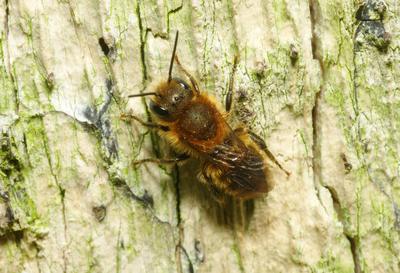 |
Osmia caerulescens, (male) © K.McGee |
CHRYSIDIDAE
Chrysis ruddii. Scarce. A male collected from an Oak stump at Mill Meadow, 23.6.2009.
Omalus aeneus. Scarce. A male collected from Angelica flowers at Mill Meadow, 2.8.2003.
POMPILIDAE
Auplopus carbonarius. Scarce. I have three females from Mill Meadow.
Anoplius caviventris. Very rare. A female collected from Mill Meadow on 8.6.2003 was subsequently confirmed by P.F.Whitehead.
SPHECIDAE
Argogorytes fargeii. Rare. A female collected from Hogweed flowers at Mill Meadow, 14.6.2003.
Didineis lunicornis. Scarce. A female collected from dry ground in Mill Meadow on 8.8.2004.
Worcestershire Record No. 27 November 2009 pp. 14-16
INVERTEBRATES AND ROAD VERGE MANAGEMENT
John Partridge
An investigation into the effects of road verge management on invertebrate populations. An attempt is made to gauge the quantity and variety of species under different treatments.
Methodology
The suction sampler is a petrol-driven garden blower and vacuum (Stihl SH56C), modified by the addition of a collecting bag (Vac-Bag from B & S Entomological Services) at the far end of the suction tube.
In an attempt to standardise the collection, the machine is walked along a 10m line, dabbing the end on the ground in overlapping places so that collecting takes place over the width of the suction nozzle (145 mm, and perhaps rather more due to the suction), and a length of 10m. This is quite easy to do when the grass is short, but it becomes more difficult to maintain a straight line in thicker, longer grass or through nettle or thistle beds. In these situations I endeavoured to try to keep the area covered the same. The drawing of mowings into the tube may have some effect on the suction further along the line, but a large free area of bag still remains for the air to pass through.
The contents of the collecting bag are transferred to a labelled, sealable polythene bag. Observation showed that there is little loss of material on transfer.
Comparisons are aimed to be as fair as possible by using short and long vegetation in the same location, at the same time, with the same orientation to the sun, and ‘edge’ effects are reduced by looking for larger areas of both long and short vegetation, and by working in the middle of these areas.
The bags are put into a freezer at –18 C for at least three hours to kill the invertebrates before sifting to collect the material for identification. It is surprising that there was often one weevil that would survive this process.
 |
Winyates road verge |
| Woodgate road verge |  |
 |
Inkberrow road verge, after the outer area had been cut |
Sites and Results:
The results in the tables show the number of each group collected, followed by the number of species identified in brackets. Many immature specimens could not be identified.
Two sites were visited more than once:
Near Inkberrow there is a sharp bend (SP009562) where the fence line has been taken well back to give better visibility, and mowing has produced three distinct areas. There is a picnic area with benches where the grass is kept very short, an outer area on the bend, which is mown infrequently possibly for hay, and an inner area that is cut annually, if at all.
On my first visit there on 24th June 2009, I was amazed that the shortest area yielded nothing, not even a springtail or a money spider.
| The outer area, which was long grass with knapweed | The inner area mostly docks with bare ground under | Closely mown area | |
| Spiders | 18 (7) | 1 (1) | 0 (0) |
| Flies | 2 (not examined) | 0 | 0 |
| Beetles | 11 (5) | 5 (4) | 0 (0) |
| Bugs | 6 (3) | 2 (3) | 0 (0) |
On a further visit on 28th July 2009, the outer area had been mown and showed some re-growth. The majority of the mowings appeared to have been removed.
| The outer area, re-growth | The inner area mostly docks with bare ground under | |
| Spiders | 3 (3) | 55, mostly immature (5) |
| Flies | 1 (not examined) | 9 (not examined) |
| Beetles | 2 (2) | 9 (5) |
| Bugs | 2 (1) | 18 (9) |
| Springtails | 0 (not examined) | 38 (not examined) |
| Harvestmen | 0 (0) | 7 (2) |
There are a number of factors involved here, including the time of year, and possible migration from one area to another.
In Winyates, Redditch, (SP072668) a wide road verge where one area is mown frequently, and other areas less frequently or not at all – seemingly at the whim of the mower operator.
On 10th July 2009
| Short grass | Longer vegetation | |
| Spiders | 4 (2) | 4 immature |
| Harvestman | 0 (0) | 1 immature |
| Beetles | 3 (2) | 12 (7) |
| Bugs | (0) | 9 (4) |
| Snails | 0 | 5 (not examined) |
| Woodlice | 0 (0) | 14 (1) |
On 7th September 2009
| Short grass, regrowth | Longer vegetation | |
| Spiders | 53, including 25 immature (10) | 63, including 33 immature (7) |
| Caterpillars | 3 (not examined) | 1 (not examined) |
| Beetles | 16 (9) | 48 (14) |
| Bugs | 2 (1) | 3 (1) |
| Snails | 5 (not examined) | 0 |
| Woodlice | 0 (0) | 6 (1) |
| Millipedes | 0 (0) | 3 juvenile |
A number of other sites were visited once:
Near Hanbury Fish Ponds (SO967 642), a narrow verge, and therefore subject to more edge effects. 5th June 2009
| Short grass | Longer vegetation | |
| Spiders | 3 (2) | 7 (2) |
| Flies | 3 (not examined) | 27 (not examined) |
| Beetles | 5 (2) | 4 (4) |
| Bugs | 3 (2) | |
| Moth | 0 (0) | 1 (0) |
Woodgate (SO972666) 5th June 2009
| Shorter grass | Longer grass, nettles, thistles | |
| Spiders | 4 (4) | 11 (7) |
| Beetles | 2 (2) | 2 (2) |
| Bugs | 6 (1) | 2 (1) |
| Snails | 1 (not examined) | 10 (not examined) |
| Woodlice | 0 (0) | 1 (1) |
Near Elcocks Brook (SP010641), 24th June 2009
| Shorter grass | Longer vegetation | |
| Spiders | 8 (5) | 7 (5) |
| Harvestmen | 1 (1) | 4 immature |
| Beetles | 7 (5) | 0 (0) |
| Bugs | 13 (4) | 3 immature |
| Snails | 0 | 0 |
| Woodlice | 0 | 1 |
| Flies | 3 (not examined) | 11 (not examined) |
Near Goosehill Wood (SO938603) 1st July 2009
| Shorter grass, regrowth | Longer vegetation | |
| Spiders | 15 (7) | 6 (5) |
| Harvestmen | 0 | 5 (3) |
| Beetles | 19 (10) | 6 (5) |
| Bugs | 7 (4) | 6 (4) |
| Woodlice | 3 (1) | 0 (0) |
| Flies | 1 (not examined) | 3 (not examined) |
Near Hanbury (SO958625) 2nd July 2009
| Shorter grass, mown about 1 week | Longer vegetation, mown last year | |
| Spiders | 6 (6) | 6 (6) |
| Harvestmen | 0 (0) | 2 (2) |
| Beetles | 3 (3) | 8 (5) |
| Bugs | 0 (0) | 10 (4) |
| Snails | 0 | 0 |
| Woodlice | 0 | 0 |
| Flies | 0 | 5 (not examined) |
Near Flyford (SO991550) 28th July 2009
| Shorter grass | Longer vegetation | |
| Spiders | 14 (9) | 27 (6) |
| Harvestmen | 0 (0) | 11 (2) |
| Beetles | 6 (4) | 44 (10) |
| Bugs | 9 (2) | 20 (4) |
| Snails | 0 | 4 (not examined) |
Conclusions:
Even based on numbers of individuals in each group without looking at species lists, it is evident that the variety and numbers differ considerably from place to place and during the season.
The first Inkberrow results suggest that the ‘neglected’ area was not as good as the area that had been managed, possibly due to its open structure, but by the time the outer area had been mown and had regrown somewhat, the ‘neglected’ area was superior.
On other sites, the managed growth had the greater numbers of invertebrates, suggesting that complete ‘neglect’ is not the answer, but over-management, producing very short grass, will give low invertebrate numbers.
It would be useful to find some measure of grass length, vegetation density and plant species diversity to correlate with the organism count, although I admit that I do not really see how this can be done, and also to know the management regime of each site.
The variations make it impossible to devise a mowing regime that will definitely encourage invertebrates in road verges, because different species have different requirements, and the requirements may well vary according to weather conditions and season.
It looks as if some management is desirable, otherwise a monoculture of nettles, or docks, or brambles could result, but all of these species have their conservation value. I also accept that it is necessary to mow verges for safety reasons, but need there be so much mown so short? Sight lines do not require very short grass, so perhaps we need some evidence as to whether cutting grass long, rather than short, would require more frequent mowing.
Further work:
2009 has been a very poor year for most invertebrates, and there is a need to do more work in what could be a more normal year, to see if the differences increase or decrease. I would also hope that this might inspire people with different expertise to have a look at this important habitat, but do bear in mind the Health & Safety aspect. I have tried to visit quiet roads or roads with wide verges, and hoped that no drivers would be distracted.
None of the above work gives any idea of the usefulness of longer vegetation during the winter. All of our resident invertebrate species have to survive the winter in some form, whether it be as eggs, larvae or adults, and the evidence from tussocking suggests that thicker grass supports a wider community – not a surprising result. We know that non-tussock grass supports a lower density of species during the winter, but this could well be outweighed by the greater area involved.
I would expect this work to suggest that there is a need to leave some areas un-mown during the winter, probably on a rotation basis to prevent eventual scrubbing up.
I would be very pleased if anyone could indicate any work that could be done to show the value of verges as wildlife corridors, which may become even more necessary as climate change drives migration.
I am indebted to Steven Bloomfield, Gary Farmer and Ann Hill for being kind enough to read through the earlier draft, and for their valuable comments. Any blame for inaccuracies remains with me.
Worcestershire Record No. 27 November 2009 p. 14
ROAD VERGES – A LARGE AND VALUABLE NATURE RESERVE OR A WASTED RESOURCE?
John Partridge
Worcestershire has 695 ha of road verge according to the Road Verges Habitat Action Plan, and just 4.4 ha are managed as Road Verge Nature Reserves (same source).
For many years I have felt considerable annoyance when seeing road verges cut at times which remove plants in flower – if there are no pollen sources, then there will be none of the insects that need them. It isn’t just the rare plant species that need protecting, anything can be valuable to the insect that uses it as a food plant. Additionally, there are many species that live on the plants but do not use the pollen, such as weevils and plant-hoppers, and many others in the ground layer living on decaying vegetation, or on the fungi that exist there, or on other fauna.
Although the BAP makes mention of fauna, not least in the Vision Statement, there is nothing else there to suggest appropriate management for invertebrates. The work that John Meiklejohn and I have done on tussocks has made it clear that cutting has a considerable effect on the winter refuges for invertebrates, but I have felt that I lacked the evidence to make a case for more sympathetic cutting in summer.
However, in recent years I have expanded the range of species that I can identify, and the availability of a suction sampler this year suggested that it was time for me to get some evidence.
The evidence that I have collected suggests that a good deal more could be done to encourage invertebrates in road verges by changes in management, and, incidentally, I believe that the same arguments can be applied to the edges of canal tow-paths, manicured churchyards and many urban parks. With ever-more intensive farming removing rough field corners, these are some of the last areas of rough grassland available to invertebrates, and they have the advantage that they are largely insecticide and herbicide free. Not only are many insects important plant pollinators, they are for the most part near the bottom of the food chain, supporting, eventually, both mammals and birds.
The conclusions that I have drawn in the following article are:
|
Close cutting of verges removes most of the invertebrate fauna. |
|
Even where the cutting is rather longer, there is a considerable reduction in the number of species present, at least until there has been perhaps 100 mm of re-growth. |
|
Different vegetation structure gives a different range of species. |
|
Variety (of treatment and vegetation) is the spice of Biodiversity. |
Some councils publish their grass-cutting policy (and costs), and it is evident that no-one has much idea of why they have a particular regime, or of what height of grass is acceptable in different circumstances. The research papers that I have found seem to concentrate on increasing grass growth, rather than reducing it, but there does seem to be an opinion that more frequent cutting encourages growth – so why do it on road verges? There are councils that have at least thought about wild flowers – seehttp://tinyurl.com/yjg7gbu and others that have not – see http://tinyurl.com/yjgq2em
I have not been able to find any policy document on the web, but I suspect that Worcestershire comes into the latter group.
| WBRC Home | Worcs Record Listing by Issue | Worcs Record Listing by Subject |
Worcestershire Record No. 27 November 2009 p. 17
WORCESTERSHIRE SPIDERS 2009
John Partridge
In common with almost all other invertebrates this year, spiders have not been around in large numbers, but a few records are worth mentioning.
In a group surveying day on the Malvern Hills on 30th July 2009, SO 757440, close to the Herefordshire border, my attention was drawn to a spider consuming a bee, in the top of a thistle. The spider looked like Enoplognatha ovata, and I nearly dismissed it as such, but it didn’t seem quite right, either in appearance or habitat, so I collected it, and later identified it as Enoplognatha latimana – as far as I know a first for Worcestershire. This has a mainly coastal distribution, plus Norfolk and the Thames corridor. It prefers more open and drier locations than E. ovata.
 |
Enoplognatha latimana |
For those of you familiar with E. ovata, apart from the rather different habitat, E. latimana usually lacks the characteristic black spots on the abdomen, and should be recognisable now that we know it is here.
 |
The picture shows the three colour varieties of E. ovata on the left, and two of the colour varieties of E. latimana on the right. The third colour variety of E. latimana has only been found once in Britain. |
The next species – Nigma walckenaeria – was first recorded in Elmley Castle SO984410 in October 2003, and then in Harry Green’s garden in Little Comberton SO966431 in 2007. David Stratford, who produced the wonderful pictures shown at the April indoor meeting, photographed a pair in his garden towards the end of September. This is a small, pretty, green spider, which again has an Essex distribution which is expanding.. The Spider Atlas says that it spins a small web on the upper surface of leaves and bushes, particularly Lilac, Forsythia, Holly and Ivy. It is adult in late summer, and for those who like to name drop, it has been found in Buckingham Palace gardens. So please keep an eye open and join H.M. in having one in your garden.
 |
Nigma walckenaeria female |
|
Nigma walckenaeria |
 |
It is also worth recording that Mick Blythe collected two of Wyre’s ’specials’ in The Great Bog on 8th July 2009. These were Araneus alsine and Neriene radiata. Neither are common, even in Wyre, and it is nice to know that they are still around.
The national distribution of all these species can be found on the NBN Gateway (up to 2000), or the BAS website www.britishspiders.org.uk ( this includes more recent records)
Worcestershire Record No. 27 November 2009 pp. 36-37
BIRDS IN WORCESTERSHIRE – May to October 2009
by Gavin Peplow
This has been a rather mixed summer weather-wise, with a hot spell in June giving way to a less settled July and August. September was dry and October mild and overall a good selection of species has been seen throughout the period.
Alongside the expected returning summer visitors and passage migrants, early May also saw the appearance of a juvenile Iceland Gull at Throckmorton Tip as well as on fields near to the Trust Headquarters at Lower Smite. This was a surprisingly late spring date for this northern species, but no doubt resulted from a large influx that saw far more birds than normal wintering well south in Western Europe.
Spring wader passage has dwindled somewhat in terms of numbers and variety of species over the last few years, but Sanderling bucked this trend this year with up to 14 birds being logged in the second half of the month and at five widespread sites. Two Wood Sandpipers were seen at Grimley and Turnstones stopped briefly at Lower Park Farm, Upton Warren and Bredon’s Hardwick. This last site also hosted a Little Stint on a single date mid month. Even though Marsh Harriers continue to increase in eastern England, it remains a good find in the County – just two were seen during the month at Upton Warren. Other spring raptors included a good spread of Red Kite sightings and Honey Buzzards were reported near Bewdley and over Summerfield. Tern passage included two Little Terns at Bredon’s Hardwick, one of these birds also visiting nearby Kemerton Lakes, whilst a concentrated passage of Black Terns mid month included flocks of nine at Bredon’s Hardwick and five at Throckmorton Lagoons.
Undoubtedly the highlight of the month for many birders was the opportunity to see Spoonbill in Worcestershire. Although there had been nine previous records, none had lingered long, so an adult at Clifton Gravel Pits in mid-month proved popular. It was seen late one afternoon before flying off, though returned again briefly the following day. Amazingly, a second bird was then seen a couple of days later at Bredon’s Hardwick. Other notable records included a White Stork over Cleeve Prior and two Common Cranes flying north over Grimley. These last birds were reported commuting widely across the Midlands over a period of a few weeks and were almost certainly the same two that were reported at Longdon in April.
Wader passage trickled on into June with a summer plumaged Curlew Sandpiper at Upton Warren during the first week, whilst a Red-necked Phalarope that paused at Throckmorton Lagoons at the same time and was only seen by it’s finders. Presumably a different Red-necked Phalarope (though again a male) was then much appreciated at Upton Warren a couple of weeks later and constituted the fifth record of this species for the reserve. Avocets have sadly not done so well this year and only one brood fledged on the Flashes, despite ten adults being present for several weeks earlier in the spring. Quail were heard at Shenstone and Longdon Marsh and there was a scattering of late passage Black Terns at several sites.
Quail continued to call from cereal fields at existing sites during July, with three newly found birds heard near Bluntington during the first couple of weeks. Little Egret sightings picked up, as has been the trend in recent years, with a maximum of five birds pausing briefly at Throckmorton Lagoons mid month. Mediterranean Gulls are also expected at this time of year following post-breeding dispersal and individuals at Upton Warren, Ripple, Clifton and Nafford didn’t disappoint! Crossbills had been fairly scarce up to this point in the year, but a flock of 48 on Bredon Hill stood out with very few other records being received. A Bittern returning to Upton Warren in mid July was the earliest ever there by nearly three months and might perhaps have been a failed breeding bird, whilst two Pink-footed Geese at Hollybed Common were decidedly unseasonal and perhaps indicative of a local feral population rather than truly wild birds!
August began with three Black Terns at Clifton Pit and a further four at Upton Warren, but it then remained fairly quiet until mid month when a few lucky observers at Upton Warren unexpectedly witnessed a male Montagu’s Harrier flying through the Flashes. More observers were then able to enjoy a Spotted Crake feeding furtively in front of the Moors Hides later the same day whilst still hoping the Harrier might return! This same site continued to attract visitors from all over the Midlands (and beyond!) when a second summer Sabine’s Gull was found roosting on the flashes later in the month and it continued to oblige most evenings for the following fortnight. Exceptionally, a further two second summer birds of this species also touched down at Westwood in the last week before quickly moving on. Little Egret numbers peaked at six at Grimley mid month whilst a Wryneck in Evesham sadly fell victim to a cat in the last week.
 Screenshot |
Sabine’s Gull at Upton Warren |
A party of eight disorientated Shags paused for a few hours at the beginning of September at Bittell and a storm blown Manx Shearwater was picked up in Perdiswell. Modern satellite technology enabled a juvenile female Osprey to be tracked moving south over the County, even revealing that it roosted over one night at Hewell Grange. Unfortunately though, Internet updates were a little too tardy to enable local birdwatchers a real chance of seeing this bird in the field! The earliest ever Snow Bunting for the West Midlands region and perhaps also the most confiding, was found mid month on the top of Worcestershire Beacon and stayed for over ten days – it allowed approach to within a few feet on many occasions! Elsewhere a juvenile Hen Harrier attracted a lot of interest in the extreme north of the County at Fairy Glen, ahead of an adult male being seen, again by a fortunate few at Upton Warren a couple of weeks later. Other September highlights included a Woodlark at Elmley Lovett, a Grey Plover heard as it flew over Lower Smite and a record count of 56 Mandarin at Trimpley at the month’s end.
 |
Pair of Mandarin Ducks |
October began with the discovery of Worcestershire’s fourth Great White Egret at the Gwen Finch Reserve at Nafford and this bird showed well on and off before heading south. A second Bittern arrived back at Upton Warren and up to four Pink-footed Geese were seen at Clifton Gravel Pits. A small passage of Ring Ouzels was noted on the North Malverns and Bredon Hill, whilst a few Crossbills continued to be noted at the latter site and also in the Wyre Forest. A Firecrest, also on the Malverns was the only one reported so far this autumn, whilst only one Black Redstart was recorded – near Sinton Green at the end of the month. Fifteen Common Scoter at Bittell was the largest flock of this species in the County for a good number of years, whilst single Red-breasted Mergansers were seen at Westwood and Upton Warren. The month concluded with three immature Scaup at Clifton, hopefully the precursor to further sea duck records over the coming winter months
Records compiled from reports received by Birdline Midlands. Please phone through details of all your interesting sightings to the 24-hour Hotline on 01905-754154 (free on application to regular callers). For all the latest information on birds currently within Worcestershire and the Midlands Region, call 09068-700247 (calls charged at 60p per minute)
Worcestershire Record No. 27 November 2009 pp. 37-42
BREEDING WADERS IN THE SEVERN AND AVON VALES (GLOUCESTERSHIRE & WORCESTERSHIRE) SUMMER 2009
Mike Smart
Introduction
For some years now, surveys of breeding waders have been carried out in the Severn and Avon Vales in Gloucestershire and Worcestershire. The original motivation came from the BTO’s survey of Breeding Waders of Wet Meadows in 2002 (Wilson and Smart, 2003), itself a follow-up to an earlier BTO survey in 1982 and to a study for RSPB (Quinn, 1995). Further, less systematic, studies for the Severn and Avon Wetland Management Partnership were carried out in each year from 2005 to 2007 and a summary published in the 2007 Gloucestershire Bird Report (Smart, 2009).
In spring and summer 2009, most of the sites identified in previous surveys as being of importance (and generally figuring in the 1999 Ecoscope Report) were checked again, generally by the same group of volunteer observers. The present report summarizes the main 2009 findings.
This report is probably incomplete. If anyone has further records or information for 2009 I will be very pleased to hear from them.
Weather and ground conditions
Conditions in 2007 had been spectacularly bad for breeding waders. Although in 2007 the early April floods of 2005 and 2006 had not recurred, there had been a moderate flood in mid-May (as in 2006), just at the worst period for ground nesting waders, which must have destroyed many nests and young birds. Then came two midsummer Severn floods (the first since 1968 and 1969), with the river overtopping its banks, one in late June, another even more severe after exceptionally heavy rain on 20 July. The period from May to July 2007 had the heaviest rainfall since records began in 1766, a total of 396.5mm. As a result little or no hay was cut, and standing hay rotted in the fields; the unseasonal flooding also drowned large numbers of worms, affecting drainage in winter 2007/08 and presumably limiting availability of food for breeding waders in summer 2008.
In 2008, there had been no spring or summer flooding, but the meadows remained very wet on the surface; July and August 2008 were dull, grey and damp, and once again, little hay was cut; conditions should theoretically have been good for breeding waders, with no flooding and late hay cutting; but perhaps the wet conditions and lack of worms represented an obstacle. Then in the first ten days of September 2008, cyclonic weather with heavy rain again brought a river flood, with the Severn again overtopping its banks in summer; once again, the result was drowned worms in autumn and poor drainage through the following winter.
In 2009, conditions for breeding waders appeared excellent: after winter flooding in January, the spring was dry, and there was no flooding from February onwards; in the last ten days of May and early June there was a near heat wave (temperatures reaching 30° C), allowing some grass to be cut for silage. But this was followed by damp conditions for most of June, with another brief heat wave in late June and early July; damp conditions, with frequent rainy days and little sun, then set in again for the rest of July. Many of the hay meadows are now in some form of Stewardship agreement with DEFRA which means that hay cutting is delayed to encourage breeding by ground-nesting birds; partly because of these arrangements, partly because of the morose weather, little hay was cut in July, and the main cutting period was in mid-August when there was a fortnight of settled weather with no rain.
A study carried out in June 2009 at Coombe Hill (Acquaviva, 2009) showed that densities of invertebrates and earthworms were lower there than would be expected for a lowland wet grassland, and suggested that the reason was either naturally low densities or the continuing effects of summer flooding in June/July 2007 and September 2008.
Site accounts
The sites are listed by river basin, north to south, Severn first, Avon second. The names and reference numbers are those used in the report to SAVWP covering 2005-2007, themselves derived from the 1999 Ecoscope report.
SITES ALONG THE SEVERN
Grimley Gravel Pits, Worcs (4.3.1)
Oystercatcher: Two pairs nested. The first pair fledged two young; the second pair fledged one (BS).
Lapwing: At least three pairs nested, three pairs each fledging two young (BS).
Little Ringed Plover: Three pairs nested: the first pair fledged two; the second pair hatched two but the final outcome is unknown; the third pair was still raising three young in early August (BS).
Curlew: A pair was present in Grimley/Holt area, but as usual there was no evidence of any nesting attempt (BS).
Redshank: At least one pair was present early in the nesting season, but as is often the case at Grimley with this species, they vanished in mid-season. Breeding was therefore not proven (BS).
Clifton Gravel Pits, Worcs (4.3.2)
No data yet.
Upton Ham, Worcs (site 4.1.6)
Redshank: Reported to have nested (per Peter Holmes).
No information yet on other species, but Curlew normally breeds here.
Ryall Pits, Worcs (site 4.3.3)
A very poor breeding season recorded at Ryall, even though the pits have been only marginally affected by the summer flooding (rise in water table).
Little Ringed Plover: four pairs attempted to nest, one was successful in raising three young (AW).
Lapwing: four to five pairs present; one pair produced one young (AW).
Redshank: two pairs present in spring, but failed to breed (AW).
Longdon Marsh, Worcs (site 4.1.8)
Little Ringed Plover: Pair on Worcs WT reserve on 16 April, not clear if they attempted to breed (RP).
Lapwing: Seven pairs on WWT reserve in April, three pairs with juveniles on 21 May (RP).
Snipe: 59 on WWT reserve on 4 March, no sign of breeding (RP).
Curlew: Male seen north of Marsh Lane in late April, pair on territory in late May; two adults with one fully fledged and flying juvenile seen on 7 July (RP).
Redshank: Two pairs on 16 April, one staying until at least 9 June, but no breeding activity seen (RP).
Uckinghall Meadow, Worcs (part site 4.1.7)
Curlew: Pair in early May in rough grassland north of Ferry Lane (AW).
Queensberry Rough/Beachley Brook, Worcs (part site 4.1.7)
Curlew: Pair in early May (probably the same bird heard across the river over Ripple Pits); probably attempted to breed but believed to have failed (AW, MS).
Ripple Pits, Worcs (part site 4.17)
A very poor breeding season at Ripple Pits (which are alongside the Severn and will have been inundated by the 2007 and 2008 summer floods).
Little Ringed Plover: Display was noted in late April and early May; two pairs attempted to nest, one was successful in raising three young (AW, MS).
Lapwing: Five to six pairs present, display continuing in early May; no young seen (AW, MS).
Redshank: Display in late April and early May; one pair present, no young seen (AW, MS).
Mythe Hook/Shuthonger Common, Glos (part site 4.17)
Lapwing: Pair on grassland apparently with young, 2 May (MS)
Curlew: Territorial pair, 2 May (MS)
Severn Ham, Tewkesbury, Glos (site 4.2.1.1)
Curlew: One, perhaps two pairs present on 28 May (Andy Jayne, AJ); none left on 28 July (MS).
Lower Lode to Chaceley Stock, Glos (part site 4.1.9a)
Curlew: Coverage limited, but none found, despite late hay cutting; none cut in mid June (MS).
Chaceley Stock to Haw Bridge, Glos (part site 4.1.9a)
Curlew: Coverage limited; one displaying in early June, none early July (MS).
Haw Bridge, Glos (site 4.4.4)
Curlew: Pair, holding territory with display flight and song and apparently breeding; seen regularly from 11 April until 26 May (MS); the hay was cut on the suspected breeding field (where they are known to have nested in previous years) in early June, when the birds became extremely agitated, and are presumed to have lost their young (TC); a solitary adult still on nearby river beach on 3 June (MS); not seen after this date.
Staunton, Glos (site 4.4.3)
Lapwing: Two, perhaps three, pairs on arable (just across the road from last year’s site) from 19 April to 9 May; apparently at least two birds incubating in late April, and perhaps one pair with young on 6 May, but may have failed to bring young off (MS).
Curlew: None seen on traditional field, March to May (MS).
Ashleworth/Hasfield Hams, Glos (part site 4.1.9a)
Lapwing: No sign of display or nesting on grassland on Hasfield Ham where they have bred in previous years, despite careful searches from mid March onwards. In late April and early May, up to four birds were displaying over the main reserve field on Ashleworth Ham; these are thought to have been birds attempting to nest on arable land above Colways Farm and coming to rest on the reserve; no indication that they produced young. In late May two pairs were incubating on arable fields below Colways (replacement clutches?), but the eggs were destroyed when the land was ploughed for maize on about 22 May (LAB, LS, MS).
Snipe: Records of up to 50 in late March were clearly birds that had wintered or were passing through. Much smaller numbers in April, up to five, more active in the evening, but no drumming; last record 29 April (in the last few years records have usually extended into May). Absolutely no sign of drumming, and almost certainly did not breed (LAB, LS, MS).
Curlew: First recorded on 22 February; regular display and song throughout March, April and May and up to mid June (last record on 23 June), concentrated in three areas: north of Stank Lane, on Hasfield Ham and round the reserve by the Ham Road. It is considered that two, perhaps three, pairs tried to nest; not known whether they succeeded in raising young (23 June would be an early date for completion of fledging, but no hay had been cut in the preferred areas by 20 July), or whether the young were taken by predators, leading the adults to abandon the area (LAB, LS, MS).
Coombe Hill North, Glos (part of site 4.1.10)
Oystercatcher: A pair, present from 2 to 30 April, often indulged in display, but gave no sign of breeding.
Little Ringed Plover: The first adult was seen on the very early date of 10 March; then ones and twos were noted from late March, through April and into May; they generally dropped in, stayed for a short while, then departed northwards, showing no sign of display flight, song or territorial behaviour; the only exception was on 30 May, when the male of a pair repeatedly and persistently did song flights over the scrapes; but this behaviour was not seen again and the last spring record was of a single on 2 June. It is considered that this species did not breed this year, and that the birds seen were on passage, moving up the Severn towards nesting sites in the Midlands; the birds on 30 May were perhaps birds that had lost eggs or young elsewhere. The first return migrants were a group of four (two adults and two young) on 18 July (LAB, LS, JW, MS).
Lapwing: A desperately bad season, despite apparently favourable conditions; the species did not even seem to attempt to nest at a site where up to ten pairs normally breed round the scrapes. Parties of 30 or 40 occurred in late February and early March, but there was no regular display round the scrapes in March or April; slight suggestion of display on grass fields in late March at the west end of the reserve; the occasional ones and twos seen round the scrapes or flying over were perhaps off duty birds which had tried to nest somewhere else in the vicinity. From the last few days of May, parties of a dozen or more were recorded round the scrapes, but these were clearly passing migrants which had nested elsewhere (LAB, LS, JW, MS).
Snipe: Small numbers in March, none in April despite visits in the evening; no drumming and almost certainly did not nest this year. The first returning migrant was noted on 8 July (LAB, LS, JW, MS), as many as 70 were present in mid-August.
Curlew: The first record was of a flock of 17, clearly passing migrants, on 17 February. Flocks of up to 25, no doubt migrants, were seen on several occasions during March, when breeding birds were present, displaying and giving song flights. As in previous years, considerable numbers of birds collected round the scrapes at dusk to roost: nine in 19 March, 28 on 1 April (which must have included some passing migrants), eight on 22 April; these numbers are higher than those suspected to be breeding in the immediate area – where do they come from? One pair appeared to be nesting on the GWT reserve, with perhaps a second further to the north. The pair on the reserve behaved as though they had young in early June (AJ), and a fully fledged young bird was seen on several occasions round the scrape from 3 July, still present (in the company of an adult in wing moult, probably one of the parents, since it responded to a fight call from the adult) on 25 and 27 July (LAB, LS, MS). A single full-grown bird remained though August into early September, coming to roost on the scrapes in the evening.
Redshank: Two birds seen in mid-March, with three roosting round the scrapes on 1 April, but remarkably few records in April (a little display once on 25 April), but it seems certain this species did not nest this year at Coombe Hill either. A pair of adults on 16 June was considered to be a pair of failed breeders from outside the area or post-breeding migrants (LAB, LS, MS).
Coombe Hill South, Glos (part of site 4.1.10)
Lapwing: As at Coombe Hill North there was little or no sign of breeding Lapwings. On the Southern Meadows of the GWT reserve, there was no sign of nesting, apart from two anxious birds chasing crows on a single occasion in mid June, which may possibly have had chicks. At Cobney Meadows, two pairs were displaying actively on 4 April, but were not seen later (MS).
Snipe: Small numbers on the Southern Meadows in March were no doubt wintering or passage birds. None found there or on Cobney Meadows in April or afterwards, and no drumming (MS).
Curlew: A pair regularly displaying and giving the bubbling song over the Southern Meadows from 8 March, through April, May and up to 16 June, and occasionally flying across the canal to drink, rest or roost on the scrapes on the Northern Meadows. No young seen but it seems likely that this pair was successful. Perhaps a second pair attempted to breed on Cobney Meadows, where display and song was noted from 10 March until well into May, but cattle were put out to graze here quite early in the preferred nesting fields, and they may not have succeeded in raising young (MS).
Redshank: Seen only once in Cobney Meadows (on 4 April), with no display, between March and June, so they do not seem to have nested at this former breeding site (MS).
Leigh Meadows, Glos (part of site 4.1.10)
Lapwing: Does not appear to have bred here this year. Two adults, behaving like breeding birds, were present on 23 April, but none seen on later visits (MS).
Curlew: One pair south of Chelt on 23 April, not found on later visit. One pair north of the Chelt in late May and until 15 June, behaving in agitated fashion in a partly cut field, as though it had young in the uncut area on 8 and 15 June, not found on 29 June, was probably successful (MS).
Redshank: None recorded this year (they have definitely bred in previous years) (MS).
Long Reach, Sandhurst, Glos (part of site 4.1.9b)
Lapwing: One, perhaps two, pairs were in a bean crop on high ground on the west bank of the Severn, overlooking the river valley, in late April and early May; very agitated on 6 May, must have had young (JAB, MS). Another pair on a cereal field near Brawn Farm on east bank of river was extremely agitated, as though they had young, on 5 May (MS). On the east bank between Gardiner’s and Bengrove Farms, about ten birds with some display but no sign of nesting on 7 May (NJP).
Curlew: Display calls heard from Horn’s Ditch area on east bank from 27 April to 7 May (NJP, MS). Probably attempted to nest, outcome unknown, but grass was cut here very early so probably unsuccessful (NJP, MS).
Wallsworth/Twigworth, Glos (site 4.4.1)
Curlew: Pair seen and bubbling heard between 21 and 28 April (JN, AJ, NJP), one still present on 23 June (JN). Probably tried to nest, may have succeeded.
Lapwing: Two on 23 June, a late date, were probably migrants (JN).
Minsterworth Ham, Glos (site 4.1.11)
Curlew: Pair heard bubbling on 5 May and 6 June (AJ). Not known to have nested here before, but may have tried to nest this year; outcome unknown.
Walmore Common, Glos (site 4.1.13)
Lapwing: A little display noted in early March, but not later (AJ, MS). Does not seem to have nested this year at this site, where they have been very successful over the last two or three years
Snipe: Good numbers of wintering birds (up to 60) in late February and into early March, but none afterwards; certainly did not breed (AJ, MS).
Curlew: A flock of three, seen flying northwards in late February, were thought to be passing migrants, as were five on 9 April. No more seen until early June, when up to six were seen on a cut hayfield, occasionally giving the bubbling song, from 2 to 7 June and staying on well into June (BH, AJ, MS). They were thought to be failed breeders returning to the estuary, since the species has not nested here for many a long year.
Redshank: No records at all this year, even though the species has nested successfully in the last couple of years.
Awre Peninsula, Glos (site 4.1.14)
Oystercatcher: The usual pair was present early in the season, with no real indication of breeding (NJP).
Aylburton Warth/Guscar Rocks, Glos (4.2.4.1)
Oystercatcher: Two pairs bred, one on the warth at Aylburton and another in a ploughed/planted field behind Guscar, always there, often alarming and attacking crows (LT).
Lapwing: Around 20 pairs (14 at Aylburton and 6 at Guscar). They were definitely more productive at the Aylburton Warth end, probably because disturbance by farming activities was lower there. A few chicks were seen on each visit through May/June (LT).
Redshank: More tricky to pin down, although there were always around 10 pairs at Aylburton and a couple of pairs further past Guscar Rocks, so presumably they bred, always lots of alarming and attacking crows etc. (LT)
New Grounds, Slimbridge, Glos (4.2.4.2)
Oystercatcher: No data available yet.
Little Ringed Plover: No data available yet.
Lapwing: 34 pairs attempted to breed on Top and Bottom New Pieces (inside the sea wall), but only one produced young, others destroyed by predator (probably a fox). On South Lake, 4-5 nests hatched but no young produced. On The Dumbles (saltmarsh outside the sea wall), two to three nests hatched. On the 100-Acre (inside the sea wall at Frampton) lots of chicks were produced but very few fledged (Martin McGill, MMcG).
Redshank: 14-15 pairs (including one, for the first time, on Top New Piece) produced 8-12 young (MMcG).
Snipe: Drumming was heard in June. (Had also drummed there last year) (MMcG)
Saul Warth, Glos, (4.2.4.3)
Lapwing: Two pairs, an early brood of 3 were reared, the later one with adults defending young (MMcG).
Redshank: Those present were probably 100 Acre birds that had walked in (MMcG).
SITES ALONG THE AVON
Throckmorton Lagoons (site 4.4.7)
Oystercatcher: A single was first seen on 16 February, joined by a second bird on 16 March; this pair was resident until June when two large juveniles were seen (RP).
Little Ringed Plover: Recorded from 30 March to 19 May, but no evidence of breeding (RP).
Lapwing: Two pairs bred, one of them successfully raising two young (RP).
Redshank: Pair present from 3 to 16 April, but no sign of breeding (RP).
Wood Norton/Craycombe, Worcs (part of site 4.1.18)
Snipe: 42 on 20 March, no sign of breeding (RP).
Curlew: Pair present, male displaying on west side of river, from 24 February to 3 May; not seen after this date, so presumably failed to raise any young (RP).
Lower Moor, Worcs (part of site 4.1.18)
Oystercatcher: A casual visitor, ones and two on many dates between 28 February and 18 June, but did not nest (RP).
Little Ringed Plover: Pair present from 19 March to 3 June; nested at nearby gravel pits but the four young were predated soon after hatching (RP).
Snipe: 45 in January, 78 in February, no sign of breeding (RP).
Curlew: Single bird present from 28 February until 13 April, when it was joined by a mate, the pair staying until 19 June and the male regularly displaying south of the river near Wick; clearly attempted to breed. Grass cut in early June, which may have affected nesting success (RP).
Redshank: Pair was present from 16 March to 17 May; much display and mating; clearly attempted to breed, but almost certainly failed (RP).
Gwen Finch Reserve, Birlingham, Worcs (part of site 4.1.18)
Lapwing: A pair on 23 June with three non-flying chicks, which fledged and joined the migrant flock in early July (RP).
Redshank: The first pair was present from 23 March, with a second pair from 12 April, both staying until at least 21 June; the first pair showed breeding activity but no proof of success; no indication of breeding from second pair. Two juveniles present from 9 to 14 July may have come from Manor Farm, Eckington, where they had nested (RP).
Gooseham and Aysham, Worcs (part of site 4.1.17)
Curlew: Two pairs in late May and June, occasionally going to bathe at Gwen Finch, clearly attempted to nest (RP).
Eckington Marshes, Worcs (part of site 4.1.17)
Redshank: one pair nested at Manor Farm (JA per RP).
Rectory Farm Meadows, Worcs (part of site 4.1.17)
No data yet.
Upham Meadow and Summer Leasow, Glos (part of site 4.1.17)
Lapwing: No sign of breeding, either on the meadows or on arable land across the Worcestershire county boundary to the north, but three birds flew over high to the south on 2 May (MS).
Curlew: Probably five breeding pairs north of the motorway and one to the south; on 20 June, all adults were agitated with barking calls as though they had young in the largely uncut hay. On 30 June, with a few strips of hay cut, eight fledged and flying juveniles were seen north of the motorway in cut strips, apparently from at least four different broods, with only four adults left. On 7 July two more juveniles were seen south of the motorway, again in cut strips, with only one adult left. At least three juveniles, two to the north and one to the south of the motorway, were still present on 9 July; no Curlews were found on 28 July, even though no additional hay had been cut (MS).
Redshank: Only one bird with display call seen on 2 May. It may already have raised chicks and departed by the next visit on 20 June (MS).
Bredon’s Hardwick East, Worcs (part of site 4.1.17)
Curlew: First noted in February, with 16 (probably passing migrants) on 27 February. Two to three pairs throughout April and early May when bubbling song was heard (RP, MS). Clearly attempted to breed; a fully fledged juvenile was seen on 18 July (AW), not clear whether this was a Bredon’s Hardwick bird or one which had moved down from nearby Upham Meadow. No sign of failed birds sitting on cut hayfields (as had occurred in previous years) here in June or July.
Bredon’s Hardwick Pits, Worcs (part of site 4.1.17)
A very poor breeding season recorded at Bredon’s Hardwick Pits which were completely submerged by the Avon floods in summer 2007 and 2008.
Oystercatcher: First bird arrived on 23 February, joined by a second bird on 2 March; this pair made two nesting attempts on nearby arable fields, both unsuccessful; at least one bird present in late June and July at this site where the species has regularly bred in recent years (RP, MS).
Redshank: Up to four birds seen regularly from 10 March to 12 May, but no sign of breeding at this site, regarded by Quinn in 1995 as one of the key breeding sites for this species (AW, RP, MS).
Carrant Catchment, Worcs (part of site 4.2.2.2)
Lapwing: About ten pairs in mainly arable fields between Aston Cross and Oxenton, eight pairs elsewhere (JC).
Curlew: One pair present, not known whether it nested successfully (JC).
Kemerton Lake, Worcs (part of site 4.2.2.2)
Oystercatcher: A pair was resident from 26 February until at least 21 June; two breeding attempts and three juveniles seen in mid-June (RP).
Lapwing: Four pairs attempted to breed, but all were predated at the egg or chick stage (RP).
SPECIES ACCOUNTS
Oystercatcher: Two pairs nested, probably successfully, (one on arable) on the west bank of the estuary in the Aylburton/Guscar area, and the usual pair appeared on arable at Awre (opposite Slimbridge) but there was no sign of breeding. On the east bank of the estuary, no confirmation of breeding attempts as yet in the Slimbridge area. Inland breeding records mainly come from gravel pits or artificial lakes, though there have been a few records in recent years on arable. Bred successfully at Grimley (two pairs), Throckmorton Lagoon and Kemerton Lake, unsuccessfully on arable land near Bredon’s Hardwick. A pair spent April at Coombe Hill, but the long-awaited breeding did not materialize; similarly at Lower Moor there were casual records but no attempt at breeding.
Total number of pairs attempting to nest: 5 (Worcs); 2+ (Glos)
Number of successful pairs: 4 (Worcs); 2+ (Glos)
Little Ringed Plover: The stronghold is in Worcestershire in riverside gravel pits, and 2009 was considered to be a poor breeding season: along the Severn, three pairs nested successfully at Grimley, four pairs attempted to breed at Ryall Pits, one of them being successful; two pairs bred at Ripple Pits, where one successfully fledged three young; no data yet from Clifton. Along the Avon, one pair attempted to nest in gravel pits near Lower Moor, but the young were predated. No breeding pairs were noted in the Gloucestershire section of the Severn and Avon Vales. No data yet from Slimbridge, where the species sometimes attempts to nest.
Total number of pairs attempting to nest: 10+ (all Worcs)
Number of successful pairs: 4 (Worcs)
Lapwing: In Worcestershire, good numbers normally nest on arable, and some pairs nesting on arable were undoubtedly overlooked, though as usual good numbers (18 pairs) were recorded in the Carrant catchment; seven pairs nested at the grassland site of Longdon, and at least three were successful. At gravel pits along the Severn, three pairs nested successfully at Grimley, four to five pairs bred at Ryall, only one producing young; five to six pairs bred at Ripple, all apparently being unsuccessful. Along the Avon, at least one pair was successful at Gwen Finch and at Throckmorton Lagoons, two pairs bred, one successfully; at Kemerton all four pairs attempting to nest were unsuccessful.
In inland sites in Gloucestershire, the 2009 nesting season seems to have been an unmitigated disaster for Lapwing: just one pair was on grass at Mythe Hook, but none were found nesting at any of the usual grassland sites at Ashleworth, Coombe Hill North and South, Leigh Meadows or Walmore Common. Only a very few pairs were noted on arable sites (generally on higher land) such as Long Reach (one pair, probably successful), Sandhurst Brawn (one pair, probably successful) and Staunton (two pairs, one perhaps successful).
On the west bank of the estuary, 20 pairs attempted to breed in the Aylburton/Guscar area, with some success, and other probably bred on arable inland of the sea wall on the Lydney New Grounds area. On the east bank, 34 pairs attempted to nest at Slimbridge and two at Saul, with minimal success because of predators.
It seems likely that the reason for the poor breeding season on inland green-field sites (in terms of both nesting attempts and breeding success) was a shortage of earthworms and other invertebrates, caused by the summer floods of 2007 and 2008.
Total number of pairs attempting to nest:
45 – 47 (Worcs)
5 (Glos inland)
56 (Glos estuary)
Number of successful pairs:
9+ (Worcs)
3 (Glos inland)
12+ (Glos estuary)
Snipe: As over the last five years, no drumming birds were found inland and there was no suspicion of breeding. Indeed, the usual flush of spring migrants, on their way back to continental breeding sites, was less noticeable this year, with few April records and none at all in May; returning migrants were recorded, as usual, by early July. On the other hand, for the second year running, drumming was recorded near the estuary, giving hope of a return of breeding birds.
Total number of pairs attempting to nest:
1 (?) (Glos estuary)
Number of successful pairs:
?
Curlew: In previous years, breeding Curlews have only been recorded north of Gloucester. This year, there was a suggestion of possible breeding at Minsterworth Ham.
Along the Worcestershire Severn, a pair was present round Grimley, but no indications of nesting were obtained. No data are available as yet from Upton Ham. However a pair nested successfully at Longdon Marsh (fledged young seen with adults in early July). Queensberry Rough and Uckinghall Meadows each probably held a pair, but their fate is unknown. On the Gloucestershire section of the Severn, at least one pair attempted to nest at Mythe Hook, one or two on the Severn Ham at Tewkesbury and one at Chaceley (outcomes unknown). At Haw Bridge, the nesting pair almost certainly lost their young to hay-cutting in early June. At Ashleworth/ Hasfield two or three pairs attempted to nest and may have been successful. At Coombe Hill (north and south combined), two perhaps three pairs nested, one of them certainly with success (a fledged young bird was seen in early July). In the Leigh Meadows, one perhaps two pairs (less than usual) attempted to nest, and one pair appears to have been successful. Just north of Gloucester, Curlews appear to have attempted to breed in Severnside meadows near Sandhurst and Wallsworth, probably unsuccessfully.
Along the Worcestershire Avon, one pair nested (probably unsuccessfully, since they disappeared in May) at Craycombe. The pair at Lower Moor nested again, possibly with success, possibly losing their young during haymaking in early June. Two pairs probably attempted to nest at Gooseham/ Aysham, near Eckington Bridge. No data yet from Rectory Farm Meadows which often hold a pair. Two to three pairs nested at Bredon’s Hardwick East; a fledged juvenile was seen here but may have come from Upham Meadow. On the Gloucestershire Avon, Upham Meadow (normally the site with the largest number of breeding Curlews) held at least six nesting pairs, and fledged young of five pairs were seen in late June and early July; most adults had departed by late June.
It is normally very difficult to find young Curlews, which hide in long grass in hayfields, though if strips of hay are cut, both adults and young seem to find feeding easier in these cut strips. The number of fledged young seen this year was unusually high (at Coombe Hill, Upham Meadow/ Bredon’s Hardwick and Longdon Marsh), and they were unusually early, with fledging completed by the end of June (Upham), or the first few days of July (Coombe Hill and Longdon). In past years, the few young Curlews found have been later, well into July, and were still unfledged and unable to fly. This suggests that in 2009, many Curlews must have succeeded with their first clutch, relatively early. Perhaps the young birds seen in July in previous years were replacement clutches for lost first clutches?
It is also surprising that Curlews seem to have done well, when Lapwing and Redshank has such a poor year inland. All three nest in fields affected by the 2007 and 2008 summer floods, even if Curlews generally use slightly higher, drier hay fields. All three feed on worms and invertebrates.
Adult Curlews which lose their young abandon the breeding area quite quickly (as at Haw Bridge). It also appears that adults leave their young to fend for themselves very early on, presumably departing to the estuary and leaving young birds to make their own way, as at Upham Meadow; this could explain the early departure from Leigh Meadows (last sighting on 15 June) and Ashleworth/ Hasfield (last sighting 23 June). The makes the presence of singles like the one at Coombe Hill North throughout August is hence surprising. Observations of individuals or small groups of Curlews flying high downriver, often giving the normal flight call and often in the evening (e.g. one over Blackwells End along the River Leadon on 28 July, one over Ashleworth on 30 August), may be migrants en route for the estuary. Similarly, the birds observed on cut hayfields at Walmore Common from early June into July may have been failed breeders that were stopping over on the way to the estuary.
Total number of pairs attempting to nest:
11-12 (Worcs: 4 Severn, 7-8 Avon)
17-21 (Glos inland: 11-15 Severn, 6 Avon)
0 (Glos estuary)
Number of successful pairs:
1+ (Worcs)
7+ (Glos)
Redshank: In Worcestershire, Redshank attempted to nest at several sites, but there were few cases of confirmed success. One pair appears to have nested at Upton Ham (success unknown), while at Longdon Marsh at least one pair was present through the breeding season (success unknown). In Severnside gravel pits one pair was present at Grimley, two pairs at Ryall and one at Ripple, but no young were seen anywhere; no data as yet from Clifton. Along the Avon, one pair probably attempted to nest at Gwen Finch, one pair bred successfully at Eckington, but there was no sign of breeding at the former stronghold of Bredon’s Hardwick, and no data from Rectory Farm Meadows, where a pair often nests.
In Gloucestershire, a disastrous breeding season: one pair may have nested at Upham Meadow. But there were nil returns from sites where the species has been successful in recent years: Coombe Hill north and South, Leigh Meadows and Walmore Common.
Could lack of earthworms or other invertebrates again be the reason for the poor breeding season inland?
On the estuary, where numbers of breeding birds are always larger, about 12 pairs were noted on the west bank around Aylburton/Guscar, while on the east bank 14-15 pairs around Slimbridge produced 8-12 young.
Total number of pairs attempting to nest:
8 (Worcs)
1 (Glos inland)
26-31 (Glos estuary)
Number of successful pairs:
1+ (Worcs)
? (Glos inland)
? (Glos estuary)
Acknowledgements:
Warmest thanks are due to the many volunteer observers, whose individual records are credited under each site: Jurjen Annen (JA), Juliet Bailey (JAB), Les Brown (LAB), John Clarke (JC), Tim Clutterbuck (TC), Bridget Hyslop (BH), Andy Jayne (AJ), Martin McGill (MMcG), Jim Northcott (JN), Dave Paynter (DJP), John Phillips (NJP), Rob Prudden (RP), Lawrence Skipp (LS), Brian Stretch (BS), Lewis Thomson (LT), Andy Warr (AW), John Wiltshire (JW).
Thanks are also due of course to the many landowners who have allowed observers to visit their land.
Bibliography
|
ACQUAVIVA C 2009: The density of soil macroinvertebrates and distribution of earthworms at Coombe Hill Nature Reserve, a lowland wet grassland in Gloucestershire: possible repercussions of management techniques after summer flooding. M. Sc. dissertation submitted to the School of Biological Sciences of the University of East Anglia, Norwich |
|
ECOSCOPE 1999: Re-creation Options for the River Severn/Avon Floodplain Wetlands. Ecoscope Applied Ecologists. Cambridge |
|
SMART M 2009: Breeding Waders of the Severn and Avon Vales 2005-2007. In Evans D (Ed) 2009: Gloucestershire Bird Report 2007. The Gloucestershire Ornithological Co-ordinating Committee. 196 pp. |
|
QUINN J L (1995): Severn Vale Breeding Wader Survey 1995; Parts I & II. Report in three volumes. Royal Society for the Protection of Birds, Sandy. |
|
WILSON A & M SMART (2003): Breeding Waders Populations in the Severn & Avon Vales Natural Area in 2002. BTO Research Report No. 329. 59pp. |
Worcestershire Record No. 27 November 2009 pp. 26-30
FUNGI OF THE MALVERN HILLS
by Sheila Spence
The Worcestershire Side of the Hills
Introduction
A survey of the fungi found on the Malvern Hills and Commons took place during 2007/8 to give an overview of both ‘what was out there’ and which were the best sites for fungi, in particular grassland fungi. At least one visit to the sites covered by the Malvern Hills Conservators (MCH) from the Wyche Cutting northwards was been made during the autumn of 2007 with the southernmost areas surveyed during the Autumn of 2008. It should be remembered, however, that fungi can only usually be identified whilst fruiting, which is often a very short space of time from a few hours to several days at the most, so there may well be several species which have not been recorded as they fruited outside the survey times.
The 2007 Survey
A full systematic field survey of each area was conducted covering each site so that within the time allowed all the MHC hills and commons were included. Some sites proved to be excellent for waxcaps and other grassland fungi whereas others held only very few records. This could be due to many reasons; fruit-bodies occurring earlier or later than the survey was conducted, traditional management of the area not conducive to the growth of fungi, in particular the length of the herbage and grazing/cutting regimes, weather conditions etc. Most areas were visited more than once during the Autumn/Winter each year.
Birches Farm
This site produced no records at all during the first visit but this was completely made up for during a visit at the end of October when 29 species of fungi were recorded, including a total of 13 species of waxcaps. Certainly the side of the field that runs alongside the Malvern Hills Outdoor Centre saw the greatest number of waxcaps, the other side of the field yielding far fewer specimens. Other grassland fungi such as Panaeolus and Entoloma species were also found in large quantities, together with many clusters of Golden Spindles, Clavulinopsis fusiformis but overall the quantities of waxcaps were the most notable.
Colwall Lands
The first visit here in July yielded three species of fungi, one being a particularly good edible fungus Calocybe gambosa, the St George’s Mushroom. Later on in the year a further eight species of fungi were found, including four species of waxcap. None were very prolific but yet another good edible also cropped up; the Field Blewit, Lepista saeva. Although the field was being grazed by Galloway cattle there were still quite large areas of long grass which did not contain any fruit-bodies – and certainly made it harder to spot any that were there.
The Hacketts
The first visit to this site in July only gave one record, a rust on Sonchus, however about 27 species were recorded during the October visit including three species of waxcap. Although there were only three species of these good indicator species they were in high numbers in the field nearest the road, being found growing prolifically throughout several areas of the first field. The field away from the road, the far side of the hill, was very poor for fungi with only a few records and of those very few specimens found.
Also growing in quantity were Bolbitius vitellinus, the Yellow Fieldcap; a pretty yellow capped, white stemmed fungus which commonly grows on dunged ground, and Armillaria mellea, Honey Fungus, which was found growing well away from any of the trees but was perhaps most prolific in the area of grass just above the small line of trees half way up the first field. The mycelium of this fungus can run for a very long way and although usually associated with trees can be found, as in this case, growing many metres away from its ‘host’.
Lodge Fields
This area of grassland did not produce many grassland species during the first visit, it did however have quite a list of fungi found on the fallen wood from a tree at the top of the field. Later in the year was much more fruitful when a large quantity of Hygrocybe conica, the Blackening Waxcap, was found near to the bottom field gate (SW) together with the Magic Mushroom Psilocybe semilanceata. Elsewhere in the field quite large quantities of waxcaps were also recorded including: the Parrot Waxcap; Hygrocybe psittacina; the Meadow Waxcap; Hygrocybe pratensis and the Ivory Waxcap; Hygrocybe virginea. In all 10 species of waxcap were recorded in this field, plus one that I have recorded as a H. virginea var. rosea which is presently under dispute as to whether or not it is actually a different species or carries an infection which makes the base of the stem pink.
 |
Parrot Waxcap |
Malvern Common
The larger area of common known as Malvern Common was surveyed in several visits and did not prove to be particularly interesting. A few waxcaps were found in an area to the south east of the common but only two species, the better area for fungi being just north west of the railway line where several species of waxcaps were found plus a wonderful display of Fly Agaric, Amanita muscaria, growing under what I believe is a Blue Cedar tree. There were several of these trees in this area but only one had fungi growing underneath it, in fact it had three species growing in profusion in the soil underneath it; Amanita muscaria, Fly Agaric, Boletus piperatus, Peppery Bolete and Collybia butyraceae, the Buttercap. The one fungus found in all areas of the common was Macrolepiota procera, The Parasol, a very large, elegant, fungus which grows in open grassland and renowned as being an easily recognisable good edible fungus.
Overall the common did not have as good a range of fungi and I had expected, considering the size and diversity of the site there were huge areas where no fungi were evident at all. Only one fungus that could be said to be prolific is Cystoderma amianthinum, the Earthy Powdercap, which seems to have had a good year almost everywhere.
 |
The Parasol
|
Malvern Link Common
This area did not give any interesting results this year with few grassland species and none of the amanitas and boletes recorded the previous year. Some of the lime trees along the road are showing signs of the Brittle Cinder fungus, Kretzschmaria deusta, (previously known as Ustulina deusta) which was recorded in 1966 just north of the Wyche at SO7745 one of only three records for the county.
Newland Common
Only one small area of the common showed any large amount of fungal interest and that was the area to the north east of the common, almost opposite the Swan public house. Here both waxcaps were found together with the three quite interesting species of Hebeloma.
One particularly interesting species recorded here was a fungus growing on a fungus; Paecilomyces marquandii, a lilac coloured mould growing on several specimens of Hygrocybe virginea – The Snowy Waxcap. It is as far as I can see otherwise unrecorded in both Herefordshire and Worcestershire so is a new county record for Worcestershire.
In all 23 records for this site but mostly in the northern end except for three small fungi growing on fallen Oak Quercus found not far from the bus stop area. The piece of fallen Oak branch was in a ditch and very wet and had three fungi growing on it, two very small cup fungi plus a slightly larger brown one; Humaria hemisphaerica. This fungus which grows on very wet rotting wood and soil has been recorded 19 times in Worcestershire mostly by M C Clark during the 1980’s, but not before at this site.
Old Hills
Of the 26 species of fungi recorded on the Old Hills only 12 were grassland species, the rest growing either with or on trees, both living and as fallen wood or growing in soil/litter in association with trees. Of the grassland species there were three waxcap species in the grassy area above the grass car parking area going away from the road. Further up towards the trig point circles of Field Mushrooms, Agaricus campestris, were found showing a distinct dark ring where the fungus gives nourishment to the grass making it a darker and more ‘lush’ green.
The Malvern Hills, from the Wyche Northward
Starting at the Wyche Cutting and working northwards to ensure that each area of the hills was covered in turn. The first area showed no waxcaps at all during the first visit, but several other grassland species, including a wealth of Lycoperdon nigrescens, Dusky Puffball, with its very dark brown spiny covering, the small round Grey Puffball, Bovista plumbea, and the Meadow Puffball, Vascellum pratense. All these are types of puffball which get blown around in the windy places on top of the hills thus freely spreading their spores.
The only other species of particular note was the delightfully coloured Yellow Brain Fungus, Tremella mesenterica, which was during both visits growing on the living branches of Gorse bushes in several areas.
During the second visit in late November a few different species were found including a large crop of Hygrocybe laeta var laeta on the north facing side of this first hill almost on the saddle with Worcestershire Beacon itself. Two further waxcaps were recorded during this visit; Hygrocybe virginea, the Snowy Waxcap and Hygrocybe chlorophana, the Golden Waxcap but only a very few specimens of each. One unusual species found at this time was Octospora (Neottiella) rutilans, a tiny bright orange cup fungus growing in moss and not previously recorded in Worcestershire. There are just over 100 records of this fungus nationally, mostly under its previous name of Neottiella rutilans.
Once on the Worcestershire Beacon things changed, eight Entolomas (Pinkgills) and six waxcap species were recorded over the whole area plus many other grassland species mostly quite high up on the hill. One species of particular note, whilst not rare, only four records in Worcestershire on the British Mycological Society (BMS) database to date, one of which is in the Hollybush area of the Malvern Hills, is Clavulinopsis fusiformis. These Golden Spindles were found in the upper part of the gully area to the north west of the Worcestershire Beacon and was particularly large for this species. It is usually found growing in much shorter grass but was in this case growing with quite long grass and its bright yellow ‘tongues’ were considerably longer than normal; approximately 12-15 cms long rather than 5 – 8 cms found elsewhere. Some of the records pertaining to this site came from the West of England Quarry area so contain several species growing with or on wood rather than in grassland.
Moving northwards onto Sugar Loaf one of the interesting finds was a waxcap not previously recorded in Worcestershire; Hygrocybe persistens var konradii, the Persistant Waxcap. Whilst Hygrocybe persistens var persistens has been recorded once before in Worcestershire this particular var. is new to the County records. One record from this area, seen on the western side below the open hill and is very much tree based, is the Eutypa spinosa, a black encrusting fungus that grows on the bark of living Beech trees. It damages the bark and although it does not otherwise harm the tree by itself, causes enough weakness to the bark to let other fungi in which can cause harm to the tree. There are no records for Worcestershire for E. spinosa on the BMS database but again this may be due to a lack of competent recorders in the county or simply under-recording, there are just under 250 records nationally and mostly on Beech Fagus sylvatica.
Another species of note in this area was the amount of Panaeolus semiovatus, the Egghead Mottlegill, found growing in cow-pats. Whilst not a particularly rare fungus it is most probably very under-recorded as there is only one other record on the BMS database for Worcestershire and that is in the Wyre Forest, it is however recorded in the WBRC for Castlemorton Common but unfortunately is one of many not apparently sent in to the National database. To put this in perspective there are well over 1,000 records countrywide for this species. Whist this and some other species specialise in growing in old cow-pats, in the areas where there had been some fairly concentrated grazing there was no sign of any high quality grassland fungi, whereas other areas which had not been grazed at all had a richer wealth of species. This may not of course be down to the cattle dunging and thus enriching the soil but that these areas have different species of grasses.
Moving across to Table Hill there was little of any consequence on the hill itself but in the saddle between Table Hill and End Hill there was a good selection of waxcaps including Hygrocybe laeta var. laeta , the Heath Waxcap, which has only been recorded once before in the county. Also recorded in this area were two species of yellow spindles; Clavulinopsis helvola, Yellow Club and Clavulinopsis luteoalba, the Apricot Club. Clavulinopsis helvola has been recorded nine times in the county, a couple of times somewhere near the Gullet, whereas Clavulinopsis luteoalba has only been recorded once before, in 1997.
Hygrocybe reidii, the Honey Waxcap, was the only waxcap found on North Hill and that was just a very few specimens in one tight area on the eastern slopes just down from the top of the hill, in the wavy grass. There may have been more but it is extremely difficult both to find fungi in very long grass but also for them to grow and spread their spores freely. There was however a fair amount of Lycoperdon nigrescens, the Dusky Puffball, and just one specimen of Macrolepiota procera, The Parasol, on the western slopes.
End Hill proved to be quite a good area with a total of five different species of waxcap, including the unusual H. laeta var. laeta again and H. quieta, the Oily Waxcap (more for its smell than its feel!). This latter species has been recorded before on Castlemorton Common in 1962, there are only six records on the BMS database for Worcestershire.
Twenty-eight species in all were recorded on this last hill, on top of those recorded as on the saddle between End Hill and Table Hill. The three species of Clavulinopsisfound there; Clavulinopsis fusiformis, Golden Spindles; Clavulinopsis luteoalba, Apricot Club and Clavulinopsis helvola, Yellow Club, were in great profusion with most across the north facing area just over the top of the highest point. Another interesting find in this area was Psilocybe coprophila growing in cow-pats and surrounding well-manured grass. Although there are over 600 records on the national database it does not appear to have been recorded in Worcestershire before, and has no English name.
The 2008 Survey
Following the successful survey of the fungi on the northern hills and commons within the Malvern Hills Conservators area a similar survey was carried out on the southern area of the hills and commons during 2008. Over 800 new fungus records were accumulated during 2008 (some 465 in 2007) with several rare and endangered species included amongst the finds.
Castlemorton Common
The survey started in August on Castlemorton Common from the Welland end. Following a long spell of prolonged rain the ground was pretty waterlogged and fruit-bodies which were in evidence did not last long in good condition. There were however very good quantities of several different species including Agrocybe cylindracea which was found growing at the base and around the roots of several of the large old Poplar trees lining the brook. In particular trees numbered 012388, 02331 and 02389, there was a large bracket fungus high up on a nearby, unnumbered, tree but too high up the trunk to identify. Also in large quantities were Parasol mushrooms, Macrolepiota procera, mainly seen in the area in front of the caravan field but in great profusion there. Also in this area were two different species of waxcap: Hygrocybe conica, the Blackening Waxcap, and Hygrocybe glutinipes, the Glutinous Waxcap.
Under the Oak trees there were many boletes, in particular Boletus chrysenteron, the Red Cracked Bolete. Due to the rain they were quite large and fleshy and again lots of them. There were just over 50 records for this small area of the common during that first visit which perhaps shows its enormous wealth of fungal interest. Castlemorton Common continued to provide large amounts of records throughout the year and several visits were made covering most areas of this large common. Another interesting site, also surveyed later the same day following a tip-off from a colleague, was a small triangle of ground surrounding the pond at Barnard’s Green. For such a small area there were 16 species records, several of them in connection with the Lime trees. Later in the year further surveys were conducted across the different parts of this large common and included 12 different species of waxcap, including the following:
Hygrocybe calciphilla
Hygrocybe chlorophana
Hygrocybe coccinea
Hygrocybe conica
Hygrocybe insipida
Hygrocybe laeta
Hygrocybe miniata
Hygrocybe pratensis
Hygrocybe reidii
Hygrocybe russocoriacea
Hygrocybe virginea
Hygrocybe virginea var ochraceopallida
Also of note in this area were the large amounts of Clavulinopsis corniculata, the Meadow Coral, and a very small patch of the tiny black earth-tongues; Trichoglossum hirsutum. only recorded once before in Worcestershire.
 |
The Meadow Coral |
Black Hill and Brand Green
On 1st September the first visit to the Black Hill, Brand Green and Gardeners Quarry/Kettle Sings areas was made. A few Amanita species were seen in these areas, in particular Amanita rubescens and a few Amanita crocea. This latter, beautifully coloured orange fungus was seen several years ago growing in large quantities between the road and the Kettle Sings. However in recent years they have only been seen in ones and two, maybe because of the lack of grazing animals in this area. Also in the past there used to be many boletus species, including The Cep, Boleteus edulis, however we found no sign of them growing this year only a few Brown Birch Boletes, Leccinum scabrum, further along the roadside under the Birch trees.
Golden Valley
During September the waxcaps started appearing in large quantities both in numbers of fruit-bodies and different species. Even as early as 7th September, probably due to the high rainfall in previous weeks, there were 20 different species of waxcap recorded with the Golden Valley area:
Hygrocybe ceracea
Hygrocybe chlorophana
Hygrocybe citrinovirens
Hygrocybe conica
Hygrocybe conica var conicopalustris
Hygrocybe fornicata
Hygrocybe insipida
Hygrocybe irrigata
Hygrocybe intermedia
Hygrocybe marchii
Hygrocybe miniata
Hygrocybe nigrescens
Hygrocybe nitrata
Hygrocybe persistens
Hygrocybe pratensis
Hygrocybe psittacina
Hygrocybe punicea
Hygrocybe quieta
Hygrocybe reidii
Hygrocybe splendidissima
Calvatia utriformis – Mosaic Puffball
 |
Mosaic Puffball |
Interestingly, in early November, much later in the year and when the majority of waxcaps could be expected to be still fruiting, only six different species of waxcap fungi were recorded over the same area. Whilst in this area we also looked at the small churchyard of the Church of All Saints, Hollybush where a wealth of interesting fungi were to be found on both visits, including nine species of waxcaps on the second visit on 2nd November when there were only the six species found in Golden Valley itself.
Herefordshire Beacon Area
On each occasion that this area was surveyed there were large amounts of fungi, not necessarily in species numbers, but certainly lots of fruit-bodies. The Pink Waxcap, Hygrocybe calyptriformis, was found on two occasions in the Hangman’s Hill area. The first occasion, on 24th September only two specimens were seen but on the second visit on 8th October there were many more in evidence, some having gone over whilst others were in prime condition. As far as I can ascertain from the records on the FRDBI managed by the British Mycological Society, there are no other records in this area for the Pink Waxcap. Fifteen species of waxcaps were recorded in this area during the survey visits, listed as follows:
Hygrocybe aurantiospendens
Hygrocybe calciphilla
Hygrocybe calyptriformis
Hygrocybe chlorophana
Hygrocybe helobia
Hygrocybe laeta
Hygrocybe marchii
Hygrocybe miniata
Hygrocybe mucronella
Hygrocybe persistens var konradii
Hygrocybe pratensis
Hygrocybe psittacina
Hygrocybe quieta
Hygrocybe reidii
Hygrocybe calyptriformis – Pink Waxcap
Hygrocybe virginea
Large numbers of several species of waxcap and fairy clubs were recorded during the last visit to this site, on the northern most area dropping down from the top of the Herefordshire Beacon itself. There were large quantities of all three of the yellow fairy clubs; Clavulinopsis luteoalba, Apricot Club; Clavulinopsis helvola, Yellow Club and Clavulinopsis fusiformis, Golden Spindles, plus the Meadow Coral, Clavulinopsis corniculata. Broad Down held an array of grassland fungi including large quantities of the more unusual puffballs: Lycoperdon nigrescens and Bovista nigrescens plus the more common Bovista plumbea and Vascellum pratense. Also seen were many specimens of the Field Mushroom, Agaricus campestris and the Parasol, Macrolepiota procera which was seen both here and on nearby Hangman’s Hill.
 |
Pink Waxcap |
Hollybed Common
Eight different species of waxcap were recorded on Hollybed Common during the survey visit of 2nd November, including the Pink Waxcap, Hygrocybe calyptriformis. All four Clavulinopsis species were recorded; C. corniculata, fragilis, helvola and luteoalba plus a quite rare Earthtongue, Geoglossum glutinosus. This unusual Earthtongue is identifiable by its glutinous outer surface, just a few fruit-bodies being found in one small patch. Earthtongues are probably more common than they appear to be recorded due to the great difficulty in finding these tiny black, very simple, fruit-bodies in the surrounding moss and grass. This particular species does not appear to have been recorded before in Worcestershire as far as I can tell from the FRDBI.
White Leaved Oak & Chase End
This area of the Malvern Hill might have been expected to show more fungal diversity than it did due to its relatively unpopulated state. However, only six different species of waxcaps were found although other fungi were more in evidence. Waxcaps found here are as follows:
Hygrocybe ceracea
Hygrocybe chlorophana
Hygrocybe irrigata
Hygrocybe miniata
Hygrocybe nitrata
Hygrocybe pratensis
Collybia butyracea, the Buttercap, and Clitocybe clavipes, the Club Foot were both found growing in grass and in profusion. These are normally thought of as woodland species but have been found quite commonly throughout the area growing in open grassland.
Conclusion
Overall a very high number of records have been collected during the fungus survey of the southern hills and commons on behalf of the Malvern Hills Conservators. Of these a large proportion are for waxcaps and other high conservation value grassland species. In fact 223 of the records collected were for waxcaps, of which there were some 33 different species. This puts the Malvern Hills and Commons into the classification of national importance for its diversity of grassland fungi in an area of high conservation value. Following Rald’s method of defining the conservation value of grassland it proves itself on waxcaps alone, but has the added benefit of two different earth-tongues and four species of Clavulinopsis to add to its value.
Focussing on Waxcaps
The list below gives the number of records on the BMS national database for Waxcap (Hygrocybe) species previously found in Worcestershire to help give some idea of the importance of the Malvern Hills and Commons for waxcap fungi recorded during 2007/8. Note that the above survey records have not yet been included in any databases so are not included in the numbers.
| Hygrocybe aurantiosplendens | 2 |
| Hygrocybe calyptriformis | 27 |
| Hygrocybe cantherellus | 2 |
| Hygrocybe ceracea | 13 |
| Hygrocybe chlorophana | 26 |
| Hygrocybe coccinea | 17 |
| Hygrocybe conica | 24 |
| Hygrocybe glutinipes var glutinipes | 2 |
| Hygrocybe insipida | 4 |
| Hygrocybe irrigata | 5 |
| Hygrocybe laeta var laeta | 1 |
| Hygrocybe marchii | 0 |
| Hygrocybe mucronella | 4 |
| Hygrocybe nitrata | 2 |
| Hygrocybe persistens var persistens | 1 |
| Hygrocybe pratensis var pratensis | 18 |
| Hygrocybe psittacina var psittacina | 23 |
| Hygrocybe punicea | 10 |
| Hygrocybe quieta | 6 |
| Hygrocybe reidii | 8 |
| Hygrocybe russocoriacea | 6 |
| Hygrocybe virginea var virginea | 27 |
It should be noted that some of these records go back to the early 1800’s making any additional records from this survey of huge importance. For example, apart from those completely new records such as Hygrocybe persistens var konradii, Hygrocybe laeta var laeta was previously recorded only once before in Worcestershire over the last two centuries and now four more records of this particular fungus found on the Worcestershire side of the Malvern Hills can be added to those already on the database. Many of the records already held were collected during the waxcap survey in 2000 organised by the British Mycological Society.
 |
|
This report was put together by Sheila Spence following the survey of fungi, in particular grassland fungi, on the Malvern Hills during 2007 and 2008.
Surveying and recording was carried out by Sheila and George Spence. All identification was carried out by Sheila Spence using the following books and field guides:
|
BOERTMANN, DAVID – The Genus Hygrocybe |
|
BON, MARCEL – The Mushrooms and Toadstools of Britain and North-Western Europe |
|
BREITENBACH J. & KRANZLIN F. – The Fungi of Switzerland (Books 1 – 6) |
|
JORDAN, MICHAEL – Encyclopedia of Fungi of Britain and Europe |
|
PHILLIPS, ROGER – Mushrooms |
Taxonomic orders are shown in accordance with the British Mycological Society guidelines. Some names may differ from those quoted in previous databases where they have been changed by the BMS, however the most up-to-date names have been used where possible.
Sheila Spence – Field Mycologist, Porcini, 12 Golding Way, Ledbury HR8 2PN
Worcestershire Record No. 27 November 2009 p. 23
ANDRENA NIGROSPINA
Geoff Trevis
 |
Andrena nigrospina female |
Monitoring at Upper Blackstone Farm has continued in 2009 and some patterns seem to be emerging which confirm observations reported previously. Foraging occurs almost exclusively on wild radish Raphanus raphanistrum though early in the year before the radish was in flower females were seen on dandelion and later photographs were taken of females on hogweed Heracleum sphondylium, creeping thistle Cirsium arvense and bramble Rubus fruticosus (sensu lato). The maximum number of foraging females was always in areas sheltered from prevailing winds with only a small number being seen on the high, exposed ground even though the rich flora was available. It will be vital therefore to ensure that the sheltered areas are maintained when re-creation of heathland is begun on the site.
Identification of nest sites remains a problem as only one nest has ever been found, as previously reported. This was on higher ground than the foraging areas and would receive the maximum amount of sunshine. This year an experiment was undertaken in which a strip of ground along the field edge, where the one nest had been found, was sprayed to keep the area sparsely vegetated. Sparse vegetation appears to be another requirement of A. nigrospina so we hoped that more nests would be encouraged. Unfortunately no additional nesting was seen though it cannot be ruled out. Solitary bee nests have also been noted in many patches of bare and lightly vegetated ground but A. nigrospina has not been seen using them and they could well be the nests of other species known to be present at Upper Blackstone Farm.
 |
Andrena nigrospina male |
One idea I had was that nesting might be on the adjacent fields of the West Midlands Safari Park. Immediately opposite our land, just across the Severn Valley Railway, is the Asian ungulates enclosure and I wondered if constant grazing and trampling would have produced bare patches that might be used for nesting by A. nigrospina. With kind permission of the Safari Park manager I was given access to the enclosure. Unfortunately, though the sward was very short it was also very dense, like a well maintained lawn. It is unlikely, therefore, that it affords good nesting conditions.
Occasionally females well laden with pollen have been seen to fly to a great height when leaving the foraging areas. This may indicate that they are leaving our fields to nest at more remote sites. George Else, one of the country’s leading hymenopterists, has confirmed that A. nigrospina may fly between 1 and 2Km between its foraging site and its nesting site. If this is the case we may have considerable difficulty in tracking down the nests.
Andy Jukes has provided data about the Highgate Common bees and it has been interesting to compare this with our Upper Blackstone Farm data. Generally his information has mirrored ours in showing the need for sheltered sites with wild radish for foraging and open very sunny sites for nesting. However, nests have been located in sandy areas of Highgate Common near Wombourne in Staffordshire which superficially look very similar to parts of Devil’s Spittleful where no A. nigrospina or their nests have ever been recorded. My first impression is that the more open grassy areas on our reserve are still too overgrown to provide the necessary habitat.
One other interesting feature noted this year was the flight period. In previous years the bees were seen from mid-May to very early August, the main flowering period of the wild radish. However, in 2009 the earliest record was on 21st April, well in advance of the wild radish flowers, and the last record was 19th June making the flight period both shorter and much earlier. Again, careful monitoring will be needed in 2010.
Clearly we still have a lot to learn about the ecology of A. nigrospina and monitoring in the coming years will be essential to provide the information needed for the detailed management plans. I would be glad to hear from anybody interested in helping with this project. I am glad to acknowledge financial assistance from Hymettus so that surveyors’ expenses could be refunded but it is unlikely that money will be available in future. I would also like to thank Dave Barnett, Harry Green, Nigel Jones, Andy Jukes, Kevin McGee, Brett Westwood and Rosemary Winnall for their continuing help with this project, and Caroline Corsie for strategic treatment of the field margin with herbicide.
Worcestershire Record No. 27 November 2009 p. 22
THE TIMES THEY ARE A’CHANGIN’ – BUMBLEBEES AND WASPS
A Worcestershire Bumblebee and Wasp Recording Group – a proposal.
Geoff Trevis
“The Times They are A’changin’” has been the subject of two meetings – the Worcestershire Recorders Annual Meeting in March and the Wyre Forest Study Group Entomology Day in November. The idea was to review the changes to wildlife in the county consequent largely on climate change but taking account of other factors that may be affecting the populations and distribution of species. Two groups which may be able to shed light on such changes are the bumblebees and social wasps.
Bumblebees are particularly interesting since closely related species have shown marked differences in their response to environmental changes in recent years. Some appear to be doing fairly well and are maintaining healthy populations e.g. the White-tailed Bumblebee Bombus lucorum, the Common Carder Bee B. pascuorum, and the Red-tailed Bumblebee B. lapdarius. Others have shown rapid declines in numbers such that the Short-haired Bumblebee B. subterraneus is now extinct in Britain whilst the Red-shanked Carder Bee B. ruderarius and the Shrill Carder Bee B. sylvarum have declined so far as to warrant protection through national Biodiversity Action Plans. Conversely, a few species are increasing. The once rare Large Garden Bumblebee B. ruderatus is turning up more and more frequently. We have several records in Worcestershire. Perhaps most interesting of all is the common Buff-tailed Bumblebee B. terrestris which is being recorded throughout the year and may be moving towards continuous broods like the honey bee instead of the annual nest cycle with only the queens surviving the winter to found a new colony each year.
Changes to social wasps are less obvious though two species new to Britain were record in the mid to late 1980’s, Dolichovespula media and D. saxonica, and there is evidence that the Hornet Vespa crabro has become significantly more common though it has shown little tendency to extend its range. It is also possible that we may expect a new genus of wasp to become more widely established, this being Polistes dominulus.
The great thing about bumblebees and social wasps is that with a little effort they may generally be identified in the field using only a hand lens and suitable collecting tube and it is not necessary to kill them for microscopic examination. Queen bumblebees are more easily identified than workers. We are hoping to set up a county Bumblebee and Wasp Recording Group to assist with monitoring changes in abundance of species and in their flight period. Data will be of interest locally and will be submitted to the national recording schemes. If you are interested in being a founder member of this group please contact me via e-mail, geoff.trevis@btinternet.com, or drop me a line at 14, Old Coach Road, Droitwich Spa, Worcs., WR9 8BB. Harry Green and I will give as much help as possible with honing your skills at identification so beginners with these groups will be very welcome.
Worcestershire Record No. 27 November 2009 pp. 22-23
THE TREE BUMBLEBEE BOMBUS HYPNORUM
Geoff Trevis
 |
Bombus hypnorum worker |
Bombus hypnorum, the Tree Bumblebee, derives its name from its natural nesting sites in hollow trees athough in this country it has taken to tit nest boxes in a big way. It is a relative newcomer to Britain which was first recorded in England in 2001 at a site in Hampshire. After an initial lag phase it has spread rapidly north until in 2009 it was found in Northumberland, near the Scottish border. Surprisingly, it has been reluctant to spread westwards and Worcestershire is on the western edge of its current range. This year it has been reported from Worcester, Hanley Swan, Droitwich Spa, Redditch, Tiddesley Wood, Eades Meadow (Fosters Green), Barnard’s Green, Nafford and Knapp and Papermill Reserve at Alfrick. It is important that the recording effort is maintained for this easily recognisable species for our own local interest and, more importantly, to add to the national database being used to study the species as it appears to provide a model for the effects of climate change on aculeate hymenoptera. It is unlikely that there will be further records this year but please keep an eye out for it in 2010 and report any sightings to the Worcestershire BRC. You will be looking for a bumblebee with a red/brown thorax, black abdomen and white tail. Luckily there is no other species likely to cause misidentification.
Worcestershire Record No. 27 November 2009 p. 35
MONITORING LOCAL COMMON BUZZARD POPULATIONS
Report compiled by Mark and Christine Turner
During the 1990s with the realisation sinking in that Common Buzzards were properly established as breeding birds on my local patch in the North Cotswolds, I decided there and then to monitor their progress and find out all I could regarding breeding successes and population spread. Of course nowadays their success story is well documented and happily buzzards are still a talking point even amongst non birdwatchers.
We are now blessed with the spectacle of buzzard flocks riding the thermals right across the country, no longer restricted to a handful of strongholds dotted far and wide. Recording flock sizes appearing over certain territories over a period of time helps the observer to carry out a health check on local populations and be able to assess increases/decreases or perhaps importantly, population stability.
It is a sad fact of life that when bird of prey numbers start to increase a certain element of our society takes umbrage or even liberties with these wonderful creatures. Once again we see a return to old ways with eggers and keepers making the news despite tougher laws being in place. All the more reason then to monitor our local birds more closely. Happily the majority of gamekeepers nowadays are more conservation minded and more tolerant of predators sharing their land. Even so I have received several stories of concern from members of the public that buzzards in our region are being shot, trapped and poisoned.
Monitoring their numbers will indicate any significant impact persecution was having and putting up the warning signs that something is wrong. I am pleased to say all appears to be well on the home front despite a number of scares in recent times.
The last 15 years have seen phenomenal success for our region’s buzzards with the population expanding in all directions from the breeding hotspots of Bredon Hill and the North Cotswolds escarpment. Buzzard flocks even appear over town centres now on a regular basis. The weeks leading up to the breeding season when pairs sort out their territories are obviously the best time to observe numbers of soaring and displaying birds. Also the post fledging period can be fruitful whilst local numbers swell before youngsters disperse. My records reveal March/April and September to be the key months for observing good flock numbers on a more regular basis.
When I first started seriously monitoring local buzzard populations in 1994, 4 or 5 birds was pretty much the most you could see as a soaring group. Nowadays flocks are commonly double this so here is a sample list of my own findings locally. More information on this subject can be found in HAWKWATCH.
Reference:
|
<pturner, m.e.<i=””>2007. Hawkwatch, North Cotswolds to Coasts 1988 – 2006</pturner,> |
COMMON BUZZARD GROUP NUMBERS SUPER-LIST FOR NORTH COTSWOLDS
AND VALE OF EVESHAM
|
DATE |
TIME |
PLACE |
COUNTY |
1 KM.SQ |
BIRDS |
| 21 03 97 | 13.30 | SALFORD COPPICE | WORCS/WARKS | SP0451 | 6 |
| 25 05 97 | 11.30 | BREDON HILL, NR SEDGEBERROW | S.E. WORCS | SP0038 | 6 |
| 23 02 99 | 12.05 | BROADWAY HILL | S.E. WORCS | SP1137 | 8 |
| 11 04 99 | 11.50 | BROADWAY | S.E. WORCS | SP0935 | 10 |
| 26 03 00 | LATE A.M. | ASHTON-UNDER-HILL | S.E. WORCS | SO9938 | 8 |
| 28 10 01 | 11.20 | ALDERTON HILL | N. GLOS | SP0034 | 7 |
| 22 09 02 | 10.15 | BROADWAY | S.E. WORCS | SP0836 | 10 |
| 15 04 06 | 12.50 | BROADWAY VILLAGE | S.E. WORCS | SP0937 | 8 |
| 18 04 06 | 13.15 | BROADWAY HILL | S.E. WORCS | SP1037 | 9 |
| 30 09 06 | 12.00 | BREDON HILL, NR KEMERTON | S.E. WORCS | SO9437 | 10 |
| 07 10 06 | P.M. | BREDON HILL, NR KEMERTON | S.E. WORCS | SO9437 | 10 |
| 19 01 07 | 11.20 | BREDON HILL, NR WESTMANCOTE | S.E. WORCS | SO9437 | 11 |
| 02 03 07 | 10.20 | BREDON HILL, NR KEMERTON | S.E. WORCS | SO9437 |
15 |
| 09 03 07 | 12.35 | SNOWSHILL | N. GLOS | SP1034 |
12 |
| 11 03 07 | 10.00 | BREDON HILL, NR KEMERTON | S.E. WORCS | SO9437 | 11 |
| 09 03 08 | 11.30 | BECKFORD | S.E. WORCS | SO9835 |
16 |
| 16 02 09 | 12.25 | BROADWAY | S.E. WORCS | SP0935 | 10 |
| 05 03 09 | 13.45 | SNOWSHILL | S.E. WORCS | SP1034 | 8 |
| 11 04 09 | 12.30 | BENGEWORTH, EVESHAM | S.E. WORCS | SP0443 |
14 |
| 11 04 09 | 13.20 | LONGDON HILL | S.E. WORCS | SP0542 | 10 |
| 26 09 09 | 13.25 | BENGEWORTH, EVESHAM | S.E. WORCS | SP0443 | 7 |
Whitehead, Paul - ROOK (CORVUS FRUGILEGUS L., 1758) MIMICKING GREYLAG GOOSE (ANSER ANSER (L., 1758))
Worcestershire Record No. 27 November 2009 p. 32
ROOK (CORVUS FRUGILEGUS L., 1758) MIMICKING GREYLAG GOOSE (ANSER ANSER (L., 1758))
Paul Whitehead
On 14 March 2009 at Little Comberton (SO94) I heard the unmistakeable sound of a small skein of Greylag Geese approaching from the north-west. Remarkably, the sound was actually produced, without interruption, by a single Rook which passed overhead. The vocalisation was a perfect likeness, producing the continuity of sound made by a distant flock which, if far enough away, becomes a syncopated buzz not unlike that of a sewing machine.
Although corvids are well-known for their vocal repertoire, Rooks are less inclined to imitate than other crows, having reasonably standardised flight calls, which become more tremulous and higher-pitched when excited. Interestingly, this Rook was on a flight trajectory often used by passing Greylag Geese in winter as they cut across major meander loops in the River Avon.
Worcestershire Record No. 27 November 2009 p. 24-25
LEMON SLUGS MALACOLIMAX TENELLUS
Rosemary Winnall
There are very few records for the Lemon Slug Malacolimax tenellus in Worcestershire except for those from the Wyre Forest in recent years. This is an ancient woodland species and should be present in other parts of the county. But has anyone looked for them? There are not a lot of slug-lovers around, and so perhaps this is a group of animals that more people would like to take an interest in outside the vegetable plot?!
It is thought that for most of the year Lemon Slugs hide away under the woodland leaf litter and feed on the hyphae of a variety of different fungi. When they are mature in the autumn, and fungi are producing fruiting bodies, the adults may be found much more easily as they come up to feed and to mate.
 |
|
|
Malacolimax tenellus, The Lemon Slug © Rosemary Winnall |
|

In the Wyre Forest we are investigating their status and distribution and when fungi are fruiting we are on the look out for this attractive creature! We are noting numbers, habitat, which fungi are eaten, record dates and behaviour. So where can they be found?
A partly eaten toadstool is a good place to start and gently turning of the leaf litter over in this vicinity might be productive. Their bright yellow colouration makes these slugs conspicuous, although darker individuals have been found. They are about 4 cms. in length, the tentacles are purple/black and their mantle has a finger-print patterning. Their body slime is bright yellow and this is produced when they are agitated, such as when they are handled. It can be prolific, although in drier seasons these slugs are more reluctant to release this valuable moisture. There is a small keel at the tail end and there is no frill around the edge of the body. Small pale-coloured Arion ater slugs, and the darker Arion subfuscus may possibly cause confusion, but these both have a striped frill along the edge of the body, have no sign of a keel, and when disturbed they hunch up which Lemon Slugs do not do.
Occasionally one might find the slug eating a fungal fruiting body and valuable behavioural information can be obtained. We have so far in Wyre found Lemon Slugs associated with the following fungi– Russula ochroleuca, Xylaria hypoxylon, Peziza sp., Collybia butyracea, Stereum hirsutum, Coprinus picaceus, Pluteus cervinus, Piptoporus betulinus, Hypholoma fasciculare and Amanita fulva. We have photographed them feeding on Xylaria hypoxylon and Piptoporus betulinus and found mating pairs on the surface of beech leaf litter and on a damp log. When this species is kept in captivity it is apparently very catholic in its taste for fungi which includes mushrooms sold in supermarkets! (Rosemary Hill pers. com.) Where there is a choice of fungi, Candle Snuff appears to be ignored in my experience, but in the absence of others, this is eaten.
 |
Malacolimax tenellus, The lemon Slug |
In the Wyre Forest Lemon Slugs have been recorded primarily from areas of beech, especially those that have been thinned and contain a lot of rotting stumps and little or no ground vegetation. However, one must note that they are probably easier to spot in these conditions, so this might not give a true indication of their status! They will inhabit other types of woodland especially where there is a high incidence of dead wood, and I have found them in oak woodland, birch with hazel coppice and also in an open conifer plantation. All of these sites contain both ground deadwood and fruiting fungi. I have never found the slugs high up on trees, although they have been found occasionally near the tree base.
In the mild November of 2009 I ventured into the Wyre Forest at night with my torch and camera. In the early evening, when there was cloud cover and the temperature was still as high as 10 C, there were plenty of Lemon Slugs around and in addition the Ash Black Slug Limax cinereoniger was present, feeding particularly on the bracket fungus Piptoporus betulinus present on fallen birch branches. I was able to photograph mating pairs of Malacolimax tenellus and observe their feeding behaviour.
 |
Malacolimax tenellus, The lemon Slug |
But where are these Lemon Slugs elsewhere in Worcestershire? Can we obtain some more records from across the county? If you find one, please photograph it and send the picture to Rosemary Winnall or Harry Green along with details of location, habitat and behaviour.
Thanks to Rosemary Hill and Ron Boyce from the Conchological Society of Great Britain and Ireland for sharing information about this species and for their encouragement in our searches.
Reference:
|
LINDLEY DAVID 2008. Malacolimax tenellus (O.F.Muller) in Nidderdale. Mollusc World 18:20-21, (The magazine of the Conchological Society of Great Britain and Ireland) |
Worcestershire Record No. 27 November 2009 p. 3
WBRC MANAGERS REPORT November 2009
Simon Wood
As we reflect on 2009’s slightly less wet summer than those we have endured for the the last couple of years I extend thanks to all who have continued to contribute data to WBRC! As ever the Worcestershire Recorders have persevered and continued to explore and record the biological diversity of Worcestershire, the combined database of accessible records now stands at nearly 980,000.
As you are probably aware we have been running Recorder 2002 as our main data storage system: during the summer we made the change to Recorder 6. This is a more robust version in the Recorder family and should provide the capacity for our data holdings to continue to expand well into the future. Those of you who currently run Recorder 2002 at home may want to upgrade but there may be no need for you do this depending on which species groups you record and the volume of data you produce, in either case please give me a call in the first instance so we can discuss your needs.
Following on from the transition to Recorder 6 has been the start of our uploading of data to the NBN Gateway. Our data is being uploaded in stages as part of our obligations to gain Natural England funds. Data will be visible at a resolution of 2km to casual observers but greater access is controlled by WBRC so will mirror the way we work already in our delivery of data to those who have a bona fide need.
In the last 6 months there has been an increase in the number of new faces who have offered their time as volunteers at WBRC’s office. Angela Pountney, Davis Arscott and Simon Roberts have joined us, together with our regulars John Partridge, John Meiklejohn and Ruth Bourne we have a full office most days!
The national Association of Local Environmental Record Centres (ALERC) is now up and running, WBRC has applied for membership and further details are available on the ALERC website (www.alerc.org.uk) but the association aims to provide a much needed voice for all county LRC’s on issues that need to be addressed with organisations at national policy level, an area which, to date has been somewhat beyond the scope of individual county LRC’s.
Please feel free to contact the office on 01905 759759, e-mail records@wbrc.org.uk to discuss any aspects of data collation or indeed other issues relating to WBRC.