
Worcestershire Record No. 25 November 2008 pp. 8-9
BLACK DARTER DRAGONFLY AT HARTLEBURY COMMON
Mike Averill
Although Worcestershire has a good proportion of heathland in the north west of the county, there is only one location that can claim to be a lowland bog and that is at Hartlebury Common. Unfortunately over the last 100 years there have been long periods when the bog has been dry and that has meant many of the rare plants like round-leaved sundew has disappeared. In the last 35 years there have been 15 years when the bog had no surface water at all and many of those dry years were clustered together in 5 to 7 year blocks meaning creatures would find it hard to survive those prolonged periods of drought.
The weather can be cyclical and at the moment two very wet years in succession have given a glimpse of the bog as it might have been in its heyday.
In the table it can be seen that there have been 18 species recorded at the common, which is a good total but that has been over a long period and some have not been seen for years. However in 2007, Four-spotted Chaser Dragonflies were seen egg laying in the bog and this year they were actually seen emerging, something that would be impossible without permanent water throughout the year.
In September this year, a lone female Black Darter Dragonfly was spotted at the bog and this just shows that if the bog can be maintained then the insects will return to it. The two dragonflies mentioned above as well as the Common Hawker and Emerald Damselfly are four of the classic species of heathland pools.
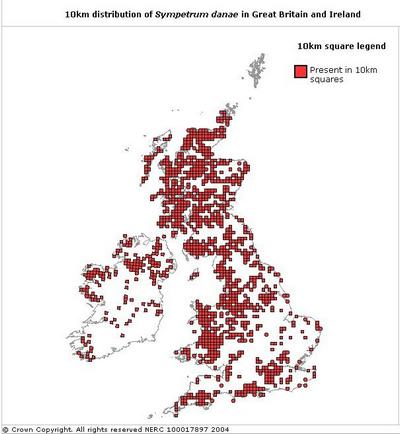
This is the first Black Darter record for the site and bodes well if water can be retained for longer periods. Looking at the figure showing the national distribution of this species it is seen to be widespread but confined to lowland heath and moorland, and in Worcestershire there are only a small scattering of records and until now none of those are recent. Male Black Darters are easily identified as they are the only all-black small dragonfly while the females have a diagnostic black triangle on the back of the thorax.

- Above and below – Black Darter Sympetrum danae


Worcestershire Record No. 25 November 2008 p. 10
DRAGONFLY ROUNDUP FOR 2008
Mike Averill
Like the previous year, 2008 started the dragonfly season promisingly with a warm spell at the start of May which encouraged the early emergence of species like Large Red Damselfly Pyrrhosoma nymphula and the Club-tailed Dragonfly Gomphus vulgatissimus. After eight years of poor emergence rates the Club-tailed Dragonfly seems to have recovered its status as numbers were the highest since 2000.
Attempts to collect the exuviae (cast larval cases) of the Scarce Chaser Libellula fulva were made easy by good emergence numbers at Eckington. This was part of a national study to attempt to assess where populations of this range-expanding species originally came from. DNA analysis can now be done from the tracheal tubes of exuviae, making this a non-invasive test compared to taking the legs of live specimens. This exercise will be carried out again next year for this species as well as the Club-tailed Dragonfly. If anyone would like to help let me know.
Unfortunately July, August and early September experienced long spells of cloudy wet weather which made sure the lawns didn’t go brown but was not good for planning field outings. The wet weather made the gravel pits at Ryall full of deep water and therefore not so suitable for the Small Red-eyed Damselfly Erythromma viridulum, however a surprise sighting of a single male of this species at Broadheath made sure it was, once again, recorded in the county.
Despite the wet weather it was business as usual for many species with the Beautiful Demoiselle Calopteryx virgo; Ruddy Darter Sympetrum sanguineum and Southern Hawker Aeshna cyanea showing well. One species that provided a surprise was a single female Black Darter Sympetrum danae at Hartlebury Common bog. This species has only been seen at about seven locations before and not for about five years so it was good to see it for the first time at a location which would have once had the ideal habitat. Hartlebury Bog has been drying out, off and on, for the last fifty years and yet the last two years have been as wet as it must have been in its heyday. Realistically this is probably only a temporary wet phase made possible by the wet summers of the last two years. The Common should hold populations of typical lowland heath dragonflies like Common Hawker Aeshna juncea sadly not seen since the 1950’s; the Black Darter; the Emerald Damselfly Lestes sponsa and the Four-spotted Chaser Libellula quadrimaculata. The Four-spotted Chaser was actually seen emerging this year at the bog, which is another encouraging sign for the Common if only permanent water can be guaranteed.
2009 will be the second of a five year re-survey programme culminating in the publication of a new dragonfly atlas. I hope to have the latest maps available for the next newsletter when you can see where the gaps are and perhaps agree to cover a specific square near you.
Worcestershire Record No. 25 November 2008 p. 8
WHAT IS HAPPENING TO WORCESTERSHIRE’S ONLY BOG?
Mike Averill
 Hartlebury Common has always been an enigmatic place for naturalists and from the mid 1800’s people such as Edwin Lees made many visits to the site. The possibility of visiting the common had the promise of the sorts of flora and fauna associated with acid rich poor soils of lowland heath. In addition a great attraction was the presence of a bog and pool where permanent water enabled specific plants to flourish such as sphagnum mosses, round-leaved sundew, bladderwort, marsh violets and cotton grass. Such a place in the Worcestershire context would also have meant the chance to see rare water beetles and scarce dragonflies.
Heathland is a transient feature in the landscape and reports from visitors over the last 100 years give testimony to the fact that a succession to a more tree covered heath has taken place as land use has changed and less grazing has occurred. The bog itself has shown periods of drying out since the early 1900’s and this threatens its future as permanent water is essential to most aquatic plants and animals. Possible reasons for the drying out are likely to be changes in groundwater abstraction, the reduction in water catchment area caused by the building of the housing estate at one end of the bog in the 1960’s, and the seasonal variation of rainfall. These, plus the changes of small scale digging in the bog have led to a grass dominated area with intermittent wet patches. For the bog to thrive it needs the supporting water table to fluctuate at a level which ensures the bog has some water even when the weather is dry. This means that when the weather is wetter, the area can be temporarily flooded.
Since 1974, when groundwater levels were first monitored by the Environment Agency and its predecessors, it has become apparent that there have been 15 years when the bog had no surface water at all. The problem tends to be compounded by the fact that the years cluster in 5 to 7 year blocks, the worst periods being in the 1970’s, the 1990’s and the early part of this century. Looking closely at the graph it can be seen that if the level in the bog is plotted over the last eight years, the period from early March 2003 to early March 2007 was completely dry. Since June 2007, the bog has had two successive wet years and a visit this year would have made the visitor think everything was normal as dragonflies hawked and darted over the bog. After many years of debate, there is a possibility of doing something to ensure there is permanent water in the bog, let’s hope it won’t be too long before these plans come to fruition otherwise Hartlebury will have been one of the last bogs in Worcestershire.

Worcestershire Record No. 25 November 2008 p. 30
DISCOVERY OF ISOLEPIS FLUITANS (L.) R.BR. FAMILY: CYPERACEAE IN WYRE FOREST, WORCESTERSHIRE
John Bingham
Isolepis (Eleogiton) fluitans, floating club-rush is not regarded as an uncommon plant nationally. The Vascular Plant Red Data List for Great Britain gives it as locally common (Cheffings & Farrell 2005) but due to agricultural improvement has seriously declined in the lowlands. It is now very rare in the Midlands and found at only two sites in Worcestershire.
Keith Barnett reported in the Worcestershire Record (Number 13, November 2002, page 9) the re-discovery by Will Watson in 2002 at Castlemorton Common. This was assumed to be the site that Lees reported the species in the 19th century. The only other know site is in the bog at Hartlebury Common. However its present status there is uncertain.
I had recorded the plant In Wyre Forest since 1979 from the Shropshire portion with a good colony in a pool at Lawley’s Coppice. In 1995 I found another smaller colony in a stream within the Roxel Rocket Motors site. Both were reported in Rare Plants of Shropshire. (Locton & Whild 2005). The plant has also suffered serious declines in Shropshire with six recent sites. However one population on Brown Clee Hill is quite substantial.
No records were known for the plant from Worcestershire side of Wyre although Gaut makes reference to the plant for Wyre Forest in 1926 as floating or submerged plants in the streams.
On the 21st June 2008 on a rather wet Wyre Forest Study Group recording day in Wyre I discovered a new Worcestershire colony. It was growing around the muddy margins of a small pool in woodland, just south of Lodgehill Farm meadows. The site had been completely shaded by rhododendron for many years until 2005 when English Nature (now Natural England) opened this area and removed the offending rhododendron.
The pool still remains quite sterile but marginal plants are now starting to reappear. Where the Isolepis came from, either introduced by natural means or from long dormant seed is debatable. It’s a welcome new site for Worcestershire and hopefully will be protected within the National Nature Reserve.
References:
 |
Cheffings, C. and Farrell, L. (Editors), 2005, The Vascular Plant Red Data List for Great Britain, JNCC |
|
Lockton A J and Whild S J 2005 Rare Plants of Shropshire: A Red Data Book of Vascular Plants, 3rd edition. Shropshire Botanical Society |
|
Gaut R C. 1926 Wyre Forest General Soil and Botanical Features. Trans Worc Nat Club Vol VIII. p.173-196 |
Worcestershire Record No. 25 November 2008 p. 32
GLOW-WORM SURVEY ON BREDON HILL
John Clarke
In 2007 a local volunteer carried out an intensive survey around a 1.25 transect above Kemerton and Westmancote. The report generated a lot of local, interest and so this year Kemerton Conservation Trust asked for local volunteers to look for glow-worms elsewhere on Bredon Hill. The response was good and we managed to put ten teams of two together. Each team was allocated a route, keeping to the footpaths, and asked to make three visits at and just after dusk to search for ‘glowing’ females. Visits took place in late-June, mid-July and late-July to early-August. The routes chosen lie mostly on the more southerly sides of the hill – from Woollas Hall to just south of Elmley Castle.
Although the survey is just a ‘snapshot’ of Glow-worm distribution, nevertheless it suggests that although it is still common on Bredon Hill local populations comprise loose groups in isolation from other populations. As the females are flightless this has implications for the future of smaller groups.
Where possible the numbers of individuals found glowing has been recorded but the data has a limited value at this stage. Numbers could be affected by weather conditions on survey nights (it was difficult this summer to find ideal ‘Glow-worm evenings’ when volunteers were available). Because of the limited number of visits we do not know when maximum numbers occurred – as I understand it the female ceases to glow once she has mated. The number of adults emerging to mate is also affected by the breeding success in earlier years (they take 2-3 years to develop).
Some volunteers have expressed a wish to do more survey work next year and we may look at extending the survey to areas around the hill not yet covered. The tops of the hill will be difficult to survey because of the length of time needed to get to a selected route – in the lighter summer evenings some of this year’s surveyors found themselves getting home around midnight!
Kemerton Conservation Trust would welcome any modern records of Glow-worm on Bredon Hill.
A copy of the report will be posted on www.kemerton.org
Worcestershire Record No. 25 November 2008 p. 31
KEMERTON CUTTINGS – APRIL – SEPTEMBER 2008

John Clarke
Kemerton Lake
The new section of permissive path – open to ‘Friends’ of Kemerton was opened. A new access track into the arboretum and woodlands has been laid.
1st April – first Swallow, 4 Gadwall, 20 Sand Martin, c.150 Common Gull overhead.
4th April – first Willow Warbler
10th April – Pair of Kingfisher prospecting
12th April – Wheatear, Common Sandpiper present and 50 Golden Plover flew over.
17th April – Oystercatcher on eggs, pair Pochard, c.50 Greylag, Mallard with 9 young
18th April – 3 pairs Pochard – later one pair raised 7 young, 2nd pair raised 2 young
19th – 2 male Garganey present and first Reed Warbler heard
20th April – 4 Common Scoter, Whimbrel & Common Tern
21st April – 2 Whimbrel, first Sedge Warbler heard
24th April and again on 28th – Little Ringed Plover
25th & 27 April – an Arctic Tern was present
27th April – Grasshopper Warbler heard
28th April – 50 Greylag, 10 Little Grebe, 2 Common Sandpiper, Dunlin, 8 Lapwing, first Swifts (15)
29th April – a Hobby and 2 Black Tern were recorded. Also Snipe, Common Sandpiper, Lesser Whitethroat
Ruddy duck were present during early spring but ‘the men from the ministry’ culled them.
5th May – 3 Common Tern, Grey Heron tagged GA
6th May – 22 singing male Reed Warbler, 2 singing Sedge Warbler and a Reed Bunting.
7th May – 2 Black Tern, 3 Common Tern, the tagged Grey Heron (ringed as a pullus Frampton)
8th May – 7 Black Tern, 1 Woodcock
9th May – Black Tern
10th May – 30 singing Reed Warbler (max count 34), 5 singing Sedge Warbler, 2 singing Reed Bunting, Kingfisher, 4 Grey heron
17th May – tagged Grey Heron still present
26th May – 2 Hobby
Sightings of Kingfisher were regular throughout the spring and summer
10th June – 3 adult Redshank, tagged Grey Heron
16th June – c.30 Lapwing in post-fledging flock
27th June – post-fledging flock of c.120 Jackdaw
3 pairs of Little Grebe and 2 pairs of Great-crested Grebe bred. The Little Grebe are thought to have reared at least 3 broods, the Great-crested Grebe also reared 3 broods.
14th July first returning Wigeon, Kingfisher, c.150 Lapwing
21st July – first returning Wigeon
24th July – first 4 returning Shoveler
25th July – c.150 Lapwing
Little Egret – from 1-5 present frequently June to September
The pair of Oystercatcher failed to breed.
Water Rail heard calling regularly June/July
1st August – Teal, Shoveler, Common Sandpiper (regular around this time)
7th August – 2 juvenile Yellow Wagtail
2nd September – 9 Teal, 180 Lapwing, 14 Little Grebe, 285 Canada Goose, 101 Greylag, 12 Barnacle, 2 Red-crested Pochard.
10th September – first Snipe
15th September – 5 Shoveler, 10 Wigeon, Little Owl, Water Rail, late Sedge Warbler, 18 Siskin
26th September –20 Shoveler, 16 Little Grebe, first Jack Snipe, late Reed Warbler, 2 Pintail, 3 Snipe
28th September – 2 Gadwall
There were several sightings of Barn Owl in the area but no breeding found.
In spring over 200 Southern Marsh Orchid, 285 Bee Orchid & 95 Pyramidal Orchid.
Campanula glomerata was found in several sites.
A hornet was seen on 26th September.
Mike Averill has been recording dragonflies and has now found 19 species at the lake
Elsewhere on the estate
7th April – 18 Snipe in a field of beans, first Swallow visiting local nest site. Later at least 3 pairs bred there and on 31st July 34 on wires.
11th May – Wood Warbler seen and heard but did not stay
13th May – Male Whinchat near Kinsham
During surveys Whitethroat and Bullfinch were widespread and fairly common but few Willow Warbler heard.
Around Bredon Hill area
3rd May – Red Kite over Conderton/Beckford
28th May – Red Kite over Kemerton
7th June – Burnet Rose found on hedge bank above Kemerton
9th June – Red Kite over Kemerton
12th July – Red Kite over Beckford
14th September – min. 12 Buzzard circling/displaying above Kemerton
The Carrant Catchment area is included in the Severn and Avon Wader Survey and away from Kemerton Lake Reserve a part survey found 22 pairs Lapwing, one pair Curlew, four pairs Reed Warbler, four pairs Sedge Warbler and three pairs Reed Bunting.
Local volunteers carried out a survey of Glow-worm on Bredon Hill and the results can be seen at www.kemerton.org
Local donations paid for 15 bat boxes sited across the estate. They have not been checked for occupancy although one is reported to have been used.
Kemerton Conservation Trust is grateful to all contributors – in particular Rob Prudden.
Worcestershire Record No. 25 November 2008 p. 32
SPOTTED FLYCATCHER PROJECT – BREDON HILL VILLAGES – 2008
John Clarke
Weather conditions were not good at the beginning and end of this the eighth year of the survey. Flycatchers forsook their regular feeding perches and instead fed high in the tree canopy, making it extremely difficult to locate breeding pairs and later to re-find birds whose first nesting attempt had failed. However, persistent surveying and a great deal of help from local people paid off and we located 22 pairs. We also found 37 nests, all of which were monitored. Despite the weather some birds arrived early. One pair was on territory by the 10th May, nest building on 19th May, and by the 25th the female was incubating five eggs. The four young were the first to fledge – on 25th June.
The nest failure rate (excluding nest-building stage) was 37%. Seven pairs made second breeding attempts after failing, with two going on to make third attempts – only one pair failed to breed. Six of the seven pairs attempting second broods succeeded – the last two broods fledging between 16th and 18th August. A minimum of 84 young fledged but the actual total may be higher as constant monitoring of all pairs was not possible (see above). The average number of young fledged per pair was 3.82 – the second highest annual figure for the study.
Of the 37 nests three were in old blackbird nests, four in small nest boxes and 18 in coconut shells.
The flycatcher study has now located a total of 328 nests of which 317 have been monitored. The study would not be possible without the help of many local people and the support of some 120 households, to whom I am extremely grateful.
In addition to the normal study I also carried out feeding observations at nest sites. The aims were to try to distinguish size of prey being fed to the young and to observe adult feeding behaviour and strategy. Each observation period lasted for one hour and I tried to carry out two sets of observations at each site during the first and second weeks of the chicks’ development. In all I spent 21 hours at a total of 12 sites. I am waiting for some scientific advice before collating the data in its most useful form.
It was during one of the one-hour observations that I twice witnessed a sparrowhawk attack directly on the nest. There were no adult flycatchers or other species around and the brood of large young had already been reduced to one. The hawk flew in over a garden hedge and straight up to the nest site concealed in creeper just above a kitchen window. I drove it off twice in 20 minutes but the following day the last youngster had gone.
Worcestershire Record No. 25 November 2008 p. 7
BOMBUS HYPNORUM FOUND IN REDDITCH
Gary Farmer
 On the 29th June 2008 I was told by Bryan Batchelor that he had been stung on his ear by a bumblebee in his garden. He reported that “brown bumblebees” were nesting in a bird-nesting-box in his garden in Walkwood, Redditch, and it was one of these that had stung him when he was mowing his lawn and got too close to the nest. I was curious so the following weekend I went to see the nest and was surprised to see very distinctive bumblebees with brown thorax and black abdomen with white ‘tail’. I was able to identify them immediately as Bombus hypnorum, a species new to Worcestershire.

The nest was observed for a few weeks and it was noted that the entrance hole was blocked up by the bees, leaving just two small holes for the workers to enter and leave the nest box. On several occasions the material blocking the hole was found to be broken away, and slug trails were evident entering the box. During the day workers could be seen positioned around the entrance hole fanning their wings presumably to move air into the nest. Also a much larger bumblebee was seen occasionally leaving the nest to walk around the perimeter of the nest box hole and then returning into the nest (presumably the queen B. hypnorum). My attempts to photograph the bees at the nest hole resulted in some very close encounters with fast-flying bees (but no stings!).
On 28th July 2008 the queen and a small worker were found dead on the lawn and the nest hole had once more been broken open. There was now very little activity around the nest and no attempt to repair the nest hole. By the 3rd August there was no activity at the nest.
Having left the nest for a further two weeks we took the box down and removed the top to see what had been going on. The box was full of strong webbing and a concentrated mass of web in the top corner of the box contained pupa and larvae of the Wax Moth Aphomia sociella. This moth lays eggs in the nest of bees and wasps and the resulting larvae eat old cells and droppings to begin with but then turn to feed on the bumblebee larvae. In this case they left no sign that a bumblebee nest had ever been there.
Worcestershire Record No. 25 November 2008 p. 7
BUSH-CRICKETS – ORTHOPTERA, TETTIGONIIDAE – FIRST SIGHTINGS 2008
Gary Farmer
Grasshoppers do not have sufficient characteristics to be identified to species in the field until they have passed through two or three moults (instars), but bush crickets can be identified even as tiny first instars.
The list below is of my first sightings of bush crickets in Worcestershire in 2008.
|
Dark Bush-cricket Pholidoptera griseoaptera 1st instar found on bramble in Monk Wood 10th May. |
|
Roesel’s Bush-cricket Metrioptera roeselii 1st instar swept from tussock grasses in Arrow Valley Park, Redditch 21st May. |
|
Long-winged Conehead Conocephalus discolor 1st instar feeding on buttercup pollen in Arrow Valley Park, Redditch 21st May. |
|
Speckled Bush-cricket Leptophyes punctatissima 1st instar on mullien in the grounds of Witley Court 24th May. |
|
Oak Bush-cricket Meconema thalassinum 2nd instar in privet hedge in Redditch 15th June. |
Worcestershire Record No. 25 November 2008 p. 24
ALBINO HEDGEHOG ERINACEUS EUROPAEUS SEEN IN ASHTON-UNDER-HILL
Harry Green
In August 2008 Jeremy King sent me pictures of an albino hedgehog taken in his garden at Ashton-under-Hill. Local Mammalogist Dr Johnny Birks said he had never seen one! The new Mammals Handbook (Harris & Yalden 2008) states they are not uncommon and that full albinos with pink eyes, nose and feet are not infrequent. White specimens with black nose and eyes have also been seen. The Ashton example clearly has a pink nose (not visible in the accompanying black and white version of the pictures but will be in colour on the web site). Jeremy King noticed it had pink eyes, a full albino.
I should be interested to hear of any other albino hedgehogs which have been seen in Worcestershire.
 |
 |
| Albino and normally coloured hedgehogs | Albino hedgehog. The pale nose can be seen amongst the leaves. Pictures © Jeremy King |
Reference:
|
HARRIS S & YALDEN DW 2008. Mammals of the British Isles: Handbook, 4th edition. The Mammal Society |
Worcestershire Record No. 25 November 2008 p. 7
BUSH-CRICKET INVASION OF WORCESTERSHIRE, 2008
Harry Green
I had hoped to follow-up the reports in previous Worcestershire Record to find out if Roesel’s Bush-cricket Metrioptera roeselii and Long-winged Conehead Conocephalus discolor had further extended their range into West Worcestershire. However the wet weather was definitely against me. However I did record both species at a few sites used in 2007 near Pershore. For example on one rare sunny afternoon we heard and saw both species on a sunny road verge near Conderton, on the south side of Bredon Hill. Brett Westwood and I also found many Long-winged Coneheads on the common at Monkwood Green on 28th September. Interestingly Ian Wright sent me records of Roesel’s Bush-crickets at Great Witley in August and October, west of the main records for 2007, and perhaps revealing further spread to the west. Hopefully we can search the western reaches of Worcestershire in 2009.
Worcestershire Record No. 25 November 2008 pp. 20-21
DEER AND WOODS
Harry Green
Everyone involved in forestry has been aware for some time of rising populations of deer throughout England, accelerating in recent years, probably because of mild winters and plenty of winter forage provided by autumn sown crops. In woods where there are high uncontrolled populations of deer they cause damage to the ecosystem by excessive grazing and browsing which stunts and kills young coppice growth, seedling trees and other ground flora. In the worst examples the understorey is grazed out and a browse line forms on the trees at the height deer can reach. Regeneration (tree and shrub growth) of woodland is, in severe cases, prevented. As deer grazing increases woodland biodiversity shrinks and declines of small mammals, birds, vascular plants, bryophytes, lichens, and many invertebrates, especially those of leaf litter and the lower zones of woodland, have been documented. Fuller & Gill (2001), editors of a symposium “Ecological Impacts of deer in woodland”, present a useful series of papers providing clear evidence of these declines.
In Worcestershire deer damage in woods has been patchy and generally at a low level. However, in recent years damage has increased and this is particularly a problem when woodland coppice regimes are introduced (usually for wildlife conservation reasons) and when natural regeneration (of trees and shrubs) is the aim following forestry operations. Furthermore, nowadays, any woodland tree planting requires protection of young trees to prevent deer browsing and fraying (by Roe deer) as well as protection from rabbits.
The data gathered for the forthcoming Atlas of Worcestershire Mammals illustrate the increases in Roe Deer and Muntjac. The maps (figures 1-4) of course show distribution and not numbers but comparison of the 1980s maps with the situation round 2000 clearly shows the spread of these species. Because it has been impossible to search every wood in Worcestershire the actual spread is certainly even greater – the majority of woods in Worcestershire now probably harbour muntjac and in the last five years sightings of Roe Deer and records of damage caused by them have steadily increased. If the numbers of deer continue to increase unchecked there will be a decline in woodland biodiversity in the county as indicated by many studies elsewhere. Further information and useful references can be found in the new 4th edition of the Mammals of the British Isles handbook.
One aim of woodland wildlife conservation has been to re-introduce coppice regimes on ancient semi-natural woodland (ASNW) nature reserves and this objective has been increasing difficult to implement because of deer browsing the re-growth on coppice stools. This has been particularly noticeable in Grafton Wood (jointly owned and managed by Worcestershire Wildlife Trust and Butterfly Conservation). This ASNW is typical of many central Worcestershire woods, once managed as coppice with standards woodlands with a highly productive understorey. When the demand for this product declined many of these woods were planted with oak around 1900 and developed into oak woodland with a subsidiary understorey partly suppressed by shading as the closely spaced oaks grew into big trees. The reason for reintroduction of coppice regimes in parts of these woodland reserves is to provide conditions for those vascular plants and invertebrates which thrive in the alternating patterns of sunshine and warmth (when coppice is cut) and shade (full coppice growth ready for re-cutting). This includes plants like violets, primroses and cowslips, and butterflies such as the Pearl-bordered and Small pearl-bordered fritillaries. The latter have declined dramatically in recent years.
To work out the best way of preventing and monitoring deer damage in Grafton Wood considerable efforts have been made to survey coppice re-growth (or otherwise). Some results of these studies have been reported in Worcestershire Record issue18, April 2005, pages 29-31. The following article provides a further update and discussion of the surveys and problems encountered in Grafton Wood. It is important that attempts are made to record and monitor a very striking change in species numbers and distribution and the effect on other species. Hopefully a scientific approach can be used to try and solve the problems and guide practical work.
References;
FULLER RJ & GILL RMA 2001 (Eds.) Ecological impacts of deer in woodland. Forestry. 74. Number 3, special issue.
HARRIS S & YALDEN DW Mammals of the British Isles: Handbook 4th edition. Mammal Society
JOHNSON C, JOHNSON W & TILT J 2005. The Grafton Wood animal damage survey Worcestershire Record No 18 April 2005 pages 29-31
Roe Deer records from 1984 Muntjac Records from 1984


Worcestershire Record No. 25 November 2008 pp. 18-19
MOLLUSCS OF BROADWAY HILL, WORCESTERSHIRE
Conchological Society of Great Britain & Ireland.
Field meetings 5th April and 14th June 2008.
Harry Green
(This article is an edited version of one written for Mollusc World, the Conchological Society’s newsletter and magazine)
A small part of the south-eastern corner of Worcestershire (VC37) extends up the Cotswold escarpment and includes a small area above Broadway. Here the hill is capped by oolitic limestone typical of the Cotswolds – the only similar Worcestershire geology is found a few miles to the west where the Cotswold outlier of Bredon Hill rises above the Vale of Evesham. Following on from a series of visits in recent years to many parts of Worcestershire, recording mainly terrestrial molluscs, we felt we should not neglect our small patch of the Cotswolds so a field meeting was planned for Saturday 5th April 2008. Around 15 people (Society members and local naturalists, including three sharp-eyed children) met in the Car park at the top of Fish hill – originally a tiny fragment of Gloucestershire (VC33) purchased by Worcestershire some years ago to provide a car park giving access to a footpath network. We decided to examine the woodland to the north in the morning and grassland to the south in the afternoon. However, the unplanned part of the day was a biting northerly wind which, following warm days, took us all by surprise and very few of us were fully insulated against temperatures just above freezing and the arctic blast! Add to this cold rain at lunchtime and we had all had more than enough and retired hurt, surely a retreat unparalleled in the history of snail recording! The idea of searching exposed grassland in such conditions had little charm and we decided to visit those areas later in the summer.
 |
 |
| Mollusc hunting on Broadway Hill © Ron Boyce | |
So, on 5th of April we visited the woodland. This is mainly of ash and beech and lies just below the top of the escarpment on the Worcestershire side of the county boundary. In the wood there is plenty of evidence of old quarrying. Beneath the trees is a thin herbaceous and scrub layer in deep shade, with leaf litter of varying depth, and patches of exposed stone and walling. Despite chilled fingers a reasonable list of snails was compiled with relatively few slugs probably because of preceeding dry conditions. Sharp-eyed children also found Cream-spotted Ladybird Calvia 14-guttata and Orange ladybird Halyzia 16-guttata hibernating in the litter, the latter in a beech mast husk, together with a few millipedes, harvestman and the centipede Lithobius variegatus which is usually an indicator of undisturbed woodland habitats.
Following the April retreat we arranged a second visit to Broadway Hill on 14th June 2008. The weather was fine, warm and with wonderful views over Worcestershire to the west! Fewer people could attend this meeting so only seven of us gathered in the car park. This time we headed south and first visited a small old quarry over-grown with beech trees and bordered by a typical Cotswold dry stone wall. This small place kept us interested for an hour and more and produced a good list of molluscs including the classic dry-stone wall species Pyramidula rupestris. An interesting non-mollusc find was a flatworm Microplana scharfi under decaying wood.
 |
 |
| Mollusc hunting on Broadway Hill © Harry Green | Glow-worm larva attacking trichia striolata © Ron Boyce |
We then followed the old road past the building which once housed the famous Fish Inn originally set on the side of the main Oxford to Worcester road but now a private dwelling down in a cul-del-sac separated from the new course of the main rod. The verges contained numerous Monacha cantiana and flowers attracted a variety of bumblebees and hoverflies. Further along and the path led through woodland to open grazed limestone grassland eroded on steep banks by sheep to expose the soils and small screes of oolitic limestone. This woodland was relatively unproductive for molluscs partly because we moved through it quickly to spend more time on the grasslands beyond. These are floristically rich and at the time of our visit the sward was quite tall and un-grazed. Ron collected several samples from the grassland and scree with his small vacuum sampler which added some tiny snails to the records. Arion fasciatus was found under a solitary large lying log and I was very pleased to find a few empty shells of Ceciliodes acicula conveniently exposed by sheep action. It was also a good day for other invertebrates and naturalist John Meiklejohn obtained useful records of Coleoptera and Hemiptera from a somewhat under-recorded part of Worcestershire. A good selection of solitary bees were found and passed on to the county recorder – there are even fewer records for this group. Towards the end of the visit several members of the group found a glow-worm eating a Trichia striolatus while I was somewhere else and much to my disappointment I didn’t see it and I don’t think we have any pictures! [Actually Ron Boyce had taken pictures]. All in all this was a good day in the sunshine which compensated for the miserable April visit.
Recorders were Rosemary Hill, Ron Boyce, John Meiklejohn, David Long, Terry Knight, Harry Green, Gary Farmer and family, Joy Ricketts and Ruben Poloni.
Worcestershire Record No. 25 November 2008 p. 10
WHAT DO BUZZARDS EAT?
Buzzard eating woodpecker!
Richard Medley noted this on the Malvern Bird eGroup:
Finally, especially for Harry, on Tuesday 24 June 2008, I looked through a window overlooking the field behind the house just in time to see a buzzard drop the last few feet onto its prey. Long grass obscured our view but we aware that a pair of green woodpeckers were making a great commotion: eventually the buzzard flew into nearby trees carrying a dead woodpecker fledgling. The woodpeckers were considerably agitated and could be heard calling for the rest of the morning. We have seen more green woodpeckers this year than in previous ones and have also noticed many Jays flying in the open and even visiting our feeders. Normally once the leaves come out we don’t see them until the acorn season.
A couple of ‘snippets’ about Buzzards:
John Clarke
On 14th September a group “thermalling” and displaying together over Kemerton. This continued for about 10 minutes with birds arriving to join whilst others drifted away. Maximum count at any one time was 12.
A local resident with large ‘wild’ gardens claims that Buzzard predate moorhens from his pond when they come off the water to graze.
Buzzard eating insects
Mark Turner
On my arrival at Broadway Gravel Pit Nature Reserve on 25th September 2008, heavy grey cloud was building and threatening to break some rather pleasant recent weather. However, directly overhead I observed a Common Buzzard Buteo buteo soaring, so leaning back against the tailgate of my car I assumed a reasonably comfortable position to watch at length. The bird was apparently in very fine fettle; no gaps to be seen in the wings or tail and an even-edged line to the trailing edges of the wings suggested a juvenile of the current year.
Occasionally the Buzzard would halt and hover momentarily and once lunged forward with the talons followed by a beak to claws action. This somewhat surprising manoeuvre suggested to me that the bird had caught winged-insect prey which it ate in mid-air, very much in the manner of a Hobby Falco subbuteo. Hawking for flying insects is certainly a common feeding method for members of the Kite family, but I don’t recall seeing a Buzzard do this before.
Worcestershire Record No. 25 November 2008 p. 35
CRANES AT HILL COURT FARM, LONGDON MARSH
The three adult Common Cranes (two ringed females and one un-ringed male) which arrived at Hill Court Farm on 21st April 2008 were later seen in Gloucestershire and hertfordshire but their origin remains a mystery. They could not be traced to an ‘official’ ringing scheme. Oliver Wadsworth took some excellent pictures – one is shown here – which could be seen on the Worcestershire Birding web site. http://www.worcesterbirding.co.uk/
Many thanks to Brian Stretch for information (Ed)

Picture © Oliver Wadsworth
Worcestershire Record No. 25 November 2008 p. 27
UNUSUAL FIND OF LICHEN PHYSICA TENELLA
Graham Hill
 Although Physica tenella is widely distributed across the UK, and is mostly found on trees and twigs (Dobson (2005, 341) it has turned up in a rather unusual location in Worcester – the back end of the roof gutter on my white van, where it is happily growing on a substrate of dirt rather than paint! This leaves me with a bit of a dilemma, I can let WBRC have a record of it, but as I have been to several places in Worcestershire of the past few months can anyone advise me as to which tetrad it should be recorded. Can anyone advise? So, now I have now to decide whether to wash the van or to drive it to the many 10km squares in the Highlands of Scotland where it has not been recorded (Dobson, 2005, 341) and send in the record to the appropriate Scottish lichen recorder.
Reference:
|
DOBSON, F. (2005) Lichens: An Illustrated Guide to the British and Irish Species. Slough,Richmond. |
(Note: perhaps we can now start a series on things growing on motor vehicles to compete with What do Buzzards eat and Hornet stories! Or insects conveyed by cars – I have seen a large robberfly from France and a Great Green Bush-cricket Tettigonia viridissima from Devon on cars in Worcestershire – both dead. Or insects on cars – Ann Fells reported an Eyed Ladybird Anatis ocellata sitting on a car headlight in Barnt Green on 10th June 2007. Ed)
Worcestershire Record No. 25 November 2008 pp. 21-23
COPPICE SURVEYS – SOME EXPERIENCES FROM GRAFTON WOOD
Wendy Johnson
The purpose of this paper is to report our experiences and to make a plea for a standardised method for coppice re-growth surveys carried out in Worcestershire Wildlife Trust (WWT) woodlands. First and foremost the method must be practicable as access to the site becomes more difficult. It needs to be simple enough to be carried out by any volunteers; the results being reproducible and comparable whoever collects the data. It should have a clear purpose and be simple enough to be carried out right through the coppice cycle. I have been involved in surveys of coppice re-growth in Grafton Wood for nine years and our experiences in carrying out these surveys should inform any method used by WWT and perhaps other organisations in the future.
I have never felt entirely satisfied with any of the methods of survey used and they have really been made it up as we went along. Despite enquires to the Forestry Commission and the Woodland Trust, as well as the Wildlife Trusts, plus research in books and on the internet I was not able to find a ‘standard’ method for studying coppice re-growth. Recent searches of the internet still found very little about surveying or monitoring coppice re-growth although there is more about the affects of muntjac on coppice re-growth and quite a lot on coppicing and its value for woodland crafts and bio-fuel.
The coupe where the first survey plot is situated was coppiced in late 1998 and measurements of growth have been made every winter (late December or January) since then. Thus there is a continuous record from 1999 to 2007. A second survey of a much larger area, selected specifically to look at the effects of animal damage on re-growth in a coupe coppiced in 2003, was also undertaken – the first measurements being carried out in February 2004 after one years growth.
The methods used are summarised below with comments on the many practical problems encountered and with suggestions for adaptations and improvements to these.
The original survey method was based on one that had been used some years earlier in another woodland. This method became both too time consuming and impractical as the stools got big and brambles re-grew. It involved setting out a 10m square using a compass and tape. All the coppice stools (18 in all) within the square were given numbers and their locations plotted on a plan by measuring co-ordinates from the SW corner. Problems began straight away:
What exactly is a coppice stool? Should it be a certain minimum diameter? Should a single stump be included? Is this large irregular stool really two? What species is it? Identifying the species when they have just been coppiced is difficult
Using the inherited survey scheme the plan was to count the number of shoots for each stool and to measure the length and diameter at the base of the longest and shortest shoot. In the early stages this may give an estimate of the volume of wood produced. Any animal damage was also noted. For the first two years access was quite easy, the stools easily found although some tags (small numbered squares of wood or metal attached to the stools with wire) were lost, and the new shoots could be measured without difficulty.
However every year more problems became evident:
Access became more and more difficult due to bramble growth which became eye, if not life, threatening! Tags marking the coppice stools were lost or very difficult to locate. They need to be securely fixed to a shoot as high up as possible in the first years (and moved up as the shoots grow). They need be brightly coloured or be attached with e.g. red PVC covered wire from electric cable. Numbers on the tags faded. They should be permanent e.g. stamped on metal with a metal punch. Stakes marking the corners of the plot should be substantial (e.g. 40 – 50 mm diameter), well driven in, tall enough to be seen when the vegetation grows and have some eye catching colour on them. Garden canes were used originally and they were knocked over by the deer. Also they did not stand out which at the time was thought an advantage for fear of human interference. Counting the number of shoots became difficult once they started to branch. Most stools had between 10 and 20 original shoots but up to 31 were recorded so once they branch and branch again the problems can be imagined. Thus only the original shoots from the base were counted and some of these die off as others become dominant. Measuring the basal diameter became somewhat imprecise as moss and debris collect over the stool. After a few years the shoots became too tall to measure – over 4metres in some cases.
Photographs were also taken across the plot from all four corners but after about three years it became impossible to see beyond the first few shrubs.
This plot is now due for re-coppicing.
The shortcomings of the method became clear and we started to question its value, purpose and practicability. It also became clear that re-growth was being reduced by something eating the shoots. Very few rabbits had been seen in Grafton Wood and there were no droppings in the survey plot area. On the other hand deer and deer footprints were seen and muntjac were often heard. Since most of the nibbling occurred on the ends of shoots up to 1m or more above ground it was concluded that deer must be responsible rather than rabbits. It had been clear for some time that deer were a problem in other parts of the wood and that a survey was needed where deer were excluded.
Within a newly coppiced coupe a large more or less rectangular enclosure to exclude deer was set up using plastic fencing. Within this 76 stools were identified and around the outside another 76 were randomly selected. They were all identified by stakes (from the coppicing) driven into the ground next to the stools. Metal tags with numbers stamped on were attached to the top of the stakes. With such a large number of stools it was clear that the original survey method would not be suitable. Also the main purpose of this survey was to investigate the impact of animal browsing on re-growth. So a much simpler method was devised which gave some comparative measure of coppice re-growth and the impact of animal damage. Each winter the maximum height and spread of the growth on every stool was measured and the amount of damage was recorded in one of three categories:
- = Slight – none or very few shoots nibbled
- = Moderate (between 1 and 3)
- = Severe – all or nearly all shoots damaged.
Just three categories were chosen, rather than percentage damage, as allotting stools to the appropriate damage category was reliable with no disagreement between assessors. Past experience in vegetation surveys with the use of percentages has shown that different assessors may differ by as much as 20%. Some would argue that there should be an even number of categories so there is no ‘sitting on the fence’ in the middle but in this particular survey most stools fell into categories 1 and 3.
Further problems included:
After a few years some of the stakes rotted and others outside the enclosure were pushed over by the deer. On returning after a year it was not always clear which stool the stake related to (although the stakes were slightly easier to find than the tags attached to the branches used on the first survey plot).
Here again after five years the survey sites both inside and outside the enclosure became almost inaccessible due to bramble growth. Cutting a way through the brambles to the stools will also allow easier access for the deer! It is clear that deer browsing has a marked affect on coppice re-growth but that most hazel and birch do recover and make good growth although those outside the enclosure remain a year or two behind the stools inside. Aspen does not produce true coppice stools after cutting but grows a thicket of single shoots from the roots adding to the access difficulties. It is not affected by browsing presumably because it is bitter and not liked by deer or rabbits. The species which suffered most was field maple which produced many shoots after cutting, almost all of which are eaten right down. Some field maple stools and stumps died and others struggled with one shoot reaching a meter or so after five years – probably as they became protected by bramble. It is suggested that all field maple stools and stumps are individually protected with brash after they are coppiced. As the purpose of the second survey was the effect of deer browsing this was concluded after five years – a report was published in the Worcestershire Record No 18 April 2005. After devising the simpler method it was possible to use this on the original site and to convert the earlier measurements to conform to this. The raw data collected from both sites, with analysis and observations, have been sent to WWT every year.
Neither method actually measures the volume of wood produced – the original method had enabled a very rough estimate in the early stages, until the shoots branched, based on number and size of shoots. However for comparison purposes it is not necessary to know the amount of timber produced as conservation management is not concerned in maximising production.
A third even simpler and quicker survey method to assess damage and growth, along a single line transect across a coupe, is now being tried in Grafton Wood. A report on this in relation to deer and/or rabbit damage and fencing will follow.
However, if coppice re-growth surveys are to continue in WWT woodlands, what we do need to arrive at is a simple, quick standardised survey method which can be carried out easily over the whole coppice cycle and which can be applied by new volunteers. The reasons for carrying out the surveys should be clearly defined and consideration should be given to how the results will be analysed. This would then provide data for comparison of different coupes within woods and between woods. It would also be valuable to continue the surveys over a number of coppice cycles to assess the impact of coppice management over time.
References
|
http://initiatives.smallwoods.org.uk/index.php |
|
http://www.greenwoodcentre.org.uk |
|
http://www.forestry.gov.uk/research |
|
COOKE AS & LAKHANI KH, Damage to coppice re-growth by muntjac deer Muntiacus reevesi and protection with electric fencing. English Nature, Northminster House, Peterborough PE1 1UA, UK, Institute of Terrestrial Ecology, Monks Wood, Abbots Ripton, Cambridgeshire PE17 2LS, UK. Received 27 February 1995; accepted 15 May 1995. ; Available online 30 November 1999. |
|
JOHNSON C, JOHNSON W & TILT J. 2005. The Grafton Wood animal damage survey Worcestershire Record No 18 April 2005 pages 29-31. |
Worcestershire Record No. 25 November 2008 p. 14
A NOMAD BEE NEW TO WORCESTERSHIRE NOMADA SIGNATA (JURINE, 1807) (APIDAE: ANTHOPHORINAE)
Kevin McGee
I collected this bee, a male, from Sallow blossom at Hartlebury Common on 17th April 2008. I believe this is the first record of this RDB species from Worcestershire. M.E.Archer has afforded it a national status of very rare. Geoff Trevis has agreed with my identification.
N.signata is a cleptoparasite of Andrena fulva (Muller in Allioni, 1766), the ‘Tawny Mining Bee’. Many readers will be familiar with A.fulva due to the combination of its bright orange-red furry appearance, its relative abundance and the fact that it commonly excavates its nest burrow in garden lawns during Spring. Therefore it seems rather strange that N. signata is such a rarity. The latest distribution map in the Provisional Atlas of the Aculeate Hymenoptera of Britain and Ireland (part 5) shows a thin scattering of records across southern England and Wales, a couple of records appear to be for Staffordshire and/or Shropshire? N.signata very much resembles its common relatives Nomada flava (Panzer, 1798) and Nomada panzeri (Lepeletier, 1841), it is possible that as a result it may have been overlooked in the past. N.signata should be looked for during April & May at sites similar to Hartlebury Common.
I was fortunate to photograph this one on Sallow blossom just prior to taking the decision to collect it, had I known it was possibly such a rarity I might not have risked the photo!
References:
-
EDWARDS, R. & BROAD, G.R. 2005 Provisional Atlas of the Aculeate Hymenoptera of Britain and Ireland. Part 5. BWARS.
Acknowledgements:
With thanks to Geoff Trevis for his expertise.

- Nomada signata (male)

- Nomada signata (male)
Worcestershire Record No. 25 November 2008 pp. 12-14
RECORDS OF NOTE, 2008
Kevin McGee
-
-
APIDAE
Osmia bicolor (Megachilinae,scarce)
-
It seems there is a small population of this scarce southern species on Bredon Hill. It may be a recent colonist due to a northward movement as a result of climate change. This is a distinctive little bee, the female looks at first like a worker of Bombus lapidarius, but the flight pattern and behaviour are quite different. Nests are constructed inside empty snail shells. I saw several females on 15.4.and 18.4.2008.
-

Coelioxys rufescens (Megachilinae, widespread).
I managed just one photo when this female turned up in the garden on 28.6.2008. Note the peculiar pointed abdomen on females of this elusive genus.
-

Andrena labiata (Andrenidae, restricted).
One female collected from Speedwell flowers at Beckford Gravel Pit in the south of the county on 11.5.2008. This is a very pretty little bee with the red bands on it’s abdomen contrasting beautifully with the blue flowers of the Speedwells. This uncommon species is known to favour Speedwells.
-

-
-
DIPTERA
Leptarthrus brevirostris (Asilidae, local).
I was lucky to get a reasonably good photo of a male amongst rank vegetation along a bank at Bredon Hill on 29.5.2008. My 1st record of this localised species, which is associated with chalk and limestone grasslands in southern England.
-

-
Dysmachus trigonus (Asilidae, local).
One of several collected from a sandy path at Kempsey Common on 30.6.2008. My only previous record is of one from Hartlebury Common. Sandy heathland is the preferred habitat for this localised robber-fly, so I believe the tiny remnant of suitable heath remaining at Kempsey must make this and many other heath-specialist species particularly vulnerable to disturbance.
-

-
-
Callicera aurata (Syrphidae, RDB3).
A male collected from Dogwood flowers alongside Deerfold Wood, Drakes Broughton on 14.6.2008 is my 1st record of this spectacular Hoverfly.
-

- BUTTERFLIES
- White-letter Hairstreak. Satyrium w-album (Lycaenidae, local).One alighted briefly on Creeping Thistle flowers along a boundary at Kempsey Common on 30.6.2008. I noted the presence of a couple of young Elms in the boundary hedgerow. I have few records of this species.

- MACRO MOTHS
- Red-belted Clearwing. Synanthedon myopaeformis (Sesiidae, notable B).One on Creeping Thistle flowers at Kempsey Common on 27.7.2008 during very hot sultry weather at noon. My 1st record of this species, which is associated with old Apple trees, the principal larval foodplant. I noted there were a few in a neglected orchard on private land on the other side of a nearby hedgerow.

- COLEOPTERA
- Leptura rubra (Cerambycidae, insufficiently known, formerly RDB3).One on ride-side foliage at Tiddesley Wood on 29.7.2008. This is only my 2nd record of this longhorn beetle following the male I photographed at almost exactly the same location at Tiddesley on 19.7.1997. That one was on Rosebay Willowherb, I suspect that both specimens had simply ‘crash-landed’ on the trackside foliage following a period of flight.

- Pyrrhidium sanguineum (Cerambycidae, RDB2).One on a small pile of recently cut Oak logs at Mill Meadow, Drakes Broughton on 10.5.2008. This species is a recent colonist into the county with records from Wyre Forest in the north and the Drakes Broughton area towards the south.

- SPHECIDAE
- Astata boops (Sphecidae,restricted).The only known population in Worcestershire seems to be thriving at Kempsey Common, but the site is just a tiny remnant of sandy heathland making the future of this species very vulnerable. Once familiarised, this large digger wasp is easily recognisable in the field. The females can be seen carrying nymphs of large pentatomid shieldbugs such as the Gorse Shieldbug back to their nest burrows. It must surely be present elsewhere in the county?

All Photographs are © Kevin McGee
Worcestershire Record No. 25 November 2008 p. 6
THE FUNGUS RECORDS OF M. C. CLARKE
John Partridge
For a number of years I had been aware of a box of Record Cards sitting in the Records Office, in its various manifestations, waiting for someone to have the time and inclination to decipher them and commit them to computer. In July 2007 Michael Jeeves, one of the Worcestershire Wildlife Trust (WWT) volunteer receptionists, was looking for something to do during the periods when he was not answering the telephone or doing other WWT tasks – the problem had met a solution. Since then, Michael has worked away, with help in decryption from John Meiklejohn, and has now got up to letter H in the first set of cards. This first batch has now been turned into maps, which I have then checked against M C Clark’s originals.
The starting of this process prompted me to find out rather more about MCC, and I was lucky enough to find the typescript, reproduced below, in the box with the records, together with a copy of an obituary of MCC by Bert Brand, which appears to have come from the WWT Newsletter. I have since been able to obtain a copy of his obituary which appeared in The Mycologist, Vol 7 pt2, May 1993 and to purchase a copy of A Fungus Flora of Warwickshire which we now hold in the WBRC. He was obviously someone who contributed a great deal in many areas, and he was honoured with two awards: in 1987 he was awarded the H.H. Bloomer medal of the Linnaean Society of London as an outstanding amateur biologist and in 1988 he was awarded the Benefactors medal of the British Mycological Society in recognition of his contributions to Mycology and to the Society.
It is my intention to get these records published on the NBN gateway, and perhaps elsewhere, so they are at last available for others to see and use. If anyone else out there feels the urge to help to computerize the remaining records, please get in touch – this mostly involves copying data from the cards into a Word table – nothing complex.
BIOLOGICAL RECORD CARDS FOR THE ASCOMYCETES ETC. OF WORCESTERSHIRE COMPLETED BY MALCOLM C. CLARK (Typescript found with the records and written by M C Clarke) My main natural history interest is the ascomycete fungi, particularly the discomycetes (cup fungi). Though many of the larger species (and a few others) were recorded by Carleton Rea in “Amphlett and Rea” etc. these records were very inadequate. I live in Worcestershire and decided in 1980 to make an up-to-date survey of this group in the county. (I had just seen the finish of the publication of A Fungus Flora of Warwickshire which I edited, after spending much of my spare time for many years on the fungus survey of that county, as part of the team engaged in that project, and needed some new project to work on.)
To assist my Worcestershire survey Dr. John Osley, then working on setting up the Biological Records Centre, let me have 1,000 of the record cards issued by the Centre. I set up a card for each species I recorded and listed all records of the species according to 1-kilometre squares, with details of habitat, date, etc. with continuation sheets on blank paper in the case of frequent species. I marked all the squares off on the outline map on the reverse side of the card. It was understood that the cards would be returned to the Centre in due course. Although the survey is by no means complete, and never can be, since it is impossible to record these often very small and obscure organisms in every square in the county, the time has perhaps arrived when the cards should be returned. Sufficient has been done to give a good representative view of the distribution and frequency of each species. Adding further records will not alter the general picture very much, except perhaps in the (apparently) rare species with only a few records.
The cards are divided as follows:-
(a) Cards for discomycetes – the group I have concentrated on
(b) Cards for other ascomycetes. It must be emphasized that I did not devote the same amount of attention to these as I did to the discomycetes, and many species are undoubtedly under-recorded, while many with which I am not very familiar will have been missed altogether.
(c) A third group of cards which I began setting up for species seen by Carleton Rea or others, which I have not re-found. These are not complete however as I found that I was using too many cards for this purpose. Cards for all these will no doubt however have been set up at the Centre by Dr.Osley.
(d) A small number of cards for miscellaneous fungi in which I was particularly interested
Though I have tried to record as widely as possible in the county I admit that parts of it have been comparatively neglected, mainly those most distant from my home. Thus, the outlying parts of the west and far south of the county have not been covered, neither have some of the intensely cultivated parts of the Vale of Evesham or the built up areas of Birmingham and its suburbs, and Worcester City. Allowance should be made for this in examining the results.
Worcestershire Record No. 25 November 2008 p. 34
BIRDS IN WORCESTERSHIRE – NOVEMBER 2007 to APRIL 2008
Gavin Peplow
Late autumn of 2007 produced some exciting birds and the following winter months, again fairly mild, provided plenty of interesting records, perhaps most noteworthy of which was the number of sightings of ‘white-winged’ Gulls from northern Scandinavia and the Arctic.
A Snow Bunting lingered on North Hill from October into November and was followed by at least two further individuals over the following weeks. Upton Warren yet again proved popular when a Grey Phalarope dropped in for a short visit. This record thereby meant that this was the first time all three Phalarope species had been recorded in the County within the same calendar year and, more remarkably, all were found at the same site!
A Red-Crested Pochard and a Water Pipit were found at Grimley, the latter settling down to winter, though it remained largely elusive throughout its stay. Westwood attracted two separate Scaup, whilst a lot more surprising was the belated revelation of a drake Lesser Scaup that had been well photographed in Stourport Marina on a single date mid month. Whooper Swans are never common in Worcestershire, so a family party of eight, initially at Upton Warren and then later near Bransford Bridge for a few days were appreciated and also reflected good breeding success for this particular group. The month concluded with a small group of four Woodlarks being located near Bittell and then two, perhaps birds from this same party, were seen on farmland at Norchard. Hopefully this species will again soon become more common locally.
A large flock of at least 500 Brambling in the Wyre Forest announced the start of a better than average winter for this species, though three Crossbills there were one of very few flocks reported throughout the period.
December highlights included a lone Waxwing in Redditch and Firecrests at both Barnt Green and at Brake Mill Pool – the latter site hosting up to three birds into the New Year. A Wheatear on the slopes of British Camp was decidedly out of season, but remained for over a week, whilst more expected were two different Glaucous Gulls and a Caspian Gull at Throckmorton Tip at the end of the month.
A single Pink-footed Goose lingered in the Lower Moor area, whilst a Short-eared Owl was seen nearby at Throckmorton. A Little Egret at Grimley was unusual for the time of year, but this species is now becoming a more regular visitor during the winter months.
The New Year began with two Brent Geese at Throckmorton Tip Lagoons, perhaps wandering birds first seen in the County the previous autumn. They moved later the same day to Westwood Pool before moving on. A Little Gull was also seen at Throckmorton briefly, whilst a drake Smew was a welcome find at Kemerton Lakes, though unfortunately had gone by the next day. Two Bitterns were seen intermittently at Upton Warren and another was seen briefly at Ryall Gravel Pits. The former site also hosted three or four Mealy Redpolls amongst a flock of Lessers feeding in alders and birches around the Moors Pool. These birds proved popular, if somewhat challenging to identify and remained in situ for several weeks. The bird of the month however was a drake American Wigeon which dropped in to Westwood late one afternoon and then promptly disappeared overnight, much to the frustration of many ! This constituted the first, albeit a long anticipated County record of this species. Flooding later in the month attracted good numbers of duck to Longdon Marsh including about 500 Pintail and a Snow Bunting was reported on one date on the Malvern Hills.
A Black Redstart visited Grimley New Workings in early February and was then seen occasionally there over the following few weeks. In the south of the County, eight Bewick’s Swans paused at Bredon’s Hardwick for a couple of days and three White-fronted Geese lingered on site with the ever-increasing Greylag flock. A Kumlein’s Gull (an Iceland Gull variant or sub-species and still subject to some taxonomic debate) was seen at Throckmorton Tip and at Westwood, whilst one or more juvenile Glaucous Gulls were also seen at the former site. The Norchard Woodlark flock had increased to six birds and they continued to be seen into the first week, although often proving quite elusive. The month concluded with the early return of the first Avocet to Upton Warren.
March continued as a good month for visiting ‘white-winged’ Gulls, with two Iceland’s at Throckmorton and Westwood and further birds later in the month again at the former site and also at Hartlebury Tip. Other gulls featured several Kittiwakes and Mediterraneans at expected wetland sites. The first Wheatears and Sand Martins returned towards the middle of the month, though a Lesser Whitethroat found in a Bromsgrove garden, may have been an over-wintering bird rather than an early returning summer visitor, judging on it’s rather tatty plumage. A Rock Pipit at Grimley attracted interest as it was of the Scandinavian race and was also beginning to show signs of its brighter summer plumage.
April was much colder and wetter than the previous year, though proved good for birding with in particular, a nice selection of waders and terns later in the month. Long stayers included at least four Mealy Redpolls at Upton Warren whilst a Reed Warbler at that site in the first week was one of the earliest on record for the region. Passage got into full swing with at least six Ospreys reported, one of which carried a satellite tag that had been attached in Scotland in 2007. This bird stayed a couple of days in the County and had been tracked all the way back up from West Africa since it’s migration started in March. It finally arrived back at it’s nest site in the Highlands six days after leaving Worcestershire and following a fairly leisurely flight north! Elsewhere several Little Gulls lingered at Upton Warren and a few Arctic and Black Terns were seen along with a Little Tern at Bredon’s Hardwick towards the months end. Upton Warren also attracted an early Curlew Sandpiper, whilst Avocet numbers built up to eight. A Grey Plover was seen at Bredon’s Hardwick and Garganey were reported from several sites. Four Common Scoter at Kemerton Lakes were the first record for the site, but the highlight for many was the appearance of three Common Cranes that were seen flying in to the new Trust reserve area at Longdon Marsh on a murky afternoon late in the month. They remained through until the next day and were enjoyed by many local birders.
Records compiled from reports received by Birdline Midlands. Please phone through details of all your interesting sightings to the 24-hour Hotline on 01905-754154 (free on application to regular callers). For all the latest information on birds currently within Worcestershire and the Midlands Region, call 09068-700247 (calls charged at 60p per minute).
Worcestershire Record No. 25 November 2008 p. 35
BIRDS IN WORCESTERSHIRE – MAY TO OCTOBER 2008
Gavin Peplow
This summer has been a little better weather-wise than that of 2007, though there were only short periods of higher temperatures and dryer spells. Nonetheless a good range of bird species have been found and enjoyed by many with some notable highlights particularly during the spring and autumn migration periods.
Black Terns were a notable feature during the first half of May, with sightings from most of the main wetland sites and peak counts of 19 at both Bredon’s Hardwick and Upton Warren on two separate dates. A Stone Curlew sitting in the middle of a tilled field near Shenstone was completely unexpected during the first weekend and was only the fourth modern Worcestershire record of this species. The same day saw a party of three Common Cranes drift steadily south, being picked up over Hartlebury Common and later Clifton Gravel Pits. Wader passage was fairly concentrated with the highlights including both Little and Temminck’s Stints at Lower Moor, a Knot at Clifton, two separate Turnstone at Throckmorton Lagoons and several Wood Sandpipers and Sanderling seen at expected sites. A Honey Buzzard was reported over British Camp, but perhaps more surprising was an unseasonal Brent Goose that lingered at Ryall and then Clifton Pits towards the month’s end.
June and July were typically quieter months but it’s pleasing to report that the Upton Warren Avocets were again successful, with three pairs raising young this year. Wandering birds of this species were also noted at Lower Moor and at Throckmorton Tip. Quail were heard at Longdon Marsh, seemingly becoming a favoured locality for this species, with another calling at Shenstone. Little Tern and Wood Sandpiper at Holt and Grimley respectively in early June were probably late migrants still moving north, whilst Little Egrets began to be found from this time, building up to higher numbers through July. Two Common Scoter and a Sandwich Tern at Bittell were good mid-summer birds and a few small parties of Crossbill were found at several scattered sites, though any anticipation of a more substantial influx remained unfulfilled !
Little Egrets were increasingly reported throughout August with a maximum of seven at both Bredon’s Hardwick and Grimley during the month. Several Mediterranean Gulls joined the Upton Warren Black-head roost, whilst poor weather mid-month encouraged a Knot to pause at Clifton Pits. This site was then visited by a County record of 12 Red-crested Pochard the following day, before these birds seemingly dispersed over the next week or so with individuals being seen at Pirton and subsequently Kemerton, Throckmorton Lagoon and Westwood. A few Black Terns moved through during the third week, but the highlight at the end of a month was a summer plumaged Red-necked Grebe that spent a day at Clifton Pit. On the same day Upton Warren attracted both a Marsh Harrier and a Grey Plover.
Early September witnessed a strong Tern passage, coinciding with a period of heavy rain and flooding of the lower Severn and Avon river valleys. Sandwich Terns were found at Upton Warren, Bredon’s Hardwick and Clifton Pit, whilst counts of Arctic Tern peaked with parties of 32 then 55 at Bredon’s Hardwick and 33 at Clifton Pit. Several Ospreys drifted through the County, with Bittell attracting one or more birds on three separate dates. Mid-month passage encouraged birders onto North Hill, Malvern to enjoy close up views of a juvenile Dotterel, whilst on the same day a Grey Phalarope arrived at Upton Warren. Wrynecks were found in an Inkberrow garden and near Lincomb, but neither hung around for long. In what has been a very good year for the species another Brent Goose turned up in the Kempsey – Clifton area, but this time attracted additional interest as it was identified as being a juvenile of the Pale-bellied race – a sub-species that some observers believe merits full specific status. Needless to say, this is the first County record of this form, the majority of which winter in Ireland. The first Black-necked Grebe of the year was found at Westwood Pool and Little Stints were found at Ryall and Upton Warren. Lower Moor attracted some quality waders in the form of a Grey Plover and then two Pectoral Sandpipers, though these latter birds only remained one evening. In what has been a good autumn nationally for the species, at least three Honey Buzzards were reported passing over the County but none lingered. A Red-backed Shrike was an unexpected find in a weedy field just south of Larford Pool in the last week and was surprisingly followed at the month’s end by a Great Grey Shrike feeding from farmland hedgerows just north of Bredicot. This bird was well watched as it lingered for nearly two weeks.
Two Bitterns returned to Upton Warren in early October and another was reported on a single date at the Gwen Finch Reserve, Nafford. Late Ospreys were seen over Clifton Pit, at Kyre Pool, Witley Court and over Bewdley whilst returning Lesser Redpoll flocks contained at least three Mealy Redpolls at Old Storridge. Only one Black Redstart was reported – on Bredon Hill, but the find of the month was a Shore Lark that gave excellent views on the shingle islands at Upton Warren Flashes – only the seventh County record. More expected records included two Red-breasted Merganser at Bittell and a Snow Bunting on Worcestershire Beacon, but one or more Gannets near Bewdley and four days later flying over Diglis Lock were a bigger surprise.
Records compiled from reports received by Birdline Midlands. Please phone through details of all your interesting sightings to the 24-hour Hotline on 01905-754154 (free on application to regular callers). For all the latest information on birds currently within Worcestershire and the Midlands Region, call 09068-700247 (calls charged at 60p per minute).
Worcestershire Record No. 25 November 2008 pp. 15-17
CRYTOCEPHALUS SEXPUNCTATUS (LINNAEUS, 1758) (CHRYSOMELIDAE) IN SHRAWLEY WOOD, WORCESTERSHIRE.
Ross Piper
The Cryptocephalus beetles, sometimes commonly referred to as ‘pot’ beetles, are a fascinating genus of leaf beetles. Worldwide, the genus is enormous with approximately 1500 described species, 18 of which are found in the UK and 14 of these are listed as endangered, vulnerable, rare, notable A or notable B.
What makes them so fascinating is their remarkable life history. As adults, they resemble any other group of leaf beetles, perching on vegetation and eating leaves, however, from egg laying right up until the adults emerge in the early summer these beetles live a life which is very different from the leaf beetle norm. A mated female perches on a leaf or twig and lays an egg which she holds with her back feet. With delicate precision she rotates the egg, sticking tiny plates of faeces to it until it resembles miniature fir cone (figs 1 and 2). Once finished, the female flicks the encased egg away from her perch and it comes to land amongst the leaf litter. On hatching the larva nibbles the end away from its egg case and sticks its head and legs into the open air. With its abdomen partly curled inside the case the larva travels with ease amongst the leaf litter, withdrawing into its case at the first sign of danger. The protection afforded by the case is enhanced by the larva’s hardened, angular head capsule that fits the case like a stopper. On a diet of leaf litter and low growing vegetation, the larva grows and after each moult it enlarges its case by adding its own faeces and moulding them with its mandibles (figs 3 and 4). A case of a fully grown larva is a perfectly formed flask or ‘pot’ and when the time is right for pupation it seals itself inside its little home and turns around to face away from the case opening. After pupation, the adult beetle chews a perfect lid in the case (fig 5) and takes its leave of the larval habitat. Larval development can take as long as three years for the larger species and the adults are found as early as April through to August, although the peak time of adult activity is in May and June.
The fact that female Cryptocephalus beetles make no obvious choice of the habitat where their larvae will develop is one reason many Cryptocephalus species are very rare. As adults they are dependent on very warm micro-climates and any habitat that is open to the wind will be devoid of these beetles. Their rarity is compounded by their limited dispersal ability.
On the afternoon of the 28th of May, 2008, a single female Cryptocephalus sexpunctatus (Figs 6 & 7) was discovered in Shrawley Wood at GR 381265.The weather was overcast and the beetle was sitting on the low vegetation at the side of the forest track.
C. sexpunctatus (RDB 2 and UK BAP) is certainly one of the rarest species of this genus in the UK. It has not been seen for many years in any considerable numbers and you would be hard pressed to find any site in the UK where you could guarantee to see one, which makes the discovery in Shrawley Wood all the more important, not only as an new locality for this species, but also as an indicator of the insect diversity in this wood. The actual location for the discovery of this beetle in Shrawley Wood is slightly atypical and it is very probable the recently emerged female had been blown from elsewhere in the wood. Many of the rare Crytocephalus beetles are found on short host trees or the lower parts of taller host trees and always in very sunny, sheltered locations, such as glades, woodland rides and similarly warm micro-habitats. These ‘edge’ habitats often support diverse scrub vegetation and most of the rare Cryptocephalus beetles will eat a small selection of host plants and C. sexpunctatus will probably eat hazel, birch, sallow and oak.
Shrawley Wood undoubtedly supports a population of this beetle and surveys should be conducted in May and June to find the core of the population so that sympathetic management can be conducted to benefit this species and the numerous other insects which depend on ‘edge’ type habitats. The presence of C. sexpunctatus in Shrawley Wood also raises the possibility that the wood supports other rare Crytocephalus species. C. coryli (RDB 1), C. nitidulus (RDB 1) C. punctiger (Notable A) C. bipunctatus (Notable B) and C. parvulus (Notable B) also depend on the same sort of habitats preferred by C. sexpunctatus and two or three of the species are often found together. Targeted surveys in the wood will undoubtedly yield some interesting results.

Location of female Cryptocephalus within Shrawley Wood © Ross Piper

Fig 8: Female Cryptocephalus © Ross Piper

Fig 9: Female Cryptocephalus © Ross Piper

Fig 10: Female Cryptocephalus © Ross Piper

Fig 4: Cryptocephalus larvae feeding. © Ross Piper

Fig 5: Cryptocephalus larval case with lid chewed by emerging adult. © Ross Piper

Fig 6: Female Cryptocephalus © Ross Piper

Fig 7: Female Cryptocephalus © Ross Piper
|
|
|
Fig. 1: Female Cryptocephalus making an egg case |
|
|
|
Fig 2: Cryptocephalus egg case © Ross Piper |
|
Fig 3: Cryptocephalus egg case and progressively larger larval cases. |


Worcestershire Record No. 25 November 2008 p. 17
THE LIME LONGHORN STENASTOLA FERREA (SCHRANK, 1776) IN SHRAWLEY WOOD
Ross Piper
On May 15th, 2002, very large numbers of Stenostola ferrea were seen around the recently coppiced stools of small leaved lime which are cut in rotation throughout the wood (SO 380266). Both males and females were found flying around the coppice re-growth in the very warm weather. The density and behaviour of these beetles indicates they were probably teneral and were aggregating, feeding and mating in close proximity to the larval habitat before the initiation of the dispersal phase. A return to the wood on May 29th, 2008, revealed that the small leaved limes in the area of the 2002 discovery had grown considerably and no S. ferrea were seen. However, a single female was discovered and photographed at SO381265. The 2002 observation provides anecdotal evidence that the early stages of coppice re-growth in sheltered glades is very beneficial for this longhorn.
 |
 |
| Two photographs of a female Lime Longhorn Stenostola ferrea taken on 29th May 2008. © Ross Piper | |
Worcestershire Record No. 25 November 2008 p. 43
POUND GREEN COMMON & HURST COPPICE – VASCULAR PLANTS
Bert Reid
This field meeting was a complete contrast to the Hipton Hill visit. Instead of an orchard on poorly drained calcareous clays, here we had heathland and woodland on well drained marls and sandstones. The flora was completely different, with only the least fussy plants in common. The morning was spent on the heathland common, where many localised species were found. Brown Bent Agrostis vinealis is rare (though sometimes overlooked) in the county and we found it in this known site. The heath is mainly grassland, and here were Pill Sedge Carex pilulifera, Heath Bedstraw Galium saxatile, Wavy Hair-grass Deschampsia flexuosa, Heath Milkwort Polygala serpyllifolia Harebell Campanula rotundifoliaand Heath Groundsel Senecio sylvaticus. The dwarf shrub heath had Heather Calluna vulgaris, Bell Heather Erica cinerea, Western Gorse Ulex gallii, and less expectedly several plants of Alder Buckthorn Frangula alnus. A different set of plants was by a recently restored pond; Common Yellow-sedge Carex viridula ssp oedocarpa, Marsh Pennywort Hydrocotyle vulgaris and Bristle Club-rush Isolepis setacea.
Hurst Coppice had many of the same plants, but with the addition of more typical woodland plants such as Hard-fern Blechnum spicant, Narrow Buckler-fern Dryopteris carthusiana, Bitter-vetch Lathyrus linifolius, Common Cow-wheat Melampyrum pratense, Lousewort Pedicularis sylvatica and Saw-wort Serratula tinctoria. The best find here was Lesser Skullcap Scutellaria minor. This is only known from 9 tetrads in the county, most in the Wyre Forest area, since 1987.
Bert Reid and Jackie Hardy recorded all the above plants. John Bingham also recorded plants during the day, adding several good finds including Flea Sedge Carex pulicaris, Southern Marsh-orchid Dactylorhiza praetermissa, Cross-leaved Heath Erica tetralix, Heath Rush Juncus squarrosus, Lemon-scented Fern Oreopteris limbosperma and Wood Club-rush Scirpus sylvaticus.
Worcestershire Record No. 25 November 2008 pp. 28-30
VASCULAR PLANT RECORDS FOR 2007 – Worcestershire Flora Project
Bert Reid
This year’s highlights
It might be thought that after 20 years of recording for the flora project, there would be little left to find in our area, and it is true that few new good sites for native plants are now coming to light. Nevertheless in 2007 we managed to get about 200 post-1987 records of plants new at the hectad level. Most of these were aliens, either garden escapes or casuals, or difficult or critical plants such as hybrids and dandelions.
One interesting new site came to light when Rosemary Winnall managed to arrange a visit to the strictly controlled Roxel works at Summerfield. John Day and Bert Reid joined her, and after a half hour health and safety briefing the large site was investigated in the company of a minder. It proved to be a very interesting area, with locally dominant Trifolium subterraneum on close-mown turf. Other interesting plants here included Cerastium arvense, C.diffusum, C.semidecandrum, Festuca filiformis, Ornithopus perpusillus and Trifolium striatum.
Another good site was discovered by Keith Barnett; a small wood by Danemoor Cross, Welland. Here he found a colony of 200+ plants of Cardamine impatiens and several patches of Ceratocapnos claviculata, the latter new to the hectad. This wood is not obviously rich and demonstrates the importance of investigating even seemingly boring sites.
Waste ground sites come and go, but may occasionally throw up rare and exotic plants in their usually short life. Roger Maskew found such a site south of the A443 by Perhill Plants nursery. He was rewarded with a rich mix of hortal, arable and ruderal plants including a first county record for Cynara cardunculus var scolymus, a first recent record for Trifolium aureum, and new hectad records for Echium vulgare, Lepidium campestre and Verbena bonariensis.
Mrs Olivia Chance had for many years been puzzled by a tree growing on a road verge by on old orchard, now a sheep pasture, in Kemerton. The mystery was finally solved in 2007, when a visit from the British Arboreal Society led to a specimen being sent to Dr Spencer at the Natural History Museum. He confirmed that the tree was the inter-generic hybrid between hawthorn and medlar, x Crataemespilus grandiflora. This is a rare hybrid and is a new record for our area and V.C. 33. Interestingly, the same parents can also combine as a chimera or graft hybrid when medlar is grown on hawthorn stock.
Also new to the county were Dorycnium hirsutum found growing on a pavement in Barnards Green by Keith Barnett, and Lathyrus sativus, found by Mike Poulton on a soil heap in an abandoned filling station at Tyseley. The first of these is a garden escape while the second probably originates from bird-seed. Other interesting alien records include three plants of Anthemis punctata found on rocks at Wyche Cutting by Keith Barnett, a young sapling of Corylus maxima John Day found in Knighton Churchyard, Mike Poulton’s Lavatera arborea on a rough grassland verge in Northfield, John Day’s Vicia villosa at Aston Fields Industrial Estate, and two sites for Polypogon viridis in Acocks Green and a third in Bromsgrove.
Some plants are clearly spreading, the most striking example being Conyza sumatrensis, found in another four hectads in 2007. Mike Poulton’s Yardley Wood record for Conyza bilbaoana suggests that this plant may also spread. Bassia scoparia has been creeping north along the M5 for several years, at last reaching Worcestershire by the Strensham Service Station where it was seen by Bert Reid. The same observer found the third site for Poa infirma, a good patch on a garden / road interface at Lower Moor. Echium plantagineumseems to be spreading with two new arable sites at Liveridge and Mount Pleasant.
Roger Maskew can normally be relied on to find several difficult or critical plants and this year was no exception. On Castlemorton Common he collected two good hybrid willowherbs, a first county record of Epilobium x schmidtianum and a third post-1987 record for E. x dacicum. His work with marsh orchids produced new sites for Dactylorhiza x transiens (Castlemorton Common), D. x grandis (Malvern Common) and D. praetermissa (Green Hayes Pature by Cadmore Brook). Of other orchids, it was a good year for Ophrys apifera, with new post-1987 hectad records in Mayfield Road Malvern and Crookbarrow Way Worcester.
Taraxacum had a very successful year with no less than seven new county records. National expert John Richards spent a day in the county with Bert Reid and this produced two of the new species, Taraxacum akteum on Smithmoor Common and T. necessarium on Marsh Common. Also found was T. corynodes on a lane bank near Porters Mill, a second Worcestershire record but new for v.c. 37. The other new dandelions were Bert Reid’s T. latens from a road verge at Whittington, and four collected by John Day; T. adiantifrons on the verge of Dark Lane Astley, T. fusciflorum from the verge of Trench Lane Dunhampstead, T. retroflexum from a hedgebank near Abberley and T. valens from his own garden at Stoke Prior. Four other species produced second county records that are shown in the detailed records and we have developed a much better understanding of the distribution of some of the commoner dandelion species. Nearly half the new hectad records for the year were dandelions.
As always, the choice of plant of the year is difficult, with a good number of excellent candidates, but I have chosen a nationally and internationally rare native species of good habitats never before found in the county. That is Taraxacum akteum. This species was peviously known from slightly saline maritime meadows in the Netherlands, single sites in Hampshire, Northamptonshire and Monmouthshire and a very few places in Oxfordshire. It is treated as vulnerable in the most recent vascular plant red data book. It grows on wet flood plain unimproved grassland, an important habitat in Worcestershire. The choice of this species can also be seen as celebrating breaking the 150 species barrier. Worcestershire (v.c. 37) now has more dandelion species expertly determined that any othe vice-county.
Detailed Records
KEY:
|
* First published record for vc37 / Worcestershire |
|
# First post-1987 for hectad concerned |
|
+ Species which is not a native / archeophyte of the British Isles |
|
0 Species which though native / archeophyte in some parts of the British Isles is not so in the locality where recorded |
Nomenclature follows the second edition of Clive Stace’s New Flora of the British Isles (1997), and finds were made in 2007 unless otherwise stated. All references to first, second etc. records refer to published records only.
Alopecurus myosuroides: # 1082, abandoned filling station, Reddings Lane Tysesley (MWP). A rare plant in urban Birmingham.
+ Anthemis punctata: # 7643, 3 on rocks at Wyche Cutting (KB). 4th record for this garden escape.
+ Atriplex hortensis: # 9159, 1 large plant, disturbed verge of Netherwood Lane (JJD)
+ Barbarea stricta: 8842, about 10 plants in ditch by Dunstall Common (KB). Last recorded from site 50+ years ago.
+ Bassia scoparia: # 9040, 1 large plant on entrance slip to M5 service station (AWR). 4th record.
+ Bromopsis inermis ssp inermis: # 1045, abundant in arable headland South Littleton (KB, JJD & AWR)
Bromus hordeaceus ssp longipedicellatus: # 0946, locally frequent in field by Blakes Hill (KB, JJD & AWR)
+ Bromus lepidus: # 9142, locally frequent on embankment of road bridge / railway Defford (AWR)
Cardamine impatiens: # 8040 colony of 200+ plants in woodland at Danemoor Cross (KB)
Carduus tenuiflorus: # 7464, small clump in grassland by drive to Birch Berrow (JJD)
Ceratocapnos claviculata: # 8040, several patches in dry woodland at Danemoor Cross (KB)
+ Ceratochloa cathartica: # 9467, about 3 small clumps on grass verge of Prior Avenue Stoke Prior (JJD)
Chrysosplenium oppositifolium: # 8043, substantial patch in Lower Arles Wood (KB)
+ Conyza bilbaoana: # 1179, pavement of Blythsford Road Yardley Wood (MWP). 3rd record.
+ Conyza sumatrensis: # 8262, Holt Heath (RM): # 9652, Naunton Fields (AWR): # 9671, bank of Spadesbourne Brook (JJD): # 0178, 0278, 0678, various sites (MWP). Four new hectads.
+ Corylus maxima: # 6369, young sapling near planted parent in Knighton churchyard (JJD)
* + x Crataemespilus grandiflora: # 9437, one well-grown tree on verge by old orchard now sheep pasture, Kemerton village (v.c.33) (Mrs O.Chance det. Dr M.A.Spencer). 1st local record for this unusual inter-generic hybrid.
*+ Cynara cardunculus var scolymus: # 7665, waste ground south of A443 by plant nursery (RM). 1st county record.
+ Cyperus eragrostis: # 9445, waste ground by A4104 Pershore (AWR).
Dactylorhiza x transiens (D. fuchsii x maculata): # 7739, 2 plants on Castlemorton Common (RM)
Dactylorhiza x grandis (D. fuchsii x praetermissa): # 7844, 20 plants on Malvern Common (RM).
Dactylorhiza praetermissa: # 5765, 15 plants in Green Hayes Pasture by Cadmore Brook (RM): # 1244, 1 in wet area by garden pond Church Honeybourne, status uncertain (TDK)
* + Dorycnium hirsutum: # 7945, 1 on pavement / foot of wall Barnards Green (KB). 1st county record.
+ Echinochloa crusgalli: # 8045, substantial clump in gutter of Barnards Green to Guarlford road (KB)
0 Echium plantagineum: # 7772, 100+ plants along edge of wood and on track through set-aside field at Liveridge, Ribbesford (BW): # 8074, about 10 plants in clover / grass ley on Mount Pleasant (BW & AWR).
Echium vulgare: # 7665, waste ground south of A443 by plant nursery (RM)
* Epilobium x schmidtianum (E. obscurum x palustre): # 7739, Castlemorton Common (RM det. G.D.Kitchener). 1st county record.
Epilobium x dacicum (E. obscurum x parviflorum): # 7739, Castlemorton Common (RM det. G.D.Kitchener). 3rd post-1987 record.
Epilobium roseum: # 0153, Rous Lench Church (JJD): # 1082, edge of shrub border A34 Stratford Road (MWP).
+ Euphorbia characias ssp characias: # 8862, 2 plants on dumped soil on edge of playing fields, Droitwich (AWR)
+ Heracleum mantegazzianum: # 1346, 1 plant by roadside ditch, Pebworth (v.c. 33) (TDK)
+ Hypericum hircinum: # 0580, 1 in steps of footbridge over Worcester and Birmingham Canal (MWP)
+ Inula helenium: # 6469, 20 plants in cutting of A443 (JJD)
+ Iris germanica: # 6364, 2 plants by Kyre Lower Pool (RM)
*+ Lathyrus sativus: # 1082, 1 on abandoned filling station at Reddings Lane Tyseley (MWP det E.J.Clement). 1st county record.
+ Lavatera arborea: # 0279, rough grassland verge of Mill Lane Northfield (MWP)
Lepidium campestre: # 7665, one plant, waste ground south of A443 by plant nursery (RM)
+ Lilium martagon: # 9362, six flowering plants naturalised by footpath near pond at Belt Covert, Hanbury Park (AWR)
+ Lupinus arboreus: # 8042, one young plant on disturbed verge of B4209 Hanley Swan (KB)
+ Melilotus indicus: 8045, 1 in gutter at Hall Green (KB). 4th post-1987 record.
+ Nicandra physalodes: # 9668, one on disturbed ground, Aston Fields Industrial Estate (JJD)
Ophrys apifera: # 7946, about 20 in short grass waste area off Mayfield Road Malvern (KB): # 8752, two on road bank of A4440 Crookbarrow Way (AWR)
Poa infirma: 9847, good patch on road edge of garden on Salters Lane Lower Moor (AWR). 3rd county record.
+ Phalaris aquatica: # 8262, spoil heap at Holt Heath (RM): # 0946, rare in ley by Blakes Hill (KB, JJD & AWR): # 1045 &1046, 3 arable fields in Littletons (KB, JJD & AWR)
+ Phalaris paradoxa: # 8042, disturbed road verge near Hanley Swan (KB det. RM)
+ Picris echioides: # 6469, in cutting of A443 (JJD)
+ Polypogon viridis: # 9570, wall base B4091 Bromsgrove (JJD): # 1281, two sites in Acocks Green (MWP & ICT). 3rd to 5th county records.
0 Prunus padus: # 8842, 1 mature planted tree in wooded area of Dunstall Common (KB)
Puccinellia distans: 7945, several in gutter of Barnards Green to Guarlford road (KB)
+ Pseudosaga japonica: # 9671, established and spreading by Spadebourne Brook, North Worcestershire College Reserve (JJD)
Ranunculus hederaceus: # 6563, Little Frog End Pool (v.c. 36) (RM)
+ Rosmarinus officinalis: # 0580, foot of brickwork of garden wall, A441 Pershore Road (MWP)
+ Saxifraga x urbium (S. spathularis x umbrosa): # 7743, about 10 plants spreading beneath laurel hedge, Hanley Terrace, Malvern Wells (KB)
+ Solidago gigantea: # 7947, one clump on verge of Townsend Way Malvern (KB)
Spergularia rubra: # 1486, gravelly area in Kents Moat Recreation Ground (MWP & ICT)
* + Taraxacum adiantifrons: # 7968, grass verge of Dark Lane Astley (JJD det. A.J.Richards). 1st county record
* Taraxacum akteum: # 8741, damp grassland on Smithmoor Common (AWR & A.J.Richards). 1st county record
+ Taracacum corynodes: # 8660, bank of lane from Porters Mill to Walnut Tree (AWR & A.J.Richards). 2nd county record, 1st for v.c.37
* + Taraxacum fusciflorum: # 9160, grass verge of Trench Lane, Dunhampstead (JJD det. AWR conf. A.J.Richards). 1st county record.
+ Taraxacum huelphersianum: # 8741, side of lane to Smithmoor Common (AWR & A.J.Richards). 2nd county record
* + Taraxacum latens: # 8752, road verge at Whittington near M5 roundabout (AWR conf. A.J.Richards). 1st county record.
* + Taraxacum necessarium: # 8942, unimproved grassland, Marsh Common (AWR & A.J.Richards). 1st county record
+ Taraxacum nitidum: # 0367, open ground by Adelaide Street Redditch (JJD det. AWR conf. A.J.Richards). 2nd county record.
+ Taraxacum prionum: # 8657, spoil bank between canal and golf course, Perdiswell (AWR conf. A.J.Richards). 2nd county record
+ Taraxacum pseudoretroflexum: # 7264, grass bank of lane from Stanford Bridge to Shelsley Beauchamp (JJD det. A.J.Richards). 2nd county record
* + Taraxacum retroflexum: # 7668, hedgebank of lane from Abberley village to Dick Brook bridge (JJD det. A.J.Richards). 1st county record
* + Taraxacum valens: # 9467, flower-bed in garden, Stoke Prior (JJD det. A.J.Richards). 1st county record
+ Trifolium aureum: # 7665, one large plant on waste ground south of A443 by plant nursery (RM). 1st post-1987 record.
Trifolium subterraneum: 8373, locally dominant in mown turf, Roxel Works Summerfield (JJD, AWR & RAW)
Valerianella locusta: # 0287, 2 on pavement of The Fordrough Northfield (MWP)
+ Verbascum densiflorum: # 0063, one on spoil mound by Cruisehill Lane Feckenham (JJD)
+ Vicia villosa: # 9668, large clump by earth bund in Aston Fields Industrial Estate (JJD)
Recorder initials:
| AWR | Bert Reid | MWP | Mile Poulton | |
| BW | Brett Westwood | RAW | Rosemary Winnall | |
| ICT | Ian Trueman | RM | Roger Maskew | |
| JJD | John Day | TDK | Terry Knight | |
| KB | Keith Barnett |
Worcestershire Record No. 25 November 2008 p. 25-26
AN OLD GYPSY TALE or THE POSSIBLE ORIGINS OF ‘DOUBLE’ TREES
Heather Rendall
In Wichenford there is a stretch of bridle path known locally as Peter Street. A joy to walk at all times of the year, it is particularly remarkable for the number of ‘double’ trees i.e. two same species trees growing from the same spot. Within a short space of less than 500 yards there are five notable examples – all oaks – with another four possibles within a short distance.
When Harry Green happened to mention on a walk to look at ancient pollards nearby that he was interested in ‘doubles’ and whether or not they were one and the same tree i.e. genetic twins or whether they were two separate trees that had happened to grow close to one another, I recounted the following story to him, which I had read in The Countryman magazine some years ago.
” A man had just moved to a cottage in the countryside that lay at the end of a cul de sac: beyond his house the road petered out into a green lane and so except for the occasional walker or rider he was undisturbed by traffic. So when one day he saw a white van go past the house, he was curious enough to go out and investigate. Someway down the green lane the van was parked and a tall man was leaning against it surveying the lane. Good mornings were civilly exchanged and the visitor offered an immediate reason for his being there. “We were travellers, my family, until recently. We’re settled now but we used to camp here in this lane many years ago and I come back from time to time to see my daughter”. A look of puzzlement brought forth the added information: “You see, when a child died, it was our custom to bury them outside the camp, with an acorn in each hand. My daughter died young and that’s her tree…” and he pointed to a fine specimen of an oak across the lane.”
Parish records frequently mention gypsy camps on nearby Kings Green during the 20th century. Perhaps Peter Street was sufficiently ‘outside the camp’ to suit as the last resting place for their beloved children, each grasping their acorns in the hope of further existence as an oak….. or, if conditions were favourable, as two oaks growing so close together they could be mistaken for twins!
Appendix – a similar story
Chris Marnham on a Gypsy character whose life on the road was tinged with great sadness.
From The Countryman May 2003
(1st paragraph)
I’m not allowed to tell you exactly where, but there’s a lonely Kentish lane beside which a little girl lies buried in the shadow of a hedge. Her arms had been tenderly arranged across her breast and acorns placed in their tiny hands. Though she had been much loved, she was unbaptised and no record of her short life has ever existed. Only a healthy oak sapling marks the place.
(last two paragraphs)
In early middle age Lijah learned to read and he became less self-consciously ‘the true gypsy’. But when tragedy struck and he lost a baby daughter, grief stirred his instinctive poetic nature and he revived a long abandoned Gypsy tradition and buried her by night beside the lane his family had so often traveled.
People passing on their way would keep her from being lonely, he told me. And the acorns she clasped would grow into a fine oak tree, so that in his old age he could lie in the long grass and meadow flowers beneath it, listening to her whispering to him in the gentle stirring of its leaves.

- This first specimen is halfway down the hill towards Fitcher Brook


Worcestershire Record No. 25 November 2008 pp. 36-42
NOTES ON BIRDS IN THE SEVERN AND AVON VALES (THE “SEVERN HAMS”), GLOUCESTERSHIRE AND SOUTH WORCESTERSHIRE, APRIL 2008 – JUNE 2008
Mike Smart
(This is an edited version of Mike Smart’s full report and concentrates mainly on birds associated with wetland habitats with a few exceptions eg Raptors, Quail, Corn Bunting. The full report will appear on the Gloucestershire Naturalists’ Society web site http://www.glosnats.org.uk/ Ed.)
General introduction
The main sites are (from the north):
Along the Severn in Worcestershire, a series of well-watched gravel workings attract many water birds, notably waders; these are (from the north): Holt and Grimley (on the west bank just north of Worcester), Clifton (on the east bank just south of Kempsey); Ryall (on the east bank opposite Upton); new pits just south of the M50 at Ripple; and Mythe hook, just in Gloucestershire. Upton Warren Nature reserve, north of Droitwich, is outside the area covered by the present report, but is occasionally mentioned as it attracts many significant birds.
Powick Ham, just south of Worcester, the flood meadows where the Teme flows into the Severn.
Upton Ham (Worcs), the Upper Ham, a hay meadow south of the town, is an SSSI and is the best conserved of the riverside hams in botanical terms; south of the old railway embankment is the Lower Ham.
Longdon Marsh (Worcs), a nearly enclosed basin north of the M50 motorway, flowing via the Longdon Brook to the Severn, just above the Mythe north of Tewkesbury; the Worcestershire Wildlife Trust has a major reserve south of Marsh Lane.
Avon Meadows (on either side of the Avon, going north from Tewkesbury), along the border between Gloucestershire and Worcestershire, and including: the restored gravel pits at Bredon’s Hardwick (Worcs); Upham Meadow (sometimes called the “Great Hay Meadow”) and Summer Leasow at Twyning (Glos); Rectory Farm Meadows, across the Avon from Upham Meadow (Worcs); Strensham Pits, sludge pools below the waterworks at Strensham (Worcs); further north along the Worcestershire Avon is the Gwen Finch Worcestershire Wildlife Trust Reserve near Nafford (Worcs), an area of shallow lakes by the Avon; between Pershore and Fladbury is Lower Moor, and just to the north Throckmorton tip, where the lagoons sometimes attract water birds. Just to the east of Bredon is Kemerton Lake (Worcs), a restored gravel pit in the valley of the Carrant Brook, which flows through Cowfield Marsh into the Avon just above Tewkesbury.
The “Severn Hams” between Tewkesbury and Gloucester, in which the main wetland areas are: Ashleworth and Hasfield Hams; Coombe Hill Canal and Meadows, including Cobney Meadows at the western end (Coombe Hill Canal is a long disused and overgrown canal, which runs through the centre of Coombe Hill Meadows); and the Leigh Meadows alongside the River Chelt and Leigh Brook above Wainlodes; Barrow Ponds are created by the artificial damming of a small tributary of the Chelt, east of the A 38. Ashleworth Ham and Coombe Hill are Gloucestershire Wildlife Trust reserves, and are particularly well-watched. This area also includes: the Severn Ham at Tewkesbury; the Severn between Lower Lode and Haw Bridge; and the Severn from Wainlodes, past Ashleworth Quay and Sandhurst, to Gloucester. The River Leadon flows into the Severn just above Gloucester, and its valley extends north past Newent. At Sandhurst, Maisemore and at Walham Pools near Gloucester there are a number of abandoned overgrown riverside brick-pits, artificial excavations in the floodplain.
Maisemore Ham is now largely converted to arable farming.
Sites on the edge of urban Gloucester, once flood meadow: Port Ham, Castlemeads and Over Ponds on Alney Island, Sudmeadow, and the Gloucester Landfill Site (GLS). Port Ham has recently been restored and some shallow scrapes dug; at the southern end of Port Ham is Lower Parting where the two arms of the Severn meet again; Sudmeadow is immediately south of Lower Parting; GLS attracts large numbers of gulls, and has a pond attractive to passage and some resident waterbirds; a little further south, near the Gloucester-Sharpness Canal, is the small Quedgeley Local Nature Reserve.
Minsterworth Ham, on the west bank of the Severn below Gloucester.
Walmore Common, on the west bank of the Severn below Gloucester; also the little marsh at Rodley (Wilmore Common), west of Walmore, along the stream west of Boxbush Farm.
Elmore Back, on the east bank of the Severn below Gloucester, opposite Walmore.
Most of these sites are marshes which flood when the level of the Severn is high (either because of water coming down from North Wales, or because of high tides downstream; or more often a combination of both), thus preventing local streams from reaching the Severn, so that they back flood. When there is a major Severn flood, with water coming over the flood-banks along the river (a “river flood”), there may be extensive floods over the whole floodplain area. The major Severn tributary, the Avon, does not have flood-banks in many places and so floods easily above Tewkesbury. The River Chelt holds running water, and is small enough to have muddy edges and mud banks.
Weather and flooding: general
April opened fairly mild, with cloud and anticyclonic conditions in the first few days, but colder from 5 to 15 April; unseasonal falls of snow on 6 April (the heaviest of the winter), even though they melted rapidly, must have been a shock to the system of migrants newly arrived from Africa; there was a dusting of fresh snow on the Cotswolds and Forest of Dean early on 7 April, with a sharp frost on 8 April; cold north westerly winds and frequent morning frosts continued till 15 April, after which there were strong easterly and north-easterly winds, blowing clockwise round an anticyclone over Germany, which continued until 19 April, decreasing in strength on 20/21 April and giving way to warmer westerly depressions on 22 April; Atlantic fronts from the west, with rain, sometimes in heavy showers, in the last week of April, especially in the last few days of the month. Nationally, April rainfall was near average, and slightly above average in southwest England and Wales. Weather continued showery and variable in the first week of May, then the first real summer weather – warm sunny, anticyclonic with light south-easterly breezes – occurred from 6 May lasting until 14 May; the first rain for some time, with winds still predominantly easterly, fell on 15-17 May; it was sunny though colder (winds still easterly) from 18-31 May, with fairly heavy rain on several days round 25 May. In late May and the first week of June there was a period of cloudy days with occasional showers, winds generally easterly still as Atlantic fronts failed to overcome the continental high pressure; bright and fine from 7 to 10 June, then winds going southwesterly with variable weather and some rain until 21 June, when winds were unusually strong for June; the last ten days of June had strongish southwest winds with some bright periods, but often cloudy with showers. Nationally weather in June was very close to the average for the last thirty years, though rain in the southwest and Wales was only 68% of the average.
Spring floods, even slight ones, are disastrous for ground-nesting birds (even though they may attract passing migrant water birds). In April 2005 and 2006 there had been floods in early April, but not in 2007, nor indeed in 2008. May 2005 had been dry, but there were light but highly damaging floods in late May 2006 and mid-May 2007; this year water levels raised slightly in late May, but there were no serious effects, nor was the unusual river flood of June 2007 repeated. In early April, most of the meadows were clear of flooding, but with a fair amount of surface water, as the mid-March flood and the high Severn levels of late March subsided; surface water continued to decrease until about 25 April, but with the heavy showers in late April, the level of the Severn rose and water levels rose in several of the meadows as local streams could not discharge into the Severn; waters dropped again in the first days of May and continued to decline gradually until mid-month; however the rain of the last ten days of May raised levels of rivers and streams again, and both Severn and Avon were quite high in the last few days of May, dropping again in early June, and down to normal summer levels by the middle of the month. In general, the meadows remained very wet on the surface, probably because of poor drainage caused by the lack of worms following last summer’s floods; hay cutting in riverside meadows was late, partly because of the wet ground, partly because of the lack of prolonged spells of fine hay-making weather in mid-June, partly also because of later hay-cutting dates established under DEFRA and Natural England stewardship arrangements for farmers. Some lucky farmers managed to get some hay cut at the end of June.
Conditions at the main sites
Upham Meadow, Twyning: Grass growth was not very well advanced on 24 May, and bare patches remained where floodwater had remained after last year’s summer floods; in the following week the Avon rose, causing ditches to back up and flood parts of the meadow; this may perhaps have flooded nests and young of some ground-nesting birds. The Avon had dropped by 19 June, but only a little hay had been cut by 25 June.
Ashleworth/Hasfield Hams: The top board in the sluice, which maintains high winter water levels on the reserve, had been removed on 31 March, and the next three were taken out on 5 April (bringing the level down to 7.98m. to 7.82 on 8 April, and dropping to 7.34 on 19 April, when the two remaining boards were removed, and to 7.23 on 22 April); levels however rose in the last few days of April and early May, as local streams backed up and reflooded the reserve (level up to 7.76 on 3 May); water levels had dropped again by 10 May (level down to 7.20 again); water flowed back in to the reserve through the sluice (7.70 on 30 May), but dropping again in June; only relatively small areas of hay had been cut by the end of May. Water levels remained low in June, but the damp weather and hay making restrictions meant that little hay had been cut by the end of June.
Coombe Hill: In early April, the scrapes were full, and there was some surface water remaining on the fields, but no real flooding; levels gradually dropping during April, until they rose slightly again at the end of the month, before retreating throughout May. In general, meadows extremely wet, draining poorly – probably because last summer’s floods had killed all the worms. Almost no hay had been cut by the end of June.
Leigh Meadows: No flooding in April, or May, though the Chelt was high in late May. Some silage cut in early June north of Leigh Brook, but in the main fields along the Chelt, no hay had been cut before the end of June.
Walmore Common: No flooding during April, but still plenty of water on the surface. At the end of May there was still shallow water in the pools on the Common.
Bird records
The periods of easterly wind from 15-21 April (even though they were cold) and from 6-9 May apparently caused a number of birds of continental origin to drift eastwards to the Severn Hams, notably Grey Plover, Yellow and White Wagtails in April and Wood Sandpiper, Temminck’s Stint and Black Tern in May. The late hay-making should have provided a boost for successful breeding by ground-nesting birds, but Lapwings, Curlews and Redshanks all seemed to fare badly on Greenfield sites, though numbers of calling Quail were unusually high.
Grebes
Little Grebe: Breeds at the few sites in the Vale with permanent water. At Nafford, one on 29 June. Three pairs bred at Kemerton. At Ashleworth, up to three in the first half of April, and one in summer plumage on 22 and 24 April, but no proof of breeding. At Coombe Hill, where nesting was first proved in 2006, one in summer plumage from 5 to 8 May, one on 17 June; breeding not proven. At Port Ham, a first breeding record when a pair with four chicks was seen on 19 June. At Over Ponds, one on 27 April.
Great Crested Grebe: Nests only in areas of deep water. Two pairs nested at Kemerton, raising three young. In Worcestershire there were up to six in May, nine in June at Bredon’s Hardwick.
In Gloucestershire one on 24 May on the Avon by Upham Meadow. At Ashleworth, one on 5 April (before water levels dropped!). At Coombe Hill, one on Long Pool on 5 April.
Cormorant: Numbers at Bredon’s Hardwick, the main loafing spot, usually decline in summer: monthly maxima of 17 on 20 April, nine on 8 May and ten on 29 June. Occasionally seen in the vale, no doubt on route to and from Bredon’s Hardwick: at Upham Meadow, one flying down the Avon on 31 May.
Little Egret: As usual in the last few years, recorded fairly regularly in summer, especially at Coombe Hill, though not invariably present there. In Worcestershire: at Holt, seven on flooded fields on 21 May, one on 8 June. At Grimley, one from 24 to 30 May. At Clifton GP, one on 28 May. At Ryall GP, one on 23 June. At Longdon Marsh, one on 15 June. At Harvington, near the Avon, one on 15 April. At Gwen Finch, one on 4 May.
At Ashleworth, one on 22 and 23 April. At Coombe Hill, up to three throughout June. At Castlemeads/Port Ham, up to three on many dates from 24 April to 30 June; at Sudmeadow, one on 30 June.
Grey Heron: Away from the two or three usual heronries ones and twos in many sites throughout the period: Longdon Marsh, Nafford, Bredon’s Hardwick, Upham Meadow (one on 31 May being mobbed by a Lapwing); Ashleworth and Coombe Hill, up to three throughout the period; Broadboard Brook, Longford (one on 24 April); Walmore (three on 2 May).
White Stork: Rarely recorded: one made a brief appearance at Ashleworth on 8 May.
Mute Swan: Breeding birds: In Worcestershire: two pairs at Lower Moor, raising five and three young; two pairs at Gwen Finch, raising three and four young. In Gloucestershire: at Upham Meadow, a pair nested at the southern tip of meadow and had five cygnets in late May and June; at Ashleworth, one nest along the main ditch and a second less obvious nest; both incubating in late April and May, two pairs of adults seen with five and four young from 9 June. At Coombe Hill, the pair that has nested by the Wharf for some years (including darvic ringed male 3AY) were nest building (not very seriously) on 3 April; serious nest construction on 8 April, female sitting on 13 April, sitting throughout April, seven recently hatched cygnets seen on 27 May, still seven on ditch on 26 June. Another one, sitting tight on 5 April in a new (very insecure) site on the southern towpath of canal, had abandoned on 7 May. Another pair was looking territorial on Cobney Meadows on 5 April. At Handkerchief Pool, female was sitting hard on 5 April and early May. At Walmore, three pairs on 8 April.
Non-breeders: Flock of up to ten birds along Avon by Upham Meadow on 25 May. The flock of 29 at Ashleworth included 23 first year birds on 5 April and had increased to 33 on 8 April, still 36 on 27 April; about 30 flew to roost at dusk (risking hitting power cables in the half light), apparently on the Severn below Wainlodes on 1 May; 34 on 3 May. The flock, numbering 16, mainly immatures, had moved to Coombe Hill by 20 May, decreasing to eight on 7 June, five on 26 June. At Walmore, at least 16 non-breeders on 2 May.
Geese
White-fronted Goose: At Bredon’s Hardwick, the three which had arrived in February were last noted on 5 April
Greylag Goose: More and more birds are being noted in summer; there has been a major increase in Worcestershire (given that the first county breeding record was only in 2001) and Greylags appear to dominate and oust Canada Geese. In Worcestershire, Bredon’s Hardwick is no longer the only breeding site; three pairs bred at Lower Moor, raising 17 goslings, while five pairs bred at Kemerton raising 21 young; at Bredon’s Hardwick, six with four goslings on 8 May, seven with 11 goslings on 13 May, 20 with at least one brood of goslings on 25 June.
At Tirley Court, three adults with eight goslings on 20, four goslings on 31 May. At Ashleworth and Coombe Hill, no breeding noted, but occasional records, usually in single figures, throughout the period, but sixteen at Coombe Hill on 20 May, ten on 27 May and 7 June; a pair there, each with a broken wings throughout.
Canada Goose: In Gloucestershire, wintering birds depart in February or early March, and only small numbers remain to breed. At Gwen Finch, 14 birds and three nests in April. At Bredon’s Hardwick 40 on 6 April, a crèche with at least ten goslings on the fishing pool, and at least three broods on the main pool, both on 25 June
At Twyning Fleet, a pair with goslings on 24 May; at Upham Meadow 35 on 20 April, and ten in late May plus a pair with four goslings, 20 on 19 June. At Tirley Court about ten on 7 May, one with goslings. On the Severn above Haw Bridge five adults tending a crèche with nine goslings on 24 June. At Ashleworth, up to six were present from April to June, including a pair in which both birds had a broken right wing, and at nearby Stonebow, a pair with eight goslings in June. At Coombe Hill, there were up to half a dozen in April, a pair with five goslings from 27 May to late June; on Cobney Meadows, a pair nested on the flight pond as last year, the female sitting on 19 April, hatched with five goslings from 7 May, had probably joined crèche at Haw Bridge from 27 May. At Walmore, a pair on 8 April, 14 coming to roost on 2 May, but no proof of breeding.
Brent Goose: Unlikely record of a bird of the Dark-bellied race at Ryall GP from 15 to 26 May!
Barnacle Goose: A feral group of a dozen birds appears to be based mainly at Tirley Court, where three pairs bred in 2007, and odd birds turn up throughout the vale. In Worcestershire: at Gwen Finch, one on 2 May. At Bredon’s Hardwick, ten on 20 April, one on 23 May. In Gloucestershire: at Tirley Court, eight present on 7 May, six on 20 May, four on 31 May, but no proof of breeding. At Ashleworth, seven flew over on 3 May, probably birds from Tirley.
Ducks
By early April, most of the wintering surface feeding ducks, which winter in good numbers (especially at Longdon, Ashleworth and Coombe Hill), have left, though some diving ducks stayed on late in Worcestershire; the main interest the concentrates on the small numbers of nesting ducks (Shelduck, possibly Teal, Mallard and the increasing Tufted Duck) and passing or possibly nesting Garganey.
Shelduck: In Worcestershire, bred at Lower Moor (nine ducklings on 19 May, all predated by 3 June) and (as in 2007) at Longdon Marsh (eleven ducklings seen on 23 June, ten fledged, perhaps accounting for records of immatures elsewhere); other records: at Holt, one on 4 May; at Clifton GP, two or three from 26 April to 9 May; at Ryall GP, five flew over on 27 April; at Gwen Finch, three on 12 April and 18 May; at Bredon’s Hardwick, three on 8 May.
In Gloucestershire: at Ashleworth, two in the first half of April, two pairs on 3 May, one pair on 10 May, two on 20 & 24 May; a single at Hasfield on 17 June. At Coombe Hill, one or two apparent pairs until 19 April, five birds on 26 April and 3 May, a pair plus an adult male on 7 May, but five on 8 May, up to three for the rest of May, with an immature female on 27 May, up to three in the first half of June, with a pair on 7 June; at Cobney Meadows, a pair in early May. At Leigh Meadows a pair on 29 May. At Castlemeads a pair on 12 May. At Sudmeadow, three on 5 May flew back downriver. At Walmore, seven on 7 April, three on 8 April and 2 May.
Mandarin Duck: In Worcestershire: on the Avon, two near Birlingham on 2 and 6 May, and one near Pershore on 11 May. A female with three ducklings on the Severn near Worcester on 26 June. In Gloucestershire: at Quedgeley, a female on 29 June.
Wigeon: The odd few summered. At Bredon’s Hardwick, 35 on 6 April, a female on 27 April, one on fishing pool on 25 June.
At Ashleworth, still 65 on 8 April, three on 30 April, up to three in May, a pair from 3 to 14 June and a female until 28 June. At Coombe Hill, one until 17 April.
Gadwall: In Worcestershire, two pairs nested at Grimley gravel workings, raising at least eleven young. Up to four at Ashleworth and Coombe Hill until 11 April.
Teal: No indication of breeding this year. At Bredon’s Hardwick, 12 on 6 April. At Ashleworth, 90 on 11 April, still 76 on evening of 22 April, only 20 on 24 April; male on 9 June. At Coombe Hill, 88 on 2 April, 15 on 19 April, a pair on 7 June, again (showing no signs of breeding) on Long Pool on 21 June. At Walmore, 60 on 7 April, only two left on 2 May.
Mallard: At Upham Meadow, females with one large and six small ducklings on 31 May. At Ashleworth, 20+ on 5 April, 15 on 23 June. At Coombe Hill, 20 on 18 April including a female with about six tiny ducklings, 25 on 7 June, a female with seven growing ducklings on 21 June. At Walmore, ten on 2 May plus two females with tiny ducklings.
Pintail: At Gwen French, two on 18 April. At Ashleworth, the last record was of six on 8 April and at Coombe Hill of two on 11 April. At Grimley two on 23 June were perhaps early return migrants?
Garganey: After an early record at Walmore on 21 March, most records were from between 20 April and 20 May, most of them in Worcestershire; no sign of breeding this year. In Worcestershire: at Holt a drake from 2 to 20 May. At Grimley, a drake on 27 April and 6 May (the Holt bird); a different bird on 9 May. At Ryall GP, a drake on 10 and 16 May. At Gwen Finch, a female on 30 April. At Kemerton, two drakes on 19 April. In Gloucestershire: at Ashleworth, a pair on 22 April; and at Coombe Hill, a pair on 22 April and a male on 26 April.
Shoveler: At Nafford, six on 20 April and a male on 18 May. At Ashleworth, 45 on 8 April, two on 13 May. At Coombe Hill, still 30 on 17 April, 10 + on 19 April, then a pair on 7 June.
Pochard: At Longdon Marsh, two on 27 May. A male and two females at Throckmorton on 28 May. At Kemerton, three pairs bred (two successful, raising seven and two young). No Gloucestershire records.
Tufted Duck: At Grimley, two to three pairs nested, hatching at least 20 young, all of which were probably predated by Lesser Black-backed Gulls which visit the site from their Worcester city centre breeding sites. At Nafford, eight on 6 April, one on 29 May. At Bredon’s Hardwick, eight on 6 April, three on 29 May, at least six on fishing pool, and at least two males on the main pool, on 25 June.
On the Avon at Upham Meadow, two on 19 June. At Tirley Court, a pair on 20 May. At Ashleworth, before the water levels decreased, 17 on 5 April, 5+ on 8 April. On the scrapes at Coombe Hill, up to 23 in early April, with much courtship chasing; five on 17 April; up to six during May, including a pair on the scrapes on 8 May, five on 7 June, two males in late June but no proof of breeding by the end of the month; a pair at Cobney Meadows on 7 May. At GLS pond a pair on 8 May.
Goldeneye: At Clifton GP, a late drake recorded throughout April, and until 31 May.
Common Scoter: At Kemerton, four (two drakes) on 20 April.
Raptors
Red Kite: More and more records of this spreading species. In Worcestershire: at Grimley, one on 22 May; at Gwen Finch, one on 9 and 14 June; at Lower Moor, one on 15 May. In Gloucestershire: at Sandhurst, one over the Severn on 11 May; over the A38 south of Tewkesbury, one on 18 May; at Ashleworth, one on 19 June; at Coombe Hill, one on 29 June.
Marsh Harrier: At Port Ham, one on 11 April.
Sparrowhawk: Widespread but poorly recorded: at Ashleworth, a second year male netted on 10 May; at Coombe Hill a female displaying on 3 April, one on 7 and 21 June.
Buzzard: Extremely widely spread. At Upham Meadow, one on 24 May, four soaring on 31 May, one on 19 June. At Ashleworth, two or more throughout the period; at Coombe Hill, up to four throughout the period; at Cobney Meadows, one on 1 May; at Leigh Meadows, one on 26 June; at Walmore, one on 23 May.
Osprey: Migrants recorded only in Worcestershire: at Bredon’s Hill, one on 14 April; at Clifton GP, one on 13 April, another on 4 May.
Kestrel: Widespread but poorly recorded. At Wainlodes, one apparently nesting on 20 May.
Merlin: At Coombe Hill, a late female landed by the scrapes for ten minutes on 18 April.
Hobby: A gratifyingly large number of records of this species; early records are likely to be of birds moving through the area on passage; records after mid-May suggest that there must be a healthy breeding population in the vales. Worcestershire Severn: at Grimley New Workings, an early bird on 10 April, then singles on 15 and 24 May; at Holt near Worcester, one was seen on 30 April, another on 20 June; at Clifton GP, two on 27 April, one on 5 and 15 May; a first summer bird on 15 June; at Ryall GP, two on 3 May and 14 June, a first summer bird on 15 June, singles on 16 and 24 June; and at Longdon Marsh, one on 15 June. Worcestershire Avon: at Throckmorton, one on 17 June; at Lower Moor, singles from 22 May to 24 June; at Gwen Finch, one on 7 May, one on 29 May, one hunting on 2 and 20 June; at Birlingham, up to three from 26 April to 20 June; at Comberton, an adult on 15 and 16 June; at Conderton one on 26 and 27 April; at Kemerton, singles on 27 April, 15 June; at Eckington, one on 13 May; at Rectory Farm, two mobbing a Buzzard very aggressively on 25 June; and at Bredon’s Hardwick, one on 4 May.
In Gloucestershire: at Ashleworth, singles on 22 April, 3 and 5 May, two on 7 May, were all chasing flying insects at midday; one perching on a pylon early on 10 May, two on 24 May, one on 31 May, two on 18 June; at Coombe Hill, one on 18 June; at Longford, one on 28 June; at Llanthony Weir in Gloucester, one on 14 May; and at Walmore, three chasing insects on 5 May.
Peregrine: At Grimley, one on 24 April, one on 14 June. At Lower Moor, one on 9 & 16 April, 22 May.
At Ashleworth, a male on the pylons on 5 and 22 April, singles on 14 – 18 June. At Leigh Meadows, a male and a female on the pylons on 28 April. At Walmore, a female hunting on 7 April.
Gamebirds and Rails
Crane: At Longdon Marsh, three adults (fourth modern day record) on 20-22 April; three heading inland towards SE on 12h50 at Eastington (near Slimbridge) on 22 April were very probably the same birds. Three seen again over Clifton GP on 5 May
Quail: A particularly good year, perhaps because of the late hay cut? Birds were heard calling repeatedly, particularly at Ashleworth from late May and throughout June, where up to three were reported calling at the same time and where they presumably bred, and at other sites too. In Worcestershire: at Longdon, one calling on 7, 8 June, two (one calling) on 10 June. In Gloucestershire: at Ashleworth, one heard on 29 May; on 2 June 2+ calling in the morning, 3+ in the evening; one from 3-5 June; on 7-8 June one heard in mid afternoon; one on 9 and three on 15 June in the evening; on 23 June calling in the morning and from two places in evening; in morning on 24 June, in evening (once only) of 29 June; at least one singing strongly from 0500 to 0730 on 30 June. At Coombe Hill, one singing on 7 June. At Leigh Meadows, one calling on 29 June.
Water Rail: Widespread but discreet, few records: at Grimley, one calling on 13 April; at Lower Moor, heard calling throughout April; at Gwen Finch at least two pairs bred; at Kemerton, male heard squealing throughout period; at Coombe Hill, one calling on 27 May and 4 – 10 June.
Moorhen: A very common breeder, though only a few records. Five pairs bred at Nafford. At Ashleworth, one building nest by scrape on 23 June. At Coombe Hill, 5+ on 3 April, three on 17 April, five on 26 April. At Walmore, one or two on 2 May.
Coot: Only breeds in a few spots where there is permanent water. Four pairs bred at Nafford. On the Avon by Upham Meadow, one on 24 May. At Tirley Court, a pair with large young on 20, 31 May. At Ashleworth, 20 on 8 April, decreasing with falling water levels to two on 24 April. At Coombe Hill, 30 on 4 April, 18 on 8 April, 15 on 19 April, 25 on 7 May with two occupied nests on Long Pool; on 8 May, 25 including a nest with four freshly hatched chicks by the Wharf, still present on 20 & 27 May; still 25 on 25 May with at least one sitting on Long Pool; total of 20 with two nests on 7 June; 20 with one still incubating but no chicks on 21, 26 June. At Port Ham a pair with two chicks on 19 June. At Sudmeadow, a pair with six chicks on the Plantation Pool on 24 April.
Waders
Waders are of particular interest in this period in the Severn and Avon vales. In the first place, birds normally move through en route to their breeding grounds, far to the north, a movement which may continue until early June for species like Ringed Plover that breed near or beyond the Arctic Circle; secondly, a number of key species (notably Lapwing, Curlew, Snipe and Redshank and more recently also Little Ringed Plover and Oystercatcher) are typical nesting birds of the meadows (and also of more artificial sites like gravel pits); finally, by the end of June, man waders are already on return passage, either because they were not sexually mature or because they are failed breeders.
Oystercatcher: Many more records from Worcestershire gravel workings, past and present, where several pairs nest and some had arrived as early as January or February: at Grimley, four on the new workings and two on the old on 1 April, two from 2 to 16 April, five on 26 May; two pairs attempted to breed but one was flooded out, the other raising two young out of three hatched (adults with two fully fledged young on the old workings on 5 June); six flying south on 6 June. At Clifton GP, two on 26 April and 3 May, one on 24 May, two on 26 May. At Throckmorton Lagoons, a pair fledged four young. At Kemerton, where they generally attempt to nest, two on 12 April. At Rectory Farm a pair is reported to have nested successfully in a bean field. At Bredon’s Hardwick, where they have nested in the past, two on 7 April, two with a nest on 20 April, two on 2 May, one up to 29 May. The only Gloucestershire record was of one over the Avon at Upham Meadow on 25 June, perhaps a bird from Bredon’s Norton.
Avocet: A species recorded more recently since it began to breed at Upton Warren in the last few years: at Throckmorton, one on 3 June.
Little Ringed Plover: Another species recorded much more frequently at Worcestershire gravel workings than in Gloucestershire; some birds had been recorded from mid March and many early April records were no doubt of birds passing through the area; at Grimley, up to six from 1 to 21 April; four pairs attempted to nest, two of them successfully (eight birds, including three fully-fledged young, on 25 June); at Holt near Worcester, two on 13 April and 3 May; at Clifton GP, where they have bred, up to four from 12 April to 26 May; at Ryall GP, ten on 28 April, 5+ on 3 May, one on 1 June, and at least six pairs bred successfully; at Longdon Marsh, one on 21 April, two on 26 May; and at Lower Moor, a pair laid four eggs, but were flooded out around 25 May.
In Gloucestershire, all records were from Coombe Hill where they did not breed this year; on northward passage, one on 8 April, three on 17 April, eight on 18, seven on 19 April, five on 20 April, two on 21 April, one on 26 & 28 April; three on 5 May were more active after dark, two on 6 May, one vocal on 7 May, one on 9 May; then a gap, with the first returning migrant on 26 June and a juvenile on 28 June.
Ringed Plover: This species generally considered to be essentially coastal, nevertheless regularly appears on spring passage along the Severn and Avon; indeed there was something of a rush in late May (mainly in Worcestershire): at Holt two on 3 May, eight on 24 May, then 13 on 25 & 26 May; at Grimley, up to three on many dates from 13 April to 15 May, then seven on 16 May, two on 24 May and one on 29 May; at Clifton GP, two 9 May, up to three from 24 to 31 May; at Buryend Flash, Upton Ham, three on 25 April and one on 27 April; at Ryall GP, one on 16 May, nine on 24 May, eight on 26 May, one to three until the end of the month; at Longdon Marsh, 17 on 26 May, two on 27 May; at Lower Moor, two on 13 May, up to six from 14 to 26 May; at Kemerton, one on 20 April; finally at Bredon’s Hardwick, one on 15 May.
All Gloucestershire records came from Coombe Hill: singles on 17 to 19 April and 6 May, two on 13 & 24 May, with five on 27 May.
Golden Plover: Good numbers still winter in Worcestershire, but April records are usually of birds moving through from further south: at Wyre Piddle near Pershore, 210 on 9 April; at Kemerton, 50 flew over on 12 April.
Grey Plover: A rare visitor to the vales: at Coombe Hill, one in winter plumage on 18 & 19 April; what may well have been the same bird was recorded at Bredon’s Hardwick on 20 April.
Lapwing: Breeding activity had already been noted from mid-March as this is one of the earliest nesting waders. In Worcestershire, some were recorded nesting on gravel pits along the Severn: at Grimley, at least ten pairs attempted to nest and at least eight young fledged; at least five pairs at Ryall Pits; probably also on arable fields; along the Avon: at Throckmorton Lagoons, three pairs raised seven young; between Fladbury and Pershore (where the species has been recorded nesting on arable land) in the past no breeding Lapwings were recorded; at Rectory Meadows near Bredon’s Norton, the farmer reported that good numbers (up to a dozen pairs) had nested successfully in a bean-field. At Black Lane Farm near Bromsberrow (actually in Herefordshire), a pair of Lapwings bred.
In Gloucestershire, Lapwings nested for the first time for many years on grassland at Upham Meadow, on a bare patch left by last summer’s floods: a pair with three young on 24 May, two adults and at least two chicks still present on 31 May. At Staunton, where five pairs had been displaying over a cereal field in March, three apparently nesting on 19 April, one on 1 May, two on 5 May appeared to have young, one in display on 20 May, not found after 24 May, perhaps all unsuccessful? At Ashleworth, display over Hasfield Ham and Colways on 8 April, but none at Colways on 19 April and the Hasfield birds appeared to have abandoned on 3 May. At Coombe Hill, up to 14 birds were involved in courtship and pair formation until at least 26 April, suggesting that early clutches may have been predated; a nest with one egg found on 17 April; during May, the birds behaviour suggested that there may have been five pairs with young, though no young were seen, and few probably fledged (had they perhaps suffered from shortage of invertebrate food?): on 7 May four males and two females round scrapes (one of females apparently with young the other had maybe lost hers), in addition another female probably with young on main field, maybe two more pairs behind Long Pool; on 20 May one displaying over scrapes, one displaying on southern meadows; on 27 May, none round scrapes but two of three females elsewhere appeared to have young; on 7 June, two on southern meadows appeared to have young. On Cobney Meadows, odd birds present but no sign of breeding. None found at Wallsworth. At Walmore, breeding success appeared to be much better: aerial display on 7 April, 30 present on 8 April; on 2 May, about 20 birds some doing aerial display some with alarm calls as though they had young, and one female seen with two tiny chicks; on 5 May, estimate of eight pairs with at least 13 tiny chicks from six pairs; on 23 May, still at least 12 adults present, and three broods of growing chicks seen.
Migrant birds: 14 on a cut hayfield near Chaceley on 24 June were undoubtedly post-breeding migrants, as were seven at Coombe Hill on 26 June.
Dunlin: Occurs regularly in small numbers on spring passage, once again with greater numbers noted in Worcestershire: at Grimley, singles from 4 to 20 April, increasing to eight on 27 April, with six on 28 April, then up to three on many dates until 27 May; at Clifton GP, two on 5 & 28 May; at Ryall GP, two on 13 April and one on 20 April, then a flock of 24 (!!) on 27 April, three on 28 April; then a gap until 24 May, with up to seven seen between that date and 1 June; at Buryend Flash, Upton, one on 25 April; at Longdon Marsh, three on 27 May; at Lower Moor, one on several dates between 16 & 27 April, with four on 25 May; at Bredon’s Hardwick, two on 16 May.
In Gloucestershire, all records came from Coombe Hill: two on 17, one on 20 April, two on 28 April, a little party of six in summer plumage, obvious migrants, on 5 May; two with Ringed Plovers on 27 May. Then, after a gap, the first returning migrant on 26 June; one on 28 June.
Little Stint: An adult at Lower Moor on 16 May was the only record.
Temminck’s Stint: Two recorded at Lower Moor on 17 May; few records at any period in the vales.
Knot: A maritime species, sparingly found inland: at Clifton GP, one in summer plumage on 4 May.
Sanderling: Another species more often found on the coast: one at Grimley on 16 May, and one at Bredon’s Hardwick on 28 May
Ruff: Remarkably, only a single record of two at Longdon Marsh on 26 May.
Jack Snipe: Several unusually late records of a species considered to be mainly a winter visitor to the area: at Grimley, one on 8 April, and at Castlemorton Common on 20 April. In Gloucestershire: at Ashleworth, one flushed on 22 April; at Coombe Hill, two flushed on 17 April; at Hempsted one on 11 April; and at Walmore, one on 8 April.
Snipe: Sadly, this year again produced no records of drumming Snipe, despite long evening and night observation stints at formerly favoured haunts. The only records were of birds flushed or calling (often at dusk), and these related no doubt to migrants on their way north: at Lower Moor, two on 19 April; at Gwen Finch, one on 29 April; at Kemerton, three on 18 April, one on 29 April; at Ashleworth, eight by day on 8 April; at least 15 with much calling at dusk but no drumming on 22 April; three or four calling but no drumming, just as the bats came out on 24 April & 1 May; at Coombe Hill, two or three calling but not drumming just after dark from 4 to 18 April, six by day on 19 April, one on 21 & 26 April; at Hempsted, 15 on 11 April; at Walmore, one on 7 April, 23 on 8 April, one flushed on 2 May.
Return passage: one on 31 May at Coombe Hill was perhaps an early return migrant, like singles on 18 and 28 June, and one at Ryall GP on 23 June.
Black-tailed Godwit: After the flush of migrants (no doubt Icelandic breeders) in late March, numbers in April and May were modest. In Worcestershire: at Grimley, one on 16 April, two on 6 May; at Longdon Marsh, two on 2 May; one flew south along the Avon near Strensham on 26 April. In Gloucestershire, one at Coombe Hill on 1 & 15 April, two on 19 April, eight on 28 April.
Three early return migrants on 27 June at Upton Warren, four on 29 June.
Curlew: Birds had returned to the usual breeding sites from late February, and in addition, flocks of up to twenty passing migrants had been recorded in March. No further records of migrants in April. Breeding appeared to be proceeding normally, and indeed the late hay cutting should have created ideal conditions for successful production of young. However, a major exodus of adults began in late June, (well before normal fledging time for the young) and by early July hardly any Curlews were left on the breeding grounds; it is suggested that this early departure was caused by a shortage of food, the result of the heavy floods in June and July 2007 which drowned many worms and other invertebrates. There were many more records from Gloucestershire than from Worcestershire.
In Worcestershire, along the Severn: at Upton Ham, two pairs were on territory, but no young seen; at Longdon Marsh, display on 11 April and 10 May; along the Avon: between Fladbury and Pershore, curlews were recorded sporadically but do not appear to have nested; around Eckington Bridge up to six pairs were claimed but this density seems unlikely; at Bredon’s Hardwick, one bubbling in meadows behind pool on 25 June.
In Gloucestershire, the situation at the usual breeding sites was as follows: At Upham Meadow, fourteen on 6 April, eight on 20 April, considered to be potential breeders; four nesting pairs, probably with no young yet, on 24 May; five pairs, two apparently with young, on 31 May; only two pairs obvious, both probably with young, on 19 June; probably four pairs, behaving as though they had young, on 25 June. At Fleet Lane (Avon Meadows), two pairs on sheep fields on 24 May, one calling on 19 June. At the Severn Ham, Tewkesbury, four on 13 April, a pair probably with young on 19 June. At Forthampton, none found on 31 May. At Chaceley, one on 24 June. At Staunton, none on 21 April. At Ashleworth/Hasfield, two pairs bubbling from 8 April onwards, one bird on 10 May, actively chasing crows as though it had young; two heard on 27 May and in the first half of June; two birds (probably a pair with young) calling anxiously on 23 & 24 June; two pairs, one feeding on cut hay field, on 29 June; at least one pair bubbling a little on 30 June. At Coombe Hill, at least 16 birds came to roost round the scrapes in the evening on 4 April, generally arriving in pairs and bubbling loudly – they appeared to be nesting in the general area and coming to a communal roost – surprising there should be so many; only about five, some bubbling, by day on 5 April; about six came to roost on evening of 13 & 18 April, four on 26 April, two on 5 May, bubbling loudly; in April, May and until the end of June, there appeared to be one pair north of the canal, another on the Southern Meadows and one or two more on Cobney Meadows, where two were bubbling and chasing crows on 1 May, though they were much quieter in May and June. At Leigh Meadows, maybe two pairs bubbling on 28 April, 29 May; only one discreet bird was left on 29 June. At Wallsworth, none on 24 April. For the first time for many years, bubbling display call was heard at Minsterworth Ham on 20 April.
Return migration began early: at Ashleworth on the morning of 23 June two parties of seven birds in all flew downriver, very high, calling; the same evening eight, feeding together on a cut hayfield, must have been migrants, and only two were left the next evening. One which flew SSE over Quedgeley on the morning of 27 June, and one over Hardwick on 29 June may also have been migrants making for the estuary.
Whimbrel: Recorded on northward passage only, mostly in the last ten days of April and the first ten days of May, with many more records in Worcestershire. At Holt, one on 28 May. At Grimley, two on 21 & 22 April, six on 26 April, four on 3 May, nine on 5 May. At Clifton GP, two on 4 May, one flew north on 28 May. At Ryall GP, two on 26 April, one on 16 May. At Buryend Flash, Upton, one on 27 & 28 April. At Eckington, three flew up the Avon on 20 April. At Kemerton, one on 20 April, two flew through on 21 April. At Bredon’s Hardwick, one flew over on 21 April, one on 24 April, one flew over on 26 April.
The only Gloucestershire records were at Coombe Hill: one calling in agitatedly late in the evening of 5 May, three on 6 May.
Redshank: Breeds in damp hay meadows and in Worcestershire gravel pits. In Worcestershire: At Upton Ham, two pairs bred and fledged young were seen; at Ryall Pits one pair bred and fledged young were seen; at Lickmoor Wetland, a new site created to compensate for habitat change on the Croome Estate, Redshanks were noted in 2007 without breeding being proved, but a pair bred successfully this year. Along the Avon, around Lower Moor flash, a pair of Redshanks were present until 11 June and mating was seen but there was no proof of nesting; a pair of Redshanks were reported near Eckington Bridge, but again, breeding was not proved; at Rectory Meadows, maybe one pair on 24 May; doesn’t appear to have bred this year at its former stronghold of Bredon’s Hardwick.
In Gloucestershire: at Upham Meadow, probably three pairs on 24 May and 31 May, when one appeared to have young; on 19 June two pairs, apparently with young; all had left by 25 June. None at Severn Ham, Tewkesbury, on 19 June. At Ashleworth, none throughout the period. At Coombe Hill, one or two pairs seemed to be breeding round the scrapes in April, with numbers up to six on the evening of 4 April and then three or four for the rest of the month, lat record a single on 6 May; another pair seen at Cobney Meadows on 5 April and 1 May. But none of these birds were seen later in May, and breeding appeared to have failed – again perhaps because of the lack of invertebrates. However, at Gwen Finch, a pair successfully raised three young, while at a new Worcestershire site, Lickmoor near High Green (Severn Stoke) a pair raised two young. At Leigh Meadows, no sign of breeding in April or May. At Walmore, two bubbling on 7 April, but no later records and breeding probably failed.
Signs of early return migration appeared from late June: at Bredon’s Hardwick, one apparent migrant on 25 June; at Coombe Hill, a pair of summer plumage adults with no sign of breeding behaviour, undoubtedly migrants, on 21 June, gone by 26 June.
Greenshank: Steady passage from mid-April to mid-May. In Worcestershire: at Grimley, one on 14 & 23 May; at Ryall GP, one on 4 May; at Gwen Finch, a late bird on 26 May; at Bredon’s Hardwick, one on 20 April, two on 2 May.
In Gloucestershire: at Ashleworth, one on 3 May; at Coombe Hill, one or two from 18 April to 3 May, with three on 26 April, then one on 13 May, and a very late bird on 4 June; at Cobney Meadows, one on 1 May.
Green Sandpiper: Many reports of departing winter visitors and passage birds, mainly in the first half of April, with almost no May records. In Worcestershire: at Grimley, up to three from 1 to 22 April; at Holt, one on 17 April; at Clifton GP, one on 13 & 20 April; at Longdon Marsh, one on 8 April; at Lower Moor, one on 16 April. In Gloucestershire: at Ashleworth, one on 19 & 22 April; at Coombe Hill, singles on 4, 9 & 26 April; one at Cobney Meadows on 5 April; at Leigh Meadows, one on 28 April; at Horsbere Brook, Longford, two on 9 April; at Sudmeadow, one on 9 April; at Walmore, where this species is surprisingly unusual, one on 8 April.
This is one of the earliest returning migrants, normally occurring from mid-June; one bird on 30 May at Ryall GP was probably a very early returning migrant; at Holt, singles on several dates from 13 – 29 June; at Grimley, one on 14 & 26 June, two on 29 June; at Clifton GP, one on 15 & 22 June; at Ryall GP, the first three on 14 June, ones and two later in the month. In Gloucestershire: at Coombe Hill and Cobney Meadows, the first four returning migrants were seen on 21 June; two more on 26 June.
Wood Sandpiper: Much less common than the previous species, not recorded every year at spring: at Ryall GP, one on 4 May; at Coombe Hill, one on 6 May, and one at Lower Moor from 8-10 May – probably the same bird? Another at Holt on 18 May. Return migration was noted early: two at Holt with a Green Sandpiper on 13 June.
Common Sandpiper: As usual, indications of northward spring passage mainly in April. In Worcestershire: at Holt, one on 25 May; at Grimley, singles from 8 to 19 April, four on 20 April, one or two from 21 to 25 April, two from 14 – 16 May, one on 1 June; at Clifton GP, one on 26 April, two on 27 April; at Ryall GP, one on 12 April; at Lower Moor, one on 14 May, two on 15 May; at Kemerton, one on 12 April; and at Bredon’s Hardwick, one on 7 & 20 April, three on 26 April.
In Gloucestershire: on the Avon near Upham Meadow, three on 24 May; at Coombe Hill, two on 8 April, one on 9 & 11 April; at Lower Parting, one on 4 May; at Sudmeadow, one on 5, 8 May.
Returning migrants: first on Severn above Haw Bridge on 24 June; two at Grimley on 29 June.
Gulls and Terns
Mediterranean Gull: An adult at Bredon’s Hardwick on 23 May.
Little Gull: At Bredon’s Hardwick, one on 17 April.
Lesser Black-backed Gull: A pair nested on the island at Bredon’s Hardwick, two small chicks on 25 & 29 June, while two pairs raised five chicks at Kemerton.
Yellow-legged Gull: At Grimley, a second year bird on 24 May and 2, 3, 5 June; third year bird on 13 June.
Kittiwake: At Bredon’s Hardwick, one on 2 May.
Common Tern: Some migrants pass northwards through the Severn Vale in spring; a few pairs stay to nest mainly in Worcestershire. At Grimley, the first one on 16 April, another flew north on 20 April, up to five in late April, last one on 9 May; at Clifton GP one on 4 & (briefly) 28 May; at Throckmorton, two on 4 June; at Lower Moor, two over sailing lake on 24 June; at Kemerton, one on 20 April, three on 5 & 7 May; at Bredon’s Hardwick, where they have nested in recent years, one on 27 April, three Common/Arctic on 28 April, two on 2 May, 14 on 5 May, two on 16 May, two (apparently with a nest) on 18 May; one on 25 & 29 June.
At Coombe Hill, three on 13 May; a pair had attempted to nest on an island in the scrape for the first time in 2007; this year, a pair appeared rather late in the season (after an unsuccessful attempt elsewhere?) on 4 June and settled to nest, mobbing passing corvids; a Raven was seen to take an egg on 10 June.
Arctic Tern: At Kemerton, one from 25 to 27 April; at Bredon’s Hardwick, one on 5 May.
Little Tern: A scarce passage bird (moving from Severn to Wash?); at Grimley, singles on 24 April and 7 June; at Bredon’s Hardwick, singles on 27 & 28 April and 5 May.
Black Tern: A good number of records, for a species not recorded every year in spring in the vales; the records round 7 May coincided with a period of easterly winds. In Worcestershire: at Grimley singles on 9 & 16 May and 2 June; at Throckmorton, one on 5 May, ten on 7 May, nine on 8 May; at Kemerton, two on 29 April & 7 May, one on 9 May; at Bredon’s Hardwick, 19 on 4 May, singles on 7 & 15 May.
In Gloucestershire: at Coombe Hill, eight flew north on the morning of 8 May
Miscellany
Kingfisher
Recorded regularly at favoured sites along the Severn and Avon: In Worcestershire, throughout the period at Lower Moor, Gwen Finch, Kemerton and Bredon’s Hardwick. In Gloucestershire: at Upham Meadow, one on 19 June. Above Haw Bridge, one on 24 June. At Ashleworth (probably flying in from a nest in the banks of the nearby Severn), one on 7, 8 & 14 June. At Sudmeadow, one on 24 May. At Lower Parting, one on 4 May.
Yellow Wagtail: Many records of birds on spring passage, mainly in mid to late April (sometimes in appreciable flocks), particularly during the period of easterly winds from 15-21 April: there was little indication of breeding in the riverside meadows by a species once regarded as a typical breeding bird of hay meadows, but which has now largely moved to arable crops to nest. In Worcestershire: at Grimley, one on 14 April, 18 on 16 April, 20 on 20 April, four on 21 April, two on 27 April, two on 5 May, one on 10 & 27 May. At Holt, seven on 19 April, six on 20 April, ten on 21 April, one over on 8 May. At Clifton GP, one on 12 April, eight on 13 April, 15+ on 20 April. At Ryall GP, one on 12 April, 23 on 20 April. At Eckington, five on 20 April. Two which were noted along meadows by the river Avon near Lower Moor on 13 June may perhaps have been nesting? Two at Ripple GP on 15 June. Several at Bredon’s Hardwick on 22 June.
In Gloucestershire: at Upham Meadow, the only record was of a male displaying on onion fields above hay meadow on 24 May. At Staunton, a female in a cereal field, perhaps preparing to nest, on 5 May, there again on 20 & 27 May, two on 31 May. At Ashleworth, one on 12 April. At Coombe Hill, a male on 9 April, two on 18 April, eight on 20 April, five on 21 April, one on 28 April. On the Oxleaze, Port Ham, three on 16 April. At Over Farm near Gloucester, at least one pair breeding in fields alongside the Microlight landing strip.
Cetti’s Warbler: At Defford a male was singing throughout the period, for the second year running; at Strensham, one was singing on 10 May; at Kemerton, one was singing on 10 & 17 May; and at The Mythe, near Tewkesbury, one on 13 April.
Sedge Warbler: A common breeder in rough vegetation in damp places through the vales, generally arriving in the second half of April. Ringing data from Ashleworth indicate that breeding populations of this species were much more severely affected by the summer 2007 floods than other species: there was a sharp and statistically significant decrease in the number of adults caught by the end of May (showing poor production of young in summer 2007).
In Worcestershire: at Grimley, one on 30 April; at Gwen French, two singing on 18 April. Highest counts of singing birds: at Lower Moor, seven on 27 April, at Gwen Finch nine on 29 April and at Kemerton five on 10 May.
In Gloucestershire: at Upham Meadow, two or three in song from 24 May to 19 June. At Severn Ham, Tewkesbury, only one on 19 June. At Forthampton, one singing on 31 May. At Ashleworth on 22 April one singing; on 3 May, eight or ten singing and seven caught, including retraps from 2004 and 2005; on 10 May six singing, seven caught included four retraps (2004, 2005, 2007 and 2008) plus two new birds with high fat scores that were probably passing migrants; on 23 June, one or two singing; on 24 June, only four adults caught; on 29 June, only one singing; on 30 June, a little song, four caught, all adults. At Coombe Hill, two singing in subdued mode on 19 April, one on 20 April, 12+ along canal on 3 May, about ten singing on 7 May, five singing on 20 & 27 May, four on 7 June. At Leigh Meadows, one singing on 29 May & 29 June. At Port Ham, eight singing on 27 April, still singing on 2 May; at Castlemeads/Port Ham, two on 13 May; at Over Ponds, two singing on 27 April, one on 21 May, one singing 29 June. At Sudmeadow, the first singing male this year was on 3 May. At Walmore, one or two singing on 2 May.
Reed Warbler: In Worcestershire: At Grimley, two singing on 12 April, six on 15 April. Highest counts of singing birds at Gwen French reserve, 42 and at Kemerton, 30 both on 10 May.
In the Gloucestershire sector of the vales (where there are few reed beds, which is maybe why they seem to arrive later and in smaller numbers): at Upham Meadow, just one singing on 31 May, 19 & 25 June. At Forthampton, one singing on 31 May. At Ashleworth (where they nest in withies), the first singing bird was heard on 10 May, two singing on 23 June; two caught (one a British control) on 24 June, still some song; at least one singing on 30 June. At Coombe Hill, first heard singing from withies on 8 May; one singing on 20 May, at least four singing on 27 May & 7 June, but only one on 21 June. At Port Ham, one singing on 4 & 13 May. At Sudmeadow, one was singing and another caught on 5 May. At Walmore, two or three singing on 2 May.
Reed Bunting: No indication from ringing at Ashleworth that numbers of this species had been affected by the summer 2007 flood. About ten pairs bred at Lower Moor. On 17 May, 12 singing males at Gwen Finch and two at Kemerton. At Upham Meadow, three or four singing on 24 May, six or seven on 31 May, about ten present on 19 June, still some song on 25 June. At the Severn Ham, Tewkesbury, about five present on 19 June. At Forthampton, one or two singing on 31 May. At Ashleworth, one or two singing on 5 April; maybe six singing on 3 May, when only one bird was caught, a retrap; on 10 May, only two or three singing, and three caught (two retraps); on 23 June lots feeding young in the hedges and long grass; on 24 June, ten caught (mainly juveniles) – they have clearly done better than Sedge Warbler; on 28 June some song, lots in hedges; on 30 June, 23 caught, mostly juveniles confirming successful breeding season. At Coombe Hill, two or three singing on 3 April, 5+ on 8 April; six males on 22 April; two or three singing on 5 May, about five singing in late May and early June. At Leigh Meadows, one or two but no song on evening of 28 April, two or three singing on 29 May, many about, one or two singing, on 29 June. One in Italian Rye Grass field at Broadboard Brook Longford on 24 April, four on 28 June. At Castlemeads/Port Ham, a female on 24 April, three males on 27 April, four males singing on 21 May. At Sudmeadow, one singing and two caught on 5 May, one singing on 8 May. At Walmore, four or five on 2 May.
Corn Bunting: This once widespread bird of hay meadows is much more frequent in Worcestershire than Gloucestershire; it seems to breed very late, dangerous if hay is cut early! At Holt, one or two from 28 May to 11 June. At Upton Ham, two singing on 8 & 12 June. At Lower Moor, two on 13 June.
At Upham Meadow, none found in what is normally a stronghold during four visits in May and June. At Severn Ham, Tewkesbury, two singing on 19 June.
This report is of unconfirmed records, compiled by M. Smart from his own observations and those of David Anderson, Gordon Avery, Les Brown, Colin Butters, Mervyn Greening, Andy Jayne, Rob Prudden, Lawrence Skipp, Brian Stretch and Andy Warr, with some cherries picked from the Gloster Birder and Worcester Birding websites.
Worcestershire Record No. 25 November 2008 p. 11
LONG-TAILED BLUE LAMPIDES BOETICUS (LINNAEUS) IN REDDITCH
Michael Southall
 On Saturday the 11th of October 2008 Mike Wakeman discovered a male Long-tailed Blue butterfly in the kitchen of his Redditch home. This constitutes the second record of this species for Worcestershire. The first was discovered by Chris Thompson on the 7th of August 2000 also in his kitchen. This record was written up by Harry Green in issue 9 of the Worcestershire Record.
This rare migrant is seldom recorded in the UK, and then usually in the south. The last natural influx was in October of 2006 when several were recorded on the Scilly Isles and the south coast. The butterfly is found throughout Africa, southern Asia, Australia, Hawaii and southern Europe.
The origin of the Redditch specimen tends to lean towards it being imported with vegetables, as a shopping trip to Tescos had preceded its discovery. It may well have been imported with mange-tout peas from Kenya. The caterpillars’ food plant are members of the legume family, leading to the butterflies alternative name of Peablue. The butterfly was in very fresh condition, including its long tails, which suggests that it had not flown very far.On the other hand, the house patio doors were open and it could have flown in. This year has been quite poor for migrant Lepidoptera in Worcestershire, although two Dark Sword-grass a migrant moths had been trapped in Worcestershire over the relevant weekend. It is impossible to be a hundred percent sure of its origin.
The butterfly was held in captivity for several days, by Steve Whitehouse, enabling local enthusiasts to see and photograph the butterfly. While being photographed on one occasion the butterfly took off and flew strongly over two gardens landing on a conservatory roof. It was eventually released.
Pictures © Mike Southall
References:
|
GREEN G.H. 2000. Long-tailed Blue Lampides boeticus in Pershore. Worcestershire Record No. 9, page 24 |
|
ASHER J et al 2001. The Millennium Atlas of butterflies in Britain and Ireland. Oxford University Press |
|
The Migrant Recorders Network |
Worcestershire Record No. 25 November 2008 p. 11
PUMPKINS AND HORNETS
Mike Southall
I have attached a photo of a five kilogram pumpkin which has a distinctive scar on its side. It is fanciful to imagine that could have been caused by a passing witch. A more likely explanation is that a badger has scarred the pumpkin in its growing phase. I noticed several pumpkins in the four acre field which had been turned. On turning one myself I found several worms between the pumpkin and the ground and presumably this is what the badger was after.
 In the hedgerow of the same the field is a hornets’ nest. This has been made in a hollow oak tree about two metres from the ground. Part of the nest is visible on the outside of the tree. A group of workers had been picking in the field including a Latvian student. He had shown an interest in the nest and had been warned to leave it alone. When it came to the end of the working day he was the last to leave the field. Unfortunately he could not resist lobbing a lump of mud at the nest. This was a direct hit which had a dramatic effect. Although I did not witness this myself, I am told around one hundred hornets left the nest and pursued the lad. They flew around his head and two hornets landed on his back. He very soon had twelve stings on his back and was shouting in pain and trying to remove his shirt. By this time everyone was running towards the minibus which was parked one hundred meters away. The hornets continued to chase the lad up to the bus where everyone else was sheltering to keep out of the way. Nobody else was stung. The stings on the student swelled into boil size lumps and must have been quite painful. He assured us that he would be ok and we told him again not to mess with hornets nests. We kept an eye on him as apparently allergic reactions can occur up to three days after a sting. He should have known better as hornets do occur in Latvia and his father keeps fifteen beehives. He recovered quickly and was back at work the next day. I don’t think he had much sympathy from his colleagues.
Picture © Mike Southall
Worcestershire Record No. 25 November 2008 pp. 23-24
PRACTICAL NOTES ON THE GRAFTON WOOD DEER DAMAGE SURVEY AND A NEW QUICK METHOD
John Tilt (Reserve manager at Grafton Wood)
After the criticisms by the Forestry Commission officers of our earlier methods of monitoring animal damage to coppice re-growth a new system was devised. The criticisms were that our previous method only covered two coupes of those coppiced, and that it seemed too difficult for some forestry officers to understand. The new system is a simple transect, walking through each new coppice coupe inspecting all the stools encountered. The transect passes through fenced and unfenced areas and records woody species, their height, and the estimated percentage damage to stools both inside and outside the enclosure. The walk can easily be repeated as the coppice grows. (Detailed results are available and will be published after the survey has been running for several years)
Conclusions:
Questions arising from the survey:
|
Have we still got a deer problem? |
|
How serious is the problem? |
|
How effective are the prevention methods we are taking? |
|
What have we learnt from our various surveys? |
Answers:
|
We still a deer browsing problem with about 50% of un-fenced stools suffering browse damage. |
|
The damage takes place in the first 2-3 years after coppicing. |
|
The deer are very selective with their browsing favouring Ash – Field Maple, Hawthorn, and Oak. Aspen never browsed. Hazel was the most numerous (about 40%) coppice stool and was not affected too badly by browsing. |
|
Oak and ash form the canopy and re-growth on stumps and stools are both badly affected by browsing. Oak very seldom regenerates at all. (This is so historically too). |
|
The plastic mesh five-foot fencing has been effective in most cases in keeping deer from browsing within the enclosure. Some rabbit damage (one coupe only) as rabbits can bite their way through the plastic mesh |
|
Low rabbit metal fencing was effective in coupe 9S but not effective in any other coupes as the deer simply jumped over it. |
|
Piling brash over ash stools was quite effective in stopping the deer from browsing and allowing re-growth. |
|
Shooting. The deer population at Grafton is currently the highest ever recorded (count of 20 Roe Deer in the adjacent fields). After one winter culling 14 deer were shot but the numbers are still increasing. It will take a long time before we see the effect of shooting on population. |
|
The areas adjacent to main paths have less browsing. The areas hidden behind deer fenced plots are often severely grazed as deer like cover to feed. |
|
Cutting the ash stools high has little or no effect on stopping browsing. |
What should we do?
|
Keep shooting deer – once per month throughout winter |
|
Fence part of freshly cut coupes with 150 metres with 5 foot fencing with wire rabbit proof fence at the bottom and plastic netting at the top (about 24 metres radius). |
|
Do not leave areas of cover within new coppice plots – clear to the edge of the rides. |
|
Fence or brash the large ash and oak stools. |
|
Do some planting in low stool density areas. |
|
Protectively fence key orchids and other uncommon plants. |
Worcestershire Record No. 25 November 2008 pp. 5-6
NOTABLE RECORDS 2007/8 FROM THE WORCESTERSHIRE RECORDERS COMMITTEE
Geoff Trevis
At each committee meeting we have space on the agenda for people to report any unusual or otherwise significant records they have. There is always something to enhance our knowledge of the county we are privileged to live in, ranging from common but important changes to rare “one-offs” and the downright bizarre. During the course of the year there is a large amount of information passed on and I hope my selection below will give some idea of our discussions. Many of the records will be presented in more detail elsewhere but an overall synthesis seems worthwhile to give a flavour of wildlife and recording activity in Worcestershire during the course of a single year. In the interests of brevity I have not appended the name of the recorder to every record but I am grateful to the whole committee, each member of which has contributed data.
Diptera
I have started here as Mick Blythe’s presence on the committee has led to a vast number of new records of sometimes common and sometimes rare species and groups of diptera that have been studied little or not at all in the past. He has added records of midges and fungus gnats as well as many of the rare and red data book species of the Wyre Forest flushes and Hartlebury Common. Details of most of these will be found elsewhere in the Record but just to give a flavour at the last meeting Mick reported Forcipomyia brevicubitus at Hartlebury Common, 3rd or 4th British record; Miltogramma germari at Hartlebury Common, RDB3; Ellipteroides alboscutellatus associated with wet flushes at Self Held Coppice, RDB1; Paradelphomyia ecalcarata associated with wet flushes at Self Held Coppice, RDB2 and many more.
Other recorders add to diptera records with a particular emphasis on hoverflies, robber flies and soldier flies. Thus the fields at Upper Blackstone Farm yielded Chrysotoxum cautum (a hoverfly) and Dysmachus trigonus (a robber fly). Other unusual hoverflies recorded were Chrysotoxum festivum (Birlingham), Sericomyia lapona(Wyre Forest), Eumerus funeralis (Little Comberton) and Sericomyia silentis (Tiddesley Wood). True flies rarely have common names but when they do the persons giving them can come up with some crackers! Paracrocera orbiculus, the top horned hunch-back fly was recorded at Hartlebury Common whilst Tiddesley Wood field pond yielded Oplodontha viridula, the Common Green Colonel and Odontomyia tigrina, the Black colonel (both soldier flies).
Odonata
2008 appears to have been a relatively poor year for this group, at least up to our meeting in September. However, Erythroma viridulum (the Small Red-eyed Damselfly) was recorded at a pool in Broadheath.
Lepidoptera
The Lepidoptera have had mixed fortunes this year. The “whites” and many of the “browns” have done quite well though all committee members continued to report the demise of the once common Small Tortoiseshell and the severe decline in the Peacock. However, among the more notable records was Narrow-bordered Bee Hawk Moth in Wyre Forest and the first records of Essex Skipper and Green Hairstreak at Upper Blackstone Farm.
Ladybirds
There have been few records this year but the continuing spread and increasing numbers of Harmonia axyridis (the Harlequin Ladybird) have been a persistent feature. As an aside from the records, members of the Amateur Entomologists Society will have seen the first small but scientific study by Prof. Michael Majerus of the impact of H. axyridis on one of our native ladybirds (Adalia bipunctata (the Two Spot Ladybird). This does not make re-assuring reading as the number of A. bipunctata hibernating annually in his house dropped from a mean of 505 (max. 1194) between 1990/91 and 2005/6 to 289 in 2006/7 and 145 in 2007/8 when H. axyridis arrived and bred.
Among the ladybirds that were reported we had Chilocorus bipustulatus (the Heather ladybird) at Hartlebury Common and Coccinella magnifica (Scarce 7 Spot ladybird) in Wyre Forest.
Other coleoptera
The rare longhorn beetle Pyrrhidium sanguineum emerged from logs taken from Lords Yard Coppice, Wyre. Polydrosus splendidus a Na weevil was taken at Defford as was Luperus longicornis, a leaf beetle previously recorded from the New Forest and a few places is southern England. There were new records of Gnorimus nobilis (Noble Chaffer) from Knightwick and Great Witley.
Arachnida
Two uncommon spiders were reported from Pound Green Common, Cercidea prominens and Xerolycosa nemoralis.
Hymenoptera
Similarly to the odonata, the hymenoptera have not had a good year. However, among the ants we continue to receive new records of Formicoxenus nitidulus (the Guest Ant), which lives as an inquiline in the nest of Formica rufa (the Wood Ant), and of Leptothorax nylanderi also in Wyre Forest. Further study in Wyre Forest confirmed that Formica sanguinea (the Slave Maker) continues to thrive, even if in relatively few areas and most of these just over the border in Shropshire.
Two notable records have been of bumblebees. Bombus hypnorum, a species only relatively recently found in Britain and believed to be spreading as a consequence of climate change, was recorded in Redditch and Worcester and at Norchard Farm. Norchard Farm also provided a new site for a thriving colony of the rare Bombus ruderatuswhich a species listed in the national Biodiversity Action Plan as in need of a recovery programme.
A new gall on acorn cups, Andricus grosslariae, has now been found.
Birds
Generally birds do not figure large in the committee reports, unless it is a real mega-tick. Reports this year concerned a large number of Bramblings last winter, tree sparrows and a Firecrest, the first report of a curlew at the new marsh created near Salwarpe and a stone curlew near Kidderminster. Pride of place, of course, for the absolutely outrageous goes to the Gannet recorded on Dowles Brook.
Mammals
Mammal records have, not surprisingly, been a major item on the committee agenda because of the impending mammals atlas. However, there were no records of exceptional rarities except for unconfirmed reports of a pine marten near Kidderminster. Otherwise the only notable record was a water shrew at Kemerton Lake.
Snails
The uncommon Cecilioides acicula (Blind Snail) has been found on Broadway Hill.
Trichoptera
Our regional speciality, the Land Caddis, was recorded at West Hagley.
Fungi
Several uncommon or rare species were reported by our mycologists. These included Battataea palloides (extremely rare) at Blackstone Country Park, Catinella olivacea(last recorded in Worcestershire between 1923 and 1927) at Beckford Gravel Pit and Entoloma incanum and Agrocybe arvalis at Bliss Gate.
Bryophytes
The bryologists have had another busy year and among their finds were the 1st county record of the very rare Syntrichia amplexa and, at Hartlebury Common, Hypnum imponens.
Grasses
Poa infirma was reported from Malvern. This is probably only the 4th county record.
Flowering Plants
Botanists continue to scour the county and several interesting records have come to the committee though few of these are new. However, Aethusa cyapium ssp agrestis, a rare subspecies of Fool’s Parsley, was found at Norchard Farm providing the first record since 1987.