
No. 11 November 2001
Worcestershire Record No. 11 November 2001 p. 12
A Checklist of the Worcestershire Flora
| A check list was written in 2001 by John Day, the Botanical Society of the British Isles (BSBI) recorder for Worcestershire VC37, using his database containing approximately 450,000 records of native and introduced plants recorded post 1970. The list is basically a table indicating for each species Status, Scientific Name, Common Name and Frequency. The list up-dates that produced by John Day many years ago. As it is a useful for various purposes it was then prepared by Andrew Fraser for printing by Worcestershire County Council. Much more information will be available when the Worcestershire Flora is published in a few years (see Roger Maskew’s note below), meanwhile it is a useful interim publication.
The Check List can be purchased from Worcestershire Wildlife Trust, Lower Smite Farm, Smite Hill, Hindlip, Worcester, WR3 8SZ: Note from Roger MaskewIn the latest Newsletter for the Worcestershire Biodiversity Partnership Action for Wildlife, Issue 7, it is stated: A checklist of Worcester shire Flora has been produced by the Worcestershire Flora Project. I wish to correct this statement. The checklist has been published by the Worcestershire Wildlife Trust, and at no time has the Flora Project been directly involved in the production of this list. Since 1987 the Flora Project has been independently conducting a detailed survey of the county, and it is our intention to publish the results in a full-scale county flora within the next few years. |
 |
Worcestershire Record No. 11 November 2001 p. 5
Stag Beetle Survey of Southern Worcestershire 2001
By Steve Bloomfield
Following the success of the stag beetle survey in Upton upon Severn in 2000 the Worcestershire Wildlife Trust commissioned a further study covering 1000 homes in the southern part of the county this year. The aim was to find ‘new’ populations of this rare BAP species, and to define areas that might be targeted as priorities for conservation measures such as the installation of new dead wood ‘refuges’.
Villages between the Upton – Welland road and the Gloucestershire border were targeted for the survey as anecdotal evidence and old records suggested that this would be the best area for the beetles outside Upton. Unfortunately the response to the survey has been limited, presumably because there are very few beetles in the wider countryside. It is possible however that there are beetles out there that are going unrecorded, either due to a lack of recorders in the area or because the beetles are in places seldom frequented by members of the public. The good news is that there were records from three new sites, one in Longdon, one in Ripple, and one in Bushley. Between them these sites help to link the population in Upton with ones in Gloucestershire and offer a glimmer of hope for stag beetles outside Upton.
If we are to target conservation measures for stag beetles effectively we need to know where they are found in the county. Therefore we are still looking for records so if you know of stag beetles in your area we would be interested to hear from you. Based on the limited information we now have it would appear that work to conserve them in the wider countryside will need to be targeted at just a very few sites. If you own, or know of, a site for stag beetles please get in touch with the Trust so that we can target the area for work in the future.
Please send your records to Steve Bloomfield at the Worcestershire Wildlife Trust.
Further information:
Worcester city (Rory McLure)
A leaflet survey to 250 homes near to Perry, Nunnery, and Tolladine Woods produced three responses, none of which have been verified, but all are believed to be correct. Males seen in 1997 and 1995 near St Nicholas Church, Warndon Villages. Male plus three females (?) in Spetchley Road near to Nunnery Wood 1998 and one male in May 2001. Also a female in Larkhill Road June 2001.
Gloucestershire Wildlife Trust (Rosie Cliffe)
Nearest known population to Worcestershire is at Apperley village (5km south of Forthampton). This seems to spread across the river to Tirley and is of unknown size. There is a good population at Bromsberrow and Bromsberrow Heath close to the Herefordshire border. Next year the GWT will use wood from an old coppice plot to put in refuges for stag beetles, much as we are doing in Upton-on-Severn
Herefordshire Nature Trust (Sarah Ailing)
HNT did a survey as part of the PTES work in 1999 but they did not find anything near to the Worcestershire border though there looks to be good habitat there.
Worcestershire Record No. 11 November 2001 p. 12
Kemerton Cuttings: News From The Kemerton Trust
By John Clarke
Foot and Mouth has severely restricted activities but there have been a few notable records:
 |
Quail was heard calling from one site – a first for Kemerton Estate. |
|
A small colony of Purple Hairstreak has been found – I believe that the nearest known colony is at Tiddesley Wood (about 8 kilometres away). |
|
A large mining bee ‘colony’ was discovered in 2000. This year we checked again and at one stage estimated 20,000 holes present in late April. The colony then went quiet but was quite busy again in late July. John Meiklejohn, Geoff Trevis and his contacts have been providing identifications of the few samples so far collected. The most notable species to date is Andrena flavipes – apparently a first record for Worcestershire. Once later specimens have been identified we will give more details. Hopefully, we can arrange visits by Worcestershire Biological Records experts in 2002. Meanwhile urgent management works are being undertaken to prevent the rapid spread of vegetation. |
Kemerton Conservation Trust has negotiated a five-year agreement with a farmer in the area – to help conserve the rich arable flora on his land. Trust staff made three visits this year – some of the headlands were yellow with Corn Buttercup, there was quite a lot of Shepherd’s Needle, both Fluellens, and in one field there were carpets of Blue Pimpernel (Anagallis arvensis ssp foemina).
KEMERTON CONSERVATION TRUST Registered Office: Kemerton Court, Tewkesbury, Gloucestershire, GL20 7HY. Registered Charity No. 702488. Governors: A.M.G. Darby, M.G. Darby, C. M. Darby, P. S. Doble, R. C Knight, C.F. Nicholson, A.J.M. Teacher, R. H. Workman, J.E.J. White.
Worcestershire Record No. 11 November 2001 p. 10-11
Spotted Flycatcher Survey – Southern Villages – Bredon Hill, 2001
By John Clarke
Hearing about the huge national decline in Spotted Flycatchers and knowing that we still had a few pairs breeding around Kemerton, I asked for local help in carrying out a survey. I originally hoped to cover Kemerton, Kinsham, Overbury and Westmancote but the response was so great that I was ‘obliged’ to add the east end of Bredon, Bredons Norton, Conderton, Beckford and Ashton under Hill!
The survey method was somewhat unusual in that it combined searches conducted from the road and information sent in by householders. In addition I collected anecdotal information about past nesting. Once a territory had been located, in order to find the nest site it was necessary to gain access to neighbouring gardens. Again, the response was amazing – an estimated 70 people co-operated in the survey, inviting me into their gardens, asking about the birds and on occasions providing afternoon tea!
Due to the sheer scale of the survey, the fact that access was on rare occasions not granted, coverage was not constant for all the villages. However, it was better to have low coverage than none at all – especially as the survey was clearly raising public interest and awareness.
The results were very mixed. Despite thorough searches, no Spotted Flycatchers were found in the east end of Bredon (last known record 1990), in Westmancote (1999) or Kinsham (1999); and only one pair was found in Bredons Norton. Ashton under Hill and Beckford were not searched but three pairs were reported and confirmed in the former and one in the latter. Conderton (five pairs), Kemerton (ten pairs) and Overbury (ten pairs) were thoroughly searched.
From the 30 definite pairs identified, 23 nests were found and monitored. Later a further ten nests (second attempts and second broods) were also found and monitored. BTO nest record cards were sent in for the 33 nests, together with a short report. A second report has been written for circulation amongst the ‘Bredon Hill Flycatcher Gang’ as it is now locally known!
The survey has confirmed that the Spotted Flycatcher has disappeared from many of its previous sites and indeed entire villages, but that it is still common in others. ‘Recorder’ shows that apart from two sightings in the early 90’s, there have been no records of the species in farmland or woodland on the Kemerton Estate since 1986. In effect, despite the widespread distribution of what appears to be suitable habitat, the decline is probably similar to the figure of 80% quoted nationally.
One unexpected but positive outcome of this survey was the discovery that villagers are extremely fond of the Spotted Flycatcher. There has been enormous interest in the survey and it is clear that many local people are keen to do what they can to encourage and protect the birds.
Worcestershire Record No. 11 November 2001 p. 21-22
MELROSE MEADOW 2001 BUTTERFLY TRANSECT
MANAGEMENT OF MEADOWS FOR INVERTEBRATES
Ian Duncan, Butterfly Conservation, Chairman West Midlands Branch
Butterfly Conservation Transects
Since 1976 Butterfly Conservation has been coordinating a number of butterfly transects throughout the UK. At present there are 19 walked in Worcestershire covering a wide range of habitats. These transects are a way of measuring the number and variety of butterflies present at a site from year to year. As butterflies are sensitive environmental indicators they can also give information on the quality of a particular site.
Recording takes place once a week from April 1 to the end of September. Walks are only carried out between 10.00 and 17.00 and only when a particular set of sunshine and temperature conditions are met. The same route is followed each week and all the butterflies are counted within 2.5 metres on both sides and 5 metres ahead. At the end of the season the data are collated in the form shown in the table to provide an annual index (total number seen) for each species.
Transect walkers may also record other invertebrates. I usually count moths, grasshoppers, crickets and bumblebees as well as butterflies.
Melrose Meadow Wildlife Reserve
Melrose Farm meadows comprise two unimproved grassland meadows and an old orchard covering 2.2 hectares and form a reserve owned by Worcestershire Wildlife Trust. They lie within the Parish of Hanley Castle 2.5 miles WNW of Upton on Severn. The main interest of the reserve lies in its unimproved grassland of NVC type MG5 (neutral-grassland). Traditional management of the site involves cutting hay in July followed by autumn grazing.
2001 Transect
My usual transect is on Castlemorton Common mostly across unimproved grassland which is never mown, only grazed. I switched to Melrose Meadow this year as Castlemorton was out of bounds due to the foot and mouth outbreak. My main purpose in writing this note is to highlight the striking differences between these two grassland areas and in particular to record the devastating effects of the July mowing on the invertebrate population.
I recognise all my observations are based on circumstantial evidence only however I think in a general sense they are noteworthy.
The main points are as follows:
|
I recorded many fewer invertebrates on Melrose Meadows than Castlemorton Common. |
|
Numbers of Orthoptera were particularly low, so low in fact I only recorded a handful. This is in marked contrast to Castlemorton. |
|
Crambid numbers were also orders of magnitude lower than on Castlemorton. |
Bumblebees were in reasonable numbers until the hay meadow was cut; they then disappeared almost completely in the absence of nectar sources which had been cut.
However, the biggest change occurred after the mowing of the meadows in mid-July see table. This week was probably the peak for butterfly numbers and the population crashed following the hay cutting which unfortunately left no uncut margins to the meadows.
Numbers declined by almost 40% in the following week and had declined by over 80% in three weeks. This contrasts with a typical season on Castlemorton where three weeks after the peak, numbers have only declined 12-20%.
Discussion
I appreciate that these meadows are nationally important and must be managed for the main interest i.e. the grassland. However I think the results above raise some fundamental questions about the management of hay meadows. Can we not do more to help the invertebrates?
I suggest the following are considered:
|
Leave an uncut margin around the meadow and an uncut “headland”. |
|
Leave some nectar sources uncut throughout the meadows. |
|
Does the meadow have to be cut around the peak of the butterfly season? |
|
Does the meadow need to be cut every year? |
I would welcome any thoughts on this subject.
PS HELP WANTED: We are always looking for new transect walkers . Please give me a call on 01684 568415 if you are interested. We would like to find walkers for Trench Wood and Perry Wood (Worcester) for 2002.
| MELROSE MEADOW TRANSECT 2001 | |||||||||||||||||||||||||
| Month | April | May | June | July | Aug | Sept | |||||||||||||||||||
| Weeks | 1 | 2 | 3 | 4 | 5 | 6 | 7 | 8 | 9 | 10 | 11 | 12 | 13 | 14 | 15 | 16 | 17 | 18 | 19 | 20 | 21 | 22 | 23 | 24 | |
| NR | NR | NR | NR | HAY | |||||||||||||||||||||
| Brimstone | 1 | ||||||||||||||||||||||||
| Small Skipper | 1 | 3 | 2 | ||||||||||||||||||||||
| Large Skipper | 5 | 1 | 1 | 3 | |||||||||||||||||||||
| Large White | 1 | 2 | 3 | CUT | 3 | 1 | 1 | 3 | 1 | ||||||||||||||||
| Small White | 2 | 1 | 3 | 3 | 4 | ||||||||||||||||||||
| Green-veined White | 1 | 1 | 1 | 4 | 3 | ||||||||||||||||||||
| Orange Tip | 3 | 3 | 11 | 8 | 4 | 1 | |||||||||||||||||||
| Small Copper | 1 | 2 | 1 | ||||||||||||||||||||||
| Common Blue | 3 | 12 | HAY | 1 | 1 | 3 | |||||||||||||||||||
| Small Tortoiseshell | 1 | 2 | |||||||||||||||||||||||
| Red Admiral | 1 | ||||||||||||||||||||||||
| Painted Lady | 1 | ||||||||||||||||||||||||
| Peacock | 1 | 1 | 1 | 1 | CUT | 1 | |||||||||||||||||||
| Comma | 3 | 4 | |||||||||||||||||||||||
| Marbled White | 8 | 74 | 76 | 80 | 34 | 4 | |||||||||||||||||||
| Speckled Wood | 2 | 1 | 4 | 2 | 1 | 1 | 1 | 1 | 7 | 4 | 4 | 4 | |||||||||||||
| Ringlet | 21 | 54 | 63 | 45 | 19 | 15 | |||||||||||||||||||
| Meadow Brown | 8 | 29 | 46 | 62 | 64 | 40 | 20 | 50 | 2 | 1 | |||||||||||||||
| Gatekeeper | 28 | 31 | 21 | 47 | 17 | 21 | 1 | 1 | |||||||||||||||||
| No. of Species | 2 | 0 | 4 | 2 | 3 | 1 | 6 | 5 | 5 | 6 | 11 | 9 | 8 | 6 | 5 | 5 | 6 | 5 | 2 | 2 | |||||
| No. of Butterflies | 2 | 0 | 7 | 4 | 16 | 8 | 13 | 16 | 43 | 160 | 226 | 230 | 145 | 109 | 40 | 76 | 19 | 11 | 8 | 7 | |||||
| Burnets | 7 | 8 | 3 | 4 | 1 | ||||||||||||||||||||
| Crambids | 9 | 1 | 2 | 6 | 7 | 1 | |||||||||||||||||||
| NR = Not Recorded | |||||||||||||||||||||||||
Worcestershire Record No. 11 November 2001 p. 32-33
The Earwigs of Worcestershire
(and you thought he was joking!)
By Gary Farmer
Earwigs are instantly recognisable insects – those irritating bugs that hide in your gardening gloves, eat your Chrysanthemum flowers and crawl into your ears whilst you are sleeping, not to mention those venomous pincers! Britain has recorded a massive eight breeding species of Earwigs, four of which are either extinct now in this country or so rare that there’s more chance of finding a colony of Mole Crickets. 75% of the remaining species have been recorded in Worcestershire – that’s three. So if you want a group of Invertebrates to “get into” but are usually put off by the sheer numbers of species involved ……… read on.
Earwigs belong to the Order Dermaptera ( part of the Orthoptera to some authors) and have the following features:
|
3-segmented tarsus. |
|
Cerci modified into pincers – Those of the male being larger, more strongly curved than the females’ but the latter is the more likely to deliver a “nip”. In both sexes these are used defensively, and offensively to catch prey. Not poisonous. |
|
Very short forewings (elytra) – tough, protective covers for the hind wings. Combined with their elongate bodies this feature give the earwigs their similarity to Staphylinidbeetles. |
|
Fan-folded hindwings – Reduced or absent in some species. An amazing piece of engineering. The elytra are “unzipped” using the cerci and full-size hindwings are unfolded for flight (yes! Earwigs do fly) and re-housed after use in a fraction of a second. |
The Species.
The Common Earwig (Forficula auricularia).
This is the species that we are most likely to encounter. Often described as a garden pest because of their liking of flower petals, but they are omnivorous and actually consume large numbers of aphids and other small, soft-bodied insects. F. auricularia displays an amazing amount of parental care, being well documented as the species that gathers it’s eggs back together if they become spread, licking them to keep them clean and free from mould. Capable of flight but their nocturnal habit means that this behaviour is very rarely observed.
Description. Dark brown species with yellowish legs. Hindwings large and slightly protruding from beneath forewings. Body length 10-15mm with forceps usually around 2.5mm, males forceps can be up to 8mm (Marshall and Haes 1988).
Distribution. Recorded just about everywhere across Britain including most off-shore islands. Very widely distributed in Worcestershire but because of its familiarity this species is often not recorded.
Lesne’s Earwig (F. lesnei).
A rare species (Nationally scarce B) and almost certainly under recorded. Particularly associated with old hedgerows especially amongst wild Clematis, but this is by no means the only habitat: scrub and areas of tall herbage are worth checking. F. lesnei has much reduced hind wings and so cannot fly.
Description. Very similar to the previous species, but smaller (body length 6-7mm with male forceps not exceeding 3mm) and light brown. Hindwings never protruded from under the forewings.
Distribution. Recorded from scattered locations in the southern part of Britain but is spreading north-east. In Worcestershire it has been found near Evesham – at Twyford Country Park and at Windmill Hill NR. Hedges in other areas of the county (especially the southern half) could hold populations of this elusive species, but be aware that F. auricularia can regularly be beaten from hedges.
The Lesser Earwig (Labia minor).
This is a very small species associated with dung heaps and compost heaps and because of this it is very under recorded. It is a very active species which flies readily and is drawn to light. Too small to be confused with our other Earwigs and is most likely to be mistaken for a small Staphylinid beetle.
Description. Dull brown and pubescent with hindwings protruding from beneath forewings. Body slender and only up to about 5mm with forceps around 1mm (slender in both sexes and only slightly curved in the male).
Distribution. Very wide spread from Cornwall to Scotland but very scattered records. Very few records in Worcestershire probably due to size and habitat but this species is drawn to light and has been recorded from the library at Lower Smite Farm during a meeting when it flew in! A useful source for records could well prove to be moth-traps run on farmland or in gardens.
Pictures adapted from Lucas 1920.
References
|
HAES ECM & HARDING PT. 1997. Atlas of Grasshoppers, Crickets and Allied Insects in Britain and Ireland. London: The Stationary Office. |
|
LUCAS WJ. 1920 A Monograph of the British Orthoptera. London: The Ray Society |
|
MARSHALL JA & HEAS ECM. 1988. Grasshoppers and Allied Insects of Great Britain and Ireland. Harley Books. |
Worcestershire Record No. 11 November 2001 p. 25
Chasers on the Wood Shed
By Andrew Fraser
As I write this (4th July 2000 in Alvechurch) yet another broad bodied chaser Libellula depressa is emerging from its nymphal case attached to the wooden door of our wood shed by the house. This must be the sixth out of about thirty we have seen that has chosen this particular spot for its transformation.
But perhaps some background first. We constructed a small pond about four by two metres including margins in Easter 1999. We planted it up with a wide range of native plants, many “borrowed” from the Worcestershire Wildlife Trust’s pond at Lower Smite Farm. With these came some invertebrates and many others have colonised since then. Last summer we saw a female chaser laying eggs in the pool and subsequently found nymphs developing in some numbers, gradually getting larger through the autumn and winter.
On 28th May we found the first adult emerging from the nymph and that on day altogether we found seven. Four more followed the next day and then smaller numbers over about a week. Another, on 10th June, was the first we have seen for several days, but that may have been because it was warm and sunny: the previous few days had been cooler and cloudy.
About seven of the nymphs have chosen plants on the west edge of the pool for emergence, all the remainder have headed off across the lawn and patio towards the house which also lies west of the pool. The furthest walked about 8 metres and climbed 1.5 metres of brickwork before settling down to emerge. They all started leaving the pond early in the morning at about 7 am and could be found walking fairly quickly across the lawn. Being due west, the house is away from the sun at that time in the morning and in most cases they emerged from their nymphs in the shade. Why did they all head in this direction? If they were heading for the darkest area on the horizon, this would actually be to the south where the neighbours have a Leylandii that would appear much darker than our house.
By l0am they were all emerging, which appears to take about an hour. They spent about an hour pumping up their wings and then for the rest of the day hung with their wings back over their bodies, only spreading them out in typical chaser fashion towards the end of the day. Occasionally, on a hot day they would fly late in the day they emerged, but normally it was the following day when they flew if it was sunny, but if it was cloudy or wet they stayed until the next sunny day.
Only one did not manage to open its wings fully and this was eaten by the next door neighbour’s cat! Several others disappeared, almost certainly taken by birds, I think blackbirds or starlings. Only pathetic little piles of wings were left as a reminder of their potential beauty.
My friend on the wood shed? Well, 20 seconds ago I saw it pull its abdomen out from nymphal case, so at least it has got that far. When it has hardened off I will move it too a less obvious place so the birds will not be so likely to find it.
P.S. The last chaser we saw emerged on 1st July, much later than the previous last one. Unfortunately, it also fell prey to the cat!
Worcestershire Record No. 11 November 2001 p. 40-41
Bryophytes 2001
By Lorna Fraser
The informal Bryophytes (i.e. mosses and liverworts) Group organised by Tessa Carrick visited several sites in Worcestershire as well as getting together indoors with microscopes to work through keys.
At the Knapp & Papermill reserve in January we recorded in woodland, stream and meadow habitats: 44 species were found, including Anomodon viticulosus Rambling tail-moss) and Mnium stellare (Starry Thyme-moss),.
In April, despite Foot and Mouth restrictions, we managed to find 39 species in parts of the Lickey Hills Country Park, including acid heathland species such as Hypnum jutlandicum (Heath Plait-moss), Campylopus introflexus (Heath Star moss) and Lepidozia reptans (Creeping fingerwort).
A visit to Chaddesley Corbett in May, together with the Border Bryologists led by Mark Lawley, resulted in 56 species being recorded, including Fissidens pusillus (Petty Pocket-moss) which was new for VC37.
In June two parts of the Malvern Hills, though parched dry, yielded a total of 34 species including acid rock & moorland species such as Ptilidium ciliare (Ciliated fringewort), Cynodontium bruntonii (Brunton’s Dog-tooth) and Hedwigia ciliata var. ciliata (Fringed Hoar-moss) See Worcestershire Record No 9 April 2001 page 8.
Two visits to Crews Hill Wood in September resulted in a list of 59 species. The first visit was by Mark Lawley (of Border Bryologists), Harry Green, Tessa Carrick and myself, while the second was a follow-up visit with several of the Bryophytes Group. Mark’s observations contributed the vast majority of identifications but the second outing did manage to add a few extras! The old limestone quarries yielded a good selection of interesting calcicoles such as Ctenidium molluscum (Chalk Comb-moss) and Neckera complanata Flat Neckera). One species Campylophyllum calcareum (Chalk Feather-moss) was “de-bracketing” for VC37. (Entries in the 1998 Census Catalogue are bracketed for species unrecorded since 1950). The species Trichostomum crispulum (Curly crisp-moss) was only recently de-bracketed for VC37, yet it was locally abundant in the quarry cuttings as well as along the stony tracks.
Records from Crews Hill Wood, Suckley, September 2001
Mosses
Amblystegium serpens
Barbula convoluta
Barbula unguiculata
Brachythecium glareosum
Brachythecium rutabulum
Brachythecium velutinum
Bryum capillare
Calliergonella cuspidata
Campylium calcareum
Campylium stellatum var. protensum
Campylophyllum calcareum
Campylopus introflexus
Cratoneuron filicinum
Ctenidium molluscum
Dicranella heteromalla
Didymodon fallax
Didymodon insulanus
Didymodon luridus
Didymodon rigidulus
Didymodon sinuosus
Ditrichum cylindricum
Ditrichum heteromallum
Eurhynchium hians
Eurhynchium praelongum
Eurhynchium striatum
Fissidens bryoides
Fissidens taxifolius
Fissidens viridulus
Funaria hygrometrica
Homalia trichomanoides
Hypnum cupressiforme
Isothecium alopecuroides
Isothecium myosuroides
Mnium hornum
Neckera complanata
Orthotrichum affine
Plagiomnium rostratum
Plagiomnium undulatum
Plagiothecium nemorale
Plagiothecium succulentum
Pohlia melanodon
Polytrichum formosum
Rhynchostegiella tenella
Rhynchostegium confertum
Rhytidiadelphus triquetrus
Schistidium crassipilum
Scleropodium purum
Thamnobryum alopecurum
Thuidium tamariscinum
Trichostomum crispulum
Liverworts
Diplophyllum albicans
Frullania dilatata
Lophocolea bidentata
Lophocolea heterophylla
Lophozia ventricosa
Marchantia polymorpha
Metzgeria furcata
Pellia endiviifolia
Plagiochila porelloides
Records from Penny Hill Quarry 21st July 2001. Records of bryophytes identified by Mark Lawley on the Worcestershire BRC recording meeting are listed with the other records elsewhere in this Worcestershire Record.
Reference
|
BLOCKEEL, T L & LONG, D G 1998. A Checklist & Census Catalogue of British & Irish Bryophytes British Bryological Society |
Worcestershire Record No. 11 November 2001 p. 8-9
British Trust for Ornithology Surveys
By Harry Green BTO Regional Representative Worcestershire.
 |
BTO surveys in 2001 were severely disrupted by the Foot & Mouth Disease epidemic. Hopefully we shall get back on track in 2002. As readers will know the results of BTO surveys are of the greatest importance in national monitoring of bird populations – whenever you see figures quoted for declines or increases they are nearly always derived from the work of BTO volunteer surveyors. The Breeding Birds Survey (BBS), following on from the old Common Bird Census, is the most important of the long-term monitoring surveys. It is supplemented by the Water Birds Breeding Survey (WBBS) which uses similar techniques along water courses. Other important surveys are the repeat survey of waders breeding in wet meadows in spring 2002, and the Winter Farmland Bird Survey. The following is a review of the various surveys and the situation in Worcestershire. |
Winter Farmland Bird Survey
This will be a survey of three full winters 1999-2000, 2000-2001 and 2002-2003 (next winter to replace the season lost to FMD) The aim of this important surveyb is to fill gaps in knowledge of the ecology of farmland birds in winter. It has three components: the randon 1 km survey, Winter Walks, and Casual Records, and the survey is on lowland farmland throughout Britain. The Random Square Survey requires three visits each winter, the others are not limited by location or number of visits required. The Randon Squares covered in Worcestershire match the Breeding Bird Survey squares and ten were surveyed in previous winters. This survey requires detailed visits to farmland and is postponed until next winter, but new observers are welcome to join in the other two surveys which do not required detailed visits to farmland.
Casual Records of farmland birds (recording form available).
This is survey of significant flocks of farmland birds between November and February within certain categories:
100 or more plovers (Golden Plover, Lapwing)
20 or more other waders (Snipe, Curlew)
100 or more thrushes and starlings (fieldfare, song thrush, redwing, mistle thrush, starling)
20 or more partridge or doves (grey partridge, stock dove)
20 or more small passerines (skylark, meadow pipit, pied wagtail, house sparrow, chaffinch, brambling, greenfinch, goldfinch, linnet, redpoll, bullfinch, yellowhammer)
all scarce passerines (woodlark, stonechat, tree sparrow, twite, snow bunting, reed bunting, corn bunting).
Winter walks recording farmland birds (recording form available).
Observers simply record the species seen using fields, hedges and farmland habitats adjacent to a route which is walked regularly between November and February. Every time you do the walk you collect records. Route chosen by observer and should be at least 1km long.
I have not seen all the records collected by these surveys in previous winters in Worcestershire but I know that several observers have contributed. If anyone wants to take part please ask for recording forms.
Pilot Winter Mammal Monitoring Survey
For more information on this see elsewhere in this newsletter under the Worcestershire Mammal Atlas project.
Waterbirds Breeding Survey
 |
This is basically a transect-style survey along a waterway randomly selected in tetrads (2×2 km squares) of the national grid. The methods used are similar to the BBS (see later). We have three surveys running in Worcestershire: two on the River Teme and one on the Worcester-Birmingham Canal. BTO are probably going to ask for more sites in 2002 so more volunteers may be required. |
Breeding Waders in Wet Meadows
We have a large number of sites in Worcestershire along the main river valleys.. The method is to visit the sites three times between mid-April and the end of June with at least two weeks between visits. Each visit should preferably be between dawn and midday. The areas need to be covered systematically and waders seen are recorded on maps provided. This survey was postponed from last spring. I have no observers so far and we badly need help, although I hope for help in the south by Mike Smart and his team from Gloucestershire. Any offers of help would be welcome – please contact me as soon as possible.
Birds on Lowland Grassland
I have little information about this survey in Worcestershire although I gather three surveyors of BBS squares were contacted by BTO on some aspects. However, I have three sets of forms for the postponed 2001 summer survey and hopefully they will be used to complete the work in summer 2002 as an adjunct to BBS survey. The aim is to assess the sue of grasslands by birds in summer.
Peregrine Survey
This is mainly organised by the Raptor Study Group and peregrine enthusiasts and aims to check existing, past and potential breeding sites in a repeat of earlier surveys. It was postponed last year but should go ahead in spring 2002. We do have a local enthusiast who will (hopefully) visit Worcestershire sites. However, peregrines are about in the county and if anyone locates breeding birds I should be grateful if they could get in touch with me. Any information given to me will be treated in confidence. We look forward to the first records of breeding birds on buildings or pylons!
Breeding Birds Survey
 |
This continuing annual survey is most important in monitoring breeding birds throughout UK. It is now based on around 2,400 randomly selected 1×1 km squares of the national grid throughout Britain. We have 51 squares in Worcestershire. These have been well-covered in previous years but the survey could not go ahead in 2001, although seven Worcestershire squares were covered in places safe from FMD: four in Wyre Forest, one in Worcester city, and two in suburban Birmingham. The main methodology is to walk two transects in a 1x1km square recording the birds on special forms, and collecting data on habitat. Once a route is established this is usually achieved by two visits between April and mid-May, and between mid-May and end of June. For a new square an early visit is need to plan the route. To me this is our most important on-going survey . I hope we can pick up the full coverage again in 2002. I know that a few observers will not be able to continue so I do need need observers. If you would like to join please get in touch with me as soon as possible. I have squares available in different parts of the county. |
Heronries Census
 |
We have two known heronries in Worcestershire (one just N and one just S of Worcester) and Shaun Micklewright is the count organiser. If you become aware of herons nesting elsewhere please get in touch with me as soon as possible. The British Heron Census is the longest running bird census in the world spanning about 75 years of counts. |
Garden Birdwatch
This survey has been running for five years and we have over 100 counters in Worcestershire and about 15,000 nationally. Although quite simple in concept it is providing some fascinating information about the numbers of birds visiting gardens and the timing of their visits throughout the year. Participants receive their own newsletter and special recording forms. If you are interested I can provide a leaflet giving further information.
New Projects
Migration Watch
 |
Starting 1st March 2002 Migration Watch is a web-based project which will trackspring migration through the country. The idea is that bird watchers will submit their daily records using specially designed, simple to use forms on the BTO web site. These can be sent from any regularly watched site. Migration will be tracked through the country. If you don’t have a computer, try web access at a library or school, or ask a friend! There are introductory pages on the BTO web site at www.bto.org. It will be updated regularly and it is hoped that observers will register their interest in early February. When the project is up and running you will be able to see daily-updated maps on the web site showing various species moving through the country. This is a new and novel approach to the study of bird migration and I urge you all to join in! |
BTO London Bird Project
This is a survey to discover exactly what birds use London’s green spaces and is a very exciting project, though not to Worcestershire-based observers!
Nightingales
 |
There is no official nightingale survey in 2002 but I am always pleased to received information on singing birds. Hopefully a phone-in recording system will again be available through Worcestershire Wildlife Trust (01905 754919).
The data collected over the last few years, including the 1999 BTO survey, is being used to prepare a leaflet encouraging landowners to create nightingale (scrub) habitat on their land. |
Worcestershire Record No. 11 November 2001 p. 11-12
Dates of the First Cuckoo in Spring 1916-2000
By Harry Green
Table 1.
|
Dates of first Cuckoo heard each year at Holly Dene, Moorgate Road, Stoke Prior, Bromsgrove, Worcestershire, B60 4AW (grid ref SO 955658) by the Honeybourne family (father and daughters Dorothy and Margaret) are shown in table 1. Records started on Margaret’s day of birth 20th April 1916 when her father started to note the dates on the wall of the outdoor privvy! These were later transcribed to paper and the recording is still continuing – on paper!. The dates in the table to the left were copied from the paper record by Harry Green 5th July 2001. Very many thanks to Dorothy and Margaret Honeybourne for for allowing us to report this remarkable series of records.
Dorothy and Margaret also commented that Cuckoos were much less commonly recorded in recent years and they thought arrival dates were getting later. Once they had a dunnock’s nest occupied by a cuckoo nestling in their garden hedge. Note the only March date is in 1920.
Andrew Fraser collected much information about the distribution of cuckoo records in Worcestershire in 2001. We await the analysis with interest. He comments that it’s the first year he has not heard a cuckoo. Table 2. Records according to date of month. Conclusion is that cuckoos generally return in April, and that some dates are very unpopular! I suspect these latter anomalies arise from the daily activities of the recorders rather than the cuckoos’ real dislike for certain arrival dates!
Table 1: Dates of first Cuckoo heard each year at Holly Dene, Moorgate Road, Stoke Prior, Bromsgrove, Worcestershire, B60 4AW (grid ref SO 955658) by the Honeybourne family |

Worcestershire Record No. 11 November 2001 p. 7
The Noble Chafer
By Harry Green
What follows is based on an article written in Worcestershire Record No 8 page 11. Kevin McGee has also reported noble chafer from Drakes Broughton – see Worcestershire RecordNo 9 page 25.
The Noble Chafer Gnorimus nobilis is a nationally scarce species of beetle listed as Red Data Book 2. It was first recorded in Worcestershire in 1985 where it was found on Hogweed at Tiddesley Wood near Pershore. It was recorded from the Defford area in the 1980’s and Monkwood and Tiddesley Wood again in 1998. It is also known to occur in the Wyre Forest where Paul Whitehead has carried out a number of surveys. Since then Worcestershire and Gloucestershire breeding sites have been located in old orchards. Following the discovery of these sites methods of recognising the trees favoured by the beetle and for distinguishing the larvae from other species have been devised. The People’s Trust for Endangered Species is leading national action related to a Biodiversity Action Plan to conserve this endangered species.
Figure 1. Rose chafer Cetonia aurata LEFT, Noble Chafer Gnorimus nobilis RIGHT
The beetle may well occur elsewhere in Worcestershire and we particularly ask anyone who is near old orchards to keep a lookout and let us know immediately if you think you have seen the species. Phone Steve Bloomfield at Worcestershire Wildlife Trust office 01905 754919
The adult beetle feeds on nectar from open flowers. Umbellifers such as Hogweed are visited on sunny days in July and August. Its larvae live in decaying ancient fruit trees in orchards and also have been recorded in oak and willow. The beetle is basically green and the Rose Chafer Cetonia aurata is superficially similar. The main differences are that the Noble Chafer has longer and thinner legs with the middle and hind legs smooth on the shins, but toothed on the Rose Chafer. There are very small white spots on the thorax of Noble Chafer. The wing cases of the Noble Chafer are much wrinklier and there are differences in the shape of the thorax. The small triangular area between the wing-cases where they join the thorax (the scutellum) is an equilateral triangle in Noble Chafer, but elongated in Rose Chafer. Both beetles vary in colour, from metallic apple green, through blue and emerald green to deep bronze green.
Undoubtedly old mature orchards are important and there could be a link between ancient forests such as Wyre and the Forest of Dean and the orchards adjacent to them.
Worcestershire Record No. 11 November 2001 p. 11
What do Buzzards Eat?
By Harry Green
Interesting observations continue to come in and I shall be pleased to receive more reports. Eventually I will draw them all together. Buzzards do seem to be versatile hunters – no wonder they are doing well!
 |
From Peter Weeks:
Twice this year I have watched buzzards catch and carry off collared doves on our farm. The doves were feeding on the ground on both occasions when the buzzards pounced on them. Like Michael Southall I find being in a noisy tractor makes a good bird hide! Most birds will come very close, acting normally, but once I’m out of the cab they keep well away. Last week our farm worker was chisel ploughing as he saw a buzzard (which had been keeping him company) land on a rook and carry it off, and found the rook to be still alive but obviously injured. He thinks it was a young rook. After he returned to his tractor the buzzard was very soon back and finished his meal. |
From Shaun Micklewright
Whilst birding last June at Ashelworth Ham Nature Reserve, Glos., I was lucky enough to observe a buzzard crash into the roadside reed bed and emerge rather bedraggled clutching a young moorhen. It flew to a nearby tree and began plucking, but possibly distracted by the mêlée of waterfowl it had aroused, it flew further away to another tree to resume feeding.
In March this year from my car I observed a buzzard on the ground feeding on the remains of a female mallard at Wilden Marsh, Kidderminster, but due to FMD restrictions I was unable to establish whether it was a fresh kill or carrion.
From Ann Fells
Dead rabbit in the lane to Lower Smite Farm this morning 31st May: was whole at 9 am. About 10 am a buzzard and a crow were sitting next to it and eating from its belly – both flew off as I drove closer!
Worcestershire Record No. 11 November 2001 p. 26
Abia Sawflies at Mill Meadow, Drakes Broughton
An amendment to previous publication.
By Kevin McGee.
| I have previously documented records (Worcestershire Record. Number 7, November 1999) for two species of Abia sawfly at Mill Meadow, Drakes Broughton, SO919483. The genus Abia belongs to the family Cimbicidae, comprising fourteen species in the British Isles. All cimbicids are large robust insects recognisable by their five segmented antennae ending in distinctive ‘clubs’. All are believed to be declining and are either very localised or rare. Previous records for Mill Meadow were thought to be of both Abia sericea (Linnaeus) and Abia candens (Konow). I now believe that all previous records for Abia candens are incorrect and that only Abia sericea is present at the site.
I first captured a specimen of an unusual looking cimbicid sawfly on flowers of Angelica at Mill Meadow on 29.7.1999, which I passed to John Meiklejohn, and which was then killed for further taxonomic study. We both carefully followed the keys as set out in Quinlan & Gauld. 1981, Handbook for the Identification of British Insects, 6,2(a). Symphyta (except Tenthredinidae). New Edition. According to these keys we had captured a male Abia candens, one of the specific features being the peculiar deep depressions on the upper surfaces of segments 4-7 of the abdomen. The text mentions that the male Abia candens is ‘excessively rare in Britain’. I have since found and photographed several more males of ‘Abia candens’, almost with embarrassing ease! It has concerned me that I should keep on finding these ‘excessively rare’ sawflies regularly. Meanwhile, I have been finding another cimbicid sawfly at the site with less regularity. A slightly larger insect, obviously an Abia, and without the deep groove-like depressions on the upper surfaces of segments 4-7 of the abdomen; these have all keyed out as female Abia sericea. I have recently acquired an earlier set of keys for the identification of sawflies. This is basically the previous version of the handbook mentioned above, but the author is R.B.Benson, 1951. Crucially, there is a line drawing on the page next to the Abia keys depicting abdominal depressions on the male Abia sericea, to which no reference is made in the 1981 handbook. This, I now know, led me to record male A.candens which were in reality male A.sericea. A reliable distinction between the males of the two species requires microscopic examination of the front of the head. In male A.sericea the space between the top of the eyes (the interocular space) is as far apart as the diameter of an ocellus. In male A.candens the interocular space is as far apart as half the diameter of an ocellus. This is immediately apparent when viewed under a microscope, as it was to John Meiklejohn and myself when we recently re-determined our specimen from 29.7.1999 to be a male of Abia sericea. Furthermore, the male of A.sericea is commoner than the female, which ties in well with data from Mill Meadow. The larval food plant of Abia sericea is Succisa pratensis (Devil’s-bit Scabious), which is abundant at Mill Meadow, and I have photographed the larva there twice, on 10.9.2000 and on 1.10.2000. In summary, all previous records of Abia candens at Mill Meadow should now be treated as being Abia sericea. I thank John Meiklejohn and Paul Whitehead for assisting with this note. |

Abia sericea (male)
Abia sericea (female).
Abia sericea (larva). |


NOTE. Mill Meadow is managed as a Wildlife Reserve by Worcestershire Wildlife Trust . The Trust does not own the land and the reserve may be visited by permit only. If you wish to visit please contact Helen Woodman at the Trust , Lower Smite Farm, Hindlip, Worcester, WR3 8SZ. 01905 754919.
Worcestershire Record No. 11 November 2001 p. 27-31
Records of Note, 2001
By Kevin McGee
Lepidoptera, Macro-Moths
Drab Looper. Minoa murinata (Geometridae).
One was photographed at Tiddesley Wood on 31.7.01. This is my 1st record for the site and one which puzzles me as I visit the wood regularly and have not seen it there before, and to-date I have yet to meet somebody that has! This nationally scarce species is readily seen during daytime at Monkwood, especially in May when the first brood is flying, I also have records for Wyre Forest. The larval foodplant is Wood Spurge (Euphorbia amygdaloides), which is common in Tiddesley. Mine would be a second brood adult, which are always more scarce than the first brood, but this would suggest that first brood adults of the species should be seen regularly earlier in the year. Has anyone else recorded Drab Looper at Tiddesley?
Hornet Moth. Sesia apiformis (Sesiidae).
A pair were in-cop amongst low vegetation at Mill Meadow, Drakes Broughton on 1.7.01. My 1st record for the species, which is nationally scarce. I first saw a large yellowish insect flying lazily in a peculiar swaying manner about three feet above the ground. I knew immediately that it was one of the Hornet Moths as it was too bright in colour to be a real Hornet. It then suddenly dropped to the ground amongst the grasses and lush vegetation and as I approached very carefully with my camera at the ready I became aware that another, the female, was already on the ground. I allowed the pair to settle down before taking some photographs. The larva feeds in the lower trunks and upper roots of the Black Poplar and other Poplars. There are no Black Poplars near to Mill Meadow, but plenty of Poplar spp. in the general area.
Hornet Moth. Sesia apiformis
Mill Meadow, Drakes Broughton, Worcestershire. 1.7.2001
Photo’, K.McGee.
Lepidoptera, Micro-Moths
Parachronistis albiceps. (Gelechiidae).
One was tubed from the trunk of a pollarded Oak at Mill Meadow, Drakes Broughton, on 2.7.01. I sent the dead specimen to Dr.ANB Simpson who identified the species for me. This is a rare species with few records for the Midlands, the larva feeds in the buds of Hazel Corylus. Dr.Simpson has also previously encountered the moth at Mill Meadow.
| Nemophora minimella. (Incurvariidae).
This is rather a rare but distinctive little ‘Longhorn’ Moth that I first became aware of when I discovered a population at Mill Meadow, Drakes Broughton, (Worcestershire Record, Number 7, November 1999). I found two adults on the flowers of Devil’s-bit Scabious near Lodgehill Farm, Wyre Forest, on 3.8.01. The larval food-plant is Devil’s-bit Scabious Succisa pratensis. Nemophora minimella |
 |
OdonataBeautiful Demoiselle Agrion virgo. (Agriidae).I found a small population of this species at the side of a very small stream along Mill Lane, Drakes Broughton, on 29.5.01. It was at the height of the foot & mouth outbreak when all recording activities were restricted to roadside verges. I’m sure that this population may have gone entirely unnoticed had it not been for the fact that access to the local ‘hotspots’ was impossible at the time Beautiful Demoiselle. Agrion virgo (female). |
 |
ColeopteraByctiscus populi. (Attelabidae, pRDB3).I found two on the foliage of an Aspen sapling at Monkwood on 25.7.01. I was able to take a few photographs of one of them before I tubed the specimen for the purpose of later identification as I knew it was probably pretty special. The beetles are about the size of a 10-spot Ladybird with a beautiful sheen of shot purples and copper colours, quite unlike anything I had encountered previously. Both John Meiklejohn and Paul Whitehead confirmed my identification of this rare Red Data Book species. It is probably the 1st Worcestershire record of a species on the northern edge of its geographic range The larva occurs in leaf rolls of Aspen, White Poplar and Black Poplar. Paul Whitehead has retained the voucher specimen. Byctiscus populi. |
 |
Agrilus laticornis. (Buprestidae, Notable B).
This is one of the ‘Jewel Beetles’, all of which are uncommon and elusive in the British Isles. I managed to eventually capture a specimen from Oak foliage at Mill Meadow, Drakes Broughton, on 29.7.01. They are only active on very hot and sunny days. I have encountered them running quickly amongst the foliage of Oaks, only occasionally stopping to sun bathe momentarily on the hottest position of a leaf surface. A very careful approach is required for closer inspection or capture, they are shy and alert and take to flight readily! Paul Whitehead kindly determined my specimen. All examples of this family should be confirmed by an expert as identification to species level is difficult. The larva develops in the thin dying branches of Oak.
Podabrus alpinus. (Cantharidae, local).
This ‘Soldier Beetle’ was photographed on the stem of a Cow Parsley at a roadside verge along Mill Lane, Drakes Broughton, on 29.5.01. A rather localised species with very few recent records for the county according to Paul Whitehead, who was able to identify the beetle from my slide. I found it at the height of the foot & mouth crisis when access to reserves was impossible, so another example of a species that may well have been missed.
 |
Phymatodes testaceus. (Cerambycidae, local).I was pleased to photograph one in our garden, Drakes Broughton, at dusk on 3.7.01. This is one of the ‘Longhorn Beetles’ that is rather more elusive than those that feed openly on pollen and nectar of umbellifers during sunny weather. P.testaceus is more nocturnal in its habits and very occasionally comes to lights. Phymatodes testaceus |
Orsodacne lineola. (Chrysomelidae, Notable B).
Identified by Paul Whitehead from a specimen tubed at Hawthorn flowers along Chevington Lane, Drakes Broughton, on 29.5.01. Very few modern records for Worcestershire.
Timarcha tenebricosa. (Chrysomelidae, local).
The ‘Bloody-nosed Beetle’. Single specimens encountered on footpaths at Hartlebury Common on 30.5.01 and 28.7.01.
Plateumaris affinis. (Chrysomelidae, Notable B).
One of the rather striking ‘Reed Beetles’. I tubed this one from poolside reeds at Hillditch Pool, Hartlebury Common, on 30.5.01. It was identified as a female of the species by Paul Whitehead. I have found three other Reed Beetle species at the site this year; Donacia simplex, Donacia vulgaris, and Plateumaris sericea. Hillditch Pool is a very good site for Reed Beetles and yet more species could well be present. Most members of this family are either localised or rare and should be sought after in suitable habitats.
Plateumaris affinis (female).
Hillditch Pool, Hartlebury Common. 30.5.2001.
Photo’, K.McGee.
Mordellistena variegata. (Mordellidae, local).
One was tubed from Oak foliage at Mill Meadow, Drakes Broughton, on 22.7.01. Rarely recorded. Identified by Paul Whitehead.
Variimorda villosa. (Mordellidae, Notable B).
I encountered one at the flowers of Convolvulus at Mill Meadow, Drakes Broughton, on 14.7.01. My 1st record for the species at the Meadow. It is commonly seen on the flowers and foliage of Meadowsweet at nearby Tiddesley Wood during late summer, but as yet this is my only record for Mill Meadow.
Pyrochroa coccinea. (Pyrochroidae, Notable B).
One was found on Bramble foliage in roadside woodland near to Hillditch Pool, Hartlebury Common, on 30.5.01. This is the much rarer ‘Cardinal Beetle’ with the black head.
Oedemera nobilis. (Oedemeridae, local).
Has anyone else noticed the rapidly increasing numbers of this distinctive beetle? Usually found feeding on nectar and pollen at flowers, it used to be found only occasionally at flower-rich sites. I am now finding the species almost everywhere that flowers are present, including our garden. On 23.6.01 I estimated a figure of approximately 50 at Mill Meadow, Drakes Broughton, and that is probably being a little conservative.
Hempitera, Heteroptera.
Alydus calcaratus. (Alydidae).
One was photographed amongst low ground vegetation at Hartlebury Common on 28.7.01. Possibly the 1st record for Worcestershire of this predominantly southern species. I only became aware of it when it flew a short distance from my feet; the bug displays a brightly coloured reddish orange abdomen which probably serves as a warning to ward off predators, otherwise the insect is a dull brown colour which blends in well with its surroundings. The photos are poor due to flash gun failure.
Heterocorydylus genistae. (Miridae).
This uncommon bug is solely associated with Dyer’s Greenweed Genista tinctoria, which occurs in profusion at Mill Meadow, Drakes Broughton. Small numbers of adults can be found on the plants at the height of their flowering season towards the end of June. One was tubed for confirmation on 23.6.01 at the site.
Oncotylus viridiflavus. (Miridae).A very localised bug associated with Knapweeds Centaurea. It is a very handsome species with lovely shades of bluish-green and dense black markings on the head and thorax. I have found it this year at Wyre Forest on 24.7.01 and at Monkwood on 25.7.01. On both occasions the bugs were on flowers of Centaurea nigra. Oncotylus viridiflavus. |
 |
Symphyta (Sawflies).
Xiphydria camelus. (Xiphydriidae).
A female was photographed ovipositing in the trunk of a dead Birch tree at Hartlebury Common on 30.5.01.
Zaraea fasciata. (Cimbicidae).One of the large and distinctive Cimbicid Sawflies with strongly clubbed antennae. I was delighted to find one for the first time at Mill Meadow, Drakes Broughton, on 23.7.01. It was feeding on the flowers of Angelica. By the 29.7.01 three individuals (probably all females) were present at Angelica flowers at the site. I have only previously recorded the species once before, at Monkwood on 25.7.1999. The larva feeds on Honeysuckle Lonicera. Zaraea fasciata (female). |
 |
Diptera.
Dysmachus trigonus. (Asilidae).
I photographed this Robber Fly with prey on Oak foliage at Hartlebury Common on 24.6.01. The identification was determined from my slide by Malcolm Smart. This is an unusual species to be found in the Midlands, as it is mainly associated with coastal areas, and heathlands in southern and eastern counties.
 |
Brachyopa bicolor. (Syrphidae, RDB3).I tubed this very rare species from the trunk of an Oak at Far Forest on 12.5.01. This was actually just (10 metres at most! – Ed) outside the county boundary and therefore in Shropshire by a matter of yards! Mike Bloxham realised what it possibly was and suggested that Rosemary Winnall should take it to the Hoverfly identification course she was due to attend soon. The specimen was determined by R.Morris of English Nature during the seminar. It has become the most westerly record for the species nationally, it is recorded more frequently towards the south and east, particularly in the New Forest area. It is known to be associated with sap-runs on damaged Oaks, although the tree on which I caught this specimen is clearly in good health with no evidence of a sap-run. R.Winnall has retained the voucher specimen. Brachyopa bicolor. |
Conops quadrifasciata. (Conopidae).
I am now able to readily identify this fascinating and somewhat localised species in the field following my first encounter with one at Mill Meadow during 2000. I managed a reasonable photo of one at Tiddesley Wood on 31.7.01. Another was found at Mill Meadow, Drakes Broughton, on 25.8.01.
Myopa buccata. (Conopidae).
Specimens were photographed in our garden, Drakes Broughton, on a variety of flowers which included Dandelion and Forget-me-not between the dates of 28.4.01 and 6.5.01.
Hymenoptera.
Ammophila pubescens. (Sphecidae).
This large and spectacular ‘Digger Wasp’ is one of the specialities of Hartlebury Common. I estimated at least 100 on 24.6.01 when I managed to capture one in order to safely confirm the correct identity, which was later established by John Meiklejohn who has retained the voucher specimen.
Philanthus triangulum. (Sphecidae).The ‘Bee-Killer Wasp’. Another species that specialises on the sandy habitat provided by Hartlebury Common. A female was observed carrying a Honey Bee to its nest burrow on 28.7.01 and a male was photographed on a Bramble stem on the same date. Two were recorded at the Devil’s Spittleful on 1.9.01, one of which was an already dead specimen that I found on the sand and is now retained by Rosemary Winnall. Philanthus triangulum (male). |
 |
Hornet. Vespa crabro (Vespidae).
Up to three were regularly seen hunting amongst the flowers of Angelica, Fleabane and Devil’s-bit Scabious at Mill Meadow, Drakes Broughton, in between 1.7.01 and 7.10.01. On 20.10.01 I found my first record of one at Tiddesley Wood when I encountered a Queen settling down for hibernation in an old Birch log.
Mammals.
Roe Deer. Capreolus capreolus (Cervidae).
Three were seen at midday on 25.2.01 in the middle of Tiddesley Wood. I think they were two bucks and a hind. They were making their way stealthily through a recently thinned out area towards the restricted area that backs on to the shooting range. An adult male was disturbed at the edge of Mill Meadow, Drakes Broughton, on 23.6.01. He quickly melted into the wooded area that borders the meadow.
Brown Hare. Lepus capensis (Leporidae).
One adult bounded across Chevington Lane, Drakes Broughton, on the evening of 21.6.01. My only record to date locally.
Stoat. Mustela erminea (Mustelidae).
One adult was searching amongst Rabbit burrows in the middle of Tiddesley Wood on 25.2.01 at the side of the main ride. My first and only encounter with the species at Tiddesley. One was a road casualty on the A44 through Drakes Broughton on 18.6.01.
Mink. Mustela vison (Mustelidae).
I saw one running along the waters edge of Dowles Brook in the Wyre Forest at midnight on 1.6.01. It was during a Moth-trapping session at Knowles Mill.
Reptilia.
Viviparous Lizard. Lacerta viviparia (Lacertidae).
One was disturbed at Hartlebury Common on 20.5.01.
Birds.
Goshawk. Accipiter gentiles (Accipitridae).
One female flew fairly low across Drakes Broughton towards the south at 5.30pm on 14.8.01. She then climbed higher on the thermals in the general direction of Pershore and Bredon Hill beyond. Watched through binoculars for fully five minutes.
Hobby. Falco subbuteo (Falconidae).
One adult flew over Mill Meadow, Drakes Broughton, on 1.7.01 being mobbed by about ten Swallows. A brown juvenile flew over our house, Drakes Broughton, on 2.9.01.
Nightingale. Luscinia megarhynchos (Turdidae).
A single bird was calling from Mill Rough, Chevington Lane, Drakes Broughton, from 19.5.01 to 29.5.01. Two could be heard calling from Dufty Coppice along Mill Lane, Drakes Broughton, on 29.5.01.
Worcestershire Record No. 11 November 2001 p. 31-32
Dolichovespula media (Hymenoptera:Vespidae). Records of this Unusual Social Wasp in Worcestershire.
By Kevin McGee.
On 14.8.2001, I photographed a very dark Wasp on the flowers of Angelica at Mill Meadow, Drakes Broughton, certainly an insect I had not noticed previously. David Green arrived at the site and upon viewing the wasp he decided that it should be killed for further taxonomic study. He sent the specimen to George R. Else at the Natural History Museum in London who later confirmed David’s initial determination that it is a male Dolichovespula media. He also remarked that “it is the darkest specimen I have seen of this sex… …there are no such dark males from anywhere in the Museum’s collection, but there is a very similar Queen from Korea.”
I photographed another male at Mill Meadow on 18.8.2001, and saw another on flowering Ivy along Chevington Lane, Drakes Broughton on the late date of 29.9.2001.
Whilst searching through rotting Birch logs at Tiddesley Wood on 20.10.2001 I found a fairly large Queen Wasp preparing to hibernate. At first glance it resembled a Hornet, Vespa crabro, being distinctly ‘reddish-brown’ in overall appearance, but she was too small. When the slides were returned it was apparent to me that it could be a Queen Dolichovespula media. I posted a spare slide to David Green who agrees that it is indeed a Queen D .media. I found another, also inside a Birch log at Tiddesley, on 18.11.2001.
Dolichovespula media is a recent arrival to the British Isles and is slowly expanding its range northwards in common with other recent colonists, probably further evidence of global warming.
Dolichovespula media (Male).
Mill Meadow, Drakes Broughton, Worcestershire. 18.8.2001.
Photo’, K.McGee.
Dolichovespula media (Queen).
Tiddesley Wood, Worcestershire. 20.10.2001.
Photo’, K.McGee.
Worcestershire Record No. 11 November 2001 p. 44
Bombardier Beetle Brachinus Crepitans Found Near Honeybourne
By John Meiklejohn, John Partridge and Harry Green
The Bombardier Beetle Brachinus crepitans (Linnaeus, 1758). Photo Roger Key
The most surprising find during tetrading described above was a site containing Bombardier Beetles. John Meiklejohn found them amongst a small sample of insects taken home for identification.
The RECORDER data-base describes the species as follows:
Bombardier beetle Brachinus crepitans (L 1758) Coleoptera: Carabidae. A 6-10 mms long, black and red beetle living under stones and leaf rosettes in short dry grassland, usually on chalk or limestone. A mainly southern species. Famous for its crepitating defence.
The species is listed as Nationally scarce (B).
Luff (1998), in the Provisional Carabid Atlas, states that it occurs across southern England and into South Wales with most modern records from coastal areas, and although there are many old inland records, the more recent ones are confined to the Cotswolds and Northamptonshire limestones, and the boulder clays of Huntingdonshire. He says that typical habitats are calcareous grasslands, chalk quarries and arable field margins. The map, adapted from the Atlas, shows the distribution. Note the only dot in Worcestershire (and in the 100 km square SO) is marking SO84 and probably represents the only known previous Worcestershire record, which is from the Brotheridge Green old railway line wildlife reserve, near Malvern. This record, from the early 1970s, was made by Ian L Crombie, and we have no further details. The beetle presumably lived on the old railway track ballast: the reserve was much more open and stony at that time than it is today. We do not know if the beetle is still there.
The new record from 26th June 2001 near Honeybourne is also associated with an old railway site which is very open and stony. It is possible that Bombardier Beetles may occur on similar sites elsewhere – an old railway line beetle!
The species is found throughout central and southern Europe and North Africa. There are many other species worldwide and the biology of American species has been worked out.
Bombardier beetle Brachinus crepitans: British distribution. Solid dots post 1970, circles pre 1970. From Luff 1998.
The Bombardier Beetle Brachinus crepitans is 6-10 mms long, of typical ground beetle shape with a rather narrow thorax. The head and thorax are red and the abdomen greenish black. A lens reveals a general hairiness. They are famous for their crepitating defence. When alarmed they eject explosive pulsating jets of noxious gas from their rear end which can be directed against an attacker (such as an ant or another beetle), appearing as puffs of smoke with a popping noise. Early naturalists thought it resembled gunfire! The spray is released from the anus and directed by the mobile tip of the abdomen at the predator. It contains hot p-benzoquinone produced explosively from components held in paired glands. Each is double, comprising a muscular compressible inner chamber containing a reservoir of hydroquinones and hydrogen peroxide, and a thick walled outer chamber containing oxidative enzymes. When threatened the beetle contracts the reservoir forcing the contents through a valve into the reaction chamber. Here an exothermic reaction produces p-benzonquinone at 100C. The jet of gas is a series of rapid pulses. (paraphrased from Gullan & Cranston 1994).
Not much is know about the breeding biology of Brachinus crepitans, The larvae are apparently ectoparasitic on the pupae of other beetles and the species seems to be associated with Amara convexiuscula (a ground beetle) and Ocypus ater (a staphylinid beetle) on the south coast (Luff pers com).
Acknowledgements
Thanks to Roger Key, Martin Luff and Mark Telfer who responded to Harry Green’s emails seeking more information on the species. Roger Key kindly provided the photograph.
References
|
GULLAN PJ & CRANSTON PS. 1994. The Insects: An outline of Entomology. London: Chapman and Hall. |
|
LINDROTH CH. reprint 1992, original German language edition 1944. Ground beetles of Fennoscandia. Part 1 Specific knowledge regarding the species. Pages 265-267. Andover: Intercept (the reprint). |
|
LINDROTH CH. 1974 reprint 1996. Coleoptera, Carabidae. Handbooks for the Identification of British Insects, Vol 4, Part 2. London: Royal Entomological Society. |
|
LUFF ML. 1998 Provisional Atlas of Ground Beetles (Coleoptera, Carabidae) of Britain. Huntingdon: Biological Records Centre. |
There are several web sites offering information. Many creationists’ web sites use this species as an example of a species which could not have evolved but must have been created because of its remarkable explosive chemistry!
Worcestershire Record No. 11 November 2001 p. 23
Some Invertebrates To Look Out For
By John Meiklejohn
First, the woodlouse Androniscus dentiger.There are many records for the five more common and larger woodlice in the W.B.R.C. but the smaller species seem to have escaped detection. A. dentiger is one of these and is likely to be found in habitats associated with man, in old walls, amongst rubble, in old quarries, etc. I find them occasionally underneath my plastic dustbin! The adults are pink to a vivid rose red in colour with a broad yellow central stripe, up to 6 mm. long, with prominent, single, black ocelli and they move quickly. (see key, Worcestershire Record No.10 page 44.) |
 |
Secondly, the snail Helicigona lapicida.This is an uncommon species with very few Worcestershire records. It has a rather flattened, distinctly keeled shell up to 19mm. wide. It is much more sharply keeled than Hygromia cinctella (See Worcestershire Record No 4, pages 5-6& No 6 page 12). Look for it in cavities in ivy-covered old walls, hollows in the base of old hawthorn trees, woods and hedgerow bases particularly on limestone. |
 |
Finally, some ants.Not the common black, red or yellow meadow ants but species for which there are very few Worcestershire records. Harry Green found a single specimen of Myrmecina graminicola in some soil that he had collected in the Penny Hill Quarry, near Martley. This dark coloured , deeply sculptured, slow moving ant is usually found in the nest of other species such as the Yellow Meadow Ant, under stones in limestone pastures or in dry woodland. |
 |
| Harry and I have both collected specimens of Leptothorax nylanderi. They form small colonies under the bark of old trees. |  |
| Finally, Lasius brunneus. This species is listed as Nationally Scarce A but it does not appear to be so uncommon in Worcestershire if looked for in the right places. If you find ants under the bark of an ancient oak tree in parkland or on a roadside verge that rapidly disappear from view when disturbed, they might well be Lasius brunneus.
I would be pleased to receive any ants that you think might be unusual. It is best to put them in alcohol, meths, (or gin!) and send them to me or leave them at WBRC Lower Smite Farm. The same goes for the smaller woodlice. |
 |
Worcestershire Record No. 11 November 2001 p. 23
Two Rare Fungi
By John Meiklejohn
| Ganoderma resinaceum. A very fine specimen (Figure 1) of this rare fungus was growing on the bole of an ancient Turkey Oak, Quercus cerris, in cultivated parkland at Bushley Green in South Worcestershire on 31st July 2001. With its bright yellow, inflated margin contrasting markedly with the red-brown upper surface and white pore surface, the young fruiting bodies were strikingly more attractive than its other Ganoderma relatives.
Figure 1. Ganoderma resinaceum Photo J W Meiklejohn
|
|
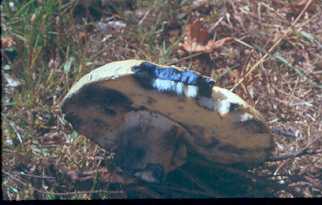
| Gyroporus cyanescens. On the WBRC’s recording day at the Devil’s Spittleful on 1st September 2001 I was handed a rather battered specimen of this fungus. It is one of the large group which used to be called Boletus but has since been split into a number of different genera. The striking sudden colour change of the flesh from whitish to intense blue on exposure to the air was obvious. The habitat description in the literature – on acid soil on heathland with scrub, especially Birch -an apt description of Devil’s Spittleful!
Figure 2. Gyroporus cyanescens. Photo J W Meiklejohn
|

Worcestershire Record No. 11 November 2001 p. 34
Zebra Mussels: A Warning and History
By Shaun Micklewright
Chris Mead, in his excellent book The State of the Nation’s Birds, has suggested that the continuing increase in Tufted Duck Aythya fuligula numbers in Britain may be partly due to the spread of Zebra Mussels Dreissena polymorpha, an alien mollusc found in many watercourses throughout Britain. Intrigued by this suggestion, and more worryingly by a recent statement by Severn Trent Water highlighting the potential damage the mussel poses as a bio-fouling agent to raw water mains, I provide recorders with a brief history/identification guide for this fascinating and little known mollusc.
The Zebra Mussel Dreissena polymorpha is a native of the Black, Aral and Caspian Seas. During the eighteenth and nineteenth centuries it spread throughout Europe as many rivers became interconnected and commerce increased amongst countries. It was first recorded in Britain in 1824 at Surrey Commercial Docks (Greater London) (Marchant et al 1990) from where it has spread to nearly every major river and canal in Britain. In Worcestershire it has been sparsely recorded mainly in the rivers Severn and Avon with a few records from the river Stour.
The common name Zebra Mussel is derived from the pattern of zebra like stripes on the shell and the scientific name polymorpha, refers to the many morphs or forms that occur in the shell’s colour pattern, including albino and solid black or brown.
Zebra Mussels have been reported to grow as large as 5cm long although most are rarely larger than 3cm. They live primarily in clusters on hard substrates in rivers, canals, lakes, and on industrial plant intake structures where they attach themselves firmly, making it difficult for either predators or high currents to pry them off. Where they are common they pose a great risk to water abstraction pipe work, and to other molluscs which they have been shown to smother and eventually kill.
A variety of animals prey upon them: fish, crayfish, and waterfowl have all been shown to consume them. The shell clusters can be extremely sharp so care should observed when collecting them.
Both Severn Trent Water and the Environment Agency are currently monitoring the mussel and any records would be most welcome. Please send your records to WBRC.
References
|
MACKIE Practical Manual for Zebra Mussel Monitoring and control |
|
MARCHANT JH, HUDSON R, CARTER SP, and ,WHITTINGTON P. 1990 Population Trends in Brititish Breeding Birds. British Trust for Ornithology. |
|
MEAD CJ. 2000 The State Of The Nations’ Birds. Whittet Books |
Picture based on that in Ellis AE. 1962. British Freshwater Bivalve Molluscs. Synopses of British Fauna. Linnean Society of London
Worcestershire Record No. 11 November 2001 p. 24-25
Worcestershire Spiders
By John Partridge
I have not written a general report since April 1999, so this covers nearly three ‘seasons’.
Almost inevitably, the majority of the new finds have been Linyphiids, the small black ‘money-spiders’ that all tend to look very similar until they are under the microscope, although the most exciting of these is in fact red. If it were bigger, it would be very noticeable because of the unusual shape of the male’s head!
Trematocephalus cristatus was first found in Britain in the 1950’s. This Notable A species was considered confined to a small area in Surrey, Sussex and W. Kent between the North and South Downs, but there are now recent isolated records from S. Essex, Somerset, Staffordshire and also Worcestershire ..
The first record in the area was from Kinver, but I am not sure which county. I found a probable immature male in Ockeridge Wood in 1999, but this year produced records from Wyre, Pensax Common and Shrawley Wood, suggesting that it is now quite well established in this area, and likely to lose its Notable A status.
I was lucky to collect three specimens of Aranea sturmi during this year, a species which I have been trying to find for over three years. Although the picture in Roberts (where it is listed as Atea sturmi) makes it look attractive and very distinctive with its red/brown ‘shoulders’, it is small and the features are not at all evident even when it is in the net. This is an orb-web spider in the same family as the Garden or Diadem spider, Araneus diadematus. It is apparently usually found on evergreen trees and bushes, but its early maturity in spring probably makes it less likey to be collected than other orb-web species.
Also from this family is the more spectacular Araneus alsine, which is a bright orange red, and a decent size – the female is up to 9 mm long without the legs. However, it hides very effectively in a retreat, above its web, which includes dead curled leaves. I saw this at its only (known) site in Scotland last year, and have looked for it, unsuccessfully in Wyre Forest from where it is also known. My emotions were mixed when John Meiklejohn turned up with a specimen from his sweep net, but it was from the Shropshire side of the brook, so perhaps it doesn’t matter too much!.
Nesticus cellulanus is a medium-sized spider which I first found under damp overhanging vegetation in Shrawley Wood, and then soon afterwards under a manhole cover in my garden. Gary Farmer has been doing some DIY recently and found it in the same situation in his garden, so please, if you find yourself lifting manhole covers for any reason, keep your eyes open – it has a body length of 3 – 6 mm, and this is glossy and usually a khaki-green with black markings. The head is rather paler, with a broad dark streak down the centre and darker edges. The front legs are about three times the body length, with dark rings on them.
The last spider I shall report on was found during the Devil’s Spittleful Recording Day, by me this time. This was Arctosa perita. This species is widespread around the coast, but more records are beginning to show up in inland heath areas, so this one is following the trend.
The best story of the year, or should have been: A small pale green Dictynid, of a type that I had not seen before, was collected by Harry Green, who inadvertently put it in a tube with the Tephritid (Picture wing) fly that he really wanted – unfortunately, when he went to get the fly, the only thing he could find was the spider and some debris! But there was a happy ending (for me at least) when I identified it as a new county species Nigma walckenaeri, another Notable A, usually confined to the south-east, with many records from Buckingham Palace gardens (although again with a few records from the Severn estuary area). It is suspected that this traveled on a cutting from the garden secreted by Jenny, Harry’s wife, when he collected his MBE! Unfortunately, the specimen was a bit small and immature, so I could not get the identification confirmed, and Harry and Jenny did not get into the gardens at the palace. Never mind, why let the truth get in the way of a good story, except that this is supposed to be a scientific journal.
You will have noted no doubt that some of the best finds are being made by other ‘none-spider’ people, probably because they are looking in different places. This seems to be a fairly common occurrence for many recorders, so, please, if you find unusual spiders I am willing to try to identify them, and I shan’t be worried if they turn out to be common – most spiders that I collect are common but they all add to our understanding of their distribution and their habitat preferences. They can be kept for some time in a container with a leaf to provide some humidity – food does not matter – they can live for weeks without – and their oxygen consumption is very small. Alternatively, if you normally preserve your collection in 70% alcohol, you can do the same with the spider. It is suggested that gin can be used in an emergency, but most of us do not have gin with this sort of alcohol content.
Worcestershire Record No. 11 November 2001 p. 9-10
Birds in Worcestershire – May to October 2001
By Gavin Peplow
This spring began with many County birdwatchers in a slightly sombre mood in response to the restrictions imposed by Foot and Mouth precautions as to the locations they could visit in search of incoming breeding migrants and passage birds. As summer arrived, access restrictions were largely lifted and throughout the period there was a good spread of interesting records, including a new species for the County along with two first breeding records.
During the last few days of April a Red-breasted Merganser dropped into Westwood briefly and an adult Whooper Swan paused at Grimley on its way back north. The wildfowl theme continued into early May with a superb adult male Eider selecting the most unlikely venue of Arrow Valley Lake to stop for a ‘breather’ before heading off to the east. Short-eared Owls were seen over Cherry Orchard, Worcester and on the north Malverns whilst a male Red-footed Falcon was seen well by one fortunate observer at Grimley a few days later. This provided what some would say was a long overdue first County record and amazingly a female of the species was then seen briefly over Westwood Pool a week later, but unfortunately again did not linger. Continuing on the birds of prey theme, a Red Kite drifted though the Lenches whilst seven or eight Marsh Harriers were noted, mainly at Upton Warren. Surprisingly only one Osprey was seen at this time.
This May was reasonable but by no means exceptional for passage waders, with the highlights being parties of up to seven Whimbrel at various sites; a Turnstone at Bredon’s Hardwick and five Sanderlings at scattered localities. Tern passage came and went very quickly with a party of ten Arctic Terns through Lower Moor and a similar number of Black Terns at Upton Warren mid month. A single Little Tern at Bredon’s Hardwick was followed by two birds at Gwen Finch, a new site record, whilst Common Terns peaked at 31 at Westwood mid-month. Several drake Garganey were seen at sites from Upton Warren to Bredon’s Hardwick and a Little Egret at Holt was the first seen there and still an unusual record for spring. Another notable record for the month arrived in the form of a Black Redstart holding territory for a fortnight around a Kidderminster carpet factory!
June is often perceived as a very quiet month for birding with most species in the midst of their breeding cycles but it can often throw up a few surprises. This year, late or perhaps early returning passage waders included a Knot at Upton Warren and a Curlew Sandpiper at Grimley, whilst this last site also hosted a Wood Sandpiper, a species that is seemingly increasingly haphazard in its appearances in the County. The main prize however (for those fortunate to see it before it departed northwards) was a Spoonbill at Wilden, the second year running that this species has been seen at this site.
July began hot and as can be the case in such conditions, several Quail were heard calling. This included up to five in the Peopleton area and three or four elsewhere. A small number of Crossbills were found in the Wyre Forest, Eyemore Wood and on Woodbury Hill whilst three drake Common Scoter rested awhile at Bittell.
It is at this time that the success or otherwise of the breeding season can become apparent. This year a potential female ‘Blue-headed’ Wagtail – the continental form of Yellow Wagtail – was seen at Holt and may have paired with a male Yellow though whether any young were raised is not known.
Two other species bred for the first time in Worcestershire this year, neither perhaps that welcome! The first were two pairs of Greylag Geese in the south and no doubt ‘overspill’ birds from further east where they are now very numerous as descendents of original feral birds. Secondly and surprisingly, was a pair of Great Black-backed Gulls that raised one juvenile at Bredon’s Hardwick.
At the end of the month the now annual ‘incursion’ of Little Egrets began with birds at Lower Moor and Upton Warren, whilst up to four juvenile Mediterranean Gulls and three Curlew Sandpipers were also seen at this last locality.
August arrived with a Black-necked Grebe being found at the unlikely location of Throckmorton Landfill site and perhaps more surprisingly it remained for ten days. There followed two birds of this species at Westwood and a further individual at Grimley over the next couple of weeks. An Osprey took up temporary residence at Trimpley Reservoir and another was seen over Bittell whilst a further five Wood Sandpipers and several Little Stint passed through the County. A Spotted Crake put in a very brief appearance at Upton Warren, emerging into a freshly cleared area of rushes for a few minutes whilst a Bittern was typically elusive at Grimley when seen several times over a four-day period mid-month. Little Egrets were somewhat easier to find with birds seen at ten well-scattered sites and with concentrations of three at Bittell and five at the Gwen Finch Reserve, Nafford on single dates.
September produced a nice variety of scarcer species without throwing out anything spectacular. A steady trickle of passage waders included Curlew Sandpipers at Grimley and Upton Warren with Spotted Redshank at this last locality and another commuting between Lower Moor and Nafford. Several Little Stints were also seen before a Pectoral Sandpiper was found at Ryall Gravel Pits at the month end.
Stronger winds pushed three Manx Shearwaters inland mid month but all of these were picked up by the RSPCA after being alerted by members of the public as to the presence of ‘a strange bird in my garden’. Other highlights included an Osprey over Holt, Little Gulls at Wilden and Upton Warren, Rock Pipits at this last locality and Grimley and a Black Redstart also at this last locality. Several Redwings arrived early this autumn with birds on Bredon Hill and elsewhere from the third week.
The autumn continued very mild with some warm days throughout October encouraging species such as Black Terns to linger at Bittell and Upton Warren. Ospreys were also later than normal this year, reported near Naunton Beauchamp and for a few days at Bittell. This last locality attracted the highlight of the month in the form of a Dartford Warbler, bizarrely found in a well trimmed hedgerow where it spent a day apparently successfully foraging for insect morsels!
A Grey Phalarope was sadly picked up dead at the beginning of the month whilst a Firecrest at this time was typically elusive near Bewdley. Other notable sightings included a White-fronted Goose at Grimley; Scaup at Bredon’s Hardwick whilst perhaps the most unexpected record of the whole autumn was a White Pelican reported flying up the Severn valley late in the month! This was presumably a bird that had been seen earlier in Gloucestershire and Herefordshire, though as usual with this species it was presumed ‘guilty before proven innocent’ in terms of its origin, this despite no claims of any escapees anywhere in the Country at the time!
Records compiled from reports received by Birdline Midlands. Please phone through details of all your interesting sightings to the 24-hour Hotline on 01905-754154 (free on application to regular callers). For all the latest information on birds currently within Worcestershire and the Midlands Region, call 09068-700247 (calls charged at 60p per minute).
Worcestershire Record No. 11 November 2001 p. 18-20
Oh! I do like to be beside the seaside
By Bert Reid
| Many of you will have noticed white edges along our motorways and major roads during April and May. This ribbon of white along the verges and central reservations is caused by the flowers of Cochleria danica (Danish Scurvygrass). This is a seaside plant which was first noted in Worcestershire in 1977, on railway ballast at the edge of a saline pit at Stoke Works. During the period of the Flora Project (1987 to date) we have seen a dramatic increase along the main road system where salt is used in winter and now the distribution map of the plant can double up as a major road atlas.
Cochleria danica Danish Scurvygrass (right) Cochleria danica is a very easy plant to see and record. Not many plants can be confidently recorded while driving at 70 mph along the motorways. Even non-botanists will notice it and ask about it. |
 |
 |
Less well known are some other plants that have also spread along salted roads in a similar fashion. Puccinellia distans (Reflexed Saltmarsh-grass) is just another grass to most people. The only chance we have to record this on motorways is to wait for the traffic jams – it is a plant for the pedestrian rather than the motorist. Spergularia marina (Lesser Sea-spurrey) is a bit easier because it has little pink flowers, but it is a very low- growing plant and small patches can easily be overlooked, even on foot. The fourth seaside plant along some main roads is Plantago coronopus (Buck’s-horn Plantain). This is a fairly widespread native on the sands around Kidderminster, but outside this area is strongly associated with bare road verges. It is definitely not a motorist’s plant. Another seaside plant we have recorded is Atriplex littoralis (Grass-leaved Orache) but this only has a couple of records, both from the M5 motorway.
Puccinellia distans Reflexed saltmarsh grass. (left) The best chance to find these seaside plants is to walk along the verges of major roads. On the 17th June 2001, the Flora Project organised a field meeting to Evesham. Included in the area covered was a section of the A46T Evesham bypass. Cochleria danica was first noticed on the bypass in 1996 and was known to be quite widespread along the road by the time of the field meeting, but no other saline plants had been recorded. Bill Thompson soon pointed out Puccinellia distans by the road, and we also managed to find small patches of Spergularia marina and Plantago coronopus. To the best of my knowledge, none of these 3 species had been previously recorded from the hectad. |
| Spergularia marina Lesser Sea-spurrey (below)
Plantago coronopus Buck’s-horn Plantain (below)
Catapodium marinum Sea Fern-grass (above) |
During the meeting we only covered a small section of the bypass, which goes through ten 1 km. squares to the south and east of Evesham. I decided that it was important to investigate the road more thoroughly, so over a few days I donned the gas mask and earplugs and walked the road. I kept strictly to the road edges (both sides) and fixed my gaze to the narrow strip of the edge. I now have a permanent stoop and glazed eyes but the recording was very successful. I found Cochleria danica in seven of the ten monads, Puccinellia distans in nine, Spergularia marina in eight and Plantago coronopus in four.
On the 29th June I was walking along the south-western end of the bypass when I spotted a vaguely familiar grass. It was a small, stiff, bright green grass with tight one-sided flower spikes. At last the penny dropped and I remembered what it was and where I had seen it. It was Catapodium marinum (Sea Fern-grass) and I had seen it before on some of my rare trips to the seaside. There were seven good clumps of the grass – a first record for the county. The second county record came two days later when I spotted four very tiny plants on another part of the bypass. Where did these seaside plants originate? The obvious answer would seem to be introduction with the de-icing salt now used so widely on our main roads, but there is good evidence that this is wrong. The spread of halophytic plants on road verges is one of the most remarkable recent changes in the British flora. The phenomenon was first reported in 1976 by Matthews & Davidson from north-eastern England and further articles by Scott & Davidson (1982) and Scott (1985) give a clear picture of the early years of the spread. The first successful coloniser was Puccinellia distans and the history of its spread shows quite clearly that the earliest records were close to the coast with a subsequent linear expansion inland. A similar picture can be seen with Spergularia marina. Cochleria danica was a late starter with few records before the late 1980s but has made up for lost time with a remarkable expansion, again starting with roads near the coast. This history strongly suggests a natural expansion from “traditional” coastal sites. Human activity has created a series of continuous corridors of suitable habitat along the bare, salt-burned verges of major roads, and vehicular slipstreams and the carriage of mud by cars and lorries has assisted seed dispersal. Anyone who has walked the edges of major roads will be well aware of the powerful suction force created by fast travelling vehicles, especially large lorries. |


What will come next? The most successful colonisers are all plants of the edges of saltmarshes, usually on rather bare compacted soil, and all have light seeds, which spread easily. We are already seeing a few cases of spread onto more minor roads in parallel with the increased use of de-icing salt and this trend is likely to continue. A number of other saline plants have been seen on road verges in other parts of the country, and some of these may well reach Worcestershire if they are not already here unrecorded. The most likely candidates in my opinion are Cochleria officinalis (Common Scurvygrass), Puccinellia maritima (Common Saltmarsh-grass), Hordeum marinum (Sea Barley) and Parapholis strigosa (Hard Grass). These are all well worth looking out for, and if anyone finds them before me I won’t be too upset!
Another seaside plant that we have found on roadsides a few times is Armeria maritime (Thrift). This plant has clearly spread from deliberate planting in gardens etc. and is also found on the Evesham by-pass with other ornamental planting in the centre of a roundabout. The Evesham plants have not managed to colonise the verge yet, but I would not be surprised to see them spreading in future.
A final surprise from the Evesham by-pass turned up on 26th August. On the demolished foundations of what was probably a barn in an arable field just off the by-pass I found two species of Sea-lavender. One was Limonium latifolia, the Florists’ Sea-lavender and the other was an as yet unidentified relation of Limonium sinuatum with winged stems but unlobed leaves. Both are clearly relics of cultivation for use as dried flowers in flower arranging. 200 metres away, on the very edge of the road and growing with Puccinellia distans and Spergularia marina, were three or four plants of the unidentified Limonium.
So forget long trips to Bournemouth, Brighton or Blackpool. For the best seaside plant hunting just come to Evesham and stroll along the by-pass!
References
|
MATHEWS, P & DAVISON, A.W. (1976). Maritime species on roadside verges. Watsonia, 11: 164. |
|
SCOTT, N.E. & DAVISON, A.W. (1982). De-icing salt and the invasion of road verges by maritime plants. Watsonia 14: 41-52. |
|
SCOTT, N.E. (1985). The updated distribution of maritime species on British roadsides. Watsonia, 15: 381-386. |
Appendix
The following maps show the current distribution of some halophytic plants as revealed by the current Worcestershire Flora Project. The first coincidence map shows the distribution of all the species and provides a road map of the county!

Reflexed saltmarsh grass is found on semi-bare mud, round estuaries, the upper edges of saltmarshes, inland saline areas, and along salted main roads.
Lesser sea-spurrey is found in sandy or muddy maritime areas, at inland saline places. Locally frequent inland.
Buck’s-horn plantain is a native British plant which grows on barish ground or amongst very short turf on gravelly or sandy soils, mostly near the sea. The map above shows that it is quite frequent on the sandy soils in the Kidderminster area, and infrequent elsewhere.
Danish scurveygrass is common on many sites near the sea, and on salt-treated roads inland.
The map caption comments are derived from STACE C 1997 New Flora of the British Isles. 2nd edition. Cambridge University Press.

The following extract was written by Fred Fincher (Trans. Worcs. Nats Club 1952, Vol 10, part 4, pages 265-269: Worcestershire has long been noted for its maritime plants and the earliest record appears to be Glyceria maritima (now Pucinellia maritima) Common Saltmarsh grass in1796 near the Droitwich Canal. Most were solitary records, and the plants never established themselves, but several are well-established and still maintain their hold. On the Keuper Marl the main area of interest is at Droitwich where brine has been known and worked since Roman times. A few plants have been recorded near Tewkesbury. Here, before Longdon and Welland Marshes were drained and various locks and weirs constructed, the Severn was tidal to well above Tewkesbury and the low-lying ground would have been inundated with saline water during floods…. He then lists the plants with comments. Many have now vanished since 1952: our current best saltmarsh has developed at Upton Warren. All very different from the modern roadside invaders.
Worcestershire Record No. 11 November 2001 p. 39
Wyre Forest Adder Census and Report 2000
By Sylvia Sheldon
(Sylvia Sheldon has been undertaking an important study of adders in Wyre Forest for many years. The following is extracted from her year 2000 report with her permission. Ed)
| Year | SitesSurveyed | Sites withadders | Maturemales | Maturefemales | Total | Average Per site |
| 1990 | 56 | 50 | 185 | 55 | 240 | 4.8 |
| 1991 | 76 | 61 | 211 | 56 | 267 | 4.4 |
| 1992 | 78 | 55 | 159 | 33 | 192 | 3.5 |
| 1993 | 80 | 59 | 186 | 70 | 256 | 4.2 |
| 1994 | 76 | 50 | 153 | 29 | 182 | 3.6 |
| 1995 | 76 | 44 | 103 | 14 | 117 | 2.6 |
| 1996 | 80 | 41 | 112 | 32 | 144 | 3.5 |
| 1997 | 84 | 44 | 102 | 31 | 133 | 3.0 |
| 1998 | 85 | 42 | 103 | 34 | 137 | 3.3 |
| 1999 | 67 | 35 | 100 | 20 | 120 | 3.4 |
| 2000 | 87 | 24 | 69 | 13 | 82 | 3.4 |
Table 1: Adder numbers
| Year | Firstsighting | Air temp(ºC) | Grass temp.(ºC) | Firstslough |
| 1990 | 5 Feb | 13.0 | 14.0 | 08 Apr |
| 1991 | 23 Feb | 14.0 | 17.0 | 19 Apr |
| 1992 | 23 Feb | 13.0 | 15.0 | 22 Apr |
| 1993 | 17 Feb | 10.7 | 12.5 | 16 Apr |
| 1994 | 10 Feb | 10.0 | 15.0 | 18 Apr |
| 1995 | 12 Feb | 11.4 | 11.0 | 10 Apr |
| 1996 | 16 Feb | 12.2 | 15.0 | 24 Apr |
| 1997 | 15 Feb | 8,6 | 11.0 | 08 Apr |
| 1998 | 11 Feb | 13.6 | 12.5 | 17 Apr |
| 1999 | 16 Feb | 8.0 | 9.0 | 16 Apr |
| 2000 | 19 Feb | 6.3 | 12.5 | 07 Apr |
Table 2: Emergence and sloughing dates of adders
| Year | Grass snakes | Slow-worms | Lizards | |||
| Mature | Juv | Mature | Juv | Mature | Juv | |
| 1990 | 30 | 6 | 23 | 3 | 22 | 2 |
| 1991 | 16 | 4 | 24 | 11 | 20 | 0 |
| 1992 | 22 | 8 | 27 | 8 | 10 | 3 |
| 1993 | 45 | 4 | 57 | 5 | 35 | 3 |
| 1994 | 18 | 2 | 36 | 10 | 22 | 1 |
| 1995 | 19 | 4 | 23 | 13 | 11 | 0 |
| 1996 | 18 | 4 | 32 | 16 | 15 | 0 |
| 1997 | 25 | 3 | 42 | 11 | 42 | 0 |
| 1998 | 20 | 1 | 34 | 8 | 37 | 0 |
| 1999 | 26 | 8 | 32 | 9 | 18 | 1 |
| 2000 | 11 | 1 | 21 | 3 | 23 | 0 |
Table 3: Other reptiles recorded in Wyre Forest during adder census

Chart shows Adder population trends 1990 to 2000
Discussion
| The result of the spring Census for 2000 has given great cause for concern. The number of mature adders recorded in Wyre Forest plummeted to an all-time low of only 82 individuals, including just 13 females. Of these females, only three were seen in the company of males. Poor weather in the summer of 1999 could have accounted for this, preventing females from feeding and building up fat reserves sufficient to permit them to breed. A cool wet September that year may also have delayed birth in pregnant females. These would then have had to hibernate still pregnant, and give birth as soon as the weather in spring 2000 was warm enough.
This appears to have happened in at least three cases. These females were seen initially to be plump and apparently in breeding condition, but by the end of April they were much thinner, as if parturition had occurred. An apparently newborn infant adder was found in the vicinity of one of the females. None of them attracted a male, and overall the evidence seems conclusive. The other seven females seen in March 2000 had all disappeared by the time mating courtship began, and they did not participate either. The effects of the summer of 1999 on the females appears obvious from the Census results. The effects on the male and the juvenile populations is unknown, other than indicated by the Census indicates – that many did not survive hibernation! Of the 87 currently or previously occupied sites surveyed in Wyre Forest, only 24 were found to support adders in 2000. Other sites were surveyed in Worcestershire during the spring, six were found to support adders with 22 males and seven females recorded. This brings the total overall to 111 mature adders in Worcestershire and the Wyre Forest (part of which is in Shropshire). Of these 91 are males and only 20 females. This represents another sharp decline in numbers and suggests that the future for adders in this survey area is bleak. AcknowledgementsI would like to thank: Chris Bradley, Jeff Hubball and Nigel Hand for their census work, .all those who reported reptile sightings and the landowners on whose property the study has been undertaken. Address for Communications: Ms Sylvia Sheldon, Knowles Mill, Dowles Brook, Wyre Forest, near Bewdley Worcestershire. DY12 2LX. |
 |
Original Artwork: Denys Ovenden
 |
WORCESTERSHIRE |
Reference
|
SHELDON, SYLVIA February 2001. Wyre Forest Adder census and report 2000: correlated with local meteorological data. |
Worcestershire Record No. 11 November 2001 p. 34-37
Worcestershire Turtles and Crawling King Snakes
By Alan Shepherd
In which Worcestershire Reptile and Amphibian Group take over (most of) this newsletter… …(NOTE views and opinions expressed in this article are strictly those of the author – keep the salt handy! Ed)
Red-eared terrapin Trachemys scripta
John Day’s brief note (Worcestershire Record no 10) about the terrapin spotted in a pool near Pirton has prompted people to prod me into writing about some of Worcestershire’s undesirable aliens, not in this case the hordes of Brummie in-comers nor even the saga of Himalayan balsam but the latest news of some unwanted additions to our county’s herpetofauna.
When you’re nationally known as a “bloke who knows about snakes and frogs” all sorts of loonies and journalists (not that the two are easily distinguished) tend to be put through to you while you’re busily trying to get some work done. Most of these are of the “I’ve got a frog in my garden and it’s frightening the kids” category; some are “They’re going to build a housing estate next door to me and the woods are full of great crested newts” but occasionally there is one of genuine interest and concern. Better still, the likes of Mike Averill ring up with reports of Green Frogs found while out spotting dragonflies in inaccessible places. I have already covered the Marsh Frog (Rana ridibunda) colonies near Droitwich and Hallow (the latter recently mistaken for a colony of spotted crakes by orgasmic twitchers!) in Worcestershire Record No. 4 May 1998) and these continue to spread further from their original sites, although not yet quite far enough to become a threat to our native species. There is a whole article about the Green Frog Complex to come – indeed a friend of mine is in the middle of her Ph.D. on the subject – but this time round let us concentrate on the seemingly minor additions to our impoverished County Herpetofauna.
Firstly, Mike Sutton considers some chelonians that may be encountered living `wild` in the UK – I quote:
In March 1999, a WRAG field meeting visited some sites in Redditch; we didn’t see any native herpetofauna apart from frog-spawn, but despite the inclement weather, we did see a terrapin. This I was called on to identify, which was difficult despite the loan of Alan’s excellent binoculars. I did attempt to get nearer the basking site, entering the thick bushes on the bank to do so but all I found out was that the bushes scratched!
Some days later I returned to the site and saw more than one specimen. All I could do as far as identification was to say that they were probably the common red-eared terrapin (slider) (Trachemys scripta elegans) and most likely to be female as these seem to do better than males. This started me thinking; were they really red-ears or could they be something else?
The red-eared slider is the one that was most commonly imported for the pet trade in great numbers since it was “farmed” in the USA (where it originates) and in Malaysia. Thankfully, the trade into the U.K has been banned due to the large numbers of releases into the wild of adult and sub-adult specimens. Originally, few animals reached a size at which people could not cope with them, but due to the increase in public awareness of their needs, more and more grew beyond the hatchling size (they should be 7.5cms long at the end of their second year) and became a liability. 20-26cms is the usual adult size. Some dealers would accept returns, some kind-hearted chelonian lovers amassed large collections (I have heard of someone fairly local who had over forty!) Many were taken to zoos, who had to start declining extra individuals when all the pools in the reptile house were full and the crocodile/alligator pool had no room for its specified inmates. When this happened, the kind owners would still donate their terrapin to the collection by releasing it in the pool intended for fish/ducks/flamingos, rather than take the unfortunate chelonian home. Some collections decided that the best course of action was to start up an outdoor enclosure for terrapins but one had to increase the number of enclosures, since different species were being brought in! Soon it became impossible to find a home for an unwanted terrapin and they were being released into any stretch of water near their owners’ home.
The sound of a plop near river, canal or pond used to signal the presence of a water vole; not any more, the cause is more likely to be a feral terrapin (or a green frog) returning to the water, disturbed by your proximity. And, yes, you are likely to see them in Worcestershire. I received a young male caught in a brook near Murcot. One animal lost when young was re-united with its owner many years later having lived in the Avon in Fladbury; the local canoe club had seen it regularly every year during the interim. Alan Shepherd is aware of two at Porter’s Mill and the Worcestershire Wildlife Trust outing up the Avon saw one opposite the Eckington Bridge car park. Are they all red-ears? Do you know the difference?
True, the Red-eared slider was the most commonly imported chelonian but there is a lot of variation, as now more than a dozen subspecies have been recognised. Its range includes Texas, Oklahoma, east Kansas, Indiana, Kentucky, Tennessee, Alabama, Florida, north-east Mexico and some of the West Indies. The red area corresponding to where an ear may be found is the main characteristic of this fairly flat, mainly yellow, green and black animal but you can’t always see this at a distance. The pattern is of fairly large stripes of yellow on head, legs and shell with the two large red stripes on the neck. They are comparatively hardy; I believe a colony has been kept outdoors at Blackpool Zoo for a number of years, although not breeding (thankfully). This species is sexually dimorphic, the males have much longer claws, which they vibrate in front of the female during courtshipTo my mind, the females are more circular in shell but I could be wrong. The male tail is usually longer and broader than that of a female.
The second terrapin you may encounter is the European Pond Tortoise (Emys orbicularis) (EPT). These come from Europe and may still be living wild (not feral) in Norfolk, as there are fossil records from before the last Ice Age. This is a smaller terrapin, rounder and higher in its shell (carapace) shape when viewed from above, which may grow up to 13-15cms long. The colour is black on a pale yellow on the head and shell but the pattern is much smaller than on a red-ear, almost a fine spotting and the legs are completely black. Never imported in the vast quantities of the red-ear, they are hardier, occurring from North Germany and Poland down to Iberia and the Balkans.
The Iberian, Leprous or Caspian Terrapin (Mauremys leprosa) is the third most likely to be seen. Like the EPT above they were imported as pets before the Red-ears became so common, but are not now usually seen on sale. They are however, the most likely to be seen wild in the `normal` holiday destinations, so I wonder if there may be an increase in individuals smuggled in by would be terrapin keepers. We have seen them during several trips abroad. Their range is smaller than EPT, mainly Iberia and the Balkans including Crete. The carapace tends to be longer, thinner, and definitely flatter than EPT or Red-ears. Colouration is drab; they are mainly grey without much or even any patterning on the carapace, although the legs are fairly similar to EPT, and the neck is striped; similar to a Red-ear but the colours are nothing like so vivid. They have quite an aggressive nature and are likely to bully larger animals, especially with excessive mating attempts.
The three species above are the most likely to be encountered. But there are others. Many will have seen the Mark O`Shea programme on Channel 4 about the Alligator Snapper Turtle (Macroclemys temminicki) but I do not think you will meet one of these. However, the smaller Common Snapper (Chelydra serpentina) has been released in this country. One was caught by an angler in the canal near Rugby in the early 1990s and more recently “the Beast of Swan Pool” in West Bromwich [initially reported as an alligator, then as a hellbender (Cryptobranchus sp.) and next as a mudpuppy (Necturus maculosis)] turned out to be this species. They do not grow as large but specimens up to 47cms have been wild caught weighing about 39kg. They are much more aggressive with a long snake-like neck. Never touch or pick up one with hand in front of the midline between the legs of one side, the beak can reach you (and will!). They are also much more tolerant of cold weather, active at 6º C. I have heard of them being seen moving about under the ice on top of a pond.
Of course any turtle being kept as a `pet` may be released into the wild although the prices charged these days should make any keeper reluctant to dispose of a specimen in this manner. I have recently seen big-headed turtle (Platysternon megacephalum) offered for sale in a garden centre and I had never seen one of those before. Likewise, a small pet shop in Blackpool had a Spiny Turtle (Heosemys spinosa) which I cannot ever remember seeing elsewhere. But since turtles are easy to smuggle in hand luggage etc. a holidaymaker could bring something quite unexpected into the country, so be on your guard.
How do you catch a feral chelonian? With difficulty! What do you do with it? Send it to the British Chelonian Group.
The first requirement is to identify favourite basking sites, observe for several days to see where the animals come out to bask and most importantly when. Then work out how to approach the site from the water, because you will never be able to approach them from land before they dive to safety. A boat, canoe or surfboard gently paddled towards the site may allow you to get a long handled net into a useable position, especially if you get there before they come out of the water. If they come out to bask after you have arrived, you are much more likely to make a catch. Remember to have something with a lid to put them in, beak and claws are sharp and buckets can be climbed out of by all but the smallest terrapin. Now, you cannot by law release a captured feral chelonian back into the wild; are you going to keep it, kill it, or pass it on to someone else? Celia and I would be happy to identify any specimen you catch but cannot offer a home to anything that does not fit in with current species kept.
The British Chelonia Group now offers a sanctuary for Red-eared Terrapins at “Secret World” in Somerset, although one of their number did say to me on the telephone that it is a pity people do not leave feral terrapins where they are!!! My diplomacy surprised me… I have approached them for input on this article, but so far have received no reply other than the telephone call to say they were passing on my request to someone else. If you do wish to contact them they are on the web, and I have a few phone numbers if you like to contact me first.
[Reprinted courtesy of Worcestershire Reptile and Amphibian Group].
Red-eared terrapin Trachemys scripta. The grey arrow points to the red, yellow or orange flash behind the eye. There are yellow stripes on the head and neck; shell is green, olive or brown with yellow and black markings. Reachs 30 cm in length. Usually seen basking in the sun.
Alan continues:
WRAG are now aware of 17 terrapins at large in Worcestershire and all are thought to be red-eared sliders. In 2002 we intend to launch a major offensive on the locations of these feral intruders, in association with fellow Amphibian and Reptile Groups. All records will be gratefully received; alan@anguis.fsnet.co.uk or alan@worcswt.cix.co.uk or telephone 01905 754919 (day) 01905 779772 (home). This is also the way you can contact Mike Sutton; I will pass your messages on to him but not your captive turtles!
Even more likely to be the subject of the ‘phone call is the “adder in the garden“. Nearly always this is a grass snake (Natrix natrix) swimming in the fishpond (“It’s not me, it’s the missus who’s frightened“) as men often say) or a slow-worm in the compost heap. Telling them that there are now less than 100 adders in Worcestershire (Sylvia Sheldon 2000-2001) doesn’t change their mind and it often takes a personal visit to assess the habitat and pacify the panic-stricken householder. Now, contrary to public opinion and the press, where dogs and children are regularly at risk, adders feed on small mammals and consequently their venom is weak. Many of us now carry a strong anti-histamine and steroid combination instead of worrying about anti-venom serum (After all, have you ever seen a vole weighing more than two stones?). Domestic dogs killed more people in the 1990s than the vicious adder managed to slaughter over the whole 20th century.
So it’s interesting when you turn up to a house on a Bromsgrove estate and produce the Field Studies Council ID sheet (with the names carefully blanked out to avoid any prejudice in identification) only to have the householder point to the smooth snake (Coronella austriaica) and say “That’s it! It had a white V on its neck and it spread its hood and hissed at me before it swam off!” Old Mr Cynical then has to be diplomatic and try to pacify somebody he would rather strangle but just once or twice there is a genuine challenge.
A phone call from a local free-sheet reporter provoked the usual response of “it’s probably a slow-worm but put him through…” but it immediately became clear that just for once it was a bit of a conundrum. A long snake (but aren’t they all at least “3 feet long“?) with an orange and white pattern had been spotted in a town garden, and the householders were in so much terror for their lives that they phoned the local weekly paper to tell the world, as you do when faced with any fearsome and unknown reptile.
Setting off with the blue light flashing and siren blaring, I got there just in time to find out that the terrible monster hadn’t been seen for two days but it was definitely lurking out there to ambush the grandchildren or eat the pet pooch (a nauseatingly obese, incontinent and malodorous mongrel that would have repulsed even a starving crocodile). Anacondas or spitting cobras aren’t gaily coloured but venomous snakes are. It was getting better, would I need my snake-hook, gloves and access to anti-venom? Oh joy! At last something interesting in the UK to apply all my 30 years’ hard-earned overseas fieldcraft to!
Well, after two hours of searching there was no sign of the menacing reptile. After a cup of tea, I decided to knock on neighbouring doors and ask if anybody had seen a peculiar snake around. Three doors away I was led to the dustbin in which lay the corpse of a hybrid Milk Snake (Lampropeltis sp.) all of 25cm long. Milk snakes can reach 55cm and so this one was obviously quite young (and now dead). Where it came from remains a mystery but hopefully it was bred in captivity rather than taken from the wild. Nevertheless, there is somebody out there who is at least £40 out of pocket, and the people of a town in south-west Worcestershire can sleep easy in their beds, knowing their pets and children are safe from a deadly reptile, even if they are still threatened by rampaging capybaras and big black cats.
OK, so it wasn’t a king snake… but then you’ve never heard an old bluesman sing “I’m a crawling hybrid milk snake mama and I’m creeping round your door” have you?
References
|
BEEBEE,T.J.C. & GRIFFITHS, R.A. 2000: Amphibians and Reptiles. Harper Collins, London. |
|
FROGLIFE ADVICE SHEET 8. Exotic reptiles and amphibians in the wild. The two illustrations in the article are adapted from this leaflet. |
Worcestershire Record No. 11 November 2001 p. 13-17
Wintering Gulls in Worcestershire
By Peter Stewart
Part 3. The Lesser Black-backed Gull L. fuscus
While formerly a complete migrant with only occasional birds remaining here in winter, in recent decades more birds, mainly second winter and older, have shown an increased tendency to winter in Britain. Today c.70,000 Lesser Black-backed Gulls are wintering in Great Britain, and wintering numbers are undoubtedly increasing. This may in part , be due to climatic changes, but the overwhelming reason is our methods of waste disposal, and the proliferation of landfill sites. It has not always been a continuing success story for this species, declines in numbers have occurred, notably in the early to mid 1970s onwards, brought about by botulism. The black plastic bags issued by local Councils for the disposing of waste was introduced in 1972. The cause of botulism, the anaerobe Clostridium Botulinum, in order to multiply successfully needs a dark environment, without oxygen, but with warmth. These black bags full of rotting foodstuffs fulfil all of these requirements (Rock 1993). Botulism was again rife in the year 2000, with many dead birds found on the Island of Flat Holm, and dead and dying birds found around the Gloucester landfill site.
The Midlands continue to be home to the majority of inland wintering gulls, probably due to its high human population, and the large number of inland waters that provide safe bathing and roost sites (Stewart 1996). In Worcestershire and nearby Gloucestershire, the Lesser Black-backed Gull is the commonest large wintering gull, where there is ample and safe roosting facilities, and the presence of numerous landfill site, with those situated in Gloucestershire preferred by the greater number of birds. Numbers in excess of 6,000 have been recorded at the Hempsted landfill site near Gloucester City, which is within close reach of the Severn Estuary. It is in this estuary where the majority of wintering birds roost, and usually holds c.400,000 birds of all gull species in mid winter. Analysis of the ringing results for Lesser Black-backed Gulls suggests that >30 of those wintering in the region are of foreign origin. Fluctuating numbers in winter and the disappearances of regularly seen colour-ringed individuals for weeks a time, suggests movements out of the region (probably south), rather than movement out of the country, though this is conjecture and requires further study.
Until very recently the Throckmorton landfill site, in Worcestershire, was a favoured feeding site, with regular counts of 2000 – 4000 birds in winter, sometimes in excess of 5000. However, bird scaring activities, using falcons, have dramatically reduced the visiting numbers to a few 100s. Despite the activities of the falconer, some of those who continue to visit the site are roosting at night on newly established pools nearby (pers. obs.)
Roof top breeding
In 1993 there was an estimated 88,700 coastal and inland breeding pairs of Lesser Black-backed Gulls in Great Britain (Gibbons et al. 1993). Despite the large breeding population the species is considered a bird of conservation concern, with > 20% of the European breeding population breeding in the UK, with > 50% of these found breeding in 10 or fewer sites (RSPB).
Disturbances and culling at long established breeding colonies in Lancashire, and elsewhere, plus a reduction in sea discards from fishing vessels, has undoubtedly led to an increase in roof top breeding, where there is limitless nest site availability, an abundance of food, and until quite recently, predators and disturbance have been almost absent. Roof top breeding has not proved a popular move, and is causing much concern among the public and local health authorities.
Landfill sites have become the main sources of food for many breeding birds, but many also scavenge for food discarded by members of the public in the towns. The ever increasing takeaway food outlets, even in the smallest towns, including food dispensed from mobile vans operating in and around business parks and industrial sites, ensure a constant supply of food.
In 1976, a survey revealed a total of 323 pairs of Lesser Black-backed Gulls nesting on buildings in Britain and Ireland, 89% concentrated in the Bristol Channel area. Only four towns had appreciable numbers on industrial sites. By 1994, the number of roof nesting pairs had increased to 2544, though estimated pairs may be as high at 3200, an increase of some 17% per annum of breeding pairs, and at least 80 industrial sites had most roof nesting gulls, including chemical plants, power stations, and steel works. The more dramatic increases were further north, in the Forth-Clyde region and Aberdeen (Raven 1994). The region with the least growth was around the Bristol Channel, though there were now more inland breeding colonies up the River Severn as far as the West Midlands, an increase from 288 pairs in 1976 to 867 pairs in 1994. A pair first bred in Birmingham in 1987, increasing to c.10 pairs in 1994, and remained at this level in 1995 and 1996. Breeding was first recorded at Smethick in 1989, and Wolverhampton in 1991. Since 1994, breeding has continued to increase in Bristol with 950 pairs there in 1996, and 1150 pairs in 1997, with c.1500 pairs in 2000. Breeding has also increased in Bath, from 146 pairs in 1996 to 220 pairs in 1997. Much nearer to home breeding was established in Gloucester, Cheltenham, Tewkesbury, Kidderminster Worcester and Hereford, and on industrial sites situated in and around the main town areas. Breeding was first established in the City of Gloucester in 1967, where two pairs nested in the docks area. In 1973, 53 pairs nested in various parts of the City, increasing to 135 pairs by 1978, with birds spreading as far south as Quedgeley. By 1982, 206 pairs were estimated breeding in Gloucester. In the 1990s the breeding area had grown to stretch north into Innsworth Industrial Estate, covering a distance north to south of six miles. Today the Gloucester breeding population has grown to some 450-500 pairs. Some birds are nesting on low industrial buildings within 1km of Gloucester landfill site. There are also notable increases in the number of adult birds present during the breeding season in the nearby towns of Cheltenham and Tewkesbury, and nearby industrial estates, where access to the high buildings is difficult, therefore, there are no recent estimates for those actually breeding, but probably into double figures.
Breeding was first established in Worcester City in 1986, when two pairs bred. Three pairs bred there in 1988, and nine pairs bred in 1994. Though no recent surveys, my own observations during 2001 would suggest that some 35-40 pairs are probably breeding in and around Worcester City, with an equal number of non-breeding and immature birds present during the breeding season. On low ground breeding has taken place on one of the islands in the lake at Bredon’s Hardwick, and this year (2001), two pairs have attempted to breed in an empty open-topped aviary at the Wildlife Rescue Centre at Beckford, and eggs were laid. This last record is interesting in that the male of one pair was colour-ringed there as a juvenile in 1995 and has been returning during the breeding season every year since. Last year he returned with an unmarked partner, but this year he was accompanied by a colour-ringed female. She had been ringed as a pulli on a roof-top in Bristol in 1994.
Summer visitors
Ringing activities and field records of colour-ringed birds have established that the birds summering, in the region are cosmopolitan, with non-breeding and immature birds from the Faeroes, Iceland, Norway, Denmark and Holland joining those that were bred locally or elsewhere in the UK. Many of those arriving in March and April, particularly immature birds, show very bleached and worn plumage and have obviously returned from their winter quarter in Iberia and North Africa, in order to moult in safer surroundings, and be near a ready source of food. On completion/or nearing completion of moult many of these birds return to their winter quarters.
Passage migrants
Large numbers of Lesser Black-backed Gulls occur on passage and become most obvious at the landfill sites from the middle of August onwards. Numbers build up in September – October when more birds from the north of England and foreign birds arrive. Some of those, from more northerly latitudes, arrive in suspended primary moult. Some of these remain to complete their moult, while others move on to complete their moult in winter quarters.
Undoubtedly a number of the foreign breeding birds are of British descent. Ringing, using British Trust for Ornithology (BTO) rings, has established that some birds, originally ringed as pulli, have been recovered in the breeding season abroad, mainly in Holland and Belgium. Up to the year 2000, 17 birds of British origin have been confirmed as breeding in Holland, including a bird that was originally ringed as a pulli on a roof-top in Gloucester, and four British birds confirmed as breeding in Belgium.
Numbers of birds caught
During the period January 1976 to January 1988 a total of 1049 Lesser Black-backed Gulls were caught by those involved in the Worcestershire and Warwickshire Gull Project. Of this total 811 birds were caught at landfill sites in Worcestershire. A further 862 Lesser Black-backed Gulls, out of a total to 12,763, were also caught in Worcestershire by the Severn Estuary Gull Group (SEGG) during the period February 1986 to June 2001. The following report therefore summarises the results obtained from the combined ringing activities of both organisations in Worcestershire. Also included are the author’s own field records of colour-ringed birds at Throckmorton landfill site. There are 433 records of colour-ringed birds at this site, involving 84 birds of foreign origin.
Controls (Birds ringed elsewhere and caught in the study area)
Only five foreign ringed birds were caught from both studies, four from Holland and one from Norway. However, field records of colour-ringed birds produced a further 85 birds of foreign origin; Holland (70), Iceland (6), Norway (5), Faeroes (1) and Spain (3). Those ringed in Spain were wintering birds and therefore of unknown origin. All birds from Norway were of the subspecies L.f. intermedius, and all were ringed as pulli. The longest distance travelled by a foreign ringed bird was 1118 km. This bird was ringed in Norway in July 1975 and caught at the Hollow, Worcester, landfill site in January 1980. The oldest bird controlled was 7 years 5 months. This bird was ringed in Holland in July 1983 and caught at Throckmorton in December 1990. The geographical distribution of ringing sites for all foreign birds controlled in the study area, including field records of colour-ringed birds, are shown in Figure 1.
A total of 59 birds of British origin were also controlled, plus a further 349 field records of colour-ringed birds. The oldest bird controlled was 15 years 8 months old. This bird was ringed as an adult on Copeland Island, Down, Ireland, in May 1963 and caught at Droitwich in January 1979. A bird from Strathclyde, Scotland had travelled a distance of 503 km before being caught again at Throckmorton. The distribution of ringing site for British birds controlled, including field records of colour-ringed birds, are shown in Figure 2.
Recoveries
Of the 160 recoveries reported for the two ringing schemes, 141 (88%) were recovered in Britain. Recoveries include birds found and reported by members of the public, recaptures by ringers some distance from the original ringing site, and rings read in the field (including birds with individually colour-coded rings). Most of the foreign recoveries were in Holland (8), with other recoveries in Norway (2), Iceland (2), Faeroes (2), Portugal (2) and one each in Belgium, France and Germany. The longest distance travelled was 1748 km. This bird was ringed at Throckmorton in December 1996 and shot in Iceland in July 1998. The longest time lapsed between ringing and recovery to date is 16 years 9 months. This bird was ringed at Droitwich in January 1980 and caught by the Severn Estuary Gull Group at the Gloucester landfill site in October 1996. A bird of Walney Island origin holds the current BTO longevity record of 32 years 9 months 2 days. This bird, ringed as a pulli in July 1965, was found dead in Portugal in April 1998 (Clark et al. 2000). The geographical locations of recovery sites for foreign recoveries are shown in Figure 1, and those Britain and Ireland shown in Figure 2.
Subspecies L.f. intermedius
Identified mainly by their dark mantles, the subspecies L.f. intermedius also occurs in the region, as a passage migrant, and as a summer and winter visitor. Summer visitors are mostly immature birds, but a few adult birds are observed, mainly at the landfill sites, but also in the cities, and local roof-top breeding with British L. f. graellsii is suspected, at least in Gloucester. A pullus ringed on a roof top in Gloucester (see above) is now breeding in Holland, and easily picked out as it is the darkest individual in the colony (H. Vercruijsse). A few very dark, and black, individuals are observed and trapped and can easily be mistaken for the nominate race L.f. fuscus, especially small females. In these cases the presence or absence of primary moult usually decides the issue. Nominate fuscus commences primary moult some two months later than intermedius. However, one very dark individual, ringed and photographed in August 2000 by this author, exhibited primary moult more typical of nominate fuscus for this date. This identity of this bird is still under discussion. If this individual was seen in the field elsewhere, particularly on the east coast, it would have caused a stampede among the ‘twitching’ fraternity. At the present time there are no acceptable records of nominate fuscus for the UK. Very large numbers of fuscus have been colour-ringed, over the years, especially in Finland, so perhaps it will be one these ringed individuals that will find its way to these shores, and be accepted onto the British List?
References
|
Barnes, J.A.G., 1952. The status of the Lesser Black-backed Gull. Brit. Birds 45: 3-17. |
|
Barnes, J.A.G., 1953. The Migration of the Lesser Black-backed Gull. Brit. Birds 46: 238-252. |
|
Barnes, J.A.G. 1961. The winter status of the Lesser Black-backed Gull 1959-60. Bird Study 8: 127-143. |
|
Bowes, A., Lack, P.C. & Fletcher, M.R. 1984. Wintering gulls in Britain January 1983. Bird Study 31: 161-170. |
|
Clarke, J.A., Wernham, C.V., Balmer, D.E., Adams, S.Y., Blackburn, J.R., Griffin, M.M. & King, J. 2000. Bird Ringing in Britain and Ireland 1998. Ringing & Migration (2000) 20, 39-93. |
|
Coulson, J.C., Monaghan, P., Butterfield, J., Duncan, N., Ensor, K., Sheldon, C. & Thomas C. 1984. Scandinavian Herring Gulls wintering in Britain. Ornis Scandinavica 15:79-88. |
|
Cramp, S. 1971. Gulls nesting on buildings in Britain and Ireland. Brit. Birds 64: 476-487. |
|
Cramp, S., Bourne, W.R.P. & Saunders, D. 1974. The Seabirds of Britain and Ireland. London. |
|
Cramp, S. & Simmons, K.E.L. (eds.) 1983. The Birds of the Western Palearctic. Vol. III. Oxford University Press. |
|
Duncan, N. 1981. The Abbeystead and Mallowdale gull colony before control. Bird Study 28: 133-138. |
|
Garner, M. & Quinn, D. 1997. Identification of Yellow-legged Gulls in Britain. Brit. Birds 90: 25-62. |
|
Gibbons, D.W., Reid, J.B. & Chapman, R.A. 1993. The New Atlas of Breeding Birds in Britain and Ireland 1988-1991. London. |
|
Green, G.H. 1977/1978. Wintering Gulls in Worcestershire & Warwickshire. Progress Reports 1&2. |
|
Harrison, G.R., Dean, A.R., Richards, A.J. & Smallshire, D. 1982. The Birds of the West Midlands. WMBC. Studley. |
|
Hamlett, T. 1983. Results of the BTO winter roost census. Gloucester Bird Report 1982: 63. |
|
Hickling, R.A.O. 1954. The wintering gulls in Britain. Bird Study 1: 129-145. |
|
Hickling, R.A.O. 1967. The inland roosting gulls in England 1963. Bird Study 14: 104-113. |
|
Hickling, R.A.O. 1977. Inland wintering gulls in England and Wales 1973. Bird Study 24:79-88. |
|
Horton, N.T., Brough, N.T. & Rochard, J.B.A. 1983. The importance of refuse tips to gulls wintering in an inland area of south-east England. J. Appl. Ecol. 20: 751-765. |
|
Horton, N., Brough, T., Fletcher, M.R., Rochard, J.B.A. & Stanley,. P.I. 1984. The winter distribution of foreign Black-headed Gulls in the British Isles. Bird Study 31: 171-186. |
|
Johnson, C. 1981. The taxonomy and systematics of Larus argentatus and Larus fuscus in north-west Europe. PhD. Thesis. |
|
Jones, T.A. 1986. Gulls in Gloucestershire: their distribution and movements. Durham. |
|
Jonsson, L. 1998. Baltic Lesser Black-backed Gull Larus fuscus fuscus – moult, ageing and identification. Birding World Vol 11: 295-317. |
|
Lack, P. 1986. The Atlas of Wintering Birds in Britain and Ireland. Poyser, Calton, Staffs. |
|
Lloyd, C., Tasker, M.L. & Partridge, K. 1991. The Status of Seabirds in Britain and Ireland. London. |
|
Monaghan, P. & Coulson, J.C. 1977. Status of large gulls nesting on buildings. Bird Study 24: 89-104. |
|
Mudge, G.P. & Ferns, P.N. 1980. A census of breeding gulls in the inner Bristol Channel. Cardiff. |
|
Raven, S. 1995. Gulls nesting on buildings in 1994. BTO News 197: 20. |
|
Raven, S. & Coulson, J. C. 1997. The distribution and abundance of Larus gulls nesting on buildings in Britain and Ireland. Bird Study 44: 13-44. |
|
RSPB 1997. Birds of conservation concern in the United Kingdom, Channel Islands and Isle of Man. Sandy Bedfordshire. |
|
Seven Vale Ringing Group 1975. Gull-ringing at Gloucester refuse tips. SVRG Annual Report 1975: 24-26. |
|
Sharrock, J.T.R. (ed.) 1976. The Atlas of Breeding Birds of Britain and Ireland. Poyser, Berkhamstead. |
|
Spaans, A.L., Bukacinska, M., Bukacinski, D. & van Swelm, N.D. 1994. The relationship between food supply, reproductive parameters and population dynamics in Dutch Lesser Black-backed Gulls Larus fuscus: a pilot study. IBN Research Report 94/9. Institute for Forestry and Nature Research, The Netherlands. |
|
Rock, P. 1993 & 1994. Roof Nesting Gulls in Bristol. Bristol. |
|
Stewart, P.F., 1991-1996. Severn Estuary Gull Group. Bulletins 2-12. |
|
Stewart, P.F., 1995. Wintering Gulls in Worcestershire & Warwickshire. Progress Report No. 3. |
|
Stewart, P.F. The Primary Moult of the Lesser Black-backed Gull Larus fuscus. (In prep.) |
|
Swain, C.M. 1982. Birds of Gloucestershire. Gloucester: Sutton. |
|
Wanless, S. & Langlow, D.R. 1983. The effects of culling on the Abbeystead and Mallowdale gallery. Bird Study 30: 17-23. |
|
Waters, R. 1994. Wintering Gulls 1953-1993. BTO News 190: 9-10. |
|
West Midland Bird Club.1934-1996. WM Bird Reports. |

Worcestershire Record No. 11 November 2001 p. 24
Hymenoptera – Summer 2001
By Geoff Trevis
I have had a steady but small flow of records during the year, most of which, as expected, add to the existing records on known sites. The major source of new material has been the recording days and the species lists for these appear separately. The outbreak of foot and mouth disease of course curtailed activity and reduced the amount of field work undertaken and limited the sites that could be visited.
I had hoped to add significantly to the records of the common social wasps and bumblebees but the response to my plea for records was disappointingly small and very few tetrads have been filled in. Nonetheless, the records that did come in were of considerable interest. Perhaps the most important came from Martin Skirrow who found nests of the two latest social wasp additions to the British list – Dolichovespula media and D. saxonica – at Hanley Swan. Both species were originally found in the south east of England and have been spreading slowly north west. There have been only two or three records of D.media in Worcestershire (see a report by Kevin McGee elsewhere in this newsletter) and this is the first record of D. saxonica for the county (unless anybody can tell me differently).
A late record (see also below) came from a Mr. C.G. Harrison, a new member of the BRC, who has had Hornets Vespa crabro visiting his house and garden at Sale Green for the last two or three years. Once again, could I make a plea for bumblebee and social wasp records or specimens.
It has been a fairly good year for bumblebees and the common garden species, Bombus terrestris, B. leucorum, B. lapidarius, B. pascuorum, B. hortorum, B. pratorum and B.ruderarius have all been seen. The only significant new record was a queen Bombus (Psithyrus) sylvestris on the capped tip at Penny Hill Quarry, near Martley. There have been tantalising sightings (only one of which was validated) in previous years of the rare B. ruderatus and we will continue to look out for this species in coming years.
John Meiklejohn has been looking at a site on the Kemerton Estate which appears to be particularly rich in hymenoptera and we will hopefully be able to investigate further next year. Both Michael Archer and Steven Falk have commented that Bredon Hill and its surroundings are seriously under recorded and could prove to be of national importance. Certainly John’s capture of Andrena flavipes at Kemerton supports this view as Michael Archer, who validated the record, noted that A. flavipes here must be at or beyond the northern boundary of its known distribution. What we do not know is whether this species has been here for some time undetected or whether we a seeing a northern expansion of range in response of global warming.
Ants have been having something of a revival with some of our invertebrate recorders and as noted previously, the shining black ant, Lasius fuliginosus, was found during tetrad recording on road side verges. L. brunneus, a species considered nationally scarce, continues to be found regularly, showing Worcestershire (and probably the Severn valley generally) to be of particular importance for its conservation. It is a tree dwelling species that seems to prefer mature but isolated trees in hedgerows and woodland boundaries. The latest find was on the recording day at Devil’s Spittleful.
I have been looking, casually, for an ant species, Formicoxenus nitidulus, so far unrecorded in Worcestershire. This is a small ant that lives in the nests of the much larger wood ants Formica rufa in southern England). The wood ants seem to get no benefit from the presence of F. nitidulus and indeed are occasionally seen to attack it. It is difficult to find as its nest is deep inside the wood ant nest but the caste most often seen is wingless males as these patrol the surface of the wood ant nest looking for unfertilised winged females. Peak emergence is in October but if you are looking at a wood ant nest at any time do look out for a much smaller species. I would be very glad to hear about it.
Editor’s Footnote:
A Big Hornet’s Nest
I happened to be at the Worcestershire Wildlife Trust office when Keith Turner phoned. Would anyone be interested in a hornet’s nest 3×2 feet in a neighbour’s roof loft! How could I resist! A few days later John Meiklejohn and I went down to Staunton on the Gloucestershire border and collected the nest (approximately 2 feet diameter in the cool light of day!). It was a very beautiful structure, much warmer yellowish in colour than a grey of a wasps’ nest and patterned with lines each laid down by a hornet from chewed wood. Hornets take a much wider range of vegetable material than wasps (I saw one green streak – perhaps painted wood) and the nest is more fragile. Harry Green
Worcestershire Record No. 11 November 2001 p. 3
This article is outdated and remains for Archive purposes only
Worcestershire BRC – A Progress Report
By Geoff Trevis
The work to develop an operational record centre has continued over the summer months, largely due to the financial assistance of English Nature. The project team met several times and had a fruitful trip to the Cheshire Record Centre which is one of the NBN pilot sites.
Capital funding has allowed us to purchase some much needed IT equipment, some decent furniture for the volunteers (John Meiklejohn and John Partridge), reference books and laminated maps. We have also been able to organise the training sessions on invertebrates, mammals and botanical recording which have been led by national authorities on the various groups. The last one of these, on botanical recording, is to be held in January 2002 and is fully booked. We have a manual for biological recording in Worcestershire in preparation. This will be a loose leaf volume with sections and updates published as they can be prepared. The first section covering basic recording information and methods with notes from the training days will be available in the New Year though the exact date is yet to be determined. Recorders and those involved with WBRC will be notified as soon as it is ready.
Establishment costs and-long term core funding continue to be a source of concern and uncertainty. However, another grant from EN has enabled us to employ a consultant to investigate the market for our services and the likely size and source of income. We look forward to a report in December 2001. In parallel with this we are also actively considering approaches to grant-giving bodies to pump prime the establishment phase. Our objective is to establish a viable centre serving the needs of the recording community, education, planners and environmental consultants and the public. Given some hard work and some luck on the financial front, the future looks very exciting.
The WBRC Recorders Group has also met and have planned three recording days in 2002, and the strategy for building the scope of the database. We will be organising the annual recorders meeting, hopefully in March-April 2002, and we look forward to seeing you there. Details of these meetings will be reported separately.
Worcestershire Record No. 11 November 2001 p. 3
Worcestershire Biological Records Centre: Policy On The Use Of BRC Data
By G H Trevis, June 2001
The Worcestershire Biological Records Centre is currently under development with the aim of becoming NBN (National Biodiversity Network) accredited and part of the Linking Local Record Centres project. One of the standards set is that the Centre should have a policy on use of data, which is available to recorders providing information to the database. The following statement covers the essential features of the Worcestershire policy though it may be expanded with additional detail by future management committees.
- Data from the centre is in the public domain and may be accessed by any bone fide enquirer for the purposes of nature conservation, research and education.
- Under exceptional circumstances e.g. where a site or species may be at risk because of disclosure, data may be treated as confidential. This would be at the discretion of the management committee.
- Recorders may ask for their data to be kept confidential. However, where such restrictions are imposed the Centre may not accept the information.
- Disclosure of complete data sets for particular taxa will only be approved for personal use and recipients will be required to agree not to use the data for publication, in whole or in part, without the express permission of the Record Centre.
- When the Record Centre itself wishes to use data for the publication of county atlases, the intention to do so will be advertised in the Centre’s newsletter, the Worcestershire Record.
- Copyright and intellectual property rights remain with the recorder, though the right to use the data has been granted to the BRC, and recorders can, therefore, use their own data for publication without permission of the BRC.
- The Record Centre will not charge for data. However, it reserves the right to charge commercial and other professional users for the administrative costs of producing reports using the database. The fees will go towards the running costs of the Centre.
- The Centre reserves the right to provide information of free of charge to certain groups e.g. volunteer recorders or educational groups or institutions. The waiver of a fee will be at the discretion of the management committee.
Worcestershire Record No. 11 November 2001 p. 37-38
The Status and Distribution of Great Crested Newts in Worcestershire 2000
By Will Watson
(This article is a modified version of that published in Great Crested News October 2001 Issue 2 which is funded by English Nature, Froglife and the Herpetological Conservation Trust. It is also a development on information given by Will Watson in Worcestershire Record No 9 pages 28-29).
Like most counties only casual records of great crested newts existed in Worcestershire before 1986. However, these showed the species to be widespread throughout the county. In 1986 the National Amphibian Survey, organised by Rob Oldham and Mary Swan from Leicester Polytechnic, was launched with funding from the Nature Conservancy Council. In 1987, Phil Williams and myself conducted a blanket amphibian survey of the Warndon Parish in Worcester City; 410ha of biodiverse rural landscape scheduled for development.
Forty-five ponds were present and great crested newts were found in twelve of them in the first year. The ponds were studied over the 10-year period of the development, recording great crested newts from 25 of the Warndon ponds. Lyppard Grange, with 187 individual adult crested newts recorded in one evening, is still the best-recorded site in Worcestershire.
Mainly from the mid 1990s onwards attention was focused on other parts of the county to find out if this high rate of occurrence was part of a pattern experienced elsewhere. Over a 14-year period (between 1987 and 2000 inclusive) I surveyed 387 ponds at least once for amphibians. A total of 335 of those ponds contained one or more species of amphibians, representing 86% of the total. An impressive 190 of those ponds surveyed contained great crested newts. This is a 49% occurrence rate for this species. About 90% of the surveys carried out were targeted at all five common species and involved a minimum of ten minute sampling, either netting or torching. Only 10% of survey work carried out involved just egg searching and so was biased towards smooth and great crested newts.
Using this knowledge, last year I concentrated amphibian surveying, within areas where there are high rates of great crested newt occurrence. Typically these areas contain clusters of ponds. At Hanbury Hall, a National Trust Estate, 26 ponds were sampled within just 1.5km². Great crested newts were found in 21 of these ponds. This does appear to be quite an exceptional area for crested newts (pers. com Jim Foster). Surveys of smaller ponds clusters within Worcestershire have revealed a similar rate of occupancy.
It is possible to compare the Worcestershire results with a similar survey conducted in Cheshire by the Pond Life Project during 1995 and 1996 (see table). A similar number of ponds were surveyed in Cheshire and found to support 31% occupancy by great crested newts. It should be noted that this work was carried out between May and July – not an ideal time for recording adult newts. Recent detailed surveys in Cheshire are now indicating that great crested newt occurrence is well in excess of 50% (pers. com Julian Whitehurst).
These landscapes contain what is known as ‘core pondscapes’ with pond densities of between 5 to 10 ponds or more per square kilometre. Pondscapes can also be defined as continuous habitats – where there is a constant movement of species (not just newts) between still water-bodies. Great crested newt meta-populations exist where there are two or more ponds within a 300 metres radius where there is regular movement of animals between ponds. The early indications suggest that at Hanbury Park these populations are linked. It could be, in such situations, that meta-populations are spread over 10s if not 100s of square kilometres. Pondscapes, which support large numbers of newts, are the most important great crested newt habitats not only nationally but also internationally. Recognition of the value and important of such habitats has been slow. Ironically counties supporting fewer ponds or lower pond densities have been able to concentrate more effort on comprehensive site evaluations, which have then enabled site designations and management objectives to be fulfilled. In the counties in west midlands where there is high pond density and crested newt occurrence it has been a struggle to fulfil many of the biodiversity objectives.
The influence of geology on great crested newt distribution
Some geographic areas support large populations of great crested newts and others do not. The factors, which influence their distribution, have intrigued for some considerable time. We have known for a long while that there is strong correlation between pond density and great crested newt occurrence, but there is more to it than that? Worcestershire covers an area of 1,735km² with approximately 5,000 ponds, each covering less than 2ha in area (derived by looking at recent Ordnance Survey maps). The average pond density in Worcestershire is 2.9 per 1km square. Both Cheshire and Suffolk have far more ponds, but Suffolk does not have anything like the same rate of occupancy by crested newts – so why the differences?
Geology clearly has an important influence on great crested newt distribution. A common feature of all three counties is that clayland landscapes dominate. The Cheshire plain contains both glacial boulder clays and Mercia Mudstone. In Worcestershire Mercia Mudstone occupies about 40% of the county and Lower Lias clays about 20% with the greatest density of ponds being on the Mercia Mudstone. This substrate contains bands of Tea-green Marl; water within such pond s usually has a pH towards the basic side of neutral. Other studies have shown that great crested newts are best suited to ponds that are slightly alkaline. If most of Suffolk ponds on boulder clay are neutral or mildly acidic this may, at least in part, explain why there are less great crested newts in that county.
Future recording trends – a personal view
Biodiversity objectives clearly guide us towards trying to identify every single great crested newt pond on a county basis to fulfil our targets. In areas of high pond density, such as Cheshire and Worcestershire, this is unrealistic given the 10 year timescale. Individual evaluation of ponds based upon the size of a population is crucial in furthering our understanding on the species – but it must not be the sole facet for site designation. Designations should also reflect the importance of pondscapes. This would parallel work carried out by the Pond Life Project, the Pond Conservation Trust, and others, where they are attempting to identify the intrinsic and generic biological value of pondscapes. Recognition of pondscapes also directs the emphasis on ponds not as individual sites but as continuous habitats where there is a constant movement of species (not just newts) between still water-bodies. The risk is that if we fail to identify the core pondscapes (which are arguably significant habitats on a global scale) counties such as Cheshire, Staffordshire, Shropshire and Worcestershire will be disadvantaged – there are just too many sites to survey and evaluate and not enough additional resources fulfil biodiversity targets. A better way might be to identify particular landscapes which best meet the requirements of great crested newts. We do not need to find every last great crested newt pond to make these conclusions. In order to achieve these aims we would have to define our parameters in terms of the percentage of ponds that we need to look at to based our conclusions. We would also need to carry out further research into factors such as geology allied with great crested newt distribution data and pond density. Once we have a comprehensive distribution map, the next and probably most exciting phase of work would be focusing on the evaluation of pond clusters. This work would involve the recording of adult newts during the breeding period using the most appropriate method according to the conditions. Sites thoroughly surveyed on such a basis should then be worthy of consideration for Special Wildlife Site, SSSI or SAC designation.
One of the consequences of the national SAP (Species Action Plan) so far is that two counties with the lowest occurrence of great crested newt in Great Britain, Devon and Cambridgeshire, have the three of the best crested newt sites in Britain. There is a strong argument for resources to be targeted strategically according to pond density and known great crested newt distribution rather than the current ad hoc county basis. I am certain that until more resources are made available to protect our pondscapes, these sites will remain vulnerable to all the inherent risks that threaten ponds.
| Worcestershire | Cheshire | |
| Area (km²) | 1,735 | 2,328 |
| No. Ponds (approx) | 5,000 | 16,000 |
| Pond density per 1km² | 2.9 | 6.9 |
| No of ponds surveyed for amphibians | 387 | 380 |
| No. Ponds containing GCN | 190 | 119 |
| GCN occurrence rate | 49 | 31 |
| Estimated county total of GCN ponds | 2,500 | 4,960 |
| County average occurrence per 1km² | 1.44 | 2.13 |
| Pond loss in the last 100 years. | 30% | 61% |
Table above shows Great crested newt occurrence in Worcestershire and Cheshire
Tailpiece: Great-crested newt tadpole
Worcestershire Record No. 11 November 2001 p. 40
Limax maculatus (Kaleniczenko, 1851) (Mollusca, Limacidae) New to Worcestershire
By P.F.Whitehead
At the end of May 2000, Mrs S. Ravenscroft of Little Comberton (SO94) found three “very large” slugs eating vegetables placed in a bowl for a pet rabbit. The slugs, which were some 14 cms long when extended, were duly photographed and these were passed to me for comment. It was immediately apparent that the animals in question were the limacid (keeled with a characteristically-patterned internal shell) slugs Limax maculatus (Kaleniczenko, 1851), a species for which, hitherto, there were scarcely any inland records in central and southern Britain. The occurrence of this species in Worcestershire is therefore of some significance (or rather was, since a Blackbird rapidly despatched two of the photographed specimens).
On 2 September 2001 a second site for L. maculatus was confirmed when a smaller specimen was found amongst tipped rubble, wood and fabric at the back of a town garden in Pershore town (SO94). It would appear, therefore, that like numerous other terrestrial mollusc species before it, L. maculatus is beginning to expand its range following in modern “white man’s footsteps.” Indeed it may now be doing so via the direct agency of humankind.
Limax maculatus does not require to be dissected for its identity to be confirmed. The principal confusion species is Limax flavus Linnaeus, 1758. This slug is positively culture-favoured to the extent that it is closely associated with human habitation sites, may occur inside houses, and is frequently found in drains. However, populations of L. flavus may also rarely occur in open country, most usually in association with dead fungoid trees. L. flavus is essentially bright olive-green, generously flecked with yellow, although it can occur in darker forms. L. maculatus is generally dull brownish green, usually with a network of large pale coffee-coloured blotches over the dorsal surface, most especially on the mantle. L. flavus may appear more glistening than L. maculatus, especially when irritated, due to its more transparent body-mucous.
Since L. maculatus now occurs throughout Ireland, where L. flavus is very rare, it will be interesting to observe the mutual fortunes of the two species in England if L. maculatus continues to expand its range. Details of these records have been lodged with the National Recorder for the group.
Limax maculates at Little Comberton. Photo S & J Ravenscroft
Addendum
On 7 November 2001 a specimen of Limax maculatus was found in a rural garden at Barton, Warwickshire, SP15, VC38, to which vice-county it is new. The background colour of this specimen was somewhat more grey than others seen, on which a network of dark olive-green mottling was super-imposed.
Worcestershire Record No. 11 November 2001 p. 41
Wyre Forest Study Group
By Rosemary Winnall
2001 has been a busy year in Wyre. We have had some stimulating meetings during which we have continued to record and have increased our expertise by learning from each other. We have encouraged local experts to visit too and have subsequently received records of more lichens from Joy Ricketts, bryophytes from Mark Lawley and Lorna Fraser, freshwater invertebrates from Will Watson, stoneworts from Bert Reid, terrestrial invertebrates from Kevin McGee, John Meiklejohn, Paul Whitehead, Mike Bloxham and Malcolm Smart, water beetles from Harry Green, fungi from Neville Wilde and spiders by John Partridge.
Long-term fieldwork continued this year with projects on Adders by Sylvia Sheldon, Dormice by Phil Rudlin, butterflies by Frank Lancaster and Phil Rudlin, Narrow-leaved Helleborine by Rosemary Winnall, Fallow Deer by Chris Bradley, and Breeding Bird Surveys were undertaken by Jim Martin and Rosemary Winnall.
Monthly moth trapping continued at Lodgehill Farm in conjunction with Butterfly Conservation, and at Knowles Mill and Willow Bank during the Foot and Mouth closure. Two excellent moth training days were held at the Discovery Centre with Butterfly Conservation: Pyralid moths with Dr. Tony Simpson and leaf miners with Dr. Michel Harper. The group joined with the Border Bryologists in November and had a most enjoyable and interesting day recording near Dowles.
John and Denise Bingham organised several meetings for us, including the mapping of two of the ancient boundary ditches that run across the forest. GPS units proved invaluable!
Dave Barnett is getting to grips with Recorder 2000 and is inputting records for us, as well as starting to look at caddis flies and crane flies.
David Harris is fast completing his excellent and painstaking editing of our second annual publication. Articles on Wyre are welcomed, as are records of this special woodland.
Worcestershire Record No. 11 November 2001 p. 49-53
Worcestershire Biological Records Centre Field Meeting at Devil’s Spittleful & Rifle Range, Kidderminster, 1st September 2001
About 15 recorders had an excellent recording day on this reserves. The first table includes all the records so far entered on the WBRC data base (extracted by John Partridge). John Meiklejohn conformed and collated many of general invertebrate records on the day. Other records will follow – Geoff Trevis, for instance, has Hymenoptera records pending.
Flowering plants were recorded by Bill Thompson for the Worcestershire Flora Project and he was mainly concerned with “missing species” – those recorded in the area in the past and not yet found during the present Project. The most interesting and surprising record was of Marsh Pennywort Hydrcotyle vulgaris growing near the tiny pool not far from the Spittleful rock. The pool is usually bone dry in summer but on our visit the pool basin contained dead wood branches (thrown into the pond!) and was still damp – a reflection on the generally damp summer. A few water beetles were found under the debris. Water beetles and a water boatman, yet to be identified, were also found in one of the track puddles.
Not surprisingly, whenever Mick Blythe visits a site a host of new Diptera records follow! Harry Green’s record of the hoverfly Sericomyia silentis was of particular interest as it is a species of peaty pools in moorland and acid habitats, including bogs on heathland in south and east of Britain, and is virtually absent from the English Midlands, though abundant in upland areas in Wales and north Britain (Ball & Morris 2000). This fly is strong flier but it is likely that a resident populations occurs on the acid heathland near Kidderminster.
| ARANEAE | Recorder | Status | Total County Records |
| Arctosa perita | Partridge, W.J. | Local | 1 |
| Bathyphantes gracilis | Partridge, W.J. | Common | 121 |
| Ceratinella brevis | Partridge, W.J. | Common | 8 |
| Clubiona phragmitis | Green, G.H. | Local | 8 |
| Clubiona terrestris | Partridge, W.J. | Common | 41 |
| Cnephalocotes obscurus | Partridge, W.J. | Local | 8 |
| Cnephalocotes obscurus | Partridge, W.J. | Local | 8 |
| Drapetisca socialis | Partridge, W.J. | Common | 19 |
| Evarcha falcata | Partridge, W.J. | Common | 18 |
| Gonatium rubens | Partridge, W.J. | Common | 15 |
| Lepthyphantes zimmermanni | Partridge, W.J. | Common | 98 |
| Linyphia triangularis | Partridge, W.J. | Common | 65 |
| Metellina segmentata | Partridge, W.J. | Common | 94 |
| Micaria pulicaria | Partridge, W.J. | Common | 5 |
| Microneta viaria | Partridge, W.J. | Common | 113 |
| Misumena vatia | Partridge, W.J. | Common | 32 |
| Pachygnatha degeeri | Partridge, W.J. | Common | 99 |
| Pardosa lugubris | Partridge, W.J. | Common | 34 |
| Pirata hygrophilus | Partridge, W.J. | Common | 16 |
| Pisaura mirabilis | Partridge, W.J. | Common | 139 |
| Scotina celans | Partridge, W.J. | Local | 1 |
| Tibellus oblongus | Partridge, W.J. | Common | 19 |
| Trochosa terricola | Partridge, W.J. | Common | 15 |
| ASCOMYCOTINA | |||
| Daldinia concentrica | Meiklejohn, J.W. | Unknown | 74 |
| Hypoxylon multiforme | Meiklejohn, J.W. | Unknown | 13 |
| Microsphaera alphitoides | Meiklejohn, J.W. | Unknown | 27 |
| BASIDIOMYCOTINA | |||
| Amanita citrina | Meiklejohn, J.W. | 45 | |
| Coltricia perennis | Meiklejohn, J.W. | Unknown | 11 |
| Daedalea quercina | Meiklejohn, J.W. | Unknown | 42 |
| Gyroporus cyanescens | Meiklejohn, J.W. | 1 | |
| Leccinum versipelle | Meiklejohn, J.W. | 16 | |
| Piptoporus betulinus | Meiklejohn, J.W. | Unknown | 73 |
| Russula atropurpurea | Meiklejohn, J.W. | 69 | |
| Russula betularum | Meiklejohn, J.W. | 14 | |
| Russula ochroleuca | Meiklejohn, J.W. | 77 | |
| Stereum hirsutum | Meiklejohn, J.W. | Unknown | 112 |
| Trametes versicolor | Meiklejohn, J.W. | Unknown | 119 |
| CHILOPODA | |||
| Lithobius calcaratus | Meiklejohn, J.W. | Local | 5 |
| Lithobius forficatus | Meiklejohn, J.W. | Common | 83 |
| Lithobius variegatus | Meiklejohn, J.W. | Common | 43 |
| COLEOPTERA | |||
| Agabus bipustulatus | Partridge, W.J. | Common | 48 |
| Agabus nebulosus | Partridge, W.J. | Common | 26 |
| Anacaena limbata s. lat. | Partridge, W.J. | Common | 1 |
| Anotylus rugosus | Partridge, W.J. | Common | 19 |
| Bembidion quadrimaculatum | Partridge, W.J. | Common | 11 |
| Chaetocnema hortensis | Partridge, W.J. | Common | 3 |
| Chalcoides aurea | Meiklejohn, J.W. | Common | 23 |
| Chilocorus bipustulatus | Meiklejohn, J.W. | Local | 1 |
| Coccinella undecimpunctata | Meiklejohn, J.W. | Local | 18 |
| Cylindrinotus laevioctostriatus | Meiklejohn, J.W. | Common | 6 |
| Deporaus betulae | Meiklejohn, J.W. | Common | 18 |
| Dorytomus melanophthalmus | Meiklejohn, J.W. | Local | 3 |
| Dromius melanocephalus | Green, G.H. | Common | 13 |
| Hippodamia variegata | Meiklejohn, J.W. | Notable/Nb | 3 |
| Metabletus obscuroguttatus | Partridge, W.J. | Local | 16 |
| Ochthebius dilatatus | Partridge, W.J. | Local | 1 |
| Oulema melanopa | Partridge, W.J. | Common | 75 |
| Oulema rufocyanea/melanopa agg. | Meiklejohn, J.W. | Common | 3 |
| Oxystoma craccae | Green, G.H. | Local | 8 |
| Polydrusus cervinus | Meiklejohn, J.W. | Common | 15 |
| Propylea quattuordecimpunctata | Meiklejohn, J.W. | Common | 175 |
| Protapion fulvipes | Meiklejohn, J.W. | Common | 17 |
| Psyllobora vigintiduopunctata | Meiklejohn, J.W. | Common | 68 |
| Pterostichus niger | Meiklejohn, J.W. | Common | 10 |
| Pterostichus nigrita | Meiklejohn, J.W. | Common | 23 |
| Sermylassa halensis | Meiklejohn, J.W. | Local | 8 |
| Sitona hispidulus | Meiklejohn, J.W. | Common | 16 |
| Sitona lineatus | Meiklejohn, J.W. | Common | 71 |
| Stenus pubescens | Partridge, W.J. | Common | 2 |
| Strophosoma melanogrammum | Meiklejohn, J.W. | Common | 17 |
| Strophosoma sus | Green, G.H. | Local | 1 |
| Strophosoma sus | Partridge, W.J. | Local | 1 |
| Subcoccinella vigintiquattuorpunctata | Meiklejohn, J.W. | Common | 30 |
| Synapion ebeninum | Meiklejohn, J.W. | Local | 1 |
| Tomocerus longicornis | Partridge, W.J. | Common | |
| DERMAPTERA | |||
| Forficula auricularia | Farmer, G. | Common | 143 |
| Forficula auricularia | Meiklejohn, J.W. | Common | 143 |
| DIPLOPODA | |||
| Cylindroiulus punctatus | Meiklejohn, J.W. | Common | 65 |
| Glomeris marginata | Meiklejohn, J.W. | Common | 64 |
| Ommatoiulus sabulosus | Meiklejohn, J.W. | Common | 11 |
| DIPTERA | |||
| Anthomyza bifasciata | Blythe, Mr M.E. | Notable/Nb | 1 |
| Coenosia testacea | Blythe, Mr M.E. | Common | 3 |
| Coenosia tigrina | Blythe, Mr M.E. | Common | 1 |
| Copromyza stercoraria | Blythe, Mr M.E. | Common | 2 |
| Dilophus febrilis | Blythe, Mr M.E. | Common | 6 |
| Dilophus febrilis | Blythe, Mr M.E. | Common | 6 |
| Dilophus febrilis | Blythe, Mr M.E. | Common | 6 |
| Dilophus febrilis | Blythe, Mr M.E. | Common | 6 |
| Drapetis assimilis | Blythe, Mr M.E. | Unknown | 1 |
| Episyrphus balteatus | Taylor, P.L. | Common | 115 |
| Episyrphus balteatus | Blythe, Mr M.E. | Common | 115 |
| Epitriptus cingulatus | Blythe, Mr M.E. | Local | 7 |
| Epitriptus cingulatus | Blythe, Mr M.E. | Local | 7 |
| Epitriptus cingulatus | Blythe, Mr M.E. | Local | 7 |
| Eristalis arbustorum | Blythe, Mr M.E. | Common | 30 |
| Eristalis horticola | Farmer, G. | Common | 9 |
| Eristalis nemorum | Blythe, Mr M.E. | Common | 25 |
| Eristalis pertinax | Blythe, Mr M.E. | Common | 60 |
| Eristalis pertinax | Taylor, P.L. | Common | 60 |
| Eristalis pertinax | Blythe, Mr M.E. | Common | 60 |
| Eristalis tenax | Taylor, P.L. | Common | 71 |
| Eristalis tenax | Blythe, Mr M.E. | Common | 71 |
| Eristalis tenax | Blythe, Mr M.E. | Common | 71 |
| Eudasyphora cyanella | Blythe, Mr M.E. | Common | 18 |
| Fannia monilis | Blythe, Mr M.E. | Unknown | 1 |
| Fannia parva | Blythe, Mr M.E. | Unknown | 2 |
| Fannia parva | Blythe, Mr M.E. | Unknown | 2 |
| Fannia rondanii | Blythe, Mr M.E. | Common | 4 |
| Fannia rondanii | Blythe, Mr M.E. | Common | 4 |
| Fannia sociella | Blythe, Mr M.E. | Common | 3 |
| Graphomya maculata | Blythe, Mr M.E. | Common | 3 |
| Helina calceata | Blythe, Mr M.E. | Notable/Nb | 1 |
| Helina impuncta | Blythe, Mr M.E. | Common | 4 |
| Helina reversio | Blythe, Mr M.E. | Common | 2 |
| Helophilus pendulus | Farmer, G. | Common | 33 |
| Helophilus pendulus | Blythe, Mr M.E. | Common | 33 |
| Hilara flavipes | Blythe, Mr M.E. | Common | 2 |
| Hybos culiciformis | Blythe, Mr M.E. | Common | 5 |
| Hydrellia griseola | Blythe, Mr M.E. | Common | 1 |
| Hydrotaea irritans | Blythe, Mr M.E. | Common | 7 |
| Hydrotaea irritans | Blythe, Mr M.E. | Common | 7 |
| Hydrotaea irritans | Blythe, Mr M.E. | Common | 7 |
| Hydrotaea irritans | Blythe, Mr M.E. | Common | 7 |
| Hydrotaea irritans | Blythe, Mr M.E. | Common | 7 |
| Hydrotaea meteorica | Blythe, Mr M.E. | Common | 3 |
| Hydrotaea meteorica | Blythe, Mr M.E. | Common | 3 |
| Hydrotaea meteorica | Blythe, Mr M.E. | Common | 3 |
| Jaapiella veronicae | Meiklejohn, J.W. | Unknown | 41 |
| Limnophora triangula | Blythe, Mr M.E. | Local | 1 |
| Lonchoptera lutea | Blythe, Mr M.E. | Common | 14 |
| Lucilia caesar | Blythe, Mr M.E. | Common | 8 |
| Lucilia sericata | Blythe, Mr M.E. | Common | 1 |
| Lyciella rorida | Blythe, Mr M.E. | Common | 12 |
| Lyciella rorida | Blythe, Mr M.E. | Common | 12 |
| Machimus atricapillus | Blythe, Mr M.E. | Common | 7 |
| Machimus atricapillus | Blythe, Mr M.E. | Common | 7 |
| Machimus atricapillus | Blythe, Mr M.E. | Common | 7 |
| Macrocera stigmoides | Blythe, Mr M.E. | Common | 2 |
| Macrodiplosis dryobia | Meiklejohn, J.W. | Unknown | 10 |
| Medetera jacula | Blythe, Mr M.E. | Unknown | 2 |
| Medetera truncorum | Blythe, Mr M.E. | Common | 4 |
| Medetera truncorum | Blythe, Mr M.E. | Common | 4 |
| Melanostoma mellinum | Blythe, Mr M.E. | Common | 31 |
| Melanostoma scalare | Blythe, Mr M.E. | Common | 32 |
| Minettia longiseta | Blythe, Mr M.E. | Unknown | 1 |
| Morellia simplex | Blythe, Mr M.E. | Common | 5 |
| Musca autumnalis | Blythe, Mr M.E. | Common | 11 |
| Musca autumnalis | Blythe, Mr M.E. | Common | 11 |
| Musca autumnalis | Blythe, Mr M.E. | Common | 11 |
| Musca autumnalis | Blythe, Mr M.E. | Common | 11 |
| Myathropa florea | Blythe, Mr M.E. | Common | 19 |
| Myathropa florea | Farmer, G. | Common | 19 |
| Myathropa florea | Taylor, P.L. | Common | 19 |
| Nemopoda nitidula | Blythe, Mr M.E. | Common | 4 |
| Neoascia podagrica | Blythe, Mr M.E. | Common | 12 |
| Neoitamus cyanurus | Blythe, Mr M.E. | Local | 1 |
| Neomyia cornicina | Blythe, Mr M.E. | Common | 2 |
| Neomyia viridescens | Blythe, Mr M.E. | Common | 6 |
| Neomyia viridescens | Blythe, Mr M.E. | Common | 6 |
| Nephrotoma scurra | Blythe, Mr M.E. | Local | 3 |
| Nephrotoma scurra | Blythe, Mr M.E. | Local | 3 |
| Opomyza germinationis | Blythe, Mr M.E. | Common | 12 |
| Phasia obesa | Blythe, Mr M.E. | Local | 1 |
| Phytomyza lonicerae | Meiklejohn, J.W. | Unknown | 8 |
| Pollenia rudis | Blythe, Mr M.E. | Common | 6 |
| Pollenia rudis angustige | Blythe, Mr M.E. | Common | 2 |
| Psilopa nitidula | Blythe, Mr M.E. | Common | 5 |
| Rhamphomyia variabilis | Blythe, Mr M.E. | Common | 2 |
| Rhamphomyia variabilis | Blythe, Mr M.E. | Common | 2 |
| Sarcophaga sp. | Blythe, Mr M.E. | 1 | |
| Sargus bipunctatus | Blythe, Mr M.E. | Common | 2 |
| Scaptomyza pallida | Blythe, Mr M.E. | Common | 7 |
| Scathophaga stercoraria | Blythe, Mr M.E. | Common | 30 |
| Scathophaga stercoraria | Blythe, Mr M.E. | Common | 30 |
| Schwenckfeldina carbonaria | Blythe, Mr M.E. | Common | 2 |
| Sciara thomae | Blythe, Mr M.E. | Unknown | 1 |
| Senotainia conica | Blythe, Mr M.E. | Local | 1 |
| Sepsis cynipsea | Blythe, Mr M.E. | Common | 8 |
| Sepsis cynipsea | Blythe, Mr M.E. | Common | 8 |
| Sepsis cynipsea | Blythe, Mr M.E. | Common | 8 |
| Sepsis cynipsea | Blythe, Mr M.E. | Common | 8 |
| Sepsis fulgens | Blythe, Mr M.E. | Common | 9 |
| Sepsis orthocnemis | Blythe, Mr M.E. | Common | 6 |
| Sepsis orthocnemis | Blythe, Mr M.E. | Common | 6 |
| Sphaerophoria scripta | Farmer, G. | Common | 32 |
| Sphaerophoria scripta | Meiklejohn, J.W. | Common | 32 |
| Suillia imberbis | Blythe, Mr M.E. | Local | 1 |
| Syritta pipiens | Blythe, Mr M.E. | Common | 47 |
| Syritta pipiens | Blythe, Mr M.E. | Common | 47 |
| Syritta pipiens | Taylor, P.L. | Common | 47 |
| Tachina fera | Blythe, Mr M.E. | Common | 12 |
| Tachina fera | Blythe, Mr M.E. | Common | 12 |
| Tachypeza nubila | Blythe, Mr M.E. | Common | 3 |
| Tipula paludosa | Blythe, Mr M.E. | Common | 12 |
| Trypetoptera punctulata | Blythe, Mr M.E. | Common | 4 |
| HEMIPTERA | |||
| Aphrophora alni | Meiklejohn, J.W. | Common | 56 |
| Cicadella viridis | Meiklejohn, J.W. | Common | 19 |
| Coriomeris denticulatus | Meiklejohn, J.W. | Common | 15 |
| Dolycoris baccarum | Meiklejohn, J.W. | Common | 49 |
| Elasmostethus interstinctus | Meiklejohn, J.W. | Common | 30 |
| Elasmucha grisea | Meiklejohn, J.W. | Common | 48 |
| Himacerus apterus | Meiklejohn, J.W. | Common | 11 |
| Kleidocerys resedae | Meiklejohn, J.W. | Common | 13 |
| Liocoris tripustulatus | Meiklejohn, J.W. | Common | 56 |
| Lygocoris lucorum | Meiklejohn, J.W. | Common | 4 |
| Nabis ferus | Meiklejohn, J.W. | Common | 8 |
| Picromerus bidens | Meiklejohn, J.W. | Common | 5 |
| Piezodorus lituratus | Meiklejohn, J.W. | Common | 7 |
| Scolopostethus affinis | Meiklejohn, J.W. | Common | 13 |
| Stenodema laevigatum | Meiklejohn, J.W. | Common | 25 |
| HYMENOPTERA | |||
| Andricus anthracina | Meiklejohn, J.W. | Unknown | 63 |
| Andricus fecundator | Meiklejohn, J.W. | Unknown | 22 |
| Andricus kollari | Meiklejohn, J.W. | Unknown | 65 |
| Andricus lignicola | Meiklejohn, J.W. | Unknown | 29 |
| Andricus quercuscalicis | Meiklejohn, J.W. | Unknown | 66 |
| Colletes daviesanus | Meiklejohn, J.W. | Common | 5 |
| Crossocerus quadrimaculatus | Blythe, Mr M.E. | Common | 6 |
| Cynips agama | Meiklejohn, J.W. | Unknown | 16 |
| Cynips divisa | Meiklejohn, J.W. | Unknown | 34 |
| Cynips longiventris | Meiklejohn, J.W. | Unknown | 3 |
| Cynips quercusfolii | Meiklejohn, J.W. | Unknown | 17 |
| Formica fusca | Meiklejohn, J.W. | Common | 6 |
| Lasius niger | Meiklejohn, J.W. | Common | 66 |
| Mellinus arvensis | Meiklejohn, J.W. | Common | 6 |
| Mellinus arvensis | Blythe, Mr M.E. | Common | 6 |
| Neuroterus numismalis | Meiklejohn, J.W. | Unknown | 72 |
| Neuroterus quercusbaccarum | Meiklejohn, J.W. | Unknown | 103 |
| ISOPODA | |||
| Armadillidium vulgare | Farmer, G. | Common | 99 |
| Oniscus asellus | Meiklejohn, J.W. | Common | 215 |
| Oniscus asellus | Farmer, G. | Common | 215 |
| Philoscia muscorum | Farmer, G. | Common | 169 |
| Porcellio scaber | Meiklejohn, J.W. | Common | 77 |
| Porcellio scaber | Farmer, G. | Common | 77 |
| LEPIDOPTERA | |||
| Autographa gamma | Meiklejohn, J.W. | Common | 159 |
| Coenonympha pamphilus | Meiklejohn, J.W. | Common | 402 |
| Lycaena phlaeas | Meiklejohn, J.W. | Common | 332 |
| Polyommatus icarus icarus | Meiklejohn, J.W. | Common | 7 |
| MOLLUSCA | |||
| Aegopinella nitidula | Meiklejohn, J.W. | Common | 109 |
| Arion subfuscus | Meiklejohn, J.W. | Common | 62 |
| Cepaea hortensis | Farmer, G. | Common | 142 |
| Cepaea nemoralis | Meiklejohn, J.W. | Common | 198 |
| Deroceras reticulatum | Meiklejohn, J.W. | Common | 127 |
| Discus rotundatus | Meiklejohn, J.W. | Common | 223 |
| Helix aspersa | Meiklejohn, J.W. | Common | 157 |
| Limax maximus | Meiklejohn, J.W. | Common | 80 |
| Oxychilus alliarius | Meiklejohn, J.W. | Common | 107 |
| Chrysopa commata | Meiklejohn, J.W. | Local | 1 |
| ODONATA | |||
| Aeshna cyanea | Meiklejohn, J.W. | Common | 820 |
| Opiliones | |||
| Dicranopalpus ramosus | Meiklejohn, J.W. | Local | 30 |
| Leiobunum rotundum | Meiklejohn, J.W. | Common | 52 |
| Paroligolophus agrestis | Meiklejohn, J.W. | Common | 40 |
| Phalangium opilio | Meiklejohn, J.W. | Common | 20 |
| ORTHOPTERA | |||
| Chorthippus brunneus | Farmer, G. | Common | 123 |
| Chorthippus brunneus | Meiklejohn, J.W. | Common | 123 |
| Chorthippus parallelus | Meiklejohn, J.W. | Common | 191 |
| Chorthippus parallelus | Farmer, G. | Common | 191 |
| Meconema thalassinum | Farmer, G. | Common | 82 |
| Myrmeleotettix maculatus | Farmer, G. | Common | 22 |
| Myrmeleotettix maculatus | Meiklejohn, J.W. | Common | 22 |
| Tetrix subulata | Farmer, G. | Local | 61 |
| Tetrix undulata | Farmer, G. | Common | 62 |
| SQUAMATA | |||
| Lacerta vivipara | Meiklejohn, J.W. | Unknown | 60 |
Kevin McGee’s records are not yet on the WBRC databasewere sent in as tables which appear below somewhat modified.
Table 9. Butterflies. Devil’s Spittleful. K.McGee.
| Family | Species |
| Lycaenidae | Common Blue |
| Lycaenidae | Small Copper |
| Nymphalidae | Red Admiral |
| Nymphalidae | Small Tortoiseshell |
| Pieridae | Green-veined White |
| Pieridae | Small White |
| Satyridae | Gatekeeper |
| Satyridae | Meadow Brown |
| Satyridae | Small Heath |
| Satyridae | Speckled Wood |
Table 10. Macro Moths. Devil’s Spittleful. K.McGee.
| Family | Species |
| Geometridae | Treble-bar |
| Lymantriidae | The Vapourer |
| Noctuidae | Silver-Y |
| Notodontidae | Chocolate-tip |
Table 11. Micro Moths. Devil’s Spittleful. K.McGee.
| Family | Species |
| Gelechiidae | Anacampsis blattariella |
Table 12. Odonata. Devil’s Spittleful. K.McGee.
| Family | Species |
| Aeshnidae | Migrant Hawker |
| Aeshnidae | Southern Hawker |
| Libellulidae | Common Darter |
Table 13. Coleoptera. Devil’s Spittleful. K.McGee.
| Family | Species |
| Attelabidae | Attelabus nitens |
| Carabidae | Nebria brevicollis |
| Carabidae | Pterostichus nigrita |
| Chrysomelidae | Lochmaea suturalis |
| Chrysomelidae | Sermylassa halensis |
| Coccinellidae | Chilocorus bipustulatus |
| Coccinellidae | Coccinella 7-punctata |
| Coccinellidae | Exochomus quadripustulatus |
| Coccinellidae | Psyllobora 22-punctata |
| Staphylinidae | Ocypus olens |
| Tenebrionidae | Cylindrinotus laevioctostriatus |
Table 14. Hemiptera. Devil’s Spittleful. K.McGee.
| Family | Species |
| Cicadellidae | Cicadella viridis |
| Coreidae | Coreus marginatus |
| Miridae | Lygocoris lucorum |
| Miridae | Phytocoris varipes |
| Nabidae | Himacerus apterus |
| Pentatomidae | Dolycoris baccarum |
| Pentatomidae | Palomena prasina |
| Pentatomidae | Picromerus bidens |
| Pentatomidae | Piezodorus lituratus |
Table 15. Diptera. Devil’s Spittleful. K.McGee.
| Family | Species |
| Asilidae | Machimus cingulatus |
| Syrphidae | Xanthogramma pedissequum |
| Tachinidae | Tachina fera |
Table 16. Miscellaneous records. Devil’s Spittleful. K.McGee.
| Family | Species | Common Name |
| Acrididae | Myrmeleotettix maculatus | Mottled Grasshopper |
| Aplodontidae | Sciurus carolinensis | Grey Squirrel |
| Sphecidae | Philanthus triangulum | ‘Bee-killer’ Wasp |
Table 17. Birds. Devil’s Spittleful. K.McGee.
| Family | Species |
| Accipitridae | Buzzard |
| Corvidae | Jay |
| Fringillidae | Bullfinch |
| Picidae | Green Woodpecker |
Records from G H Green not yet entered on WBRC data base:
DIPTERA:
| Episyrphus balteatus |
| Eristalis arbustorum |
| Eristalis pertinax |
| Helophilus pendulus |
| Sericomyia silentis |
| Syritta pipiens |
| Syrphus ribesii |
HYMENOPTERA
| Bombus pascuorum |
| Formica fusca |
| Lasium niger |
| Lasius brunneus |
| Lasius flavus |
| Myrmica ruginodis |
Mick Blythe writes:
The new British Soldierflies (Stubbs & Drake 2001) confirms the identification of Leptogaster cylindrica at Penny Hill Quarry, as well as all three species of Asilidae at the Devil’s Spittleful. You can remove the qualification if you like.
Unfortunately it has uncovered an error from last year. My Beris geniculata from Grimley turns out to be Beris morrisii Dale, 1841. I now have both species in the reference collection, and they are quite different! What a misleading manual is that Royal Ent. Soc. key!
Reference: STUBBS AE & DRAKE M 2001 British Soldier Flies & their allies. British Entomological & Natural History Society.
Records from G H Trevis not yet in WBRC data base.
HYMENOPTERA
| Lasius alienus | ||||||||||||||||||||||||||||||||||||||||||||||
| Lasius brunneus (also GHG – 0ne of our most NW records) | ||||||||||||||||||||||||||||||||||||||||||||||
| Nomada furcata | ||||||||||||||||||||||||||||||||||||||||||||||
| Mellinus arvensis | ||||||||||||||||||||||||||||||||||||||||||||||
| Epeolus sp | ||||||||||||||||||||||||||||||||||||||||||||||
| Sphecodes sp | ||||||||||||||||||||||||||||||||||||||||||||||
| Crossocerus quadrimaculata (ID Mick Blythe) | ||||||||||||||||||||||||||||||||||||||||||||||
LICHENS Identified by Joy Ricketts who writes: The Devil’s Spittleful had a number of substrates. The north facing sides of the sandstone outcrops offered a few thalli despite the rather heavy shading. Ideally the upper well illuminated surfaces should be the best sites, however, the amateur rock carvers are continually eroding the surface through their ‘creative ‘efforts. The birch scrub had no lichen cover, but one mature birch had an extensive sheet of Dimerlla pineti down the trunk. The fruits are very small and rather resemble well sucked fruit pastilles. The best lichen cover was found on isolated Oak trees with low spreading branches. In this situation the lichens have maximum illumination. The heathland was quite interesting. Where the grass had been almost excluded and the heather not too invasive then swards of Cladonia gracilis. C Portentosa, C ramulosa and C. diversa were found. The soil species, namely the Placynthiellas and Trapeliopsis were only seen in the first heathy enclosure. LICHENS SPECIES LIST
Marsh Pennywort Hydrocotyl vulgaris: a new and unexpected marsh plant found at the Devil’s Spittleful |

Worcestershire Record No. 11 November 2001 p. 45-49
Worcestershire Biological Records Centre Field Meeting To Penny Hill Quarry And Penny Hill Bank Reserve 21st July 2001
Fifteen recorders spent an interesting day at these two sites.
Many thanks to Mr Damien Smith of Shanks Waste Solutions for permission to visit the quarry.
Mick Blythe collected many new Diptera records. We were pleased that Mark Lawley (Bryophytes) and Trevor Duke with Joy Ricketts (lichens) were able to join us. Flowering plants were largely ignored although we did find Lotus glaber well away from its usual haunts (see Bert Reid’s paper in Worcestershire Record No 10 pages 32-36). John Meiklejohn was unable to attend, hence a sharp drop in Coleoptera and Hemiptera records!
Two interesting records from the quarry were the snail Helicogona lapicida which is closely related to limestone soils. The West Worcestershire Hills may well be interesting for snails and further searches are needed. Another was the ant Myrmecina graminicola – a species associated with dry limestone grasslands – see John Meiklejohn’s comments elsewhere in this Worcestershire Record.
The following table contains all the records entered so far in the WBRC data base (extracted by John Partridge).
| Species | Collector | Status | Number of VC37 Records |
| ARANEAE | |||
| Agelena labyrinthica | Partridge, W.J. | Common | 48 |
| Amaurobius ferox | Partridge, W.J. | Common | 13 |
| Enoplognatha ovata | Partridge, W.J. | Common | 110 |
| Harpactea hombergi | Partridge, W.J. | Local | 54 |
| Larinioides cornutus | Partridge, W.J. | Common | 87 |
| Lepthyphantes tenuis | Partridge, W.J. | Common | 151 |
| Microneta viaria | Partridge, W.J. | Common | 113 |
| Oedothorax fuscus | Partridge, W.J. | Common | 97 |
| Pardosa hortensis | Partridge, W.J. | Local | 4 |
| Philodromus cespitum | Partridge, W.J. | Common | 25 |
| Philodromus dispar | Partridge, W.J. | Common | 38 |
| Pisaura mirabilis | Partridge, W.J. | Common | 139 |
| Theridion impressum | Partridge, W.J. | Local | 53 |
| CHILOPODA | |||
| Cryptops hortensis | Partridge, W.J. | Common | 13 |
| COLEOPTERA | |||
| Adalia bipunctata | Partridge, W.J. | Common | 120 |
| Agonum marginatum | Green, G.H. | Local | 2 |
| Apion frumentarium | Partridge, W.J. | Common | 27 |
| Bembidion genei | Green, G.H. | Common | 1 |
| Coccinella septempunctata | Partridge, W.J. | Common | 202 |
| Dromius linearis | Green, G.H. | Common | 33 |
| Halyzia sedecimguttata | Partridge, W.J. | Local | 28 |
| Harpalus rufibarbis | Partridge, W.J. | Common | 7 |
| Notiophilus biguttatus | Partridge, W.J. | Common | 29 |
| DERMAPTERA | |||
| Forficula auricularia | Farmer, G. | Common | 143 |
| DIPTERA | |||
| Calliopum aeneum | Blythe, Mr M.E. | Common | 2 |
| Chaoborus crystallinus | Blythe, Mr M.E. | Unknown | 4 |
| Cheilotrichia (Platytoma) cinerascens | Blythe, Mr M.E. | Common | 2 |
| Chloromyia formosa | Blythe, Mr M.E. | Common | 11 |
| Chrysogaster solstitialis | Blythe, Mr M.E. | Common | 6 |
| Chrysotoxum bicinctum | Blythe, Mr M.E. | Local | 22 |
| Chrysotoxum bicinctum | Farmer, G. | Local | 22 |
| Chrysotus blepharosceles | Blythe, Mr M.E. | Local | 3 |
| Chrysotus blepharosceles | Blythe, Mr M.E. | Local | 3 |
| Chrysotus gramineus | Blythe, Mr M.E. | Common | 6 |
| Chrysotus gramineus | Blythe, Mr M.E. | Common | 6 |
| Coremacera marginata | Blythe, Mr M.E. | Local | 7 |
| Discachaeta pumila | Blythe, Mr M.E. | Local | 2 |
| Dolichopus festivus | Blythe, Mr M.E. | Common | 3 |
| Dolichopus griseipennis | Blythe, Mr M.E. | Common | 5 |
| Dolichopus griseipennis | Blythe, Mr M.E. | Common | 5 |
| Dolichopus trivialis | Blythe, Mr M.E. | Common | 6 |
| Dolichopus trivialis | Blythe, Mr M.E. | Common | 6 |
| Empis (Coptophlebia) albinervis | Blythe, Mr M.E. | Local | 1 |
| Episyrphus balteatus | Blythe, Mr M.E. | Common | 115 |
| Episyrphus balteatus | Taylor, P.L. | Common | 115 |
| Episyrphus balteatus | Taylor, P.L. | Common | 115 |
| Eriothrix rufomaculata | Blythe, Mr M.E. | Common | 7 |
| Eristalis arbustorum | Farmer, G. | Common | 30 |
| Eristalis nemorum | Blythe, Mr M.E. | Common | 25 |
| Eristalis pertinax | Blythe, Mr M.E. | Common | 60 |
| Eristalis pertinax | Taylor, P.L. | Common | 60 |
| Eristalis tenax | Taylor, P.L. | Common | 71 |
| Eristalis tenax | Taylor, P.L. | Common | 71 |
| Eudasyphora cyanella | Blythe, Mr M.E. | Common | 18 |
| Eupeodes corollae | Blythe, Mr M.E. | Common | 14 |
| Fannia rondanii | Blythe, Mr M.E. | Common | 4 |
| Fannia serena | Blythe, Mr M.E. | Common | 3 |
| Fannia serena | Blythe, Mr M.E. | Common | 3 |
| Fannia similis | Blythe, Mr M.E. | Common | 3 |
| Fannia umbrosa | Blythe, Mr M.E. | Local | 1 |
| Helina setiventris | Blythe, Mr M.E. | Common | 1 |
| Herina germinationis | Blythe, Mr M.E. | Local | 1 |
| Hybos culiciformis | Blythe, Mr M.E. | Common | 5 |
| Leptogaster cylindrica | Blythe, Mr M.E. | Common | 3 |
| Limnia unguicornis | Blythe, Mr M.E. | Common | 2 |
| Medetera truncorum | Blythe, Mr M.E. | Common | 4 |
| Medetera truncorum | Blythe, Mr M.E. | Common | 4 |
| Melanomya nana | Blythe, Mr M.E. | Common | 3 |
| Melanostoma mellinum | Blythe, Mr M.E. | Common | 31 |
| Melanostoma mellinum | Blythe, Mr M.E. | Common | 31 |
| Melanostoma mellinum | Farmer, G. | Common | 31 |
| Minettia rivosa | Blythe, Mr M.E. | Common | 2 |
| Minettia rivosa | Blythe, Mr M.E. | Common | 2 |
| Musca autumnalis | Blythe, Mr M.E. | Common | 11 |
| Neomyia viridescens | Blythe, Mr M.E. | Common | 6 |
| Opomyza florum | Blythe, Mr M.E. | Common | 8 |
| Opomyza germinationis | Blythe, Mr M.E. | Common | 12 |
| Opomyza germinationis | Blythe, Mr M.E. | Common | 12 |
| Pachygaster atra | Blythe, Mr M.E. | Common | 4 |
| Pherbellia cinerella | Blythe, Mr M.E. | Common | 3 |
| Pherbellia cinerella | Blythe, Mr M.E. | Common | 3 |
| Phryxe vulgaris | Blythe, Mr M.E. | Common | 1 |
| Platycheirus albimanus | Taylor, P.L. | Common | 30 |
| Platypalpus longiseta | Blythe, Mr M.E. | Common | 2 |
| Poecilobothrus nobilitatus | Blythe, Mr M.E. | Common | 4 |
| Procladius choreus | Blythe, Mr M.E. | Unknown | 1 |
| Protocalliphora azurea | Blythe, Mr M.E. | Unknown | 1 |
| Psilopa nitidula | Blythe, Mr M.E. | Common | 5 |
| Rhinophora lepida | Blythe, Mr M.E. | Unknown | 2 |
| Sapromyza quadripunctata | Blythe, Mr M.E. | Unknown | 3 |
| Sapromyza quadripunctata | Blythe, Mr M.E. | Unknown | 3 |
| Sarcophaga carnaria | Blythe, Mr M.E. | Common | 10 |
| Scaeva pyrastri | Farmer, G. | Common | 20 |
| Scaeva pyrastri | Taylor, P.L. | Common | 20 |
| Scathophaga stercoraria | Blythe, Mr M.E. | Common | 30 |
| Scellus notatus | Blythe, Mr M.E. | Local | 3 |
| Schoenomyza litorella | Blythe, Mr M.E. | Common | 1 |
| Sepsis cynipsea | Blythe, Mr M.E. | Common | 8 |
| Sepsis cynipsea | Blythe, Mr M.E. | Common | 8 |
| Sepsis fulgens | Blythe, Mr M.E. | Common | 9 |
| Sepsis fulgens | Blythe, Mr M.E. | Common | 9 |
| Sepsis orthocnemis | Blythe, Mr M.E. | Common | 6 |
| Sepsis orthocnemis | Blythe, Mr M.E. | Common | 6 |
| Sepsis punctum | Blythe, Mr M.E. | Common | 4 |
| Sepsis violacea | Blythe, Mr M.E. | Common | 3 |
| Syritta pipiens | Blythe, Mr M.E. | Common | 47 |
| Syritta pipiens | Blythe, Mr M.E. | Common | 47 |
| Syritta pipiens | Farmer, G. | Common | 47 |
| Syritta pipiens | Taylor, P.L. | Common | 47 |
| Tephritis neesi | Blythe, Mr M.E. | Local | 1 |
| Terellia colon | Blythe, Mr M.E. | Local | 1 |
| Tomosvaryella kuthyi | Blythe, Mr M.E. | Unknown | 2 |
| Tomosvaryella kuthyi | Blythe, Mr M.E. | Unknown | 2 |
| Trupanea stellata | Blythe, Mr M.E. | Local | 1 |
| Trypetoptera punctulata | Blythe, Mr M.E. | Common | 4 |
| Trypetoptera punctulata | Blythe, Mr M.E. | Common | 4 |
| HEMIPTERA | |||
| Coriomeris denticulatus | Partridge, W.J. | Common | 15 |
| Neophilaenus campestris | Green, G.H. | Common | 5 |
| Scolopostethus affinis | Partridge, W.J. | Common | 13 |
| HEPATICAE | |||
| Metzgeria furcata | Lawley, Mr M. | Common | 4 |
| HYMENOPTERA | |||
| Formica fusca | Partridge, W.J. | Common | 6 |
| Myrmecina graminicola | Green, G.H. | Local | 1 |
| Myrmica rubra | Partridge, W.J. | Common | 60 |
| Myrmica ruginodis | Partridge, W.J. | Common | 32 |
| ISOPODA | |||
| Androniscus dentiger | Farmer, G. | Common | 13 |
| Armadillidium vulgare | Farmer, G. | Common | 99 |
| Armadillidium vulgare | Farmer, G. | Common | 99 |
| Oniscus asellus | Farmer, G. | Common | 215 |
| Oniscus asellus | Farmer, G. | Common | 215 |
| Philoscia muscorum | Farmer, G. | Common | 169 |
| Philoscia muscorum | Farmer, G. | Common | 169 |
| Trichoniscus pusillus | Farmer, G. | Common | 103 |
| LEPIDOPTERA | |||
| Polyommatus icarus | Farmer, G. | Common | 357 |
| MOLLUSCA | |||
| Boettgerilla pallens | Farmer, G. | Naturalised | 2 |
| Candidula intersecta | Farmer, G. | Local | 57 |
| Candidula intersecta | Green, G.H. | Local | 57 |
| Cepaea hortensis | Farmer, G. | Common | 142 |
| Cepaea nemoralis | Farmer, G. | Common | 198 |
| Cernuella virgata | Green, G.H. | Common | 55 |
| Clausilia bidentata | Farmer, G. | Common | 155 |
| Helicigona lapicida | Green, G.H. | Local | 19 |
| Helix aspersa | Partridge, W.J. | Common | 157 |
| Lauria cylindracea | Farmer, G. | Common | 49 |
| Oxychilus cellarius | Green, G.H. | Common | 118 |
| Oxychilus helveticus | Farmer, G. | Common | 42 |
| Trichia striolata | Farmer, G. | Common | 132 |
| Trichia striolata | Green, G.H. | Common | 132 |
| MUSCI | |||
| Aloina aloides var. aloides | Lawley, Mr M. | Local | 1 |
| Barbula fallax | Lawley, Mr M. | Common | 2 |
| Barbula recurvirostra | Lawley, Mr M. | Common | 1 |
| Barbula rigidula | Lawley, Mr M. | Common | 2 |
| Barbula trifaria | Lawley, Mr M. | Common | 1 |
| Barbula unguiculata | Lawley, Mr M. | Common | 2 |
| Barbula vinealis | Lawley, Mr M. | Common | 4 |
| Brachythecium rutabulum | Lawley, Mr M. | Common | 12 |
| Bryum argenteum | Lawley, Mr M. | Common | 1 |
| Bryum bicolor sens. lat. | Lawley, Mr M. | Common | 1 |
| Bryum capillare | Lawley, Mr M. | Common | 7 |
| Bryum rubens | Lawley, Mr M. | Common | 1 |
| Bryum sauteri | Lawley, Mr M. | Local | 1 |
| Calliergon cuspidatum | Lawley, Mr M. | Common | 5 |
| Ctenidium molluscum | Lawley, Mr M. | Common | 1 |
| Dicranella schreberana | Lawley, Mr M. | Common | 1 |
| Dicranella varia | Lawley, Mr M. | Common | 2 |
| Dicranoweisia cirrata | Lawley, Mr M. | Common | 9 |
| Eurhynchium striatum | Lawley, Mr M. | Common | 6 |
| Eurhynchium swartzii | Lawley, Mr M. | Common | 5 |
| Fissidens taxifolius | Lawley, Mr M. | Common | 6 |
| Grimmia pulvinata | Lawley, Mr M. | Common | 4 |
| Homalothecium lutescens | Lawley, Mr M. | Common | 2 |
| Hypnum cupressiforme var. cupressiforme | Lawley, Mr M. | Common | 3 |
| Hypnum cupressiforme var. lacunosum | Lawley, Mr M. | Common | 1 |
| Orthotrichum diaphanum | Lawley, Mr M. | Common | 5 |
| Pleurozium schreberi | Lawley, Mr M. | Common | 3 |
| Pseudoscleropodium purum | Lawley, Mr M. | Common | 8 |
| Rhytidiadelphus squarrosus | Lawley, Mr M. | Common | 11 |
| Rhytidiadelphus triquetrus | Lawley, Mr M. | Common | 2 |
| Thuidium tamariscinum | Lawley, Mr M. | Common | 9 |
| Tortula muralis var. muralis | Lawley, Mr M. | Common | 1 |
| Tortula ruralis ssp. ruralis | Lawley, Mr M. | Common | 1 |
| Trichostomum crispulum | Lawley, Mr M. | Common | 1 |
| Weissia rutilans | Lawley, Mr M. | Local | 1 |
| ODONATA | |||
| Enallagma cyathigerum | Farmer, G. | Common | 58 |
| Sympetrum striolatum | Farmer, G. | Common | 94 |
| OPILIONES | |||
| Dicranopalpus ramosus | Partridge, W.J. | Local | 30 |
| Leiobunum rotundum | Partridge, W.J. | Common | 52 |
| Phalangium opilio | Partridge, W.J. | Common | 20 |
| ORTHOPTERA | |||
| Chorthippus brunneus | Farmer, G. | Common | 123 |
| Chorthippus parallelus | Farmer, G. | Common | 191 |
| Chorthippus parallelus | Farmer, G. | Common | 191 |
| Leptophyes punctatissima | Farmer, G. | Common | 130 |
| Leptophyes punctatissima | Farmer, G. | Common | 130 |
| Meconema thalassinum | Farmer, G. | Common | 82 |
| Pholidoptera griseoaptera | Farmer, G. | Common | 165 |
| Pholidoptera griseoaptera | Farmer, G. | Common | 165 |
| Tetrix subulata | Farmer, G. | Local | 61 |
| Tetrix undulata | Farmer, G. | Common | 62 |
| PASSERIFORMES | |||
| Oenanthe oenanthe | Farmer, G. | Unknown |
The following records are not yet in the WBRC data base:
MOSSES (MUSCI)
Mosses found on the recording meeting appear in the table above but there has been some up-dating and apparent conflict of nomenclature. So the experts sort it out also included below is the up-to-date list of Bryophytes identified by Mark Lawley, including confirmation of some records, as supplied by Lorna Fraser. Refer to moss report elsewhere in this Worcestershire Record.
| Aloina aloides |
| Barbula unguiculata |
| Brachythecium rutabulum |
| Bryoerythrophyllum recurvirostrum |
| Bryum argenteum |
| Bryum bicolor |
| Bryum capillare |
| Bryum rubens |
| Bryum sauteri |
| Ctenidium molluscum |
| Dicranella schreberiana |
| Dicranella varia |
| Dicranoweisia cirrata |
| Didymodon fallax |
| Didymodon luridus |
| Didymodon rigidulus |
| Didymodon vinealis |
| Ditrichum gracile (debracketing for VC37) |
| Eurhynchium striatum |
| Eurhynchium hians |
| Fissidens taxifolius |
| Funaria hygrometrica |
| Grimmia pulvinata |
| Homalothecium lutescens |
| Hypnum cupressiforme |
| Hypnum lacunosum |
| Orthotrichum diaphanum |
| Pleurozium schreberi |
| Scleropodium purum |
| Rhytidiadelphus squarrosus |
| Rhytidiadelphus triquetrus |
| Schistidium crassipilum (new for VC37) |
| Syntrichia ruralis |
| Thuidium tamariscinum |
| Tortula muralis |
| Trichostomum crispulum (debracketing for VC37) |
| Weissia longifolia var.angustifolia (new for VC37) |
| Weissia rutilans |
The following are records from Kevin McGee submitted in tables that have been modified somewhat!
Table 1. Butterflies. Penny Hill Quarry. K.McGee.
| Family | Species |
| Hesperiidae | Small Skipper |
| Lycaenidae | Holly Blue |
| Nymphalidae | Small Tortoiseshell |
| Pieridae | Small White |
| Satyridae | Gatekeeper |
| Satyridae | Marbled White |
| Satyridae | Meadow Brown |
| Satyridae | Ringlet |
Table 2. Macro Moths. Penny Hill Quarry. K.McGee.
| Family | Species |
| Arctiidae | Cinnabar |
| Geometridae | Shaded Broad-bar |
Table 3. Odonata. Penny Hill Quarry. K.McGee.
| Family | Species |
| Aeshnidae | Emperor Dragonfly |
| Aeshnidae | Southern Hawker |
| Coenagriidae | Common Blue Damselfly |
| Libellulidae | Common Darter |
Table 4. Coleoptera. Penny Hill Quarry. K.McGee.
| Family | Species | Status |
| Cantharidae | Rhagonycha fulva | Common |
| Cerambycidae | Strangalia maculata | Common |
| Chrysomelidae | Chalcoides aurea | Common |
| Chrysomelidae | Chrysolina hyperici | Local |
| Coccinellidae | Adalia 2-punctata | Common |
| Coccinellidae | Coccinella 7-punctata | Common |
| Lucanidae | Dorcus parallelipipedus | Local |
| Oedemeridae | Oedemera lurida | Local |
| Oedemeridae | Oedemera nobilis | Local |
| Staphylinidae | Ocypus olens | Common |
Table 5. Diptera. Penny Hill Quarry. K.McGee.
| Family | Species | Status |
| Syrphidae | Episyrphus balteatus | Common |
Table 6. Hemiptera. Penny Hill Quarry. K.McGee.
| Family | Species | Status |
| Coreidae | Coreus marginatus | Common |
| Miridae | Adelphocoris lineolatus | Common |
| Miridae | Calocoris norvegicus | Common |
| Miridae | Lygocoris pabulinus | Common |
| Miridae | Phytocoris varipes | Common |
| Pentatomidae | Dolycoris baccarum | Common |
| Pentatomidae | Palomena prasina | Common |
Table 7. Miscellaneous records. Penny Hill Quarry. K.McGee.
| Family | Species | Common Name |
| Acrididae | Chorthippus brunneus | Field Grasshopper |
| Bufonidae | Bufo bufo | Common Toad |
| Salamandridae | Triturus vulgaris | Smooth Newt |
| Tetrigidae | Tetrix undulata | Common Groundhopper |
| Tettigoniidae | Leptophyes punctatissima | Speckled Bush Cricket |
| Tettigoniidae | Pholidoptera griseoaptera | Dark Bush Cricket |
Table 8. Birds. Penny Hill Quarry. K.McGee.
| Family | Species |
| Alaudidae | Skylark |
| Apodidae | Swift |
| Fringillidae | Linnet |
| Hirundinidae | Swallow |
| Turdidae | Song Thrush |
One or two records still to be determined by P.Whitehead & ANB.Simpson.
Late news:
A Plume moth photo’d is Amblyptilia punctidactyla (Pterophoridae). Local. Confirmed by ANB Simpson.
A Micro moth photo’d is Eucosma hohenwartiana (Tortricidae). Local. Confirmed by ANB Simpson.
Other records by G H Green not yet in WBRC data base:
MOLLUSCA
| Ena obscura |
| Candidula intersecta |
HYMENOPTERA
| Bombus pascuorum |
| Bombus lapidaries |
| Bombus terrestris |
LEPIDOPTERA
| Silver-Y moth |
OTHERS
Pond skater and water boatman from tanks to be identified.
Other records by GH Trevis not yet in BRC data base:
HYMENOPTERA
| Lasius flavus |
| Lasius niger |
| Myrmica rubra |
| Bombus lapidaries |
| Bombus ruderarius |
| Bombus terrestris |
| Bombus pratorum |
| Bombus (Psithyrus) sylvestris |
| Mellinus arvensis |
| A Pompilid possibly Evagetes crassicornis |
| Halictus sp |
| Mellita sp |
| Lasioglossum sp |
ISOPODA
| Platyarthrus hoffmanseggi (in L niger nest) |
LICHENS
Neither of the Martley sites had anything special. With reference to the Quarry, the best part lichen-wise, was the car parking area. The whole site has been too disturbed and it will be many years before you can expect lichen establishment. In a way it was a pity that a lichen survey was not done before the quarry was used as a land-fill site. There are two items of interest. The rather unstable bank on the left side of the track as you come out of the car-park had Collema tenax ceranoides. This is one of those lichens that can just grow fast enough to keep its head above the moving soil particles. Its usually found on slow-shifting sand dunes. The other item is found on the trees lining the track. These have been enriched with lime-dust and this has caused a proliferation of those species which thrive in this enrichment, namely the Xanthorian species. We were both amazed to find Collema tenax growing as a twig species, normally this is found on basic earth, sand and mortar in walls.
The Penny Hill Bank Reserve could only offer the trees as a lichen substrate, and those species found are typical. There was nothing outstanding lichen-wise.
MARTLEY. PENNY HILL QUARRY. SO 753 614
Recorders: Trevor Duke. Joy Ricketts.
Substrate: Concrete
| Aspicilia contorta |
| Caloplaca citrina |
| Candelariella aurella |
| Collema crispum |
| Lecanora dispersa |
| Lecidella stigmatea |
| Protoblastinia rupestris |
| Sarcogyne regularis |
| Verrucaria muralis |
| Verrucaria nigrescens |
Substrate: Semi-stablised banks
| Collema tenax ssp ceranoides |
| Peltigera membranacea |
Substrate: Trees
| Candellariella xanthostigrna |
| Collema tenax |
| Lecania crytella |
| Lecanora chlarotera |
| Parmelia sulcata |
| Phaeophyscia orbicularis |
| Physcia tenella |
| Xanthoria parietina |
| Xanthoria polycarpa |
Substrate: Lignin
| Parrnelia glabratula ssp glabratula |
PENNY HILL BANK RESERVE. SO 755 615
Lichen Recorders: Trevor Duke, Joy Ricketts
Subtrate: Trees
| Amandinea punctata |
| Candelariella reflexa |
| Candelariella xanthostigma |
| Dimerella pineti |
| Lecania cyrtella |
| Lecanora chlarotera |
| Lecidella elaeochroma |
| Parmelia saxatilis |
| Parmelia subaurifera |
| Parmelia sulcata |
| Phaeophyscia orbicularis |
| Physcia tenella |
| Porina aenea |
| Xanthoria candelaria |
| Xanthoria parietina |
| Xanthoria polycarpa |
A Wheatear Oenanthe oenanthe was foraging around the quarry
Helicogona lapicida, the Lapidiary snail found in the quarry