
No. 14 April 2003
Worcestershire Record No. 14 April 2003 p. 14-15
GREAT CORMORANTS PHALACROCORAX CARBO ON MOORS POOL, UPTON WARREN, WORCESTERSHIRE: A PRELIMINARY STUDY
Tessa Carrick
 |
Like several other members of Worcestershire Wildlife Trust, I have attended the courses for the Certificate in Ornithology and Diploma in Ornithology at the University of Birmingham. One of the five modules required is an independent study. Since a few months, at most, are available for the study, most people’s work is not exhaustive. When I carried out my first project, there had been considerable argument between anglers and ornithologists about the impact of cormorants on the stock of fish in waterways and lakes (e.g. Carter, 1994; Draulans, 1988; Kirby, 1993; Kirby and Sellers, 1993; Kirby et al., 1993). Consequently, I chose to look at the behaviour, habitat utilization and feeding of the population of Great Cormorants Phalacrocorax carbo visiting Moors Pool, Upton Warren, during the winter of 1994-1995. The study aimed to:
o record the weather during the winter; |
A major portion of my study was an evaluation of different methods for recording behaviour patterns of cormorants. Although this produced a large number of tables of data, I will merely summarise the findings.
An important part of the study was to survey the extensive literature on Great Cormorants. Much of what is known is summarized by Cramp (1977), Johnsgard (1993) and Kirby. Since completing this study there have been two major publications on Great Cormorants (Feltham et al, 1999; McKay et al, 1999).
Population
Cormorants visited Moors Pool for part of the day only. From various sources and with the help of John Belsey, I found the maximum number of cormorants recorded at Moors Pool for the winters between 1989 and 1994.
Year Maximum number recorded
1989 1
1990 6
1991 11
1992 9
1993 At least 9
1994 30
During the winter of 1994-1995, numbers declined as the winter progressed. Fluctuations in weather and water level made no obvious difference to the numbers of birds observed.
Habitat utilisation
Birds fished in both open water, mainly in the deeper northern half of Moors Pool, and among the bistort.
Observations on behaviour
The behavioural studies undertaken took account of the work on methods of sampling behaviour by Altmann (1974) and by Martin and Bateson (1993). Four methods of observing behaviour proved useful, namely:
a) a descriptive, timed record of events;
b) a tabulated record of activities for a number of birds, recorded at regular time intervals;
c) a coded record of duration of states of behaviour for a single focal bird;
d) a coded record of frequency of activities for a single focal bird.
Spread-wing behaviour
Spread-wing behaviour, in which birds extend their wings, was observed on a number of occasions. Such behaviour invariably occurred soon after emergence from water but it did not always take place. There was considerable variation between individuals on the same day and with different environmental conditions.
Many articles (e.g. Curry-Lindahl, 1970; Elowson, 1984; Rijke, 1968) have been written about the reason for spread-wing behaviour. It has been suggested it may either help to dry the wing feathers or be thermoregulatory, but research results do not provide conclusive support for either possibility. Cormorants at Moors Pool did not always spread their wings after a period of diving before flying off to some other site. It is not, therefore, essential for the wings to be spread before flying and so, even if such behaviour does fulfill a role in drying the feathers, this is not a necessary precursor to flight.
Wing-spreading was more limited when weather was damp and was absent when raining. On such occasions the value of wing-spreading for the purpose of drying feathers would be limited. Equally, in such weather it would be unsatisfactory as a method of thermoregulation, since there would be little radiation from the sun to provide energy. Detailed observation of wing-spreading behaviour in relation to small-scale changes in weather and with regard to orientation to the sun might help to elucidate the value of wing-spreading.
Preening
Preening occupies prolonged periods and is a major occupation of cormorants when out of water. One bird, which appeared to be sick, did very little preening throughout a whole day.
Agonistic behaviour
Few records were made of agonistic behaviour (conflict behaviour) but there was some competition when fishing and some displacement of one bird by another from resting sites. There was sometimes resistance to displacement but no defence behaviour was observed at Moors Pool.
Diving
Analysis of the data for the three birds observed diving were as follows:
Period of diving session /minutes Max diveduration/seconds Dive duration/ seconds Pause between dives/seconds
25, with interruptions 27 Mean = 19.75 Mean = 14.5
8 (approx.) 34 Mean = 12.23, s = 6.96 Mean = 8.43, s= 6.98
35 (approx.) 25 Mean = 16.5, s = 3.646 Mean = 4.4, s = 1.674
These figures are similar to published figures (Cooper, 1986). Statistical analysis on results from Moors Pool suggest that there may be variation in the pattern of dive/pause during a prolonged bout of diving.
Estimation of fish consumption during the winter of 1994-1995
Cramp (1977) claims that at least larger fish are brought to the surface for swallowing. In this study it was assumed that continuous observation at Moors Pool revealed the bulk of the fish caught. The length of fish caught was estimated by comparison with the available figures for the length of a cormorant’s head.
Using these assumptions, it was possible to estimate the number and mass of fish consumed at Moors Pool for a period of three months during the winter. Probably, the main fish taken from Moors Pool are roach, perch and eels. Hartley (1947) found that roach of 30 cm weighed about 250 g. Most birds observed at Moors Pool moved out of the water after bringing a single large fish (probably roach) to the surface, that is a fish of at least 250 g, and were not seen to fish again. An immature cormorant observed for a whole day took a single, small fish, weighing about 125 g.
If each cormorant visiting Moors Pool on 26th November, when 30 birds were seen, caught one large fish from the lake, 30 fish or about 7.5 kg of fish would have been consumed. For the 3 months November to January, 388 cormorant visits were recorded for the 53 days on which observations were made, giving an average number of birds visiting each day of 7.3. This figure is possibly on the low side since the maximum number is usually present for a very short period of the day and could occur when no-one was recording birds. However, assuming this average is applicable for the whole three months (that is 92 days), the total number of daily visits would be 674. If a single 30 cm fish were consumed on each visit, 674 fish would be eaten or 168 kg of fish during the three months November, December and January.
These calculations merely provide a very rough estimate of the fish consumption. They take no account of the variation in foraging ability between birds. Incidentally, I was told that the Management Committee for the Christopher Cadbury Wetland Reserve (personal communication) are not averse to the presence of cormorants on Moors Pool as they hope that the consequent culling of the numerous larger fish will leave food so younger fish stock survive to provide more suitable prey for other species of birds. Since no figures are available for the fish population in Moors Pool, it is impossible to gauge the impact of the cormorants on the fish stock.
In the past, the arguments about whether cormorants depleted fish-stocks on inland waters related to the winter. Now that there are large numbers of birds breeding at a few inland sites, such as Abberton Reservoir, it would be valuable to have some idea of the impact of birds on fish-stocks when feeding their chicks.
Although cormorants may sometimes have a significant impact on the fish population of an inland body of water, caution should be exercised in lessening restrictions on shooting or granting shooting licences. There is no doubt that cormorants can be a nuisance to fish farms, but in some situations cormorants may aid management for conservation, perhaps favourably altering the age structure of the fish population or reducing the number of a coarse fish such as perch. There is also some evidence that selective predation may improve the quality of fish-stocks remaining.
Conclusion
As an exploratory study of cormorants on Moors Pool, no earth-shattering insights into cormorant biology were likely. Because this investigation did not concentrate on one particular aspect of cormorant activity and because there is variation in behaviour between individuals, the results for any one part of the study were limited.
However, these preliminary findings might provide a starting point for more focused, prolonged investigations. For instance, it would be of interest to investigate the following:
What is the age structure of the population of cormorants visiting Moors Pool?
What are the distinctive habitat features of inland sites where cormorants breed, roost or forage?
Does the pattern of dive duration and pauses vary during a period of diving and with the circumstances?
To what extent does the behaviour of individuals when out of water vary?
Is the behaviour of wintering cormorants different at inland and coastal sites?
Do environmental conditions influence spread-wing behaviour?
What is the effect of disturbance on preening behaviour?
What factors affect the decisions cormorants make about choice of alternative behaviours?
To what extent is it possible to model the costs and benefits of alternative behaviours?
Acknowledgements
The following kindly helped with this study: my advisor, Professor Graham Martin; my husband, Michael Carrick, as recorder; John Belsey, Arthur Jacobs and other members of the Christopher Cadbury Wetland Reserve Management Committee, who helped with information. Cormorant drawing by R M Bishop
References
ALTMANN, J. 1974 Observational study of behaviour: sampling methods. Behaviour 49: 227-267.
COOPER, J. 1986 Diving patterns of cormorants. Phalacrocoracidae. Ibis 128:562-570.
CRAMP, S. 1977 Handbook of the Birds of Europe, the middle East and North Africa. The Birds of the Western Palearctic Volume 1 Ostrich to Ducks. Oxford: Oxford University Press (p. 199 et seq.).
CURRY-LINDAHL, K. 1970 Spread-wing postures in Pelecaniformes and Ciconiiformes. Auk 87: 371-2.
DRAULANS, D. 1988 Effects of fish-eating birds on freshwater fish stocks: an evaluation. Biological Conservation 44: 251-263.
ELOWSON, A. M. 1984 Spread-wing postures and the water repellency of feathers: a test of Rijke’s hypothesis. Auk 101: 371-383.
FELTHAM, M. J., DAVIES, J. M., WILSON, B. R. AND HOLDEN, T, COWX, I. G., HARVEY, J. P. AND BRITTON, J. R. 1999. Case studies of the impact of fish-eating birds on inland fisheries in England and Wales. York: MAFF.
HARTLEY, P. H. T. 1947 Scientific publication 12: The coarse fishes of Britain. Wray Castle: FBA.
JOHNSGARD, P. A. 1993 Cormorants, darters and pelicans of the world. Washington: Smithsomian Institute Press.
KIRBY, J. S. 1993 Position Statement Concerning Cormorant Research, Conservation and Management., Gdansk 1993, cited in Waters, R. J. and Cranswick, P.A. (1993) The Wetland Bird Survey 1992-1993: Wildfowl and Wader Counts. Slimbridge: BTO/WWT/RSPB/JNCC.
KIRBY, J. S., HOLMES, J. AND SELLERS, R.M. 1993 Conservation and management of Cormorants in Great Britain: the current situation. Proc. 3rd Internationa;l Cormorant Research Group Meeting, Gdansk 1993, cited in Waters, R. J. and Cranswick, P.A. (1993) The Wetland Bird Survey 1992-1993: Wildfowl and Wader Counts. Slimbridge: BTO/WWT/RSPB/JNCC.
KIRBY, J. S. AND SELLERS, R. M. 1993 Recent trends in the numbers and distribution of Cormorants in Great Britain. Proc. 3rd International Research Group Meeting, Gdansk, cited in Waters, R. J. and Cranswick, P.A. (1993) The Wetland Bird Survey 1992-1993: Wildfowl and Wader Counts. Slimbridge: BTO/WWT/RSPB/JNCC.
MARTIN, P. AND BATESON, P. 1993 Measuring Behaviour: an Introductory Guide, 2nd Ed. Cambridge: Cambridge University Press.
MCKAY, H., FURNESS, R., RUSSELL, I, PARROTT, D., REHFISCH, M., WATOLA, G., PACKER, J., ARMITAGE, M., GILL, E., AND ROBERTSON, P. 1999. The assessment of the effectiveness of management measures to control change by fish-eating birds to inland fisheries in England and Wales. York: MAFF.
RIJKE, A. M. 1968 The water repellency and feather structure of cormorants, Phalacrocacidae. Journal of Experimental Biology 48: 185-189.
Worcestershire Record No. 14 April 2003 p. 33-34
MUD-COVERED MOSS HUNTERS : WORCESTERSHIRE’S INFORMAL MOSS GROUP
Tessa Carrick
During the past year increasing numbers, now well over twenty, have joined in Saturday visits to many parts of Worcestershire to learn about mosses and liverworts. Although we usually seem to have good weather, it has sometimes been remarkably muddy. We find the days really enjoyable, even though we look a little unusual with our wellingtons and over-trousers -a motley group of all ages, as we scramble up rocks or down into valleys, often bending down to the ground or reaching up into the branches of trees, hand lenses to the fore.
With the help of Lorna Fraser, the original group is gradually improving in ability to identify the bryophytes. We have recently been joined by some more experienced people coming from as far afield as Abingdon and Northamptonshire. We have compiled lists of species for all the sites we have visited and new species continue to turn up for VC37 (see mark Lawley’s article) – Harry Green made the most significant find with the red data book liverwort Sphaerocarpos texanus in an old rhubarb field. When Lorna has been unable to join us, we have sometimes had the invaluable help of Mark. Some of us have also joined his more ambitious group, the Border Bryologists, on outings in the border counties. Their most recent outing was to The Gullet area of Castlemorton Common, where a new species for VC37 was another liverwort, Microlejeunea ulicina.
There have been two indoor microscopical days in the past year and we spent some time working on the bryophytes of two of the fields at Lower Smite Farm. Our most recent outdoor meetings have been to Hornhill and Trench Woods, to Ragged Stone at the southern end of the Malverns and to Broadway Hill.
A small splinter group has been making recce visits to additional sites as preparation for the 2004 Spring Meeting of the British Bryological Society which will be based in Malvern. Our visits have included two private woodlands, Death’s Dingle and Wissetts Wood with their tufa streams, Sapey Brook – an area known as Paradise to the 19th century Worcestershire naturalists – and Witchery Hole.
We have also nearly completed the computerisation of the old BRC records of mosses and will soon be tackling the liverworts.
Worcestershire Record No. 14 April 2003 p. 17-18
THE MINING BEE COLONY AT KEMERTON LAKE NATURE RESERVE
John Clarke
In 1997, as part of the final landscaping of Kemerton Lake Nature Reserve, a screen bank was built adjacent to the footpath and hedge marking the north west boundary of the site. The bank was built from sub-soil removed during gravel extraction.
2000
In April 2000 a large number of Mining Bees were seen along the bank. Their nest holes were mainly on the more-sparsely vegetated south east facing slopes with smaller numbers on the top. Two specimens were collected – the first identified by John Meiklejohn (JM) as Andrena dorsata, the other by Geoff Trevis (GT) as Andrena flavipes, a local but widely distributed Mining bee.
2001
On the 19th April 2001, despite the bank becoming increasingly vegetated there were large numbers of Mining Bees present. Several specimens were taken and passed to JM. On 26th April the colony was even busier and more specimens were collected for JM. He identified Nomada rufipes and N. fabriciana – two common kleptoparasites of Mining Bees – and GT confirmed Andrena flavipes. As this would be the first known site in Worcestershire for A. flavipes GT sent the specimen on to hymenopterist Dr Mike Archer who agreed the identification.
The extent of the colony along the slope of the bank was measured and five random 1m square quadrats were thrown, within which a total of 560 nest holes were counted. This produced an average number of 112 holes per square metre. The total area covered by the colony was 120m x 2m, giving an estimated 26,880 holes. The Mining Bees were observed feeding at a variety of plants in the vicinity – including Veronica persica, Myosotis arvensis, Glechoma hederacea, Prunus spinosa and Ulex europeus.
The bank was checked by JC and JM on 20th June but there was no bee activity. However on 25th July the colony was again active and samples were taken to JM who did not find any new species. In July several other, smaller colonies were found at the reserve.
2002
On 29th March 2002 GT, Harry Green and JC visited the area and GT identified Andrena cineraria., a mining bee patchily distributed in England and Wales. Two Little Owl pellets found on the Mining Bee bank were almost entirely composed of bee remains. Bombylius major, a common bee-fly parasitic of mining bees, was seen at a nearby Mining Bee colony and has since been seen at the Kemerton Lake site.
On April 18th 2002 HG and John Clarke (JC) visited the site and the Mining Bees were very active but a violent hailstorm brought proceedings to an abrupt end. HG collected a grey fly that was visiting the burrows. David Green identified it as Leucophora personata – a grey fly which parasitises .mining bees and wasps.
The following day, JC returned and carried out a full survey of the reserve. Mining Bees seemed to occur wherever there was bare ground – even in wheel ruts and rabbit scrapes. The survey counted only larger colonies – where more than 500 nest holes were visible. Seven larger colonies were identified and despite the destruction of some nest entrances by the previous day’s storm a total of 40,000 holes were counted. It was interesting to note that the number of nest holes in the original bank had fallen to 15,000 from 26,880 in 2001. During this visit it was observed that a mole had been very active along the bank but not on either side. This led to speculation that the mole was feeding on the contents of Mining Bee nests.
GT, JWM, HG and John Partridge visited the site on the 8th May. The colony was still active and GT collected specimens of two more bees Halictus tumulorum and Lasioglossum morio, both common and widespread
On 16th May JC and HG visited. Activity was dying down and no new species were found. Mining Bees were found feeding at a variety of plants in and around the reserve – bees were found up to 200 metres from the colonies. Food plants included Crataegus monogyna, Ranunculus repens, Taraxacum agg, and Arctium minus.
On one of his visits GT also collected a Cuckoo Bumble Bee Psithyrus vestalis. He has also identified two specimens sent to him by HG (collected in 2002) as bees Colletes daviesana (a common species) and Lasioglossum smeathmanellus, a bee of unknown status
The main colony was reported as very active on the 1st July. More samples were collected on 21st August when the colony was still fairly active but no new species were identified. Fergus Henderson – the summer warden at Kemerton Lake – collected a specimen on the 5th September which JM identified as bee Halictus rubicundus, a common species. On the 9th September JC collected a specimen, identified by JM as Lasioglossum malachurum, a mining bee usually found on cliffs in southern England.
As a small experiment a ‘turf” was lifted from the main Mining Bee bank, during the April breeding period. The sample measured 15cm x 15cm by 15cm deep. The turf was carefully broken up by removing 2cm at a time (starting at the top) and searching for signs of bee nests. No nests were found in the top 5cm. In the tunnel ends various stages of breeding were found – some were empty, some with traces of pollen/nectar. Others held a single egg or a larva, together with pollen/nectar. There were clearly different larval species also present. Within the turf eight mining bee larvae were found, measuring up to 1cm long. There was no nest lining or ‘cell’. Three small unidentified larvae were found in otherwise empty tunnels and were assumed to be klepto-parasite spp. The sample is too small to use for definitive counts but shows that the larvae can occur at a density of 355 per square metre (when JC was studying Mining Bee colonies in Scotland he found densities of Colletes succinctus – which excavates several cells off each tunnel – of over 900 per square metre).
Geoff Trevis et al feel that the Kemerton Lake Mining Bee colonies may be of national importance and that there may well be several rare species of Hymenoptera present. As the site is being rapidly colonised by vegetation a pilot management has been undertaken by Kemerton Conservation Trust. The trial includes chemical control of the vegetation – particularly on the main bank, but also in a second area. On November 18th 2002 an area 100m x 4m on the bank and an area 20m x 3m along the bank of the lake was sprayed. This will be repeated as required to prevent plant roots from destroying the nest tunnels and to allow clear access for the bees in April 2003. Subject to funding, much of the bare ground will be protected from Rabbits by pegging down wire netting. It is proposed that more visits will be made during the spring and summer 2003 to collect specimens. After that a discussion should be held on the future of the colony. NB. During the Scottish study JC found that for no obvious reasons colonies of Mining Bee were sometimes apparently completely abandoned – there are a number of theories about this phenomenon.
References
Information on status from RECORDER 3.1 data base
Worcestershire Record No. 14 April 2003 p. 47-48
ASSESSING FLORISTIC CHANGE FROM THE BOTANICAL LITERATURE. A WORKED EXAMPLE : CHANGE IN FABACEAE (PEA FAMILY) 1867 – 2000 (PRELIMINARY RESULTS)
J J Day
Edwin Lees, in Botany of Worcestershire 1867, presents his systematic list in the form of a table divided into four Botanical Divisions: The Table of Plants. For each species, an assessment of abundance is given for each division. He gives 13 categories of abundance/distribution which are applied to all species. In addition, three relating to habitat and four relating to status are noted when appropriate. Interpretation of the 13 categories relating to abundance/distribution present a number of difficulties. These relate mainly to the two parameters of geographical distribution and abundance being insufficiently defined and combined or confused by Lees. Furthermore, their application is not always consistent. Despite this the 13 categories seemed too close to the ten frequency classes defined in the Checklist of the Worcestershire Flora (Day, J.J. 2000) to be ignored. Having come to an understanding of Lees’ categories after entering the whole of Lees’ Table of Plants (about 3500 records) onto the database the Lees categories were aligned to the ten point scale in the Checklist.
| Frequency class | Number of monads | Percentage of monads | Score |
| Very common | 1501+ | >75-100% | 1 |
| Common | 1001-1500 | >50-75% | 2 |
| Widespread | 501-1000 | >25-50% | 3 |
| Widespread but localised | 201-500 | >10-25% | 4 |
| Uncommon | 101-200 | >5-10% | 5 |
| Scarce | 51-100 | >2.5-5% | 6 |
| Very scarce | 26-50 | >1.25-2.5% | 7 |
| Rare | 13-25 | >0.6-1.25% | 8 |
| Very Rare | 1-12 | 0.05-0.6% | 9 |
| Extinct | 0 | 0% | 10 |
Above: Table of Checklist Frequency Classes (Day, J.J. 2000)
| Lees’ Classes | Assigned to checklist class |
| General | 1 |
| Plentiful | 2 |
| Many places | 3 |
| Abundant | 3 |
| Not uncommon | 4 |
| Not common | 5 |
| Various places | 5 |
| Several places | 6 |
| Rather uncommon | 7 |
| Occasional | 7 |
| Very uncommon | 8 |
| Numbered sites (1-4 localities) | 9 |
| Extinct | 10 |
Above: Table of Lees’ classes and assignment to Checklist class
The Pea Family, Fabaceae were selected to test the methodology .
The assigned Checklist values were applied to the Lees categories. This for each species and within each district. The values were summed and divided by four to give a county average. Where a species was not present in a district in was assigned a rarity value of 10.
The Lees county averages were compared to the Checklist frequency class and the species ranked according to degree of change.
These are first draft results and the following notes should be taken into account before drawing conclusions.
they are not a direct comparison, the modern assessment is based on geographical distribution as a measure of frequency, Lees includes local and relative abundance. the modern survey has covered the ground more systematically and thoroughly (see distribution map elsewhere of all records to 1875); it will be likely to overestimate uncommon species in relation to Lees. 2001 assessment is strictly numerical, Lees is an estimation from memory, his method is not good at ranking fairly common and widespread species Lees’ evaluations may need minor refinements Lees has a tendency to inconsistency and error Lees assessments change as he works through list (but not consistently) Lees values have not been adjusted for the different areas of Botanical Districts, this is important as the 2001 classes are based on area. Lees missed species (the Vicia orobus record is a herbarium specimen of Lees) Lees did not know either the Lickey Division or the upper Teme valley well; there are under assessments here loss within last 30 years not taken into account
The results are presented below. They indicate a number of trends but should not be taken as a template for the flora as a whole. It is not a random sample and is highly unlikely to be representative of the entire flora. This is a single family with biological unity, especially in regard to physiology and breeding strategies.
Those species showing no apparent change or declines are similar to expected. This gives credence to the methodology as an agent for measuring change. There is a surprise, however, with the large group of species exhibiting apparent increases. This family, as a unit appears to have done well out of the land use changes of the past 150 years. The results seem reliable with regard to the spread of non-native species. However, there are some features which suggest that a further refinement of the method may be needed. Some anomalies may be due to Lees’ inconsistencies. For instance, the surge in Medicago lupulina was entirely unexpected and will need verification against other sources. There is also a group of uncommon natives which indicate a low level of increase. I suspect this may be an artefact of recent survey effort and they are species in decline, having been under-recorded in the past.
In summary, the overall trends and patterns appear to be real, in the majority of cases, but the levels of change should not be taken as absolute values.
CHANGE 1867 – 2000
In the list that follows the First number = frequency based on Lees 1867 and the Second number = frequency based on Day 2001. X = not recorded in Lees Table of Plants
Species with No Apparent Change
tend to be :
very common species very rare species (where suitable habitat has survived)
Genista anglica 9 9
Genista pilosa 10 10
Hippocrepis comosa 9 9
Lathyrus aphaca 9 9
Lathyrus pratensis 1 1
Lotus corniculatus 1 1
Ononis spinosa 7 7
Securigera varia 9 9
Trifolium dubium 1 1
Trifolium incarnatum 9 9
Trifolium ochroleucon 9 9
Trifolium pratense 1 1
Trifolium repens 1 1
Vicia bithynica 9 9
Vicia cracca 2 2
Vicia lathyroides 9 9
Vicia parviflora 9 9
Vicia tetrasperma 3 3
Species with Apparent Declines
tend to be:
scarce natives confined by habitat light demanding perennials (grassland / heath & saum communities)
One order decline
Vicia sepium 1 2
Ulex europaeus 2 3
Anthyllis vulneraria 7 8
Vicia sylvatica 7 8
Two order decline
Onobrychis viciifolia 7 9
Trifolium campestre 1 3
Ulex gallii 3 5
Three order decline
Lathyrus linifolius 1 4
Genista tinctoria 1 5
Extinctions
Lathyrus palustris 9 10 Extinction
Trifolium scabrum X(9) 10 Extinction
Vicia orobus X(9) 10 Extinction
Species with Apparent Increases
tend to be:
non-native taxa species associated with specific grassland management regimes plants of tall grassland (climbers) plants of tight grazed grassland (impact of motor mowing) annuals colonists, plants of disturbed ground and arable habitats
One order increase
Vicia sativa 3 2
Cytisus scoparius 4 3
Ononis repens 5 4
Trifolium fragiferum 6 5
Ornithopus perpusillus 7 6
Trifolium striatum 7 6
Astragalus glycyphyllos 8 7 [but recent decline]
Lotus glaber 8 7
Two order increase
Vicia hirsuta 4 2
Trifolium medium 5 3
Melilotus altissimus 6 4
Medicago sativa subsp. sativa 7 5
Trifolium arvense 7 5
Trifolium micranthum 7 5
Lathyrus sylvestris 9 7
Medicago polymorpha 9 7
Medicago minima X 9
Medicago sativa subsp.falcata X 9
Melilotus indicus X 9
Melilotus sulcatus X 9
Trifolium ornithopodioides X 9
Trifolium subterraneum X 9
Trifolium aureum X 9
Trifolium resupinatum X 9
Vicia lutea X 9
Three order increase
Lotus pendunculatus 6 3
Lathyrus nissolia 7 4
Lathyrus grandiflorus X 8
Four order increase
Medicago lupulina 5 1
Melilotus officinalis 9 5
Five order increase
Lathyrus latifolius 10 5
Medicago arabica 9 4
Melilotus albus X 6
Vicia faba X 6
Eight order increase
Trifolium hybridum X 3
References:
 |
DAY, J.J., Checklist of the Worcestershire Flora, 2001. |
|
LEES, E., Botany of Worcestershire, 1867. |
Worcestershire Record No. 14 April 2003 p. 49-53
BIOGRAPHIES OF WORCESTERSHIRE BOTANISTS NO.1. WILLIAM GROVES PERRY 1796 – 1863
J J Day
Perry was a Warwick man. He published several significant works on the flora of Warwickshire and was, in his day, one of its leading botanical authorities. His Warwickshire work is well documented by Bagnall, 1891, pp.494-502 and Cadbury et al, 1971, pp.52-54. His activities relating to Worcestershire botany are less well known. This note seeks to fill that gap.
Perry was born in Warwick and was a bookseller in the High Street.
The Warwickshire Natural History & Archeological Society was formed in 1838, he was secretary for many years and keeper of their Herbarium from 1841/1842. After his death, his own herbarium was incorporated into that of the Society. His principal collection is now housed in Warwick Museum, (Bagnall 1891; Cadbury 1971).
Bagnall (1891) describes Perry as “a truly enthusiastic botanist”, “an able linguist, well skilled in mathematics, and an accomplished musician” and as “an amiable man, and always ready to lend a helping hand”.
He took up the study of botany early in life. He left notes and specimens from 1812. His first published list (for Warwickshire) was in 1817 (Perry 1817).
His first Worcestershire contribution was early. It is a good one. There is a specimen in Warwick Museum of Clinopodium ascendens, from Hampton Magna, Evesham, collected in 1812, when he was 16. This remains the sole record for hectad SP04.
Perry’s Published Records Relating to Worcestershire
Perry, W.G., Loudon’s Magazine of Natural History Vol.IV., 1831, p.450. A list of the rarer plants of Worcester, dated Warwick March 12 1830. 128 records.
Leighton, W.A., Flora of Shropshire, 1841; Leighton acknowledges Perry as a correspondent. 26 records from Wyre Forest area attributed to Perry. The precise locations indicate that the majority of records are from Worcestershire.
Bagnall, J.E., Flora of Warwickshire, 1891. Single record (Perry 1839), from Ipsley in vice-county 38.
Newman, E., Phytologist Vol.I, March 1843, pp.508, 512-514, A List of the Ferns and Fern Allies from the counties of Stafford, Warwick, and Worcester, contributed by the Editor Edward Newman, from various sources. Perry contributed Royal Fern, Osmunda regalis from Moseley. This is cited in Lees, E., Botany of Worcestershire, 1867.
Total number of published Worcestershire records : 157
In addition to the published sources, Perry’ herbarium is in Warwick Museum. The catalogue of the Warwick collection lists 118 sheets of Perry’s relating to vc37 (Copson, P. c1990).
Total traced Worcestershire records : 275 (38 published records are duplicated by herbarium material). These contain records for 133 species. Of these, 50 species are the earliest traced county record.
W.G.Perry’s Visits to Worcestershire
Perry was a frequent visitor to Worcestershire. The following is a tabulation, in chronological order, of Perry’s visits.
1812 Hampton Magna, Evesham
1813 Worcester / Bevere / Ombersley / Kidderminster
1816-1839 Kidderminster / Wyre Forest area :-
2 August – 18 September 1816 15 June 1821 22 June 1823 – 27 July 1823 also Abberley 26 March 1827 22 June – 7 July 1827 10 June-13 June 1829 also Abberley 28 May 1832 28 May 1833 16 July – 22 July 1834 25 July 1836 23 June 1837 June 1839
pre-1839 Ipsley
29 January 1841 Malvern
9 September 1841 Worcester
21 September1841 Malvern & Worcester
pre-1842 Moseley
30 June 1856 Bromsgrove (probably Lickey Hills)
The visit to Worcester, 1813
The 1813 records are of interest. It appears probable that they resulted from a single visit over a couple of days. This can be reconstructed from his herbarium specimens. The youthful, he was 17, and, apparently energetic Perry had the opportunity to visit Worcester in the mid to late-summer of 1817. He, very likely, came in search of a new plant, a national rarity, the Twiggy Mullein, Verbascum virgatum.
In Withering’s Botanical Arrangement 1787, the editor Dr.J.Stokes (who named the species), published a record for V.virgatum. He gives precise details of location :- “The side of the Turnpike road from Worecester to Ombersley, opposite to the lane leading to Beverley.” It appears that Perry held a copy of this or a later edition.
He collected a specimen from the roadside at Bevere. It seems he had an early start, for he had already collected Snapdragon, Antirrhinum majus, from the Cathedral Walls in Worcester. Having secured his rare Mullein, he went north towards Ombersley, collecting from by the roadside Wood Spurge, perhaps at Bourne’s Dingle, where it still survives. Reaching Ombersley Common (its demise is documented by Hastings 1832), with its giant chestnut trees he began to explore; he found the Spreading Bellflower, a wood-pasture speciality of Worcestershire (it would be another four years before he secured a Warwickshire specimen, Bagnall 1891). Then, in the way of a good field botanist, he hunted out the wet spots. He discovered and left record of a mesotrophic assemblage, currently, extinct to the county. Perry’s records are our sole source of knowledge of this site and its native fen communities.
Having secured his rarities he appears to have proceeded hot-foot, as far as Kidderminster, where he collected Erica tetralix and Eriophorum angustifolium from a lost bog, near to Round Hill Bridge.
His vasculum was full of new and exciting captures, it had been a red-letter day, he determined to return.
1813
| Worcester Cathedral | Antirrhinum majus | Snapdragon |
| A449 near Bevere | Verbascum virgatum | Twiggy Mullein |
| A449 Ombersley | Euphorbia amygdaloides ssp. amygdaloides | Wood Spurge |
| Ombersley | Campanula patula | preading Bellflower |
| Oldfield Fen | Baldellia ranunculoides | Lesser Water-plantain |
| Pedicularis sylvatica | Lousewort | |
| Potentilla palustris | Marsh Cinquefoil | |
| Falling Sands Common Kidderminster | Erica cinerea | Bell Heather |
| Erica tetralix | Cross-leaved Heath | |
| Eriophorum angustifolium | Common Cottongrass |
Kidderminster / Wyre Forest area 1816 – 1839
The 1813 excursion seems to have sparked Perry’s botanical enthusiasm. The sandstone country around Kidderminster was novel terrain for a Warwickshire botanist but close enough to visit regularily. Over the period between 1816 – 1839, Perry visited the area on at least twelve occasions. Several visits extended over one or two week periods. The dated labels on his herbarium specimens, from the years 1816 and 1827, arranged in chronological order, not only provide a diary of his excursions in the Kidderminster area but also indicate the range and pattern of his activities :-
| 02 AUG 1816 | Scleranthus annuus | Kidderminster |
| 03 AUG 1816 | Drosera rotundifolia | Falling Sands Bog |
| 03 AUG 1816 | Epilobium palustre | Falling Sands Bog |
| 03 AUG 1816 | Epilobium roseum | Kidderminster |
| 05 AUG 1816 | Triglochin palustre | Bog by Fenny Rough |
| 06 AUG 1816 | Cirsium palustre | Kidderminster |
| 06 AUG 1816 | Epilobium parviflorum | Bog by Fenny Rough |
| 06 AUG 1816 | Epilobium tetragonum | Bog by Fenny Rough |
| 07 AUG 1816 | Athyrium filix-femina | Kidderminster |
| 07 AUG 1816 | Athyrium filix-femina | Bewdley |
| 07 AUG 1816 | Cystopteris fragilis | Kidderminster |
| 07 AUG 1816 | Cystopteris fragilis | Bewdley |
| 07 AUG 1816 | Rumex maritimus | Stack Pool |
| 07 AUG 1816 | Spergularia rubra | Kidderminster |
| 08 AUG 1816 | Anagallis tenella | Bog by Fenny Rough |
| 09 AUG 1816 | Dianthus deltoides | Blackstone Rock |
| 09 AUG 1816 | Hypericum montanum | Blackstone Rock |
| 12 AUG 1816 | Blechnum spicant | Foxholes Kidderminster |
| 12 AUG 1816 | Potentilla argentea | Foxholes Kidderminster |
| 12 AUG 1816 | Verbascum blattaria | Foxholes Kidderminster |
| 18 SEP 1816 | Dipsacus pilosus | Blackstone Rock |
| 26 MAR 1827 | Juncus squarrosus | Devils Spittleful |
| 22 JUN 1827 | Deschampsia flexuosa | Sutton Common |
| 22 JUN 1827 | Lithospermum arvense | Sutton Common |
| 22 JUN 1827 | Nardus stricta | Sutton Common |
| 22 JUN 1827 | Senecio sylvaticus | Stour Hill |
| 22 JUN 1827 | Viola arvensis | Kidderminster |
| 23 JUN 1827 | Athyrium filix-femina | Bewdley |
| 23 JUN 1827 | Dryopteris dilatata | Bewdley |
| 23 JUN 1827 | Equisetum palustre | Kidderminster |
| 23 JUN 1827 | Luzula sylvatica | Blackstone Rock |
| 23 JUN 1827 | Melica uniflora | Blackstone Rock |
| 25 JUN 1827 | Ceratocapnos claviculata | Kidderminster |
| 25 JUN 1827 | Cornus sanguinea | Foxholes Kidderminster |
| 25 JUN 1827 | Deschampsia flexuosa | Foxholes Kidderminster |
| 25 JUN 1827 | Marrubium vulgare | Kidderminster |
| 25 JUN 1827 | Polygala vulgaris | Kidderminster |
| 25 JUN 1827 | Hieracium sp. | Habberley Valley |
| 25 JUN 1827 | Hypericum androsaemum | Habberley Valley |
| 25 JUN 1827 | Trifolium striatum | Pekket Rock |
| 25 JUN 1827 | Vaccinium myrtillus | Pekket Rock |
| 25 JUN 1827 | Pedicularis sylvatica | Trimpley |
| 25 JUN 1827 | Sorbus domestica | New Parks Wyre Forest |
| 26 JUN 1827 | Eriophorum latifolium | Park Brook Bogs |
| 26 JUN 1827 | Sorbus aucuparia | Wyre Forest |
| 26 JUN 1827 | Trifolium striatum | Bewdley to Tenbury Wells Road |
| 29 JUN 1827 | Athyrium filix-femina | Fenny Rough |
| 29 JUN 1827 | Carex remota | Fenny Rough |
| 04 JUL 1827 | Eleocharis palustris | Stack Pool |
| 06 JUL 1827 | Rumex maritimus | Stack Pool |
| 07 JUL 1827 | Hypericum montanum | Abberley Common |
| 07 JUL 1827 | Ranunculus hederaceus | Abberley Hill Flush |
| 07 JUL 1827 | Stachys arvensis | between Dunley and Abberley Hill |
| 02 AUG 1816 | Scleranthus annuus | Kidderminster | |
| 03 AUG 1816 | Drosera rotundifolia | Falling Sands Bog | |
| 03 AUG 1816 | Epilobium palustre | Falling Sands Bog | |
| 03 AUG 1816 | Epilobium roseum | Kidderminster | |
| 05 AUG 1816 | Triglochin palustre | Bog by Fenny Rough | |
| 06 AUG 1816 | Cirsium palustre | Kidderminster | |
| 06 AUG 1816 | Epilobium parviflorum | Bog by Fenny Rough | |
| 06 AUG 1816 | Epilobium tetragonum | Bog by Fenny Rough | |
| 07 AUG 1816 | Athyrium filix-femina | Kidderminster | |
| 07 AUG 1816 | Athyrium filix-femina | Bewdley | |
| 07 AUG 1816 | Cystopteris fragilis | Kidderminster | |
| 07 AUG 1816 | Cystopteris fragilis | Bewdley | |
| 07 AUG 1816 | Rumex maritimus | Stack Pool | |
| 07 AUG 1816 | Spergularia rubra | Kidderminster | |
| 08 AUG 1816 | Anagallis tenella Bog by Fenny Rough | ||
| 09 AUG 1816 | Dianthus deltoides | Blackstone Rock | |
| 09 AUG 1816 | Hypericum montanum | Blackstone Rock | |
| 12 AUG 1816 | Blechnum spicant | Foxholes Kidderminster | |
| 12 AUG 1816 | Potentilla argentea | Foxholes Kidderminster | |
| 12 AUG 1816 | Verbascum blattaria | Foxholes Kidderminster | |
| 18 SEP 1816 | Dipsacus pilosus | Blackstone Rock | |
| 26 MAR 1827 | Juncus squarrosus | Devils Spittleful | |
| 22 JUN 1827 | Deschampsia flexuosa | Sutton Common | |
| 22 JUN 1827 | Lithospermum arvense | Sutton Common | |
| 22 JUN 1827 | Nardus stricta | Sutton Common | |
| 22 JUN 1827 | Senecio sylvaticus | Stour Hill | |
| 22 JUN 1827 | Viola arvensis | Kidderminster | |
| 23 JUN 1827 | Athyrium filix-femina | Bewdley | |
| 23 JUN 1827 | Dryopteris dilatata | Bewdley | |
| 23 JUN 1827 | Equisetum palustre | Kidderminster | |
| 23 JUN 1827 | Luzula sylvatica | Blackstone Rock | |
| 23 JUN 1827 | Melica uniflora | Blackstone Rock | |
| 25 JUN 1827 | Ceratocapnos claviculata | Kidderminster | |
| 25 JUN 1827 | Cornus sanguinea | Foxholes Kidderminster | |
| 25 JUN 1827 | Deschampsia flexuosa | Foxholes Kidderminster | |
| 25 JUN 1827 | Marrubium vulgare | Kidderminster | |
| 25 JUN 1827 | Polygala vulgaris | Kidderminster | |
| 25 JUN 1827 | Hieracium sp. | Habberley Valley | |
| 25 JUN 1827 | Hypericum androsaemum | Habberley Valley | |
| 25 JUN 1827 | Trifolium striatum | Pekket Rock | |
| 25 JUN 1827 | Vaccinium myrtillus | Pekket Rock | |
| 25 JUN 1827 | Pedicularis sylvatica | Trimpley | |
| 25 JUN 1827 | Sorbus domestica | New Parks | Wyre Forest |
| 26 JUN 1827 | Eriophorum latifolium Park Brook Bogs | ||
| 26 JUN 1827 | Sorbus aucuparia | Wyre Forest | |
| 26 JUN 1827 | Trifolium striatum | Bewdley to Tenbury Wells Road | |
| 29 JUN 1827 | Athyrium filix-femina | Fenny Rough | |
| 29 JUN 1827 | Carex remota | Fenny Rough | |
| 04 JUL 1827 | Eleocharis palustris | Stack Pool | |
| 06 JUL 1827 | Rumex maritimus | Stack Pool | |
| 07 JUL 1827 | Hypericum montanum | Abberley Common | |
| 07 JUL 1827 | Ranunculus hederaceus | Abberley Hill Flush | |
| 07 JUL 1827 | Stachys arvensis | between Dunley and Abberley Hill |
The maps of Perry’s Worcestershire records indicate that he covered the ground around Kidderminster and Bewdley, in some detail.
W.G.Perry Worcestershire Records are mapped below

Map shows Perry records allocated to tetrads (2×2 km squares) of the national grid.

Map shows Perry records allocated to monads (1×1 km squares) of the national grid
It is mainly, due to Perry’s work that the early nineteenth century botanical landscape of the sandstone country around Kidderminster is known (a full list of his records appears in the Appendix). Scott (1832) worked the Stourbridge area but no-one had seriously explored the Bromsgrove Sandstone country, further to the south. Perry was the principal early worker on the sandstones, east of the Severn. This was at a time of significant change in the agricultural landscape. Much of the botanically productive ground was lost before the later part of the nineteenth century.
The highlight is his wetland records. As with many experienced field naturalists, Perry’s attention seems to have been drawn to wet places, a third of his surviving records are wetland plants.
His records document wetlands at Oldfield, Fenny Rough, Falling Sands Common, Abberley Hill, Park Brook, Devils Spittleful, Rock Coppice, the Great Bog in Wyre. The lists are brief but can be presumed relative complete, for the uncommon species. They include good indicator species for specific fen and bog conditions.
The native flush communities of the Worcestershire sandstone country are virtually lost. Perry’s are the best and often only record of the natural flush assemblages in the district. Several of the communities indicated are extinct as Worcestershire habitats.
In March 1830, he wrote up some of his records for Loudon’s Magazine, although, curiously, he fails to make reference to his visits of 1821 and 1823. Later, c1840, he supplied a list of plants from Wyre Forest to W.A.Leighton for the latter’s Flora of Shropshire (1841). His herbarium specimens provide a record of his continuing activity in the Kidderminster area which apparently ceases after 1840. Subsequently, only occasional visits to Malvern and Worcester are recorded. His last known trip to the county was to Bromsgrove, probably Lickey, on 30th.June 1856.
Footnote
Perhaps the most curious fact concerning Perry is that he and his records are almost entirely ignored by Edwin Lees. The only reference by Lees (1867) traced to date concerning Perry is a repeat of the 1843 record of Osmunda regalis on Moseley Bog (Newman 1843). Lees (1867) also notes four other recorders.
The two men’s career’s seem to run parallel and in adjoining counties. Perry was born in 1796 and Lees in 1800. Both were involved in the book trade. Perry had a bookshop on the High Street, Warwick. Lees’ early career had been in publishing and bookselling, when he occupied an establishment on the High Street, Worcester. Both were interested in natural history from a young age, and devoted much of their adult life to its contemplation and study. Both were intimately connected with their Natural History Clubs, whose areas of study bordered each other. Both published early lists for their respective counties. Both published lists of Worcestershire plants in the same volume of a national journal (Lees 1830, Perry 1831, Lees 1831). Both were known to Leighton in Shropshire and provided records for his flora of that county, 1841. It seems probable that they were acquainted; they had shared interests and moved in the same local circles.
So why did Lees maintain a silence? Record keeping was not Lees’ strongpoint. He was disorganised, as any serious study of his Botany of Worcestershire (Lees 1867) will indicate. But Perry’s list (Perry 1831) is of considerable interest to a Worcestershire botanist, with many new county records. It was only 13 pages away from a published article of Lees (Lees 1831). Lees was a regular contributor to and therefore, presumably, a reader of this journal. It would seem he deliberately ignored Perry’s published records. Is this a case of botanical rivalry, concerning first county records? Did Lees resent a Warwickshire man beating him into print? This seems unlikely as Lees freely acknowledges the contributions of others in his work. Does the explanation lay elsewhere, perhaps through shared business interests? Whatever the explanation, Lees seems to have held silent, throughout. His friend, William Mathews, co-founder with Lees of the Worcestershire Naturalists Field Club in 1847 (ed.Rea 1897), appeared nonplussed when writing on the matter, in 1888, “Perry’s list appears to have escaped Mr.Lees’s attention.”
References
AMPHLETT, J. AND REA, C., Flora of Worcestershire, 1909.
BAGNALL, J.E., Flora of Warwickshire, 1891 (biography pp.494-502).
CADBURY, D.A. ET AL; A Computer-mapped Flora of Warwickshire, 1971 (biography pp.52-54).
COPSON, P., Worcestershire Vice County 37 Catalogue of Specimens in Warwickshire Museum herbarium. Typescript manuscript undated, c1990.
HASTINGS, DR.C., Illustrations of the Natural History of Worcestershire, London 1834.
LEES, E., Loudon’s Magazine of Natural History, Vol.III., 1830, p160.
LEES, E., Loudon’s Magazine of Natural History, Vol.IV., 1831 p.437.
LEES, E. Botany of Worcestershire, 1867.
LEIGHTON, W.A., Flora of Shropshire, 1841.
MATHEWS, W., History of the County Botany of Worcester, Midland Naturalist Vol.XI, 1888, p.123.
NEWMAN,E. Phytologist Vol.I, March 1843, pp.508, 512-514.
PERRY,W.G., A Select List of Plants found in Warwickshire. Appeared in Dugdale’s Warwickshire, 1817.
PERRY,W.G., Manuscript notes interleaved in Perry’s personal copy of Plantae Varvicenses Selectae, compiled c.1823-1839.
PERRY,W.G., Loudon’s Magazine of Natural History Vol.IV., 1831, p.450.
REA, C editor, Transactions of the Worcestershire Naturalists’ Club Vol.I 1897.
SCOTT W., History of Stourbridge and its Vicinity, 1832.
WITHERING,W., ED.STOKES, DR.J., Botanical Arrangement of British Plants, Second Edition, 1787.
Appendix : W.G.Perry’s Worcestershire Records
Records in bold are the current known First County Records, by date. Many of these pre-date the records in Amphlett and Rea, 1909, and are published here for the first time.
| Scientific name | Site name | Date |
| Arabis glabra | A448 SO87 | 1829 |
| Verbascum virgatum | A449 SO85 | 1813 |
| Euphorbia amygdaloides | A449 SO86 | 1813 |
| Arabis glabra | A449 SO87 | 1829 |
| Sambucus nigra | A449 SO87 | 28 MAY 1832 |
| Sambucus nigra var laciniata | A449 SO87 | 1829 |
| Dryopteris carthusiana | A456 SO87 | 1829 |
| Potentilla argentea | A456 SO87 | 1829 |
| Apium nodiflorum | Abberley Bog | 07 JUL 1822 |
| Apium repens | Abberley Bog | 07 JUL 1823 |
| Montia fontana | Abberley Bog | 1829 |
| Ranunculus hederaceus | Abberley Bog | 07 JUL 1827 |
| Onobrychis viciifolia | Abberley Common | 1829 |
| Pseudofumaria lutea | Abberley Parish | 1829 |
| Hypericum montanum | Apostles Wood | 07 JUL 1827 |
| Malva moschata | Apostles Wood | 1829 |
| Mycelis muralis | B4091 Worcester Road Bromsgrove | 1829 |
| Campanula trachelium | B4203 Great Witley – Bromyard Road | 1829 |
| Asplenium adiantum-nigrum | Bewdley | AUG 1816 |
| Athyrium filix-femina | Bewdley | 07 AUG 1816 |
| Athyrium filix-femina | Bewdley | 23 JUN 1827 |
| Athyrium filix-femina | Bewdley | 17 JUL 1834 |
| Chamerion angustifolium | Bewdley | 22 JUL 1834 |
| Cystopteris fragilis | Bewdley | 07 AUG 1816 |
| Dryopteris dilatata | Bewdley | 23 JUN 1827 |
| Galium mollugo | Bewdley | 10 JUL 1829 |
| Malva moschata | Bewdley | 1829 |
| Myosotis secunda | Bewdley | 11 JUL 1829 |
| Solidago virgaurea | Bewdley | 11 JUL 1829 |
| Sedum dasyphyllum | Bewdley to Tenbury Wells Road | 1829 |
| Trifolium striatum | Bewdley to Tenbury Wells Road | 26 JUN 1827 |
| Asplenium trichomanes | Blackstone Rock | 1829 |
| Blechnum spicant | Blackstone Rock | 1829 |
| Campanula trachelium | Blackstone Rock | 1829 |
| Dianthus deltoide | Blackstone Rock | 09 AUG 1816 |
| Dipsacus pilosus | Blackstone Rock | 18 SEP 1816 |
| Dryopteris dilatata | Blackstone Rock | 1829 |
| Geranium lucidum | Blackstone Rock | 1829 |
| Hypericum montanum | Blackstone Rock | 09 AUG 1816 |
| Luzula sylvatica | Blackstone Rock | 23 JUN 1827 |
| Melampyrum pratense | Blackstone Rock | 1829 |
| Melica uniflora | Blackstone | 23 JUN 1827 |
| Mycelis muralis | Blackstone Rock | 1829 |
| Ornithopus perpusillus | Blackstone Rock | 1829 |
| Anagallis tenella | Bog by Fenny Rough | 08 AUG 1816 |
| Epilobium parviflorum | Bog by Fenny Rough | 06 AUG 1816 |
| Epilobium tetragonum | Bog by Fenny Rough | 06 AUG 1816 |
| Eriophorum angustifolium | Bog by Fenny Rough | 1829 |
| Menyanthes trifoliata | Bog by Fenny Rough | 1829 |
| Triglochin palustre | Bog by Fenny Rough | 05 AUG 1816 |
| Aira caryophyllea | Bromsgrove (?Lickey) | 30 JUN 1856 |
| Ceratocapnos claviculata | Bromsgrove (?Lickey) | 30 JUN 1856 |
| Festuca ovina sens.str. | Bromsgrove (?Lickey) | 30 JUN 1856 |
| Blechnum spicant | Burnt Wood | 1829 |
| Eriophorum angustifolium | Burnt Wood | 1829 |
| Hieracium sp. | Burnt Wood | 1829 |
| Melampyrum pratense | Burnt Wood | 1829 |
| Myosotis laxa | Burnt Wood | 1829 |
| Pedicularis palustris | Burnt Wood | 1829 |
| Solidago virgaurea | Burnt Wood | 1829 |
| Campanula patula | Chaddesley Corbett Parish | 1829 |
| Inula conyzae | Chaddesley Corbett Parish | 1829 |
| Asplenium adiantum-nigrum | Cookley | JUL 1834 |
| Campanula patula | Cookley | 16 JUL 1834 |
| Campanula rotundifolia | Cookley | 16 JUL 1834 |
| Galium mollugo ssp. erectum | Cookley | 16 JUL 1834 |
| Drosera rotundifolia | Devils Spittleful | 1829 |
| Juncus squarrosus | Devils Spittleful | 26 MAR 1827 |
| Campanula patula | Dolphin Lane? | 1829 |
| Aquilegia vulgaris | Dowles Brook | 1829 |
| Sparganium emersum | Dowles Brook | 17 JUL 1834 |
| Drosera rotundifolia | Falling Sands Bog | 03 AUG 1816 |
| Drosera rotundifolia | Falling Sands Bog | 1829 |
| Epilobium palustre | Falling Sands Bog | 03 AUG 1816 |
| Erica tetralix | Falling Sands Bog | 1813 |
| Eriophorum angustifolium | Falling Sands Bog | 1813 |
| Eriophorum angustifolium | Falling Sands Bog | 23 JUN 1837 |
| Pedicularis sylvatica | Falling Sands Bog | 1829 |
| Vicia sativa ssp. nigra | Falling Sands Bog | 1829 |
| Teesdalia nudicaulis | Falling Sands Common | 1829 |
| Athyrium filix-femina | Fenny Rough | 29 JUN 1827 |
| Blechnum spicant | Fenny Rough | 1829 |
| Carex remota | Fenny Rough | 29 JUN 1827 |
| Hieracium sp. | Fenny Rough | 1829 |
| Blechnum spicant | Foxholes Kidderminster | 12 AUG 1816 |
| Cornus sanguinea | Foxholes Kidderminster | 25 JUN 1827 |
| Deschampsia flexuosa | Foxholes Kidderminster | 25 JUN 1827 |
| Hieracium sp. | Foxholes Kidderminster | 1829 |
| Potentilla argentea | Foxholes Kidderminster | 12 AUG 1816 |
| Potentilla argentea | Foxholes Kidderminster | 1829 |
| Umbilicus rupestris | Foxholes Kidderminster | 1829 |
| Verbascum blattaria | Foxholes Kidderminster | 12 AUG 1816 |
| Eriophorum latifolium | Great Bog New Parks | 1841 |
| Anthriscus caucalis | Greenhill Kidderminster | 28 MAY 1833 |
| Blackstonia perfoliata | Habberley Valley | 21 JUL 1834 |
| Erodium maritimum | Habberley Valley | 1829 |
| Hieracium sp. | Habberley Valley | 25 JUN 1827 |
| Hypericum androsaemum | Habberley Valley | 25 JUN 1827 |
| Lysimachia nemorum | Habberley Valley | 1829 |
| Mycelis muralis | Habberley Valley | 1829 |
| Clinopodium ascendens | Hampton Evesham | 1812 |
| Kickxia spuria | Hampton Evesham | 1812 |
| Eriophorum angustifolium | Hartlebury Common | JUN 1839 |
| Inula conyzae | Hartlebury Parish | 1829 |
| Linum usitatissimum | Hartlebury Parish | 1829 |
| Thlaspi arvense | Hartlebury Parish | 1829 |
| Verbena officinalis | Hartlebury Parish | 1829 |
| Scutellaria minor | Hitterhill Coppice Wyre Forest | 1841 |
| Vaccinium myrtillus | Ipsley Coppice | 1839 |
| Arabis glabra | Kidderminster | 1829 |
| Asplenium adiantum-nigrum | Kidderminster | AUG 1816 |
| Asplenium adiantum-nigrum | Kidderminster | JUN 1827 |
| Athyrium filix-femina | Kidderminster | 07 AUG 1816 |
| Blechnum spicant | Kidderminster | 1829 |
| Carduus crispus | Kidderminster | 1829 |
| Ceratocapnos claviculata | Kidderminster | 25 JUN 1827 |
| Cirsium palustre | Kidderminster | 06 AUG 1816 |
| Cystopteris fragilis | Kidderminster | 07 AUG 1816 |
| Epilobium roseum | Kidderminster | 03 AUG 1816 |
| Epilobium roseum | Kidderminster | 1829 |
| Equisetum palustre | Kidderminster | 23 JUN 1827 |
| Erica cinerea | Kidderminster | 1813 |
| Galium saxatile | Kidderminster | 1829 |
| Geranium columbinum | Kidderminster | 1829 |
| Marrubium vulgare | Kidderminster | 25 JUN 1827 |
| Ornithopus perpusillus | Kidderminster | 1829 |
| Polygala vulgaris | Kidderminster | 25 JUN 1827 |
| Scleranthus annuus | Kidderminster | 02 AUG 1816 |
| Spergularia rubra | Kidderminster | 07 AUG 1816 |
| Thlaspi arvense | Kidderminster | 1829 |
| Vicia sativa ssp. nigra | Kidderminster | 1829 |
| Viola arvensis | Kidderminster | 22 JUN 1827 |
| Athyrium filix-femina | Malvern Hills | 21 SEP 1841 |
| Ceratocapnos claviculata | Malvern Hills | 21 SEP 1841 |
| Dryopteris dilatata | Malvern Hills | 21 SEP 1841 |
| Osmunda regalis | Moseley Common | 1842 |
| Rosa pimpinellifolia x sherardii | New Parks Wyre Forest | 1829 |
| Sorbus domestica | New Parks Wyre Forest | 25 JUN 1827 |
| Centaurium erythraea | North Wood Wribbenhall | 22 JUL 1834 |
| Erica cinerea | North Wood Wribbenhall | 22 JUL 1834 |
| Lysimachia vulgaris | North Wood Wribbenhall | 22 JUL 1834 |
| Baldellia ranunculoides | Oldfield Fen | 1813 |
| Pedicularis palustris | Oldfield Fen | 1829 |
| Pedicularis sylvatica | Oldfield Fen | 1813 |
| Potentilla palustris | Oldfield Fen | 1813 |
| Campanula patula | Ombersley Parish | 1813 |
| Pedicularis sylvatica | Ombersley Parish | 1813 |
| Eleocharis palustris | Park Brook Bogs | 17 JUL 1834 |
| Eriophorum latifolium | Park Brook Bogs | 26 JUN 1827 |
| Gymnadenia conopsea | Park Brook Bogs | 1829 |
| Gymnadenia conopsea | Park Brook Bogs | 17 JUL 1834 |
| Isolepis setacea | Park Brook Bogs | 17 JUL 1834 |
| Alchemilla vulgaris agg. | Park Brook Wyre Forest | 1841 |
| Aquilegia vulgaris | Park Brook Wyre Forest | 1841 |
| Carex pulicaris | Park Brook Wyre Forest | 1841 |
| Eriophorum latifolium | Park Brook Wyre Forest | 1841 |
| Geranium sylvaticum | Park Brook Wyre Forest | 1841 |
| Gymnadenia conopsea | Park Brook Wyre Forest | 1841 |
| Isolepis setacea | Park Brook Wyre Forest | 1841 |
| Valeriana dioica | Park BrookWyre Forest | 1841 |
| Ceratocapnos claviculata | Pekket Rock | 1829 |
| Cirsium palustre | Pekket Rock | 1829 |
| Cirsium palustre | Pekket Rock | 13 JUL 1829 |
| Hypericum montanum | Pekket Rock | 1829 |
| Polygala vulgaris | Pekket Rock | 1829 |
| Trifolium striatum | Pekket Rock | 25 JUN 1827 |
| Trifolium striatum | Pekket Rock | 1829 |
| Umbilicus rupestris | Pekket Rock | 1829 |
| Vaccinium myrtillus | Pekket Rock | 25 JUN 1827 |
| Lobularia maritima | Red Hill Worcester | 09 SEP 1841 |
| Campanula trachelium | River Severn | 1829 |
| Blechnum spicant | Rock Coppice | 1829 |
| Hieracium sp. | Rock Coppice | 1829 |
| Melampyrum pratense | Rock Coppice | 1829 |
| Mycelis muralis | Rock Coppice | 1829 |
| Scutellaria minor | Rock Coppice | 11 JUL 1829 |
| Stachys arvensis | SO76 tetrad U | 07 JUL 1827 |
| Verbena officinalis | SO76 tetrad U | 1829 |
| Carex pseudocyperus | Stack Pool | 1829 |
| Eleocharis palustris | Stack Pool | 04 JUL 1827 |
| Rorippa palustris | Stack Pool | 1829 |
| Rumex maritimus | Stack Pool | 07 AUG 1816 |
| Rumex maritimus | Stack Pool | 06 JUL 1827 |
| Scirpus sylvaticus | Stack Pool | 22 JUN 1823 |
| Symphytum officinale | Staffordshire & Worcs. Canal | 1829 |
| Asplenium ruta-muraria | Stone Church | 1829 |
| Verbena officinalis | Stone Church | 1829 |
| Verbena officinalis | Stone Parish | 15 JUL 1836 |
| Hieracium sp. | Stour Hill | 1829 |
| Mycelis muralis | Stour Hill | 1829 |
| Onopordum acanthium | Stour Hill | 1829 |
| Senecio sylvaticus | Stour Hill | 22 JUN 1827 |
| Deschampsia flexuosa | Sutton Common | 22 JUN 1827 |
| Lithospermum arvense | Sutton Common | 22 JUN 1827 |
| Nardus stricta | Sutton Common | 22 JUN 1827 |
| Ornithopus perpusillus | Sutton Common | 1829 |
| Galium odoratum | Trimpley | 21 JUL 1834 |
| Pedicularis sylvatica | Trimpley | 25 JUN 1827 |
| Oreopteris limbosperma | Trimpley Green | 21 JUL 1834 |
| Polystichum setiferum | Trimpley Green | 21 JUL 1834 |
| Veronica montana | Trimpley Green | 21 JUL 1834 |
| Hieracium sp. | Wassall Wood | 1829 |
| Vicia sylvatica | Wassall Wood | 13 JUL 1829 |
| Carduus crispus | Wolverley Parish | 16 JUL 1834 |
| Potentilla argentea | Wolverley Parish | 1829 |
| Verbascum lychnitis | Wolverley Parish | 1829 |
| Asplenium ruta-muraria | Worcester | 21 SEP 1841 |
| Antirrhinum majus | Worcester Cathedral | 1813 |
| Cirsium palustre | Worcestershire Beacon | 21 SEP 1841 |
| Veronica officinalis | Worcestershire Beacon | 29 JAN 1841 |
| Blechnum spicant | Wordley Dingle | 1829 |
| Saponaria officinalis | Wribbenhall | 22 JUL 1834 |
| Aquilegia vulgaris | Wyre Forest | 1841 |
| Campanula trachelium | Wyre Forest | 1841 |
| Centaurium erythraea | Wyre Forest | 1841 |
| Drosera rotundifolia | Wyre Forest | 17 JUL 1834 |
| Geranium sylvaticum | Wyre Forest | 1841 |
| Hypericum androsaemum | Wyre Forest | 17 JUL 1834 |
| Juniperus communis | Wyre Forest | 1829 |
| Juniperus communis | Wyre Forest | 1841 |
| Malva moschata | Wyre Forest | 1841 |
| Melampyrum pratense | Wyre Forest | 26 JUN 1823 |
| Pedicularis palustris | Wyre Forest | 1829 |
| Pedicularis palustris | Wyre Forest | 1841 |
| Platanthera bifolia | Wyre Forest | 1841 |
| Polygala vulgaris | Wyre Forest | 1841 |
| Potamogeton crispus | Wyre Forest | 1841 |
| Prunus domestica | Wyre Forest | 1841 |
| Rosa tomentosa agg. | Wyre Forest | 25 JUN 1821 |
| Scirpus sylvaticus | Wyre Forest | 1829 |
| Scirpus sylvaticus | Wyre Forest | 1841 |
| Sorbus aucuparia | Wyre Forest | 26 JUN 1827 |
| Sparganium emersum | Wyre Forest | 1841 |
| Vaccinium myrtillus | Wyre Forest | 1841 |
| Valeriana officinalis | Wyre Forest | 1841 |
| Veronica officinalis | Wyre Forest | 1841 |
237 Rows (38 literature records duplicate herbarium material, in these the date is taken from the specimen).
Worcestershire Record No. 14 April 2003 p. 45
RECENT DECLINES IN THE WORCESTERSHIRE FLORA (1970-2002) ASSESSED FROM CHANGES IN TETRAD DISTRIBUTION
J.J.Day
March 2003
The results presented here are preliminary, the original data has not been fully verified. However, they were considered important enough for the preliminary findings to be reported, and conservation bodies to be alerted. The declines should not be taken as absolute.
During a verification check on the flora database, Bert Reid produced a list of species showing the largest apparent changes. The species with changes likely due to recorder error, nomenclatural change, etc. were weeded out. There remained an alarming number of species indicating a recent sharp decline in frequency, as measured by their tetrad distributions. This group seem to warrant further investigation. So a preliminary interrogation of the database was undertaken. The database holds approximately equal numbers of records ( 200,000 to 250,000) for each of the periods 1970-1986 and 1987-2002. Records for the two periods were compared.
The following percentage losses were calculated :-
Column 1
Gross percentage decline 1970-2002
(Total of non-re-found tetrads 1970-1986 / Total recorded tetrads 1969-2002).
This can be taken to represent a minimum decline.
Column 2
Absolute decline within known distribution.
The datasets for the two periods are of a similar size but do not come from comparable surveys. The early set mainly derive from site based records whilst the later set mainly from area surveys and cover more of the county. Therefore to assess actual declines, the re-find percentage was calculated for populations known in the period 1970-1986.
(Total of non-re-found tetrads 1970-1986/Total re-found tetrads 1987-2002)
Column 3
No two surveys will produce identical lists. Decline rates will be overestimated comparing two surveys. A number of assessments of the Worcestershire Flora Project data have been undertaken. The probability of re-find is for most species within the range 0.65-0.85. For the most realistic of assessment of actual decline the figure in column 2 has been adjusted by a factor of 0.7. This is considered the best estimate of decline, at this stage.
| 1 | 2 | 3 | |
| Elodea canadensis | 29% | 55% | 39% |
| Myriophyllum spicatum | 30% | 54% | 38% |
| Equisetum palustre | 14% | 51% | 34% |
| Campanula latifolia | 26% | 48% | 34% |
| Myosotis laxa | 13% | 46% | 32% |
| Listera ovata | 24% | 45% | 32% |
| Mentha arvensis | 13% | 46% | 31% |
| Eupatorium cannibinum | 16% | 33% | 23% |
| Genista tinctoria | 18% | 33% | 23% |
| Potamogeton pectinatus | 19% | 32% | 22% |
| Orchis mascula | 18% | 31% | 22% |
| Myosotis scorpioides | 13% | 25% | 20% |
| Rhinanthus minor | 12% | 27% | 19% |
| Scutellaria galericulata | 17% | 26% | 18% |
| Epilobium parviflorum | 7% | 24% | 17% |
| Paris quadrifolia | 11% | 24% | 17% |
| Galium odoratum | 7% | 21% | 15% |
| Dactylorhiza fuchsia | 11% | 21% | 15% |
| Hypericum tetrapterum | 8% | 22% | 15% |
| Myosoton aquaticum | 12% | 19% | 13% |
| Succisia pratensis | 10% | 18% | 13% |
| Ulex europaeus | 7% | 18% | 13% |
| Athyrium felix-femina | 11% | 17% | 12% |
| Phyllitis scolopendrium | 8% | 15% | 11% |
| Sparganium erectum | 7% | 14% | 9% |
A few species, which had not been identified as declining, were also assessed. These give credibility to the trends observed and give an indication of the apparent loss due to survey methodology.
| Oxalis acetosella | 5% | 10% | 7% |
| Anemone nemorosa | 4% | 10% | 7% |
| Mentha aquatica | 2% | 4% | 3% |
For several species the resolution on the data is more precise. The decline rates were recalculated on the basis of monad distribution.
Comparison of tetrad to monad decline
First figure = % loss as measured by tetrad distribution.
Second figure = % loss as measured by monad distribution
| 1 | 2 | 3 | |
| Listera ovata | 26%->24% | 45% ->54% | 32% ->38% |
| Genista tinctoria | 18% -> 22% | 33% -> 47% | 23% -> 33% |
| Orchis mascula | 18% ->19% | 31% ->45% | 22% -> 32% |
| Paris quadrifolia | 11% ->10% | 24% ->32% | 17% -> 23% |
For most uncommon species the monad distribution is a very close approximation to actual populations. The higher resolution on the data indicates a worse situation.
Summary
The suite of species represented come, in the main, from the widespread element in the flora. The decline in many of these species was unexpected and emphasises that substantive losses are still occurring in the countryside. The trend towards uniformity and abundance of a narrow group of species within the rural landscape is cause for concern.
Worcestershire Record No. 14 April 2003 p. 45-47
TALES OF THE EASTERN BORAGE AND TRIALS FROM THE ARCHIVES
J J Day
At the indoor meeting, 22nd.March 2003, Brett Westwood informed me that Trachystemon orientalis (L.) Don, Abraham-Isaac-Jacob, still grew by the A456 on Hagley Hill, where he had recorded it in 1993. Coincidently, on 30th.March 2003, the first known record from the same site was entered onto the database. This was made by William Mathews and published in 1868. Other literature references followed in 1881, 1893, 1909, 1954.
A considerable survival span for an alien, 135 years shows remarkable tenacity to site. It indicates a tolerance of the complete current range of climatological conditions prevalent in central England. On the other hand, it has shown no ability to spread. This has remained the sole location in Worcestershire.
This is in contrast to its known associate. In the early records, it was growing with Leopard’s Bane, Doronicum pardalianches. This was only the second recorded locality in Worcestershire. It is now, apparently, lost from Hagley but has spread in the intervening period and was, for instance, found in 33 sites between 1970-2002.
The presence of two established aliens in the mid-nineteenth century,is suggestive of a deliberate and early introduction. There might be a connection with the landscaping of Hagley Park. (The Croome area, which inherits a similiar tradition in its landscape history, is threaded with a spectrum of exotics).
The botanical literature, in this case, well illustrates some of the pitfalls in dealing with the written record. References to the plant are reproduced in the Appendix. They are copied, as faithfully as possible, from the original published sources.
At first sight the tale seems straightforward:
The first published record for Hagley Hill was in 1868. It was still there in 1881, when Mathews wrote his Clent and Lickey Flora. Amphlett and Rea, in 1909, repeat Mathew’s record but add no novel material. Hardaker has it still growing there in c.1940s, although he is worried, in the Spring of 1952, that the plant has been lost to road alterations. He need not of worried – Brett re-found it in 1993.
On a closer inspection the records become ambiguous.
Firstly, in the systematic list (Flora of the Clent and Lickey Hills, 1881), Mathews is clearly referring to Trachystemon orientalis (L.) Don :
“Borago orientalis (L.) Eastern Borage. A native of Turkey (figured in pl. 288 of the Botanical Register, vol.iv,1818)”.
In the Introduction on p.8 he refers, in an almost identical description of location, to “Borago officinalis” i.e. Borage. This seems to be erroneous and was likely overlooked on proof reading, officinalis and orientalis are very close. Furthermore, officinalis is familiar and makes sense to a brain in scan mode.
However, Mathews obviously meant B.orientalis as he repeats this record in 1893 and of course there is the living proof.
In the Botanical section of Victoria County History written by John Amphlett, dated “complete to December 1900”, there is no reference, in the text or systematic County list, to Trachystemon orientalis. However, “Borago officinalis” is mentioned as lost from Hagley (VCH Vol. I p.43). Amphlett is clearly copying Mathews textual error but ignoring three separate references, by the same author to “Borago orientalis”.
By 1909 Amphlett and Rea have re-found the Trachystemon orientalis record. They refer to it. They cite p.34 of Mathews (1881) and quote him verbatim (although they can not help adding a hyphen to his “water trough”).
They give the name “Borago orientale Linn.” in brackets, it appears to have been restored but then it is entered under “Symphytum orientale, Linn.”, as the sole record for that species.
This is a wholly novel species and even genus.
Carlton Rea appears to retain this error. He published his own record for Symphytum orientale from the railway banks north of Bewdley (C.Rea, 1913, B.E.C.R. III, p.214). This was repeated in Rea’s, Appendix to The Botany of Worcestershire, Transactions Worcestershire Naturalists’ Club Vol.VIII p.47 plus the comment “known there for fifteen years”.
It is not indicated as the first county record, which it should have been if the Hagley record is correctly entered. Rea kept the County list. So either the error, in The Botany of Worcestershire, was overlooked or it was ignored. Rea’s own annotated copy of The Botany of Worcestershire is in the British Museum, this might shed some light on the matter.
It was reinstated as a Worcestershire plant, by Hardaker’s reference. But just to reintroduce a little uncertainty the record is put down as Severn (Botanical District), whereas it lies just within the Lickey Botanical District. It is of interest to note that the syntax, in 1951 (Hardaker had been active in the county since 1910), is indicative of a widely known locality, Rea died in 1946.
During the whole period, despite statements to the contrary, Trachystemon orientalis survived at Hagley.
If the botanical references had ceased in 1932, there would have been uncertainty as to which, of the three species, was meant. Fortunately, W.Hardaker in c.1940s and Brett in the 1990/2000s have confirmed the original Mathews identification.
A seemingly, straightforward record has become confused, by carelessness; Mathews, Amphlett, Amphlett & Rea and Rea all introduce muddle. Mathews was very meticulous in his botanical work. His error rate is low. So this is unexpected. Amphlett was a bibliographer, historian and archivist well used to precision; Rea was a meticulous and careful botanist, for instance, he wrote a standard reference work on British Basidiomycetes. So this complete loss from the record and subsequent transference of a species is a most unusual and atypical error (shades of Edwin Lees).
Appendix The Records for Borago orientalis, alias Borago officinalis, alias Symphytum orientale, alias Trachystemon orientalis
William Mathews, 1868 :
Flora of the Clent Hills, W.Mathews p.111, in Clentine Rambles by W.Harris, Stourbridge: Mark and Moody 1868.
First published record.
William Mathews, 1881 :
The Flora of the Clent and Lickey Hills and the neighbouring parts of the County of Worcester, by William Mathews M.A., 1881, Stourbridge: Mark and Moody. London: Simpkin, Marshall & Co. p.34 in systematic list :
“Borago orientalis (L.) Eastern Borage. A native of Turkey (figured in pl. 288 of the Botanical Register, vol.iv,1818), is established in the hedge at Hagley Park, by the Birmingham road, below the water trough, where it has been growing for many years in company with Doronicum pardalianches.”
p.8 in Introduction – a note on aliens :
“Borago officinalis, hedge of Hagley Park, on the Birmingham Road, below the water trough, 1868 to 1881.”
William Mathews, 1893 :
History of the County Botany of Worcester by Wm.Mathews M.A., Midland Naturalist Volume XVI, 1893, p.20 :
“Borago orientalis. A native of Turkey (figured in pl. 288 of the Botanical Register, Vol.iv,1818), is established in the hedge at Hagley Park, by the Birmingham Road, below the water trough, where it has been growing for many years in company with Doronicum pardalianches. First record in previous edition, 1868.”
John Amphlett 1901 :
The Victoria History of Worcestershire (1901); Botany; Phanerogamia (Flowering Plants), by John Amphlett M.A., S.C.L.; list dated as complete to the end of December 1900. No reference to Trachystemon orientalis. On p.43 under Lickey District is the note :“Doronicum pardalianches occurs at Hagley and Clent, and with it at Hagley flourished Borago officinalis, which has now disappeared,”.
John Amphlett and Carlton Rea 1909 :
The Botany of Worcestershire, by John Amphlett and Carlton Rea, Cornish Brothers Ltd. Birmingham, 1909 p.251 :
“Symphytum orientale, Linn.
(Borago orientale Linn.)
Mr.Mathews notes of this alien, Clent and Lickey Fl., p.34 (1881), that it
“is established in the hedge at Hagley Park, by the Birmingham road, below the water-trough, where it has been growing for many years in company with Doronicum pardalianches.””
William Hardaker 1952
The Botany of Worcesterhire : Appendix II, by W.H.Hardaker (from manuscript dated March 3rd, 1952); Transactions of the Worcestershire Naturalists’ Club Vol.XI pt.I 1954 p.336 :
“Trachystemon orientalis D. Don. Severn. Owing to road alterations it seems to have disappeared from Hagley Hill. A friend of mine, Mr.C.Thomas of Edgbaston, rescued some of the plant and grew it successfully in his garden.”
Worcestershire Record No. 14 April 2003 p. 53
WORCESTERSHIRE ALGAE
J.J.Day
December 2002
As John Dodge remarks in Worcestershire Record No.13 the county’s Algae have received little study. However, the literature is not quite as sparse, as suggested. As BSBI Vice-county Recorder I have collected a bibliography of published references on Worcestershire Botany. This is predominately for vascular plants but on a quick trawl through these I can add the following references to the Algae.
Published references on Worcestershire Algae
Lees, E., Remarks upon some conspicuous aquatic and terrestrial Algae, recently observed in the vicinity of the Malvern Hills. Transactions of the Malvern Naturalists’ Field Club, Part II, 1858, pp.23-34
Lees, E., Botany of the Malvern Hills, first edition, 1843, pp.61-62 [second and third editions not checked]
Lees, E., Botrydium granulosum at Henwick, Worcestershire. Phytologist, Vol.I, 1844, p.1019
Transactions of the Worcestershire Naturalists Club, Vol.I, 1847-1896
p.14 Enteromorpha intestinalis
p.64 Batrachospermum sp.
p.85 Botrydium granulosum
p.123 Chroolepus iolithus
p.158 Botrydium granulosum
p.400 Nostoc commune
Transactions of the Worcestershire Naturalists Club, Vol.II, 1897-1899 p.3 Tetraspora explanata
Victoria County History of Worcestershire, Vol. I, 1901. Botany, Algae, by J.E.Bagnall, p.69 [21 taxa mostly a re-list of Lees, E. Botany of the Malvern Hills]
Amphlett, A. & Rea, C., Botany of Worcestershire, 1909, pp.631-638 [c.65 taxa]
West, G.S., Algological Notes, Journal of Botany Vol.49, 1911, pp.82-89 Worcestershire records
West, G.S., Algological Notes, Journal of Botany Vol.50, 1912, pp.329-331 Worcestershire records
Transactions of the Worcestershire Naturalists Club Vol.VIII 1921-1931. Appendix to The Botany of Worcestershire, Algae pp.123-135. [lists 493 taxa – consists largely of Worcestershire records extracted from G.S.West’s records published in Journal of Botany Vol.LVIII 1920]
Poulton, Ethel M., The Algae of Hartlebury Common, Proceedings of the Birmingham Natural History and Philosophical Society Vol.XVI, Part IV, 1933, pp.81-87 [c.135 taxa listed for the common, a substantive post-West list.]
Other records
Holmes, N. Survey of River Teme 1979 NCC [several “macros.” recorded]
The WWT hold in their site files, from freshwater surveys, many records for the genus Enteromorpha.
Charophyta
I have collated all known records.
The Charophyta have been recorded for the Worcestershire Flora Project (1987-2003).
Worcestershire Record No. 14 April 2003 p. 38-44
WORCESTERSHIRE BOTANY – THE HISTORICAL RECORD
J J Day
This article based on a paper presented at the WBRC Annual Meeting March 2003.
Botanical records are being extracted from the literature and entered onto the RECORDER database in chronological order. The period 1600 – 1875 is largely, complete. This article presents some facts and figures derived from these historical records.
Botanical Literature
Several bibliographical indexes are available for Worcestershire.
Principal Indexes / Bibliographies on Worcestershire Botany
William Mathews, History of the County Botany of Worcester, Midland Naturalist, 1887-1893. This is not a strict bibliography but reviews literature and selects records. These include all first county records and most first district records.
John Humphreys, Bibliography of Worcestershire. Part III. Works Relating To The Botany of Worcestershire, Worcestershire Historical Society, 1907
Simpson, N.D., Index of the Bibliography of the British Flora, 1960
post-1960 Botanical Society of British Isles (BSBI) Abstracts
These cover the majority of known and available sources but are not exhaustive. Novel sources and overlooked references continue to be unearthed. For instance, a MS copy of Edwin Lees’ hand written journal from the 1820s and Richard Towndrow’s MS List of Malvern Plants c1903, were recently discovered, both in Worcester Library.
Worcestershire’s Earliest Botanical References
The record starts with a reference to Worcestershire in Leland’s Itinery of 1549. However the site, for Juniper, is in Gloucestershire, at Tetbury Castle, in Twyning. The first genuine Worcestershire records are How’s from 1650. The early publications contains some excellent records, including several firsts for Britain, but there are very few in number before 1750.
Worcestershire’s Earliest Botanical References 1600 – 1750
* = First British Record
| 1650 | Consolida ajacis | Pershore Parish | How | W. |
| 1650 | Ranunculus ficaria | Worcestershire | How | W. [reference is to a large flowered specimen – hints at ssp. ficariiformis] |
| 1666 | Bellis perennis | Worcestershire | Morgan | Mr |
| 1666 | Gentianella amarella | Church Lench | Merrett | C. |
| 1666 | Lactuca saligna | Church Lench | Merrett | C. |
| 1666 | Rosa pimpinellifolia | Church Lench | Merrett | C. |
| 1666 | Rosa pimpinellifolia | Worcester | Brown | Mr |
| 1666 | Rosa rubiginosa agg. | Worcestershire | Brown | Mr |
| *1670 | Cynoglossum germanicum | Worcester | Pitt | Mr E |
| *1677 | Sorbus domestica | Wyre Forest | Pitt | Mr E. |
| 1695 | Colchicum autumnale | Worcestershire | Ray | J. |
| 1695 | Triticum aestivum | Worcestershire | Ray | J. |
| 1724 | Colchicum autumnale | Mathon Parish | Manningham | Mr |
| *1726 | Campanula patula | Elbury Hill | Brewer | Mr |
The botanical description of Worcestershire starts to get underway towards the end of the eighteenth century. This is heralded by the publication of a first county list by Nash in 1781 and the second edition of Withering’s Arrangement of British Plants, edited by Stokes. Doctors of Medicine figure prominently in the early work. Withering himself was a doctor based in Birmingham and his editor, Johnathan Stokes, a Kidderminster doctor. Nash produced a supplement in 1799. It appears the compiler was Dr.J.Seward of Great Comberton and later of Sapey, a doctor at Worcester Infirmary. He added Hypericum maculatum to the British list, from Sapey, where it still occurs.
Records of Dr.Seward in Nash published 1781, 1799
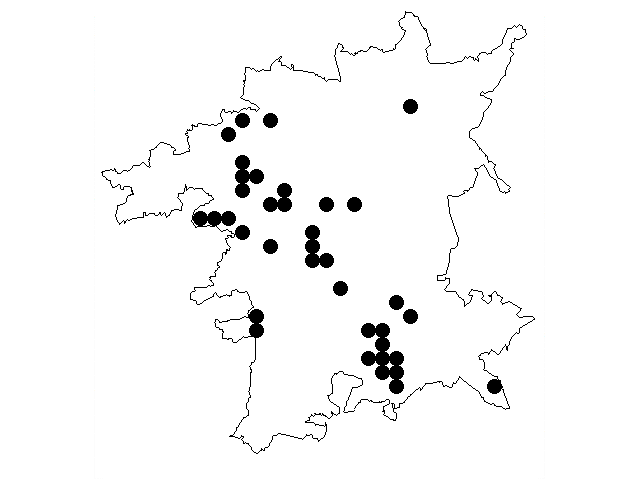
Map above shows tetrad distribution of Dr.Seward’s records:
An impression of the trends and level of botanical activity can be gleaned from the rate of production of botanical publications. The trends in botanical publication reflect fashions within botanical recording and also broader sociological changes within Britain. The situation in Worcestershire presents a microcosm for trends in British botanical recording. For an overview see David Allen’s Naturalists in Britain.
Number of Botanical Publications 1500 – 1950
1500-1950 Publications per half century
| 1500-1599 | 1 | [First botanic reference 1549 Leland’s Itinery but record in Gloucs.] |
| 1600-1649 | 2 | |
| 1650-1699 | 6 | |
| 1700-1750 | 4 | |
| 1750-1799 | 22 | |
| 1800-1849 | 106 | |
| 1850-1899 | 255 | |
| 1900-1950 | 81 |
1750-1930 Publications per decade
| 1750-1759 | 1 | |
| 1760-1769 | 2 | |
| 1770-1779 | 5 | Nash (First County List); Withering |
| 1780-1789 | 6 | |
| 1790-1799 | 8 | |
| 1800-1809 | 5 | |
| 1810-1819 | 7 | Purton’s Regional Flora of Midlands; Pitt Agriculture of Worcestershire |
| 1820-1829 | 17 | Lees’ first publication 1828 |
| 1830-1839 | 31 | Scott’s local flora of Stourbridge area |
| 1840-1849 | 46 | Lees district flora of Malvern Hills; Worcs.Nat.Club (formation); New’s local flora of Evesham area |
| 1850-1859 | 65 | Lees district flora of Malvern Hills; Baxter’s local flora of Worcester area. |
| 1860-1869 | 36 | Lees Flora of Worcestershire; Lees district flora of Malvern Hills; Mathews local flora of Clent area; Jorden’s local flora of Bewdley / Wyre Forest |
| 1870-1879 | 33 | |
| 1880-1889 | 70 | Mathews’ local flora of Clent and Lickey; Mathews History of Worcestershire Botany |
| 1890-1899 | 51 | Towndrow flora of Malvern district |
| 1900-1909 | 49 | Amphlett full county list, Amphlett & Rea Flora of Worcestershire |
| 1910-1919 | 17 | Humphreys Flora of East Worcestershire |
| 1920-1929 | 9 | Rea’s Appendix to Flora of Worcestershire |
Quantity of Records generated from Literature
Novel Literature Records Cumulative Total
| 1400 -1699 | 16 |
| 1400 -1750 | 18 |
| 1400 -1799 | 300 |
| 1400 -1825 | 824 |
| 1400 -1850 | 4374 |
| 1400 -1875 | 12755 |
| there are many repetitions in the literature (each major publication reviews its predecessors) | |
| individual records can have up to eight separate literature references. These are counted only once. | |
| the totals include site / species repetitions, when date or recorder is novel. For instance, Lepidium draba, Hoary Pennycress has 10 separate references by Lees from the roadside by Powick Bridge | |
| it is estimated that throughout literature 1400-1875 there is a likely maximum of 5000 un-extracted records, the majority of these will give new date classes only |
The number of records is surprisingly small. Especially so when set against the amount of field work undertaken. The early workers were pioneers of discovery, Lees spent much of his life plant hunting. They were highly selective in the record they left, with an emphasis on the rare and unusual. The quality of the record is high. Textual help at the time was sparse, no Plant Crib or Stace, so there was both a necessity for and a reliance on specimen based recording. The vast majority of old records (outside the critical groups) are reliable.
Distribution of Records / Geographical Coverage of the County
The patterns of accumulation of records are interesting.
There is a strong correlation between home-base and density of dots. Where the pattern is fragmented it should not be presumed there was no recording. In moving between dots, before motorised transport, botanists covered vastly more ground than they left records for. The tetrad maps are useful in identifying the range of botanical activities. The clustering on the monad maps indicate well worked areas, often around a favoured locality or home-base.
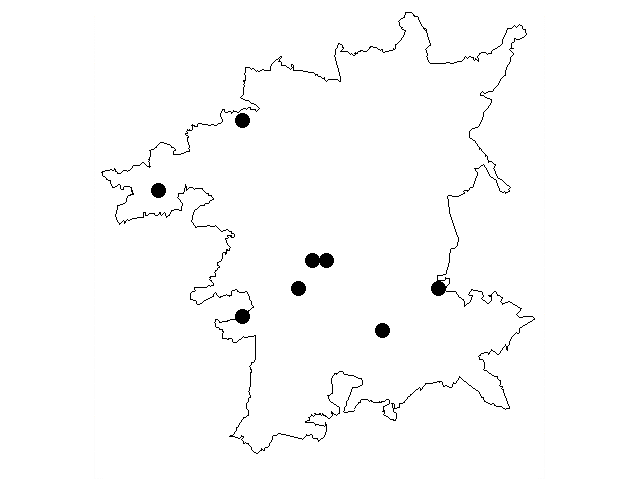
Map above shows All Records 1400-1750 (tetrads)
TO INSERT MAP
Map above shows All Records 1400-1799 (tetrads)
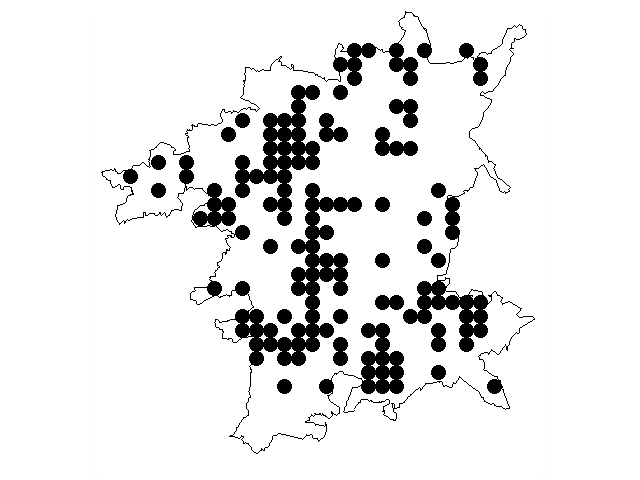
Map above shows All Records 1400-1825 (tetrads)
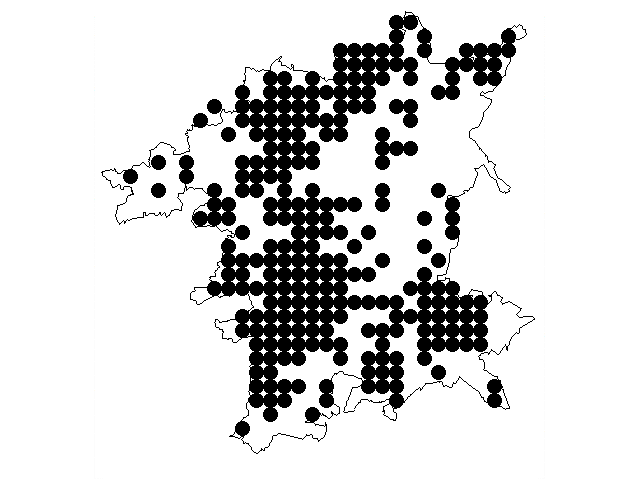
Map above shows All Records 1400-1850 (tetrads)
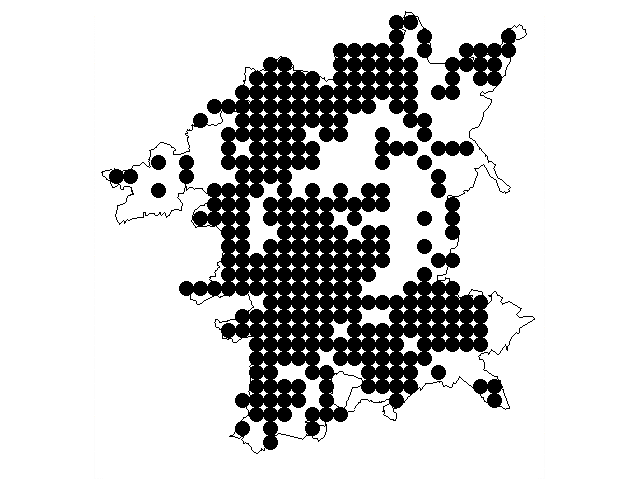
Map above shows all Records 1400-1875 (tetrads)
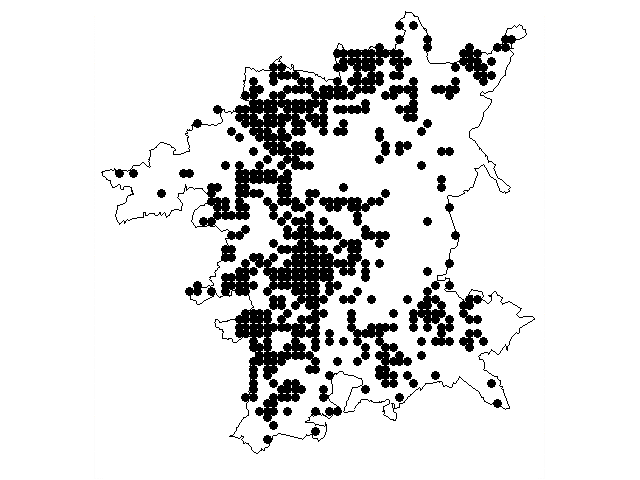
Map above shows all Records 1400-1875 (monads).
The gaps in distribution highlight areas of least activity. These can be deceptive. For instance, the Teme and Kyre Brook valleys indicate little recording. They were undoubtedly not as thoroughly covered as elsewhere but the records include several very rare species, Fly Orchid and Mezereum. To hunt these down, quite a lot of fieldwork would have been necessary. Most records come from incumbent priests. We can presume a good deal of fieldwork was undertaken but only a trace of this remains in the botanical record. The gap immediately around Redditch is largely filled with records from the Bagnall’s Flora of Warwickshire, 1891. The gap in the Wythall / Beoley area remains largely unfilled until the 1970s. It would seem that it was, in part, entirely unvisited. The major surprises are the lack of records from the triangle between Bromsgrove, Droitwich and Kidderminster and in the east beyond Upton Snodsbury and around Inkberrow. Were these areas worked and nothing found or were they neglected? Interestingly, these areas have been proved some of the least diverse during recording for Worcestershire Flora Project (WFP Newsletters).
The Early Records 1780-1830
This was a period of considerable change in the English countryside. It was the time of agricultural “improvements” and widespread enclosures. The botanical records allow a glimpse of the pre-improvement landscape. There is frequent reference to lost and diminishing sites. Once entered onto the database, the records can be viewed and grouped in a variety of ways to aid interpretation. During the period, each new major publication, seemed to generate a series of local correspondents :-
The Stokes / Withering partnership received records from Mr.Ballard, a surgeon of Hanley Castle, who provided records from the pre-enclosed Malvern Chase. His lists give a bog component to the flora. This had been lost by the time Lees worked the district in the 1820s-1830s.
Mr.Ballard : Records Malvern Chase 1780s / 90s
Total 61 records
| Acorus calamus | Sweet-flag |
| Anthyllis vulneraria | Kidney Vetch |
| Apium inundatum | Lesser Marshwort |
| Aquilegia vulgaris | Columbine |
| Blackstonia perfoliata | Yellow-wort |
| Butomus umbellatus | Flowering Rush |
| Carex disticha | Brown Sedge |
| Carex pulicaris | Flea Sedge |
| Ceratocapnos claviculata | Climbing Corydalis |
| Chrysosplenium alternifolium | Alternate-leaved Golden-saxifrage |
| Cirsium dissectum | Meadow Thistle |
| Cirsium eriophorum | Woolly Thistle |
| Colchicum autumnale | Meadow Saffron |
| Dipsacus pilosus | Small Teasel |
| Drosera rotundifolia | Round-leaved Sundew |
| Epipactis palustris | Marsh Helleborine |
| Erica tetralix | Cross-leaved Heath |
| Filipendula vulgaris | Dropwort |
| Helleborus viridis | Green Hellebore |
| Lathyrus latifolius | Broad-leaved Everlasting-pea |
| Luzula sylvatica | Great Wood-rush |
| Lysimachia vulgaris | Yellow Loosestrife |
| Mentha pulegium | Pennyroyal |
| Minuartia hybrida | Fine-leaved Sandwort |
| Misopates orontium | Weasel’s-snout |
| Myosurus minimus | Mousetail |
| Myrrhis odorata | Sweet Cicely |
| Nardus stricta | Mat-grass |
| Oenanthe aquatica | Fine-leaved Water-dropwort |
| Orobanche rapum-genistae | Greater Broomrape |
| Paris quadrifolia | Herb Paris |
| Persicaria bistorta | Common Bistort |
| Petrorhagia prolifera | Proliferous Pink |
| Pimpinella major | Greater Burnet-saxifrage |
| Pinguicula vulgaris | Common Butterwort |
| Potentilla argentea | Hoary Cinquefoil |
| Ranunculus lingua | Greater Spearwort |
| Ranunculus parviflorus | Small-flowered Buttercup |
| Rumex hydrolapathum | Water Dock |
| Rumex maritimus | Golden Dock |
| Sambucus ebulus | Dwarf Elder |
| Samolus valerandi | Brookweed |
| Sedum rupestre | Reflexed Stonecrop |
| Sedum telephium | Orpine |
| Umbilicus rupestris | Navelwort |
| Vaccinium myrtillus | Bilberry |
| Viburnum lantana | Wayfaring-tree |
Thomas Purton was a doctor of medicine who lived at Alcester. He produced the first full regional flora of the Midlands in 1817 (only the rarer species are localised). Purton’s own records show he had extensive knowledge of Worcestershire.
It is well known that it is only through Purton’ s records that the botanical riches and lost fen communities of Feckenham Bog are known (the site had been destroyed when Lees visited 20-30 years later). But his records also indicate a little known acidic heath and bog community at Astwood Bank.
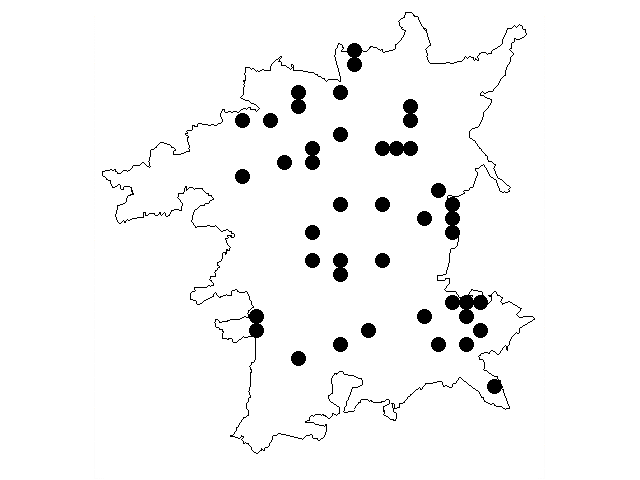
Map above shows Purton’s records (tetrads)
Thomas Purton : Site Lists for Hectad SP06, records published 1817-1821
| Astwood Bank | Carlina vulgaris |
| Astwood Bank | Linum usitatissimum |
| Astwood Bank | Salix aurita |
| Astwood Bank | Salix purpurea |
| Astwood Bank | Veronica officinalis |
| Astwood Common | Agrostis capillaris |
| Astwood Common | Erica tetralix |
| Astwood Common | Hydrocotyle vulgaris |
| Astwood Common | Radiola linoides |
| Astwood Common | Senecio sylvaticus |
| Astwood Common | Trifolium micranthum |
| Astwood Common | Ulex gallii |
| Astwood Common | Vulpia bromoides |
| Cookhill Parish | Galanthus nivalis |
| Evesham Road Headless Cross | Plantago coronopus |
| Feckenham Bog | Anagallis tenella |
| Feckenham Bog | Baldellia ranunculoides |
| Feckenham Bog | Carex distans |
| Feckenham Bog | Carex pulicaris |
| Feckenham Bog | Chara tomentosa |
| Feckenham Bog | Cirsium dissectum |
| Feckenham Bog | Cladium mariscus |
| Feckenham Bog | Epilobium palustre |
| Feckenham Bog | Equisetum palustre |
| Feckenham Bog | Galium uliginosum |
| Feckenham Bog | Hydrocotyle vulgaris |
| Feckenham Bog | Lemna trisulca |
| Feckenham Bog | Parnassia palustris |
| Feckenham Bog | Pinguicula vulgaris |
| Feckenham Bog | Schoenus nigricans |
| Feckenham Bog | Triglochin palustre |
| Feckenham Bog | Zannichellia palustris |
| Ipsley Parish | Carpinus betulus |
| River Arrow in VC38 | Campanula latifolia |
| River Arrow in VC38 | Oenothera biennis |
| Washford | Mycelis muralis |
| Washford | Sparganium emersum |
One of his early correspondents was the Rev.W.S.Rufford of Badsey. His records provide a wealth of detail on the species and communities in the Vale of Evesham. The list is in many respects stunning. There would be no inkling of this assemblage, particularily the halophytes and arable weed spectrum, without Rufford’s work. W.Cheshire visted the Badsey area in the 1850’s, in an attempt to relocate rarities, but reported little of interest amidst an improved landscape and deeply dug drains.
Rev.W.S.Rufford : Records published 1871-1821 mainly, S.E.Worcs, especially, Badsey and Littleton area
Total 30 records
| Acorus calamus | Sweet-flag |
| Asperula cynanchica | Squinancywort |
| Bolboschoenus maritimus | Sea Club-rush |
| Carex dioica | Dioecious Sedge |
| Cerastium arvense | Field Mouse-ear |
| Ceterach officinarum | Rustyback |
| Chaenorhinum minus | Small Toadflax |
| Chamaemelum nobile | Chamomile |
| Erigeron acer | Blue Fleabane |
| Festuca pratensis x Lolium perenne | |
| Geranium phaeum | Dusky Crane’s-bill |
| Helictotrichon pratense | Meadow Oat-grass |
| Koeleria macrantha | Crested Hair-grass |
| Limosella aquatica | Mudwort |
| Linaria vulgaris | Common Toadflax |
| Lythrum hyssopifolia | Grass-poly |
| Myosotis discolor | Changing Forget-me-not |
| Oenanthe aquatica | Fine-leaved Water-dropwort |
| Ophrys apifera | Bee Orchid |
| Pseudofumaria lutea | Yellow Corydalis |
| Pyrola minor | Common Wintergreen |
| Rorippa sylvestris | Creeping Yellow-cress |
| Sagina nodosa | Knotted Pearlwort |
| Sedum dasyphyllum | Thick-leaved Stonecrop |
| Senecio viscosus | Sticky Groundsel |
| Spergularia marina | Lesser Sea-spurrey |
| Verbascum virgatum | Twiggy Mullein |
| Vicia sylvatica | Wood Vetch |
Purton’s Midland Flora was a success. It generated so many new records that an Appendix was issued in 1821. Two of the contributors of Worcestershire records were a Mrs.Gardener and a Mr.Hickman, who both produced records from the Abberley area. Mr.Hickman was a Ludlow man but little is currently, known of Mrs.Gardener. Botany was by and large a male preserve in the nineteenth century (the Naturalists’ Clubs were generally all male affairs). So Mrs.Gardener is not only the first woman to make a contribution to the botanical record, but one of less than half a dozen female names to appear in the whole of the nineteenth century. Her 19 records indicate a good botanical eye, a serious knowledge of plants and tell of considerable time spent in the field. It can be presumed that Purton vouched their records, in most cases with specimens. It is highly probable their lists were much longer and that Purton cherry-picked the records.
Mr.Hickman : Records published 1821 Stourport / Abberley area
Total 17 records
| Aquilegia vulgaris | Columbine |
| Brassica napus | Rape |
| Campanula latifolia | Giant Bellflower |
| Campanula patula | Spreading Bellflower |
| Cardamine amara | Large Bitter-cress |
| Convallaria majalis | Lily of the Valley |
| Corydalis solida | Bird-in-a-bush |
| Galanthus nivalis | Snowdrop |
| Geum rivale | Water Avens |
| Helleborus foetidus | Stinking Hellebore |
| Lathyrus aphaca | Yellow Vetchling |
| Menyanthes trifoliata | Bogbean |
| Scutellaria minor | Lesser Skullcap |
| Stellaria palustris | Marsh Stitchwort |
| Thlaspi arvense | Field Penny-cress |
Mrs.Gardener : Records published 1821 Shrawley / Abberley area
Total 19 records
| Butomus umbellatus | Flowering Rush |
| Campanula latifolia | Giant Bellflower |
| Campanula patula | Spreading Bellflower |
| Cardamine amara | Large Bitter-cress |
| Cardamine impatiens | Narrow-leaved Bitter-cress |
| Cephalanthera longifolia | Narrow-leaved Helleborine |
| Dianthus deltoides | Maiden Pink |
| Gentianella amarella | Autumn Gentian |
| Helleborus foetidus | Stinking Hellebore |
| Helleborus viridis | Green Hellebore |
| Lathraea squamaria | Toothwort |
| Lathyrus nissolia | Grass Vetchling |
| Lysimachia vulgaris | Yellow Loosestrife |
| Misopates orontium | Weasel’s-snout |
| Monotropa hypopitys | Yellow Bird’s-nest |
| Ophrys apifera | Bee Orchid |
| Orchis ustulata | Burnt Orchid |
| Potentilla palustris | Marsh Cinquefoil |
| Silene gallica | Small-flowered Catchfly |
Habitat Lists
The first community list for Worcestershire was a surprise find. Tucked away in Pitt’s General Survey of the Agriculture of Worcestershire, 1813, is a plant list (mainly grasses), by W.Marshall, agricultural advisor, concerning the flood plain meadows of the Severn and Avon vales, from 1805. This contains first county records and has been overlooked by previous researchers. If Lees specific references from this habitat are added, a very creditable community description is provided.
Ham Meadows of the Severn and Avon Valleys
William Marshall, 1805, in W.Pitt’s General Survey of the Agriculture of Worcestershire :-
Agrostis capillaris
Agrostis stolonifera
Alopecurus geniculatus
Alopecurus pratensis
Anthoxanthum odoratum
Briza media
Bromus hordeaceus
Carex sp.
Cynosurus cristatus
Dactylis glomerata
Festuca arundinacea
Glyceria fluitans
Holcus lanatus
Hordeum secalinum
Lathyrus pratensis
Lolium perenne
Lotus corniculatus
Phleum pratense sens.lat
Poa sp.
Ranunculus repens
Sanguisorba officinalis
Trifolium dubium
Trifolium pratense
Trifolium repens
Edwin Lees 1867 Botany of Worcestershire :-
Cardamine pratensis
Colchicum autumnale
Oenanthe pimpinelloides
Oenanthe silaifolia
Phleum pratense sens.str.
Ranunculus acris
Taraxacum sp.
Other Avenues of Exploration
Sources beyond the botanical literature
These remain to be extracted in detail. They include :-
Primary sources – in Herbaria
Nineteenth century botany was based on specimens – originally there must have existed several hundred thousand herbaria specimens for Worcestershire. Most of this is now lost but the herbaria of the most prominent Worcestershire botanists are often still extant, although scattered through the nation’s museums. Worcester Museum still houses an exceptionally important but not easily utilisable collection . It is likely that the surviving herbarium element will surpass the literature records by five or even ten times. This source is as yet largely untapped. It may be impractical to incorporate until national and local collections are fully catalogued and made available through databases. This source produces a wealth of novel, often site-based records, wherever a new collection is explored.
Horticultural Sources
Archeological Sources, this is in part firm and datable, specimen-based evidence
Other Scientific Disciplines, e.g. quaternary studies
Manuscripts
| letters | |
| botanists own books |
Paintings and drawings – landscapes, plants (Miss Moseley, the second woman to contribute records in Worcestershire, produced paintings of British plants, which are now housed in the British Museum)
Historical Records from other written sources.
These have generally, been poorly exploited by botanists yet they offer a potentially rich vein of records. For certain types of information this may be the best or indeed only source. This is the case with some species and for those who are interested in landscape ecology. Care is necessary with regard to taxonomy but this should not be viewed as an impediment, it is surmountable. There has been no systematic attempt to extract this data yet. A few examples are given.
Roman
The written record, apparently, begins for Worcestershire with Roman Sources. For instance, the River Severn is referred to by Tacitus c115 AD.
Anglo-Saxon
The natural history literature begins in earnest with the Anglo-Saxons. For Worcestershire, the primary colonisation appears to have been around 570-590. The two principal sources, for local detail come from Anglo-Saxon Charters and place-name evidence.
The Anglo-Saxon Charters are in effect land deeds. Their value to the natural historian lies in their detailed description of the bounds of land. These are precisely located and hold a wealth of biological detail.
Areas of interest to the natural historian include details on :
| species | |
| habitats / communities | |
| land use / management | |
| change |
Worcestershire has many charters. This is, primarily, due to the careful stewardship of the Bishopric exercised by St.Wulstan, the last Anglo-Saxon Bishop in England, in the eleventh century. This wealth of material has attracted Anglo-Saxon scholars throughout the modern historical period. Worcestershire is fortunate as most Charters have been solved and have a modern translation (see for instance Finberg, Sawyer, Hooke, Jones). The work of Della Hooke is highly recommended.
To illustrate the detail, information is presented from a single parish, Wichenford.
Wichenford : Species Data from the Anglo-Saxon Charters (extracted from Hooke, D. 1990)
Flora
The numeric references are the suggested date of the original charters. Monad locations are given, although six-figure grid references could be given in many cases.
Sedge – Carex sp. 757; 786; SO7756
Thorn – Crataegus sp. 757; 786; SO7556
{Ship Oak – Quercus sp.{notable veteran tree} 757; SO7960
{Rough Barked Oak – Quercus sp. {probably the Ship Oak of 757}816; SO7960
Great Aspen – Populus tremula {notable veteran tree}757; SO7960
Woad Land – Isatis tinctoria {Landuse; Great Aspen gone, boundary marked by cultivated field of woad} 816; SO7960; [Change 757-816]
Reed – likely Phalaris arundinacea (possible Phragmites australis) 757; SO7960
{Five Oaks – Quercus sp. {notable grove of veteran trees}757; 969 [Stability]; SO7862
{the bent-down oak – Quercus sp. {notable veteran tree at Five Oaks}1042; SO7862 [Change 969 -1042]
Three Oaks – Quercus sp. {notable group, likely veteran trees}816; SO7857
Bealda’s Ash-tree – Fraxinus excelsior{notable, likely, veteran tree}816; SO8058
Fern pasture – Pteridium aquilinum {landuse – common – likely wood pasture} 855; SO7961
Fern hedge – Pteridium aquilinum 969; SO7961
Fauna
hart bourne = Stag – Red Deer Brook 962
hawk ridge ?Buteo / Accipiter 962
king’s swine 855
baerbroc = Baer Brook [Feeding ground for swine in woodland] = Ockeridge 962
Cat’s Piece = Wild Cat Wood 816
Foxbatch = Fox Brook 786
Laughern = poss. Celtic name for Fox 757
wolf-pit = Canis lupus 786 [Pit for capture and slaughter of wolves]
The following notes are taken from the Anglo-Saxon Charters; these extend over a c300 year period. They relate to a 1.5km. length close-by the bounds of Ockeridge Wood and illustrate the wealth of detail available.
851 to sihtferd [tributary of Grimley Brook now Grimley Brook]
962 to (the) sihtford [tributary of Grimley Brook now Grimley Brook]
969 to (the) sihtford [tributary of Grimley Brook now Grimley Brook]
1017 to (the) sihtfyrp [tributary of Grimley Brook now Grimley Brook]
1042 to (the) sihtfyrd [tributary of Grimley Brook now Grimley Brook]
962 to (the) baerbroc {name of tributary broc = brook, baer may = baer pature esp. in woodland, a feeding ground for swine}
851 and thence from the old stud-fold by (the) Bentley people’s boundary {ley ending denotes cleared woodland}
855 right to exclusion of king’s pigs
969 from (the) sihtford to (the) fern hedge
962 to the old dyke
1017 to the old ?linear clearing
1042 to the old ?linear clearing
757 to the way which is called five oaks
969 from (the) fern hedge to (the) Yard Way
851 to King’s Old Enclosure – so thus along the king’s old enclosure northwards
851 to the old stud-fold {?within the King’s enclosure}
757 straight on to the same five oaks
969 from (the) Yard Way to (the) five oak trees
851 to King’s Old Enclosure – so thus along the king’s old enclosure northwards
851 by the boundary of the people of Moseley over Sihtferd {Grimley Brook}
962 along dyke to hart bourne {hiort = hart ie deer brook} – deer in landscape
962 along below hart bourne to hawk ridge {= Ockeridge}
1042 along the ?linear clearing to the bent-down oak
1042 from the bent-down oak again to the old ?linear clearing
1042 along the ?linear clearing to (the) three boundaries
757 to the three boundaries
969 from (the) five oak trees to (the) three boundaries
1017 along the ?linear clearing to (the) three boundaries
975 From (the) three boundaries due west to the dyke
1017 from the three boundaries to the old dyke
757 from that place by a straight westerly way to that dyke
1042 from (the) three boundaries to the doferic [Shrawley Brook]
[1086 DB Hay -enclosure for capturing wild deer]
Worcestershire Anglo-Saxon Charters other Botanical References
Principal reference. Hooke, D. 1990 Worcestershire Anglo-Saxon Charter Bounds
rush Juncus sp.
apple Malus sp.
willow Salix ?fragilis / alba
withy Salix ?viminalis / purpurea / cinerea / caprea
alder Alnus glutinosa
barley Hordeum sp.
birch Betula sp.
broom Cytisus scoparius
water-cress Rorippa nasturtium-aquaticum agg.
yew Taxus baccata
hazel Corylus avellena
heather Calluna / Erica
heathy Vaccinium / Calluna / Erica
coarse grass ?Deschampsia cespitosa
nut-tree ?Juglans regia
holly Ilex aquilifolium
wheat Triticum sp.
hop Humulus lupulus
ivy Hedera helix
flax Linum usitatissimum
spindle Euonymus europaeus
maple Acer campestre
moss / bog Sphagnum sp.
plum Prunus sp.
pease Vicia sp [Pisum sp.]
rye Secale cerale
thistle Cirsium sp.
service Sorbus torminalis [sole English refn. Stoke Prior (Rackham,O.)]
Place name evidence
Refn. ; Mawer, A. & Stenton, F.M. Place Names of Worestershire,1927
Other species occur solely in place names
bent Agrostis capillaris (Bentley in Holt)
lime Tilia sp. (locally frequent e.g. Lineholt, Lincomb)
Medieval Sources – Doomsday Book
The Doomsday Book 1086 provides a wealth of detail on land use, population and the rural economy. It is a very rich source for landscape historians but is poor in species information. Faunal references are very scarce. Fisheries and eels get several mentions. There is reference to a Hay – an enclosure for catching Wild (Red) Deer at Bentley, Holt. Floral references are even rarer. There is a sole enigmatic entry, considered unique, within the whole of the Doomsday Survey (VCH) – “at Lawern there are 12 oaks”.[This grouping of twelve, 11th.C, oaks are 4km. from the group of three, 9th.C oaks and 7km. from the group of five, 8th-10th.C oaks (see above). A pattern begins to emerge. The Anglo-Saxons called this district, in 816, Weogorena-leage, the wood pasture lands of the Vigorna. The Vigorna were the tribe that gave their name to the county of Worcestershire.]
Other Information available within Historical Record
Veteran Trees
The botanical literature is reasonable. Edwin Lees took a keen interest in veteran trees as individual specimens. He left a record of 150-200, many measured. County topographies, histories and folk-lore mention specimen and venerated trees. These are added to the database as they come to light e.g. Prince Robins Tree, a hawthorn, in Powick Parish and still extant in the nineteenth century, under which Prince Rupert was said to have stood to survey the enemy’s disposition, before he attacked at the first Battle of Worcester, in 1642.
The Anglo-Saxon charters are also a rich source (yet to be extracted).
A total of 226 veteran and specimen trees from the period 1600-1899 have been entered:-
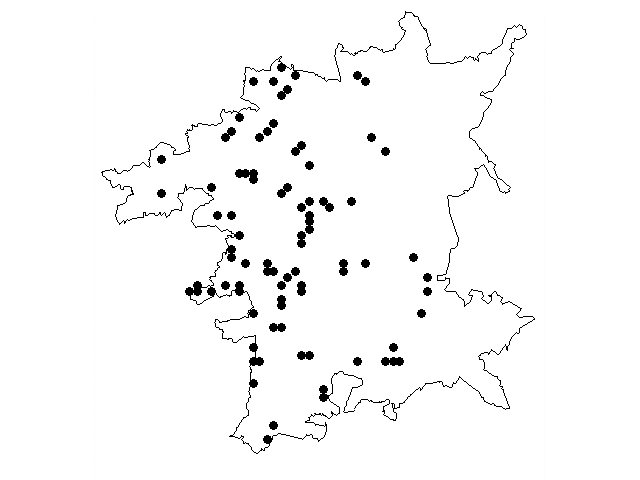
Map above shows location of records of veteran trees (monads)
Species Information
Pear, Pyrus communis s.l.
The pear, arguably, encapsulates the local distinctiveness of Worcestershire to a greater degree than any other species. Yet the botanical literature deals poorly with the subject. To capture its influence upon and presence within the county, it is necessary to look outside of the botanical literature.
Old pear trees are a distinctive and regenerating element, within Worcestershire hedgerows. There is the possibility of a locally native Pyrus. However, millennia of selection, tending and planting, will have obscured the original situation. Pear certainly behaves as a native on the county’s gravel soils. It regenerates quite freely and is fully able to compete with native species.
The pear was established by the Anglo-Saxon period. This indicates a, likely, stocked landscape in the Romano-British period. Bronze Age exploitation of the pear in Worcestershire is quite likely.
Pears – pirige, pyrige are mentioned as boundary marks in the Anglo-Saxon charters. It’s early importance to the county can be gleaned from its adoption by the Anglo-Saxon bishops of Worcester as a symbol for their standard. The medieval Florence of Worcester relates of St.Wulstans pear emblazoned banner. By the seventeenth century there is the testimony of Nathaniel Wharton. He was a Londoner, and a serving NCO in Essex’s Army (Parliament). He wrote a letter home, in September 1642 from Worcestershire. The most striking feature of the landscape was :- “every hedge and highway beset with fruit especially pears”
Pitt in his General Survey of the Agriculture of Worcestershire, 1813, highlights the importance of fruit growing in Worcestershire. Its relative value to the agricultural economy can be gauged from the space devoted to it. He gives 38 pages to Gardens and Orchards, this is second in length only to Arable (77 pages) and ahead of Livestock (37 pages) and Grasslands (9 pages).
“the pear loves sloping ground (Withering), in such situations it will flourish in cold clay (Marshall)”, this quote from Pitt neatly summarises the prevalence of pear in the Worcestershire countryside.
Detailing the situation in the hit year (bumper crop) of 1784, Pitt describes a situation where the pear and perry is a commonplace and locally abundant feature of the county landscape, “for want of casks, …. the liquor was spoilt: in Pershore, the juice is said to have run from the pear-hoards, in currents, into the common sewers”.
Pears were widespread and abundant. Most farms, villages and many cottagers had orchards. Further confirmation of their significance can be inferred from Tithe name evidence, c.1830s. For instance, Wichenford Parish has seven references in field names to pear and a single mention of apple (and that, solely, to a special variety “Codling”).
According to Pitt, pears were capable of producing twice as much liquor as apples from the same land. It was thus favoured as the common drink. Perry must have been a significant part of the calorific intake of the county’s agricultural labourers. Pears have helped fuel the rural economy of the county for probably a millennium and possibly much longer.
References
A full list of references has not been included with this article due to pressures of time and space. Various sources have been detailed in the text. For further information please contact the author.
Worcestershire Record No. 14 April 2003 p. 10
DATES OF THE FIRST CUCKOO IN SPRING 1916-2003
Harry Green
We reported in Worcestershire Record No 11 November 2001 the remarkable series of cuckoo first-dates records collected Moorgate Road, Stoke Prior by the Honeybourne family since 1916. Recording has continued since our last report and Dorothy Honeybourne phoned recently to give me the more recent dates which are:
2001 30 April
2002 1 May
2003 6 May
Generally cuckoos were heard in Worcestershire about two weeks before the 2002 dates. However the numbers of cuckoos in the county are now much reduced so the likelihood of recording the first Worcestershire cuckoo in any year at Moorgate Road is low! Nevertheless Dorothy and Margaret Honeybourne had their front door open for during much of the warm and sunny weather during April.
Worcestershire Record No. 14 April 2003 p. 18-19
THE NOBLE CHAFER GNORIMUS NOBILIS– RECORDS WANTED
Harry Green
We have made several appeals for records of sightings of this uncommon and interesting beetle as part of a national effort to discover its true status and to take steps for ensuring its conservation. The content of this article is based on the previous articles (see reference list) with some additional information.
The Noble Chafer Gnorimus nobilis is a nationally scarce species of beetle listed as Red Data Book 2. In recent times it has been recorded in Worcestershire in 1985 and 1986 where it was found on Hogweed at Tiddesley Wood near Pershore. It was recorded from the Defford area in the 1980’s and Monkwood and Tiddesley Wood again in 1998. Kevin McGee found it at Drakes Broughton in 2000 and evidence of its presence has been seen at another site in SE Worcestershire and two sites in the Teme valley. It is also known to occur in the Wyre Forest where Paul Whitehead has carried out a number of surveys, and there are old reports form Bewdley and Broadheath in the 1940s.
Worcestershire and Gloucestershire breeding sites have been located in old orchards. Following the discovery of these sites methods of recognising the trees favoured by the beetle and for distinguishing the larvae from other species have been devised. The People’s Trust for Endangered Species is leading national action related to a Biodiversity Action Plan to conserve this endangered species and is funding further survey work. It now seem likely that the main national distribution lies in and around Gloucestershire, Worcestershire and Herefordshire.
One important type of breeding site is within the rotting contents of old fruit tree trunks – traces have been found in trees in plum, apple and cherry orchards and the beetle seem to have a particular liking for old plum trees. Eggs are laid therein and the larvae develop in the rotting wood for 2-3 years. After pupation the emergent beetles may mate and remain inside the tree. When the beetles do fly they have been recorded visiting flowers of hogweed, angelica and meadow sweet.
The beetle is basically green and the Rose Chafer Cetonia aurata is superficially similar. The main differences are that the Noble Chafer has longer and thinner legs with the middle and hind legs smooth on the shins, but toothed on the Rose Chafer. There are very small white spots on the thorax of Noble Chafer. The wing cases of the Noble Chafer are much wrinklier and there are differences in the shape of the thorax. The small triangular area between the wing-cases where they join the thorax (the scutellum) is an equilateral triangle in Noble Chafer, but elongated in Rose Chafer. Both beetles vary in colour, from metallic apple green, through blue and emerald green to deep bronze green.
A national focus group co-ordinated by the Peoples Trust for Endangered Species, is working on discovering more about the distribution and ecology of the species. Undoubtedly old mature orchards are important and there could be a link between ancient forests such as Wyre and the Forest of Dean and the orchards adjacent to them.
Any Worcestershire records are invaluable to finding out more about their ecology and so helping to conserve this attractive beetle species. Enclosed in this edition of Worcestershire Record is a postcard to remind you to look out for them this summer.
The beetle may well occur anywhere in Worcestershire and we particularly ask anyone who is near old orchards to keep a lookout and let us know immediately if you think you have seen the species. Also if you have news of old orchards being cleared we should like to know as soon as possible. If larvae are found in the trees is may be possible to rear them for later release. Please phone Steve Bloomfield at Worcestershire Wildlife Trust office 01905 754919 or contact the writer zen130501@zen.co.uk
Figure 1. Rose chafer Cetonia aurata LEFT, Noble Chafer Gnorimus nobilis RIGHT
References
JONES J 2000 Worcestershire Record 8:11
McGEE K 2000 Worcestershire Record 9:25
GREEN GH 2001 Worcestershire Record 11:7
Worcestershire Record No. 14 April 2003 p. 19
VOLUCELLA INANIS REACHES WORCESTERSHIRE
Harry Green, Kevin McGee & Brett Westwood
The following note appeared in the Hoverfly Newsletter, Spring 2003.
While looking for hoverflies in Tiddesley Wood, near Pershore, Worestershire, on 4th August 2002 HG & BW were fortunate to see one Volucella inanis visiting to ragwort flowers growing by the side of woodland rides near the centre of the wood (SO930454). Despite further searches no others were seen until KM caught a female visiting Devil’s-bit scabious flowers on 1st September (SO930455) and HG caught another female on 4th September (SO929458). As far as we know these are the first records for modern Worcestershire and, according to David Iliff (Gloucestershire Hoverfly recorder and editor of the Hoverfly Newsletter), the first for the 100 km square SO. Elsewhere in the old vice-county of Worcestershire (VC37) Mike Bloxham has recently reported Volucella inanis from Moseley around SP0881, now firmly in the West Midlands! (Worcestershire Record No 13 November 2002). Meanwhile we wait for Volucella zonariawhich David Iliff tells us has been seen at Buckland, near Broadway, just over the border into Gloucestershire.
Incidentally it is worth noting that Devil’s-bit Scabious has been steadily increasing and spreading along ride sides in Tiddesley Wood in the last few years and the late flowers (which continue into October) are very attractive to many hoverflies (especially Eristalis sp) and other insects
| V. innanis | V. zonaria | |
| Wing Length (mm) | 12.25 – 14.25 | 15.5 – 19.5 |
| Size-appearance | Rather large | Bloody massive! |
| Scutellum | Yellow | Chestnut |
| Tergite 2 | Yellow | Chestnut |
| banding (yellow and black) | Wasp-like | Very hornet-like |
These two species are very big – Gary Farmer’s summary table above sets it out very well! If you do see any very large hoverflies this summer we should like to hear from you. Please take a photograph!
Worcestershire Record No. 14 April 2003 p. 5
WORCESTERSHIRE’S ANCIENT TREE REGISTER
Harry Green & John Tilt
This scheme was launched with the April 2002 number of Worcestershire Record. A course was run in May 2002 to encourage more people to join in recording and another (fully booked!) will be held Saturday 17th May 2003 at Lower Smite Farm.
Those who attended the Worcestershire Wildlife Trust’s Volunteers Conference on 21st September 2002 received great encouragement to record ancient trees through an outstanding lecture by Ted Green and a memorable visit to Elmley Castle Deer Park. Many of us are still reeling from the experience of Ted in full flight!
Records are slowly accumulating in the data base. Very many thanks to all those who have sent in information. We do encourage you to join in and help in recording. There is a lot to do! We can easily send you copies of instructions and recording forms – the latter can be sent and returned via email if you wish. We can also work on minimum information and visit trees ourselves. Please note that we really need accurate eight-figure grid references if at all possible, please. This can be obtained quite easily from the OS Explorer (orange) 1:25000 maps or by GPS. Trying to find a tree again in a 100 m square from a six-figure grid reference is not always easy. Alternatively a photocopy of a map with a dot on it would help!
Amongst recent discoveries are a series of ancient ash trees on the eastern end of Bredon Hill, oaks in Malvern, ancient lime trees in several woods in west Worcestershire, and ash trees in the Teme valley. The Wyre Forest Study Group enjoyed an excellent day (15th February 2003) looking at old trees in that area. These included great oaks at Ribbesford, an enormous sweet chestnut in Bewdley, a surprising black poplar hidden in a dingle valley, some very large maiden oaks just over the border into Staffordshire at Birchen Park, and the stricken Mawley Oak (See Worcestershire Record No 12 April 2002 for details). The owners kindly allowed the Group to look closely at the Mawley Oak and the following notes were made:
Many years ago the tree was fixed with a support hawser and rotting wood in trunk was cut out and the hollow painted with bitumen paint. This seems to have stopped further heart rot. If the tree had been left to go hollow naturally and if some weight had been taken off the tall limbs the tree may have survived and not collapsed. Collapse occurred on a calm day (29th October 2001) presumably because the strength of the trunk was not great enough to support the multiple heavy limbs. Most of the large fallen limbs still lie by the tree. For the tree to continue to survive as a large pollard some of the remaining limbs would best be shortened to take off weight and so prolong life of tree. There is a scar on one fallen limb probably from a lightening strike long ago.
A Ring count made fairly high up on a fallen cut limb about 200. Ring counts on part of the trunk and from 1 cm samples (Group activity!) estimated that the tree’s age was between 400-450 years, which is similar to Brian Stephens’ estimates in Worcestershire Record No12.April 2002. The tree probably started life between 1550 and 1600.
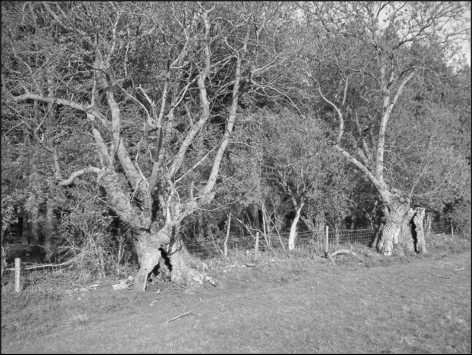 Ancient ash trees near Ashton-under-Hill on Bredon Hill. Photo Roger Umpelby.
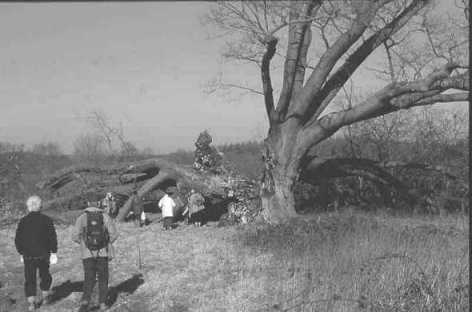 Mawley Oak 15th February 2003, Photo Harry Green.
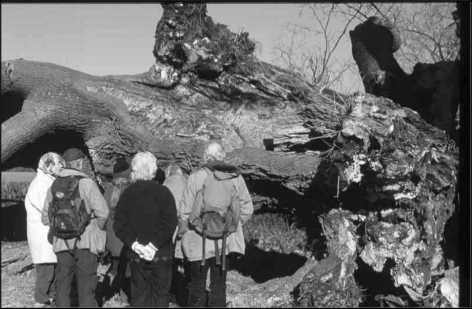 Wyre Forest Study Group meets the Mawley Oak 15th February 2003. Photo G H Green
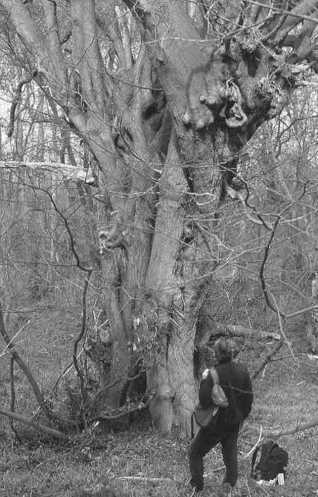 Small-leaved lime near Shelsley Kings. This tree has a 5.4 metres breast height circumference. Photo G H Green
Worcestershire Record No. 14 April 2003 p. 7
CONTINUING THE SEARCH FOR LAND CADDIS ENOICYLA PUSILLA
Harry Green and Brett Westwood
Since our report in Worcestershire Record No 13 November 2002 page 28 we have been able to search several new areas in west Worcestershire and now have records from 150 1×1 km squares. In addition the moth trappers in Wyre Forest have recorded the larvae entering traps on several occasions and have provided accurate location reports from several sites in the Forest and also for Ribbesford Wood. It is not clear why the larvae are entering the moth traps. They may be simply crawling in when the trap is placed on the ground over them or perhaps they are attracted to the light, although the latter seems unlikely. Nevertheless the records are useful and it would be helpful if all moth trappers kept a look out for them and sent us records.
Caddis larvae were also found along the Dick Brook near Joan’s Hole in April. In this case many larvae were found crawling on mosses and dead leaves a few feet above the stream. It is perhaps surprising that they should be found so close to a stream prone to flooding. Perhaps they can survive watery immersion for a while and the stream may transport them to new locations. Land Caddis larvae apparently survive best in leaf litter where the relative humidity is between 70% and 100%. When it is too dry they move downwards through leaf litter and possibly into cracks in the ground to find moister conditions – we discovered that it was very difficult to find them during the very dry spell in April this year. After rain and heavy dew they have been seen to swarm upwards onto brambles or tree trunks and “hang out to dry”, returning to leaf litter as they dry out (Harding 1995). Those seen at Joan’s Hole hay have been drying out after rain.
If anyone finds land caddis please let us know. If you have not seen land caddis before we should like to see your find to check identity. Certain micro-moth cases have occasionally been mistaken for land caddis in the past.
Both Nigel Stone and Rosemary Winnall lave taken to excellent pictures of land caddis recently and are included here – many thanks to you both and apologies because converting them to black and white and then photocopying theem does not do them justice, but it’s the best we can do!.
Reference
HARDING DJL 1995 Land Register for a caddis larva?
 |
 |
|
| Above: Land caddis case with spines on larval head showing on the left. Actual size about6 mm long. Photo Nigel Stone | ||
| Right: Land caddis larval head. Photo Nigel Stone | ||
| Below: Land caddis walking. Photo Nigel Stone | ||
 |
 |
|
| Above: Land Caddis from Joan’s Hole. Photo R. Winnall |
Worcestershire Record No. 14 April 2003 p. 20-22
VC37 (WORCESTERSHIRE) BUTTERFLY TRANSECTS ANNUAL REVIEW 2002
Neil Gregory,
(February 2003)
Introduction
This Annual Review is based on information gathered from the transect walking data within VC37. Data is transferred from paper to the Transect Walker software, which is freely available from Butterfly Conservation’s website (www.butterfly-conservation.org/features/transect_walker/). Individual transects can then be analysed to note trends according to changes in local habitat or fluctuations in species numbers according to yearly cycles. This data is then evaluated in the Butterfly Conservation’s (BC) Regional Co-ordinator software (forming the basis for much of the data which can be found here).
This year we have compared this “Regional data” to the National Indices supplied from the “Butterfly Monitoring Scheme” (BMS). The national indices can be interpreted as indicators of national status, especially where BMS coverage is representative throughout the UK. The regional data, collated by the West Midland Branch of BC is based on 141,416 records since transects began in the region in 1982 of which VC37 has a significant part (32% of all transects ever walked in Gloucs, Herefs, Worcs, Staffs, Shrops and West Mids).
A full version of this document with comparison between Regional and National trends can be found at: www.WestMidlandsButterflyConservation.org.uk .
| Species Accounts Once all the transect data is analysed, we can build a picture of the status of butterflies in the region, which can be compared to recent trends both regionally and nationally by use of an index value. A summary of this can be seen below. Although day-flying moths can be recorded using the butterfly transect method, there is very little data available. It is hoped in the future, more recording will be undertaken of day-flying moths, thus improving our knowledge especially of notable species such as the Drab Looper. Small Skipper (14) – This has only been an average year, but increasing since the low of 1998. The regional data shows close agreement with the national data. In 2002 there were increases at 3 sites, decreases at 5 and 7 showed no change. Essex Skipper (9) – Numbers at 3 sites have increased and 1 showed no change. This species continues to spread and is a good species to look out for in the coming years, although Small and Essex Skipper can be difficult to separate. Large Skipper (16) – This has been an average year with good agreement with the national picture. 4 sites showed an increase, 3 a decrease and 9 showed no change. Dingy Skipper (1) – Data is insufficient to generate a regional index as data comes from 1 site, where no change was observed. The national picture also shows a general downward trend. Grizzled Skipper (1) – This species is recorded from 1 site, which showed no change. This year seems to have been quite a good one nationally with an increase over the previous few years. Wood White (2) – BAP status: Species of Conservation Concern – No national indices available. One site showed an increase this year and 1 showed no change, but seems only to be an average year compared to the previous few years. Brimstone (14) – A gradual decrease in numbers over the last 5 years has been seen. This decline has also been noted in other regions. Foot and Mouth affected the data from 2001. 5 sites increased, 1 decreased and 8 showed no change. Large White (17) – This follows the national picture well year-on-year. This year 8 sites showed an increase, 1 a decrease and 8 showed no change, indicating it to be a good year. Small White (17)- This follows the national picture, and proved to be a relatively poor year with an increase on 5 sites, decrease on 4 and no change on 8. Green-veined White (17) – There is good agreement with the national picture for this variable species, this year being better than last. 8 sites showed an increase and 9 showed no change. Orange-tip (17) – Numbers for his species mostly agree with the national picture. This year was a good year, showing some of the highest figures and a continual general increase after recent decline. Numbers increased in 2 sites, decreased in 2 and showed no change in 13. Green Hairstreak (2) – Data for this species is now limited to only 2 sites, with 1 site loss (though not seen every year) and 2 sites showing no change. The national trend from the BMS shows a general increase over the last 14 years at monitored sites, although the BNM survey highlighted substantial declines in a number of English counties. Brown Hairstreak (1) – BAP status: Species of Conservation Concern. This species is only found at 1 site and no national indices are available, as the species is poorly sampled by transects. It is a relatively stable species, with the most seen this year on transect. In 2002 there was the earliest ever sighting on a transect (15th Aug). Purple Hairstreak (10) – Data is insufficient to generate a regional index. 1 site has lost this species, 3 showed an increase, 1 a decrease and 6 showed no change. The data does show this to be a relatively stable species. White Letter Hairstreak (0) – No national or regional indices available for this butterfly, which is poorly sampled by the transect method. The data shows a general decline over the last 6 years. None were seen on transect at all in 2002! Small Copper (12) – This follows the national indices nicely, showing its showing the cyclical nature of the fluctuations in abundance of this species. At the moment it is in quite a trough. This species has 2 generations per year in the West Midlands, but in the following years it appears to have had a partial 3rd generation: 1990, 1995, 1997, 1998 2001. This mostly correlates to the years with the and higher index values. There were 2 site extinctions, 3 increases, decreases and 4 sites showing no change. Small Blue (1) – BAP status: Species of Conservation Concern – No national or regional indices available. In 2002 there was the earliest ever sighting on a transect (23rd May) as well as the latest ever (20th Aug). This species is only recorded on one transect, which showed no change. Brown Argus (4) – Data is insufficient to generate a regional index. In 2002 there was the earliest ever sighting on a transect (21st May). This species has been lost from one site, numbers decreased at one and showed no change at 3. The regional picture shows a bad year with the 2nd . lowest ever index in the West Midlands. The regional picture does show a good similarity to the national variable trend over previous years. Common Blue (13) – This agrees with the national picture and shows a rising index again this year from the low in 1999. Numbers at 5 sites have increased, decreased at 1 and showed no change at 7, although are still well below the previous highs in 1990 and 1996. Holly Blue (16) – Fluctuations in the regional indices for this cyclical species correspond nicely with the national figures, with a recent low in 2000. There is a rising trend over the past 2 years with increases at 6 sites and no changes at 10. |
White Admiral (7) – This species has again shown another poor year at the 8 sites on which it is recorded. One site showed an increase, 1 a decrease and 5 showed no changes. This is the 4th year in a row to show a decline, roughly in line with the national picture. Red Admiral (14) – This species has populations boosted from migrants, which were poor this year. Only one site showed an increase with 9 showing a decrease and 4 showing no changes this year. This gave the 2nd lowest index ever in the region, whilst a general rise has been seen nationally recently. Painted Lady (12) – In 2002 there was the latest ever sighting on a transect (9th Oct). This species, like other migrants, shows great variability from year to year, with the last major invasion being in 1996. Although the data shows an increase this year on those in the 90s, few were recorded, with 1 site increase, 2 decreases and 9 showing with no changes. Small Tortoiseshell (16) – The regional and national pictures are similar, with a gradual increase over the past 5 years. 5 sites this year showed in increase, 2 showed a decrease and 9 showed no change. Peacock (18) – In 2002 there was the latest ever sighting on a transect (9th Oct). The fluctuations in the regional index are similar to those of the national one. This year was average with 5 site increases, 1 decrease and 12 showing no changes. Comma (16) – This year was average for this species. It closely follows the national picture, with 6 site increases, 5 decreases and 5 showing no changes. Small Pearl-bordered Fritillary (2) – BAP status: Species of Conservation Concern. Data is insufficient to generate a regional index. This species is recorded on only 2 sites, with 1 site showing an increase and 1 showing no change. As in the national picture, it was a good year with rising numbers compared to the low of 1999. However, BC nationally collated data highlights alarming declines from monitoring sites over the last 15 years. The butterfly remains widespread in Scotland, where remarkably it is the 8th most common species! Pearl Bordered Fritillary (2) – BAP status: Priority Species. Data is insufficient to generate a regional index. This species is recorded on only 2 sites, 1 of which showed an increase and the other showed no change this year. Monitoring shows a general increase over the past 4 years and is similar to the national picture. We can be cautiously optimistic for this butterfly, which has undergone a massive UK range contraction in recent decades. High Brown Fritillary (1) – BAP status: Priority Species. Data is insufficient to generate a regional or national index. This species is recorded on only 1 site (Malvern Hills), and continues to show a sad decline despite much conservation effort. Dark Green Fritillary (0) – Data is insufficient to generate a regional index. The species was recorded on no sites this year. It has shown to be in decline since 1997 nationally and 1995 regionally. Silver-washed Fritillary (1) – BAP status: Species of Conservation Concern. This species also continues to show a decline since the peak in 1996, although numbers increased on the 1 site where it is recorded. Marsh Fritillary (1) – BAP status: Priority Species. Data is scarce and insufficient to generate a regional or national index. This was recorded on only 1 site this year, where no substantial change was seen. Speckled Wood (16) – The general increases and decreases in the national indices are reflected in the regional indices, except that the general regional trend shows stability rather than a general rise in recent years. This year has shown an increase in 6 sites, a decrease in 1 site and no change in 9 sites indicating that it was only an average year. Wall (0) – The species was recorded on no sites this year. Nationally, it has declined drastically from the peak in 1989, and there is a similar regional picture. Marbled White (9) – Fluctuations in the regional indices for this species correspond well with those nationally, with a general increase over the past 15 years. This year, numbers have increased at 2 sites, decreased at 4, showed no change at 3 and was lost from 1 site. This year was only average although numbers increasing from the 1989 low. Grayling (1) – Data is insufficient to generate a regional index. This species is located at only 1 site (Malvern Hills), where no apparent change was seen this year compared to last. Its numbers have increased from the lows at the end of the 90s, reflected in the national picture. In 2002 there was the latest ever sighting on a transect (4th Sept). Gatekeeper / Hedge Brown (15) – The fluctuations in the regional Indices for this species correspond well with those of the national indices, except for the greater growth in the end of the 80s. This year though was average showing a slight downward trend, with increases at 1 site, decreases at 5 and 9 sites showing no changes. Meadow Brown (15) – Fluctuations in the regional indices correspond well with those of the national indices with a general decrease over the past 3 years. There is evidence from the indices of an approximately 5-yearly cyclical pattern of increases followed by decreases. Numbers increased on 2 sites, decreased on 8 and showed no change on 5. Ringlet (15) – There is fairly close agreement between the fluctuations in the regional and national indices. The species shows a general regional increase since 1987 with this year having nearly the highest ever. Numbers on 4 sites increased, decreased on 2 and showed no change on 9. In 2002 there was the latest ever transect sighting (12th Sept). Small Heath (3) – This species continues to show decline in the region and corresponds well to the national picture from BMS data. Data recently collated by BC from 388 UK Small Heath transect sites shows a mean annual decline from 1991-2000 of 4.4% per annum. If the trend continues, this would equate to 66% over 25 years, and the species would qualify as a BAP Priority! This year figures for the region showed all 3 sites with no change. |
Transects Walked in 2002
| Transect | Recorder | Started | Principal Habitat | Conservation Status | ||
| Blackminster | Terry Knight | 2000 | Mixed edges | |||
| Briar Hill Droitwich Spa | Neil and Corinna Gregory | 2001 | Mixed edges | Wildlife Trust | ||
| Castlemorton Common | Ian Duncan | 1998 | Marshy grasslands | SSSI | ||
| Chaddesley Wood New | Steve Harper | 1989 | Mixed Woodland | |||
| Cleeve Prior | Terry Knight | 1984 | Broadleaved | LNR | ||
| Grafton Wood | John Tilt | 1998 | Mixed Woodland | SSSI | ||
| Honeybourne | Terry Knight | 1998 | Bare ground | |||
| Knapp and Papermill Reserve | Garth and Pam Lowe | 1984 | Neutral Grassland | SSSI | ||
| Malvern Hills North | Colin Dolding | 1999 | Dry grassland | |||
| Malvern Hills South | Digby Wood | 1987 | Bracken | SSSI | ||
| Melrose Meadow | Ian Duncan | 2001 | Neutral Grassland | SSSI | ||
| Monkwood 1 | Claire Turner | 1986 | Broadleaved | SSSI | ||
| Monkwood 2 | David White | 1996 | Broadleaved | |||
| Trench Wood | David White | 1987 | Woodland | SSSI | ||
| Uffmoor Wood | David White | 1996 | Broadleaved | |||
| Windmill Hill | Terry Knight | 1982 | Dry grassland | SSSI | ||
| Wyre Forest East | Terry Higgins | 1984 | Broadleaved | |||
| Wyre Forest West | Frank Lancaster | 1988 | Broadleaved | |||

Data Status on Transect Walker Software
This Map above produced from MapMate software shows the locations at 2km resolution of the VC37 transects.
| Transects Ever Walked | Total Years of data | Years of Full Weekly Data | Years of Annual Summary Only | Years of Annual Index Only | No of lost Years |
| 32 | 290 | 181 62.4% | 75 25.9% | 3 1.0% | 31 10.7% |
The table above shows the amount of data that has been processed onto the Transect Walker Database. The ideal data set is that with Full Weekly Data because individual sections of the transect can then be studied.
Recording on the Transects
At present there are a few Transects where there is no walker(s), including Perry Wood, Shelfheld Coppice and Bredon Hill. If you would like to walk one of these transects or set up your own please contact Neil Gregory as soon as possible.
The West Midlands Branch of Butterfly Conservation are holding a Transect Training Day on July 27th at the Wyre Forest. If you are interested in setting up a butterfly transect or already carry out a transect but would like to learn how to use transect walker software please do join us for the day for a classroom session in the morning followed by an afternoon practical session in the Wyre Forest. Meet at the Wyre Forest Visitor Centre at 11.00am. Contact Jenny Joy on 01952 245684.
Acknowledgements
All-sites collated indices are produced by the Butterfly Monitoring Scheme run by the Centre for Ecology and Hydrology Monks Wood, Huntingdon and are used with permission. Our thanks go to all the recorders for all their hard work in 2002, BC Conservation Office, DEFRA and to Ian Duncan with help with this review. Transect Walker (1.3) and Regional Co-ordinator (1.33) software have been developed and made available thanks to DEFRA research funding to Butterfly Conservation.
Worcestershire Record No. 14 April 2003 p. 22
CATERPILLARS IN DECEMBER AT SALE GREEN, NEAR DROITWICH
Colin Harrison
Due to a frost-free autumn some nasturtium plants situated in a sunny south facing corner of my house where still growing and flowering in November 2002. On close investigation it was discovered that caterpillars of both the Small White Pieris rapae and the Large White Pieris brassicae where present. A watch was kept on these insects and on1st December at least one caterpillars of each species were still to be found on the leaves of the plant with a further few climbing away up the wall to pupate.
The Millennium Atlas of Butterflies of Britain and Ireland does suggest there can be three broods of these two butterflies and this observation is perhaps an unusually late example of caterpillars from a second brood, or even perhaps of larvae from eggs laid by a third brood. Survival of caterpillars from a third brood to pupation and over-wintering must be unusual.
It would be interesting to hear of any other examples of December larvae of these two Whites
Reference
ASHER, J, et al 2001.The Millennium Atlas of Butterflies in Britain and Ireland. OUP
Worcestershire Record No. 14 April 2003 p. 16
In Search of the Woolly Bear – please help
People in Worcestershire are being asked to look out for Woolly Bears in their gardens. Woolly Bears are the familiar name for the caterpillars of the striking Garden Tiger moth, which scientists believe to be becoming rarer. National research has shown that in the past thirty years, numbers of the once common Garden Tiger moth have dropped by 44% across Great Britain. Their woolly bear caterpillars were once familiar to children everywhere but scientists fear that they will become a rare sight for future generations. Now members of the West Midlands branch of Butterfly Conservation, the national insect charity, are launching a survey to find out how the Woolly Bear is faring in the region.
Local Moth Officer, Neil Gregory said “Woolly Bears are orange and black in colour and very hairy. They feed on a variety of garden weeds and can be seen basking in the sunshine during May or later crossing paths as they move off to their pupation sites. The adult moth, which is large with brown and white markings and orange underwings, flies at night during July and August and is attracted to light. We are asking that people keep a look out for the caterpillar or moth and let us know if they see it. Sightings can be reported by phoning 01905 771623 or by email to droitwich@btinternet.com We hope to show that, despite the national decline, Tigers are still lurking in the gardens of (county). Photographs of the Garden Tiger and its caterpillar can be viewed on the West Midlands Butterfly Conservation website: www.westmidlandsbutterflyconservation.org.uk”
The decline in numbers of Garden Tigers is mirrored by that of other moths. New figures from the oldest agricultural research station in the world at Rothamsted have revealed devastating declines in numbers of once common moth species. Total numbers of moths recorded from the longest-running light-trap at Rothamsted Research Station in Hertfordshire have declined by over 60% since the 1930s. Preliminary studies of individual moth species across the Rothamsted Insect Survey’s extensive national light-trap network have also triggered alarm bells. During the same period, populations of other once commonplace moths such as the Lackey and the Figure of Eight have been decimated – their numbers reduced by 72% and 64% respectively.
Nationally, Butterfly Conservation will now be working with scientists at Rothamsted to discover how hundreds of other moth species are faring, thanks to a new grant from the Esmée Fairbairn Foundation, and the findings from the West Midlands survey will feed into this research.
Dr Martin Warren, Chief Executive of Butterfly Conservation said “The preliminary findings are shocking and suggest that many common moths may be suffering considerable declines. Moths are a vital part of the food chain, and our results will help us understand how serious the knock-on effects of their declines will be for other species.”
Ian Woiwod, Head of the Rothamsted Insect Survey, added “We are delighted to be able to expand our research with the help of Butterfly Conservation. Together we will try to identify all the factors contributing to the demise of our moths, such as climate and land use change. There is still much research to be done, but a better understanding of the situation will ensure that we take the correct action to protect these important insects.”
For further information contact Neil Gregory on 01905 771623

Garden tiger moth. The underwing is orange with black spots. Photo Neil Gregory
Worcestershire Record No. 14 April 2003 p. 35-37
FIELD GARLICS AND WILD ORCHIDS AT WINDMILL HILL 1981 TO 2002
Terry Knight
The Reserve
Windmill Hill is a Site of Special Scientific Interest situated in south-east Worcestershire in the parish of North and Middle Littleton at grid reference SP 070472. It consists of a half mile long west facing escarpment of the Rhaetic and Mercian Mudstone beds with a base rich topsoil. The bottom 20 to 25 metres is now mature hawthorn scrub with some ash Fraxinus excelsior and field maple Acer campestre. Above this is grassland, generally about 60 metres in width, dominated by tor-grass Brachypodium pinnatum.
Management
The site was formerly grazed but for forty years or more prior to 1979 it was managed only by irregular burning of the grass. This was insufficient to prevent invasion of scrub and allowed what was originally the bottom hedge to expand into the present belt of mature hawthorns. It probably also accounts for the dominance of tor-grass. When the Worcestershire Wildlife Trust purchased the site for a nature reserve in 1979 its first priority was to reintroduce grazing to slow down scrub invasion and to try to control the tor-grass. Most of the grassland has now been fenced to give five end-to-end paddocks. Three of these were first grazed in 1982, a fourth in 1993 and the fifth remains ungrazed at present. Sheep have been used for grazing up to now, usually in the winter and spring, but in eight of the twenty two seasons there was no appreciable grazing. Experiments were carried out in 1998 and 1999 on three sets of small sample plots of grassland. One of these was in a species poor / tor-grass dominant area, the second in a herb rich / tor-grass scarce area and the third in an intermediate area. The plots in each set were subjected to various degrees of ‘hand grazing’ over the two seasons. From the results of this it was decided to increase the severity of grazing in the paddocks between autumn and spring where this was practical. Despite this, hawthorn continues to invade the paddocks, at a substantial rate at the bottom, and requires to be removed by hand on a four or five year rotation. Some smallish areas of more permanent scrub exist in the ungrazed paddock.
Recording
Out of interest, in 1973 and 1974 most of the field garlics Allium oleraceum and wild orchids were mapped. The wild orchids included bee Ophrys apifera, common spotted Dactylorhiza fuchsii, greater butterfly Platanthera chlorantha, pyramidal Anacamptis pyramidalis and twayblade Listera ovata. When the site became a nature reserve in 1979 it was decided to try to map all six as thoroughly as possible each year. All are perennial monocotyledons and have their growing point below ground and hence protected from grazing although the leaves and inflorescences are vulnerable. Each species occurs in modest numbers and is not too difficult to find, particularly when in bud or flower, making mapping not too onerous a task. The coverage has been fairly good but in some years the reserve was grazed in the summer making mapping impractical. Over recent years rabbit grazing in the summer has extended further into the paddocks. This has probably slightly reduced the number of orchids spotted, particularly in the centre paddock. In a few other years time available, and occasionally enthusiasm, was insufficient to provide full coverage. Where only partial coverage was achieved an adjustment has been made in some cases to estimate the likely yearly total. The results from 1981 have been used as this is the year prior to the introduction of grazing. These are given in Table 1.
| Actual number | Adjusted number | Split | ||||||
| Field garlic | Bee Orchid | Other orchids | Field Garlic | Bee Orchid | Other Orchid | Other un-grazed | Other grazed | |
| Year | ||||||||
| 1981 | 22 | 132 | 204 | 22 | 132 | 204 | 43 | 161 |
| 1982 | 11 | 151 | 147 | 11 | 151 | 193 | 53 | 140 |
| 1983 | 97 | 233 | 25 | 97 | 291 | 104 | 187 | |
| 1984 | 98 | 25 | 88 | 175 | 36 | 139 | ||
| 1985 | 111 | 79 | 174 | 111 | 79 | 232 | 26 | 206 |
| 1986 | 18 | 402 | 30 | 18 | 457 | 84 | 373 | |
| 1987 | 5 | 122 | 5 | 62 | 265 | 28 | 237 | |
| 1988 | 190 | 106 | 861 | 190 | 106 | 861 | 158 | 703 |
| 1989 | 152 | 98 | 366 | 152 | 98 | 402 | 92 | 310 |
| 1990 | 569 | 86 | 191 | 569 | 86 | 191 | 101 | 90 |
| 1991 | 36 | 73 | 243 | 36 | 73 | 328 | 22 | 306 |
| 1992 | 18 | 27 | 285 | 18 | 27 | 452 | 11 | 441 |
| 1993 | 140 | 68 | 572 | 140 | 68 | 572 | 113 | 459 |
| 1994 | 75 | 5 | 199 | 75 | 5 | 362 | 54 | 308 |
| 1995 | 398 | 32 | 487 | 398 | 32 | 694 | 113 | 481 |
| 1996 | 5 | 1 | 172 | 5 | 1 | 344 | 48 | 296 |
| 1997 | 4 | 188 | 100 | 4 | 272 | 35 | 237 | |
| 1998 | 45 | 8 | 305 | 45 | 8 | 693 | 83 | 610 |
| 1999 | 89 | 22 | 492 | 89 | 22 | 541 | 35 | 506 |
| 2000 | 10 | 440 | 150 | 10 | 440 | 42 | 398 | |
| 2001 | 564 | 6 | 906 | 564 | 6 | 906 | 82 | 824 |
| 2002 | 1025 | 4 | 847 | 1025 | 4 | 847 | 50 | 797 |
Table 1. Number of plants per year
Field Garlics
This is a species of dry grassy banks and although the inflorescence consists of flowers and bulbils it rarely produces seed. New plants therefore usually arise from the bulbils falling to the ground and propagating. This is probably assisted on the reserve by the ground shrinking significantly in the summer to produce substantial cracks for bulbils to fall into. They are usually scattered but groups of closely spaced plants do occur in places from time to time. Few records are made from the flatter upper half of the site, most come from the steepest slopes just below the middle path with others on some of the somewhat less steep slopes below. Unfortunately, this makes recording a bit more difficult. As the grass in most places on the reserve is reasonably long in the late spring and summer it is only practical to record around mid July when the inflorescence is well developed. Consequently only flowering plants have been recorded. In scattered locations groups of 25 to 100 flowers come up spontaneously or over a period of one or two years and then disappear just as quickly. A group may then have a similar resurgence and decline in the same spot a few years later. Whether this sporadic appearance applies to the plants themselves or just the flowers is not known.
From Table 1 it can be seen that the numbers vary considerably from year to year. The maximum number recorded was 1025 in 2002. A graph of the adjusted numbers is given in Figure 1. From this, the trend line indicates an annual increase in numbers over the 22 seasons of 12% with derived figures of 18 in 1981 and 200 in 2002. However, as the results are so variable this needs to be treated with a bit of caution. The numbers occurring in the ungrazed paddock are too small to draw any comparison between it and the grazed paddocks other than the numbers appear to be less and the increase small or non-existent.

Fig. 1. Garlics in all paddocks 1981 to 2002
Bee Orchids
The plants have occurred in three main colonies at the top of the reserve with an occasional plant elsewhere. They tend to be fairly short-lived wintergreen perennials and are normally self-pollinating. Numbers vary considerably from year to year as can be seen from Table 1. Basal leaves first appear in October and continue to appear up to April when they begin to shrivel and die off. Stem leaves and the inflorescence develop in May and June with flowering in July and seed dispersal in August by which time all leaves have shrivelled. Seed is abundant but very light and easily transported away from the reserve by the wind. Where the grass is short they are best recorded in April when the basal leaves are most developed but in long grass it is necessary to wait until the flowers appear. As the main leaves are at their best only in the winter and early spring then this species is likely to be more affected by winter grazing than the other five species. A detailed study carried out between 1975 and 1983 found that, when ungrazed, individual plants could survive at least seven years and flower up to four times.
The adjusted plant numbers recorded each year are plotted in Figure 2. This indicates an annual decline rate of 18% with derived figures of 197 in 1981 and 5 in 2002. No plants have been found in the ungrazed paddock since 1973 so no comparison can be made between grazed and ungrazed paddocks.

Fig. 2. Bee Orchids in Grazed paddocks 1981 to 2002
Detailed recording of the flowers from 1975 to 1983 showed much variation in lip pattern. Lang (2001) illustrated the basic flower type together with eight recognised variations. None of these recognised variations has been found on the reserve even though up to two-thirds of the flowering plants in a colony had at least one flower in which the lip was significantly different to the basic flower type. Occasionally an abnormal flower has been found. In 1979 one flower was found with the lower half of the left-hand sepal joined to the right-hand half of the lip with the left-hand petal missing. Three flowers on separate plants had abnormal petals in 1981. In one the left-hand petal was replaced by an additional inward facing column with viscidia. The other two had petals deformed such that the petal base resembled the base of a column with viscidia, but the petal apex was almost normal except for ending in three blunt points. One of the two had both petals deformed this way and the other just the left-hand one. All three had normal lips. The degree of variation in flowers of the colonies may indicate that the plants were subject to some sort of stress other than grazing which has contributed to their decline.
Other Orchids
Of the four other orchids only pyramidal is wintergreen. It is usually found in the upper half of the reserve. Like the bee orchid its main leaves start to appear in October and are all above ground by April. However, they are less likely to shrivel in the spring but usually last well into the summer making this species likely to be less affected by winter grazing than the bee orchid. It flowers in July and like the other orchids produces an abundance of light- weight seed that is easily transported away by the wind. As its leaves are very grass-like it is only practical to record it when it is in bud or flowering. The leaves of the other three orchids appear in early May and so are not affected by winter grazing. They flower in June and can be found anywhere in the paddocks although common spotted and twayblade seem to prefer the bottom half. Recording of these three can usually be carried out any time from when the main leaves have emerged until the end of flowering. An attempt has been made to identify individual plants of these species to check for longevity. The record for the site of one isolated plant of each is given in Table 3. This seems to indicate that common spotted survives for at least 14 years, greater butterfly at least 9 but possibly 19 years, pyramidal and twayblade probably at least 13 years.
|
|
Common Spotted |
Greater Butterfly Orchid |
Pyramidal Orchid |
Twayblade |
||||
| Ref No | 19I | 63H | 71J | 56G | ||||
| Year | ||||||||
| 1981 | a | u | a | u | a | u | P | u |
| 1982 | P | u | a | u | a | u | a | g |
| 1983 | P | u | a | u | a | u | g | |
| 1984 | u | P | u | a | u | a | g | |
| 1985 | P | u | a | u | a | u | g | |
| 1986 | P | u | P | u | a | u | P | g |
| 1987 | a | u | a | u | a | u | P | u |
| 1988 | P | u | P | u | P | u | a | g |
| 1989 | P | u | a | u | P | u | P | g |
| 1990 | a | u | P | u | a | u | P | g |
| 1991 | P | u | P | u | a | u | u | |
| 1992 | P | u | P | u | P | u | u | |
| 1993 | P | u | a | u | a | u | P | u |
| 1994 | a | g | u | u | u | |||
| 1995 | P | g | a | u | P | u | g | |
| 1996 | u | u | u | u | ||||
| 1997 | a | u | u | u | a | u | ||
| 1998 | g | u | u | g | ||||
| 1999 | a | g | u | a | u | g | ||
| 2000 | a | u | a | u | P | u | a | u |
| 2001 | a | g | a | u | a | u | a | u |
| 2002 | a | g | P | u | P | u | a | g |
Table 3 Record of individual orchis plants. P = present, a = not found, u = un-grazed, g = grazed, blank = no recording carried out at this site. These records are of single isolated plants. They are considered to be single individuals but could possibly be an individual followed by a single offspring in the same place.
In the grazed paddocks the proportion of each species has remained fairly constant: common spotted 38%, pyramidal 53%, twayblade 9%, and greater butterfly just over 0%. The figures for the un-grazed paddock are common spotted 86%, pyramidal 3%, twayblade 0%, and greater butterfly 11% but this is a bit more variable as the numbers are much lower. However, the proportions are constant enough to be able to analyse the records as a group for the grazed paddocks and the un-grazed paddock. The adjusted numbers in each case are plotted in Figures 3 and 4. This indicates an annual growth rate of 6.6% in the grazed paddocks and zero in the un-grazed paddock. Derived figures from the trend line are :- grazed paddocks 1981 – 151, 2002 – 589 un-grazed paddock 1981 and 2002 – 54.
 |
 |
| Fig. 3. Other Orchids in grazed paddocks 1981 to 2002 | Fig. 4. Other Orchids in ungrazed paddocks 1981 to 2002 |
| PADDOCK SERIAL NUMBER below | ||||||
| 1(N) |
2 |
3 |
4 |
5(S) | TOTAL | |
| YEAR | ||||||
|
1981 |
99 |
43 |
41 |
8 |
35 |
|
|
1988 |
392 |
159 |
272 |
139 |
89 |
|
|
1993 |
213 |
113 |
140 |
161 |
85 |
|
|
2001 |
322 |
83 |
140 |
422 |
503 |
|
|
2002 |
373 |
68 |
322 |
561 |
548 |
|
| NUMBER OF PLANTS (above) | ||||||
| AREA |
0.839 |
0.5 |
0.833 |
0.674 |
0.849 |
|
| YEAR | ||||||
|
1981 |
118 |
86 |
49 |
12 |
41 |
306 |
|
1988 |
467 |
318 |
327 |
206 |
105 |
1423 |
|
1993 |
254 |
226 |
168 |
239 |
100 |
987 |
|
2001 |
384 |
166 |
168 |
626 |
592 |
1936 |
|
2002 |
445 |
136 |
387 |
832 |
645 |
2445 |
| PLANTS PER HECTARE (Above) | ||||||
| Table 2 Distribution of all plants except bee orchids | ||||||
Effects of grazing
If bee orchids are ignored there still remain sufficient plants in each paddock of the other four orchids and field garlic to attempt a comparison between paddocks. Full coverage in recording occurred in 1981, 1988, 1993, 2001 and 2002. The figures for these years are given in Table 2 together with the calculated density per hectare and percentage density for each paddock. Figure 5 shows the densities for each paddock. Comparisons between each paddock suggest that the biggest increases of plants occur in some paddocks when grazed but no increase occurs in paddocks when ungrazed. This agrees well with the calculated increase for the four orchids in the grazed paddocks of 6.6% per annum and zero in the ungrazed paddock. However, there appears to be only an initial increase after resumption of grazing in two of the paddocks that have been grazed most. It is difficult to draw any firm conclusion from this, due in part to the long life cycle of the orchids, but it may be that increases in numbers occur after winter grazing is reintroduced then stabilise after it is continued for a number of years.
 |
| Fig. 5. Density per Paddock |
References:
|
LANG, D. C. 2001 A new variant of Ophrys apifera in Britain. BSBI News 88 41-43. |
|
STACE, H. E. and DIXON, T. E. 1994 Allium oleraceum. Scarce Plants in Britain. |
Worcestershire Record No. 14 April 2003 p. 31-34
THE CONTEMPORARY BRYOLOGICAL SCENE IN WORCESTERSHIRE
Mark Lawley
The British Bryological Society’s week-long meeting in Worcestershire in April 2004 presents a fine opportunity for local naturalists to develop their understanding of mosses and liverworts. Much remains to be discovered about Worcestershire’s bryoflora, which has been unjustly neglected since the days of J.B. Duncan in the first quarter of the 20th century.
In consequence, Team Worcestershire’s reconnoitring excursions during the last year or so to sites ear-marked for exploration by the BBS in 2004 have turned up a number of species not seen in the county for many years, as well as others which had never been vouchered for vc 37.
Last winter, calcareous rock and soil on the north scarp of Bredon Hill produced Didymodon ferrugineus, Microbryum rectum, Tortella tortuosa and Scapania aspera new to the county. From more acidic substrates on the Malvern Hills, Joy Ricketts found Buxbaumia aphylla – a strange and very scarce moss with no leaves, which can therefore only be found when its large, lop-sided capsules develop in winter. Lorna Fraser found the uncommon Hedwigia ciliata, only recently distinguished from the commoner H. stellata, and Schistostega pennata also turned up, an iridescent moss which lines the earthen walls of disused rabbit-burrows on the Malverns, just as it does on the Long Mynd in Shropshire. Grimmia laevigata keeps company with Pterogonium gracile on Hangman’s Hill, and Scleropodium tourettii adorns a disused quarry near Whiteleaved Oak. On Castlemorton Common Ann Hill collected Climacium dendroides from wet ground in a coppice. This distinctive moss has an unusually upright habit, just like a tree – hence its specific name. Nearby on the trunk of a hawthorn tree Rita Holmes discovered Microlejeunea ulicina, a minute liverwort with the delightful English name of Fairy Beads.
Several sites along the Teme Valley have attested bryodiversity. Thuidium philibertii grows among grass on Penny Hill, with Ditrichum gracile, Trichostomum crispulum and Weissia longifolia var. angustifolia in the disused quarry nearby. Crews Hill gave us Campylophyllum calcareum and Wissett’s Wood near Mamble has Platygyrium repens, an epiphytic moss which looks just like Hypnum resupinatum except for prominent spiky clusters of propagules at the tips of its shoots, as well as a minute epiphytic liverwort called Cololejeunea minutissima. Both these species appear to be spreading across southern England. Indeed, like the epiphytic moss Ulota phyllantha, Cololejeunea minutissima was mainly coastal until a few years ago. The liverworts Lejeunea cavifolia and Nowellia curvifolia live in Hanley Dingle (the Nowellia is another species extending its distribution), and Eurhynchium schleicheri and Plagiochila britannica like the shallow soil enriched by underlying tufa at Southstone Rock.
Wyre Forest seldom disappoints, and recent visits revealed the mosses Leucobryum juniperoideum and Sphagnum inundatum, plus the liverworts Lejeunea lamacerina and Trichocolea tomentella.
Other sites in the county have also produced interesting records, most notably Harry Green’s discovery of the Red Data Book liverwort Sphaerocarpos texanus on sandy soil in a field of rhubarb near Holt Fleet. S. texanus forms a pale green blob which looks as if it might have recently touched down from outer space, and can only be distinguished from its slightly commoner congener S. michelii by examining the size and papillosity of alveoli on the surface of its spores. Fortunately Harry’s gathering was mature, and I understand he intends to dine out in bryological circles for some time to come on the back of this fine record.
With a recently revitalised local interest in bryology, and a deluge of further discoveries sure to materialise when the cream of cryptogamists visit the county next year, it seems regrettable that our changing perceptions of Worcestershire’s bryoflora cannot be incorporated in the planned Flora of Worcestershire. To be sure, we still have much to learn about the occurrences and distributions of bryophytes in the county, but all the best regional Floras now include cryptogams.
Moreover, evidence of large gaps in our understanding is a powerful reason for publishing what we do know about Worcestershire’s bryophytes rather than staying silent on the subject, for there can be no more certain stimulus to further exploration and discovery than a readily available summary of what has been found where.
I append a list of species which have been recorded and vouchered for vc 37 before 1950 but not more recently and for which modern vouchers are therefore required, followed by a more speculative list of species which have never been vouchered but are likely to occur somewhere in the county. It will be interesting to see how many species can be excused from these lists after April 2004. Do come and join the hunt.
When viewing these tables, please ensure that your page width is sufficient to prevent the names taking up more than one line, otherwise the names will not match.
| Species which were recorded and vouchered for vc 37 before 1950, but have not been vouchered since, and for which modern vouchers are therefore required. | ||
| CURRENT LATIN NAME | PREVIOUS LATIN NAME | |
| LIVERWORTS AND HORNWORTS
Anthoceros agrestis MOSSES |
Anthoceros agrestis Barbilophozia barbata Cephaloziella rubella Cephaloziella stellulifera Kurzia sylvatica Marsupella funckii Odontoschisma sphagni Pellia neesiana Plagiochila spinulosa sens.str. Riccia fluitans Scapania umbrosa Targionia hypophylla Tritomaria exsectiformisAloina rigida Amblyodon dealbatus Andreaea rothii ssp. falcata Antitrichia curtipendula Physcomitrella patens Atrichum angustatum Bartramia ithyphylla Bryum donianum Bryum intermedium Bryum uliginosum Calliergon giganteum Amblystegium compactum Dicranum fuscescens var. fuscescens Barbula acuta Discelium nudum Drepanocladus revolvens var. intermedius Campylium polygamum Drepanocladus sendtneri Entodon concinnus Funaria fascicularis Funaria obtusa Eurhynchium speciosum Fontinalis squamosa Grimmia donniana var. donniana Grimmia orbicularis Gymnostomum calcareum Hedwigia stellata Pottia heimii Phascum curvicolle Pottia davalliana sensu lat. Octodiceras fontanum Orthotrichum striatum Philonotis arnellii Philonotis calcarea Plagiomnium elatum Plagiothecium ruthei Pohlia proligera sens.str. Polytrichum alpinum Pterygoneurum lamellatum Pterygoneurum ovatum Racomitrium aquaticum Racomitrium canescens sensu strict. Racomitrium ericoides Rhynchostegiella curviseta Schistidium elegantulum subsp. wilsonii Schistidium alpicola var. rivulare Schistidium strictum Scorpidium scorpioides Seligeria recurvata Sphagnum rubellum Sphagnum cuspidatum Sphagnum auriculatum var. auriculatum Sphagnum quinquefarium Sphagnum tenellum Tortula papillosa Homalothecium nitens Tortula subulata var. angustata Tortula subulata var. subulata Weissia squarrosa Weissia sterilis Zygodon viridissimus var. stirtonii |
Field Hornwort Bearded Pawwort Red Threadwort Heath Threadwort Wood Fingerwort Funck’s Rustwort Bog-moss Flapwort Nees’ Pellia Prickly Featherwort Floating Crystalwort Shady Earwort Orobus-seed Liverwort Larger Cut NotchwortRigid Aloe-moss Short-tooth Hump-moss Hunt’s Rock-moss Pendulous Wing-moss Spreading Earth-moss Lesser Smoothcap Straight-leaved Apple-moss Don’s Thread-moss Many-seasoned Thread-moss Cernuous Thread-moss Giant Spear-moss Compact Feather-moss Dusky Fork-moss Pointed Beard-moss Flag-moss Intermediate Hook-moss Fertile Feather-moss Chalk Hook-moss Montagne’s Cylinder-moss Hasselquist’s Hyssop Blunt Cord-moss Showy Feather-moss Alpine Water-moss Donn’s Grimmia Round-fruited Grimmia Blunt-leaf Tufa-moss Starry Hoar-moss Heim’s Pottia Swan-necked Earth-moss Smallest Pottia Fountain Pocket-moss Shaw’s Bristle-moss Arnell’s Apple-moss Thick-nerved Apple-moss Tall Thyme-moss Swamp Silk-moss Bent-bud Thread-moss Alpine Haircap Spiral Chalk-moss Oval-leaved Pottia Narrow-leaved Fringe-moss Hoary Fringe-moss Dense Fringe-moss Curve-stalked Feather-moss Wilson’s Grimmia River Grimmia Upright Brown Grimmia Hooked Scorpion-moss Recurved Rock-bristle Red Bog-moss Feathery Bog-moss Cow-horn Bog-moss Five-ranked Bog-moss Soft Bog-moss Marble Screw-moss Woolly Feather-moss Upright Screw-moss Awl-leaved Screw-moss Spreading-leaved Beardless-moss Sterile Beardless-moss Stirton’s Yoke-moss |
When viewing these tables, please ensure that your page width is sufficient to prevent the names taking up more than one line, otherwise the names will not match.
| Species which have never been vouchered for vc 37, and are worth looking for. | ||
| CURRENT LATIN NAME | PREVIOUS LATIN NAME | |
| LIVERWORTS AND HORNWORTS
Phaeoceros laevis MOSSES |
Phaeoceros laevis ssp. laevis Cephalozia connivens Cephaloziella hampeana Diplophyllum obtusifolium Leiocolea badensis Lophozia sudetica Porella cordaeana Scapania gracilisAndreaea rupestris Bryum pallescens Drepanocladus revolvens var. revolvens Fissidens celticus Drepanocladus vernicosus Plagiomnium ellipticum Pohlia lescuriana Racomitrium elongatum Tortella nitida Oxystegus tenuirostris Zygodon baumgartneri |
Smooth Hornwort Forcipated Pincerwort Hampe’s Threadwort Blunt-leaved Earwort Scarce Notchwort Hill Notchwort Cliff Scalewort Western EarwortBlack Rock-moss Tall-clustered Thread-moss Rusty Hook-moss Welsh Pocket-moss Varnished Hook-moss Marsh Thyme-moss Pretty Nodding-moss Long Fringe-moss Neat Crisp-moss Narrow-fruited Crisp-moss Park Yoke-moss |
Worcestershire Record No. 14 April 2003 p. 11
ROSE-COLOURED STARLING IN SOUTH EAST WORCESTERSHIRE
Graham Martin and Peter Handy
We report here on the occurrence of a single Rose-coloured Starling in Aston Somerville (SP045382) between August 23rd and 25th 2002.
Rose-coloured Starlings (also known as Rosy Starlings (British Ornithologists’ Union 1992)) are currently known under two scientific names Sturnus roseus ((Cramp & Perrins 1994) and Pastor roseus (Feare & Craig 1998). Feare’s preference for the older generic name of Pastor places these birds in a mono-typic genus. His decision to use Pastor is an acknowledgement of the reduced specialisation of the skull structure and musculature for “prying”. Prying or “open-billed probing” involves breaking into the surface of soil or short vegetation using a powerful opening movement of the beak. It is a particularly characteristic adaptation of Common Starlings Sturnus vulgaris and is thought to be a principle factor in their successful colonisation of new areas around the world following the development of agriculture. Rose-coloured Starlings do not to pry but take insects mainly from the surface during the breeding seasons, switching to a diet of soft fruits (such as grapes and mulberries) at other times. However, Rose-coloured Starlings share many behavioural features in common with Common Starlings, especially their gregarious habits.
The Aston Somerville Rose-coloured Starling was seen for three days feeding with a flock of about 30 Common Starlings on Elder berries. The Rose-coloured Starling arrived and left with the flock that was circulating around the gardens of the village. The bird was an adult and was recorded with the flock on video on August 24th. After August 25th the flock remained but the Rose-coloured Starling was not seen again.
The nearest regular breeding areas for Rose-coloured Starlings are in the Balkans but the bulk of the population breed east of the Black Sea through central Asia as far as western China. These populations have an interesting pattern of movements. They are all migratory. The majority of birds disperse from breeding colonies soon after juveniles have fledged and by August the birds tend to start moving towards the wintering area of peninsular India and Sri Lanka. The population from the western end of the breeding range is thought to migrate almost directly east before heading southeast into India. However, vagrant records in both spring and autumn occur throughout Western Europe with birds having been recorded as far north and west as Iceland. Unlike many of the movements of “vagrant” birds, these movements of Rose-coloured Starlings are not thought to be weather assisted. Rather they represent extreme examples of post breeding dispersal or spring migratory overshoot. There are one or two records of birds having successfully over-wintered in Western Europe and there are records of irregular colonization in Italy, at the edge of the breeding distribution. However these westward colonisations have failed to extend the regular breeding range. This is probably due to the lack of the preferred food for the nestlings; the flightless “hopper” stages of developing locusts and grasshoppers. These typically occur in swarms near nesting colonies and the starlings are generally welcomed as natural predators of these insects.
Rose-coloured Starlings are spectacular birds that, like their common cousins, exhibit fascinating social behaviour, especially when in flocks. One of us has seen hundreds of these pink and black birds wheeling very much like Common Starlings, while others brought bright green hoppers to nests sited in scree, at a colony in Central Asia . It is exciting to speculate upon the factors that lead to this particular bird’s late summer arrival in Aston Somerville. This bird was at least 2500km from its most likely breeding area and 8000km from its typical wintering area. Clearly Elder berries tied it over for a few days but whether these were sufficient to fuel the start of a proper migration to India seems unlikely. At the very least the bird would have to have moved south, possibly as far as the Mediterranean, to find soft fruits in sufficient abundance to see it through to the next breeding season.
References
BRITISH ORNITHOLOGISTS’ UNION 1992. Checklist of birds of Britain and Ireland. Tring, Herts., U.K.: British Ornithologists’ Union.
CRAMP, S & PERRINS, C. M. 1994. Handbook of the Birds of Europe, the Middle East and North Africa. The Birds of the Western Palearctic. Oxford: Oxford University Press.
FEARE, C J & CRAIG, A. 1998. Starlings and Mynas. London: Christopher Helm.
Worcestershire Record No. 14 April 2003 p. 34
THE SQUASH BUG COREUS MARGINATUS IN WORCESTERSHIRE
John Meiklejohn
This large bug is said to be restricted to the southern half of England and Wales being quite common in the southern counties. It is found in Worcestershire with more records from the South than from the North of the county. The common name derives from it being a pest on squash crops in North America. In Britain it is found in a wide range of reasonably open habitats where it feeds on docks, knotweeds, sorrel and Persicarias. Later in the year the adults can be found feeding on blackberries and other seed heads before going into hibernation.
Does the northern boundary of its distribution in Britain pass through Worcestershire? We need more records to find out so please keep a look out for this bug and send your records to me at the WBRC office.
The adult bug is red-brown in colour, often very dark, 14-15 mms long and looking like a large Shield Bug. On the head between the bases of the antennae there are two small but distinct horns. The antennae have only four segments, the Shield Bugs have five.
 |
 |
|
| Coreus marginatus. Actual size 14 mms from front of head (excluding antennae) to rear tip of abdomen |
||
 |
||
| Coreus marginatus Showing the two projections between the antennae (see text). Photo J W Meiklejohn |
||
 |
| Coreus marginatus Map showing all records currently held in WBRC (1 km squares resolution) Prepared by J Partridge from Recorder 3.3 using DMap. |
Worcestershire Record No. 14 April 2003 p. 10
MALLARD FEEDING FRENZY
Shaun Micklewright
During a visit to Trimpley Reservoir in mid February 2003 I was surprised to record a significant increase in the numbers of Mallards Anas platyrhynchos present on the main reservoir. Although present throughout the year on the reservoirs and adjacent River Severn, with the maximum number of birds recorded around 30, I was quite surprised to observe approximately 140 feeding around the rocky shore of the reservoir. The water level was approximately two meters below full capacity, exposing a dark tide mark which I first thought was a type of alga, but on closer inspection I was amazed to discover it was caused by thousands of Zebra Mussels Dreissena polymorpha tightly encrusted on the rocks and concrete banks. The Mallards appeared to be prizing them off (no mean feat) with gusto and swallowing them whole in what I can only describe as a feeding frenzy.
The Birds of the Western Palaearctic concise edition describes Mallard food/feeding requirements as ‘omnivorous and opportunistic with a range of food and feeding methods’. I have yet to find any reference specifically related to Zebra Mussel as part of Mallard diet although both Tufted Duck Aythya fuligula and Scaup Aythya marila regularly feed on them when they are available.
All records of Zebra Mussels would be most welcome (see Worcestershire Record No 11 November 2001). The Trimpley record is a first for this site and, more worryingly, a potential headache for water abstraction engineers.
Editor’s note
The main BWP (Cramp 1977) states animal food includes “insects, molluscs, crustaceans, annelids, amphibians, fish, and occasionally even birds and mammals size range up to 5 cms but usually 1mm to 1 cm”. Bulk of diet is usually vegetable material but mallards are nothing if not opportunistic feeders! No mention of zebra mussels although BWP volume one was written 27 years ago and there may be more recent reports.
Reference:
D.W.SNOW, C.M.PERRINS 1998 The Birds of the Western Palearctic. Concise Edition. OUP
CRAMP S et al 1977 The Birds of the Western Palearctic. Volume 1. OUP
Worcestershire Record No. 14 April 2003 p. 6
MISUMENA VATIA RECORDS REQUIRED
John Partridge
My request for records of this spectacular flower spider in 2002 seemed to fall on deaf ears, although, to be fair, it did seem to be poor year for them! However, I would like you to keep an eye out for them in the sunny days ahead.
This pale female crab spider can be found in flower heads on sunny days, just sitting and waiting for insects to land before it grabs them for its next meal. Its coloration varies from white to pale yellow and pale green, with the mature females able to change the colour to match the background. For this reason, pictures of the spider in its natural habitat are not very clear, especially when reduced to black and white.
The new national atlas shows a very clear cut-off line for this species which goes straight through Worcestershire (map reproduced with permission), and our own county records, based on 2 km squares, show the same thing. It would be interesting to know how sharp this line is, whether it matches up with any natural features in the county, and whether it is moving. It is most likely to be found on umbellifer heads, or it could turn up in sweep nets for the habitual vegetation bashers amongst our recorders. It is quite frequently seen in gardens on cultivated flowers. Your records, please, to me, John Partridge, via e-mail: records@wbrc.org.uk or any other route.
 |
 |
| Photo: Alan and Adrian Uren | |
|
National Atlas Mapping of Misumena vatia records |
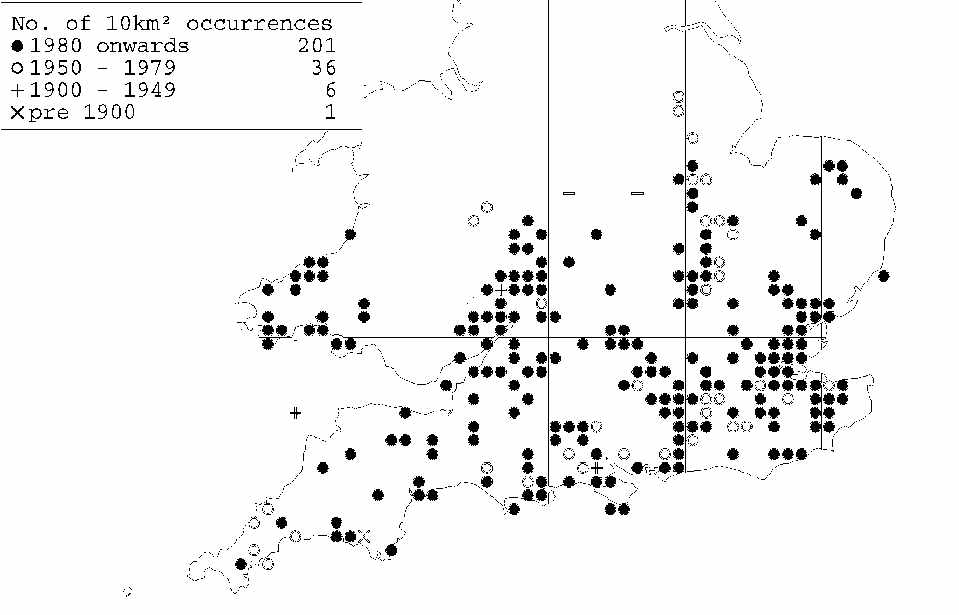 |
Worcestershire Record No. 14 April 2003 p. 9
BIRDS IN WORCESTERSHIRE – November 2002 to April 2003
by Gavin Peplow
This last winter has been fairly mild with only two or three colder snaps. After a wet late autumn, rainfall was very limited between February and April. As always, an interesting mix of expected and more unusual birds have been reported though sightings particularly during the early part of 2003 have kept all keen birders active!
November began with waterfowl grabbing most attention. The female Long-tailed Duck remained at Westwood (and was to continue in residence here until the beginning of March !), whilst this site also attracted a Common Scoter and two separate Slavonian Grebes. Meanwhile, the drake Scaup from there relocated to Bishampton Vale Pool for a few days and a female of this species found the Gwen Finch Reserve at Nafford to it’s liking. One or two late Grey Plovers were seen briefly at Bredon’s Hardwick and an adult Ring-billed Gull at Throckmorton Landfill provided the fifth County record of the year of this increasingly regular North American transient. There is of course a good chance that it may have been a returning bird from the passage witnessed in the Spring. Other birds of particular interest included a Firecrest seen for only a few minutes at Grimley and two Twite at Ryall Gravel Pits.
A Black-necked Grebe at Westwood from mid December was surprisingly the first of the year in Worcestershire but it lingered into the New Year. Other pre-Christmas sightings included a Red-breasted Merganser at Bredon’s Hardwick and two White-fronted Geese on the flood meadows at this locality. Surprisingly, four separate Sanderling were seen during the month – this being a species more familiarly recorded during spring wader passage. The other main highlight was an adult Iceland Gull, seen on and off at Throckmorton Landfill and Westwood. Having been very scarce for a number of years, it does appear that this species may now be becoming a bit more regular again.
January dawned with an unexpected flush of Little Gull sightings including six together roosting on the floodwater at Upton-upon-Severn. This flooding also attracted 250 Pintail to Longdon Marsh but quickly subsided as drier conditions set in. As the month progressed a party of five Waxwings were found in Kidderminster where they feasted on a diet of apples and berries. A smart male Snow Bunting located at Holt quickly followed, though unfortunately it didn’t stay long. A first winter Iceland Gull was seen briefly at Lower Moor and then over Bredon’s Hardwick and soon after up to three redhead (female or immature) Smew turned up at this latter site before also being seen at Kinsham Pit. The two White-fronted Geese also continued to linger in the Avon valley.
Perhaps the highlight of the month was the discovery of a drake Green-winged Teal at Grimley New Workings. This provided only the second County sighting of this distinctive North American bird, which has only recently been given full specific status. This was closely rivalled by a Great Grey Shrike that was unexpectedly found in an area of farmland south of Wadborough. Other highlights included a further Little Gull, two Kittiwakes and a Mediterranean Gull at scattered sites, along with a good number of Crossbills at Eyemore Wood.
A Bittern, which during a cold snap in the second half of February walked out onto the ice at Upton Warren Moors Pool, attracted a lot of interest during its stay of several weeks, and showed itself very well on occasions to patient observers. This is surely just reward for all the hard work that has gone into improving the habitat at this reserve in recent years. A Water Pipit was reported from Wilden but couldn’t be relocated later, whilst a drake Red-crested Pochard that was ringed at Bredon’s Hardwick settled in for a long stay. A party of six White-fronted Geese at Grimley was notable though a Pint-foot there was of slightly more suspect origin having toured several other sites around the County with the local Canada Geese over the preceding few weeks.
March started with a bang when an adult ‘Kumlein’s’ Gull was found in the Westwood roost though it sadly appeared to leave just prior to dusk. This distinctive sub-species of Iceland Gull is still a very rare visitor to the UK and needless to say, this was the first record for the County. Mediterranean Gulls were well represented with two birds seen together at Throckmorton and a further ‘pair’ at Westwood during the month, whilst a second year Ring-billed Gull paid a brief visit to Bittell.
A Long-eared Owl was a welcome discovery on Castlemorton Common, being the first for four years and equally popular was an Avocet at Upton Warren mid month. A drake Scaup was seen at Bredon before it or another settled in at the Gwen Finch reserve. A Black Redstart appeared around a housing estate in Droitwich, whilst two on North Hill shortly afterwards were at a more expected location. Early migrants began to arrive as the month progressed with Sand Martins and Chiffchaffs as always leading the way. Wheatears were scarce but two Ring Ouzels on the Clent Hills just after mid month were very early. An Osprey was also seen tracking north over both Grimley and Trimpley reservoir.
Migration gathered pace as always once April arrived with waders represented by two separate Knot followed by two Avocets at Grimley, several Whimbrel, a Turnstone at Wilden and a Sanderling at Upton Warren. An adult Ring-billed Gull visited the sheep fields at Bredon’s Hardwick during the course of the second week whilst Tern passage was unexceptional but did include three or four individual Black Terns at various sites. The first Garganey seen were a pair at Upton Warren – somewhat later than normally expected for the species and a Marsh Harrier also passed through there.
Of note, a small party of Waxwings were reported in a Redditch garden though full details have yet to emerge. These could well however have been the same birds as seen earlier in March in nearby Warwickshire.
Finally, towards the end of the month a Hoopoe was located in the north of the County near Hunnington and proved very popular, though equally elusive during it’s stay. Interestingly it was reported that perhaps the same bird had been seen here a month previously!
Records compiled from reports received by Birdline Midlands. Please phone through details of all your interesting sightings to the 24-hour Hotline on 01905-754154 (free on application to regular callers). For all the latest information on birds currently within Worcestershire and the Midlands Region, call 09068-700247 (calls charged at 60p per minute).
Worcestershire Record No. 14 April 2003 p. 4
NEWS FROM THE WORCESTERSHIRE BIODIVERSITY PARTNERSHIP
Alex Preston
Biodiversity Action Plan Manager
It’s all happening down at the WBRC – no sooner is the new Manager, Simon, getting stuck into his new role he is given a star slot in the first edition of the Regional Biodiversity Partnership’s newsletter. With the appointment of Simon all hopes are pinned on the ‘coming of age’ of the Worcestershire Biological Records Centre, and this will be not a minute too soon. The need for improved access to biological data is a theme that seems to be cropping up more and more frequently, not least at a Development Workshop held by the Worcestershire Biodiversity Partnership recently.
The aim of the workshop was to consider the broad balance of activity across our Partnership working – have we got the mix of Education, Information and Action right, and what are the sorts of things the Partnership really needs to be tackling over the next few years?
The urgent need for improved access to biological information came out as an extremely strong message from this workshop – something for the Local Authority representatives attending the meeting to take away and digest when considering budget allocations for the next year.
However, furthering the work of the WBRC is not going to be helped by the outrageous ‘poaching’ of high quality volunteers that seems to be going on! To assist with data entry Simon had managed to entice one Nick Button, who had recently moved to the area after working for the Dorset Biological Records Centre, to volunteer for the WBRC. Nick has some excellent experience, and no doubt Simon was really looking forward to making the most of this windfall. However, unluckily for Simon, but good for Nick, some Aggregates Levy funding had been procured by Worcestershire Biodiversity Partnership for a one year post to look at aspects of nature conservation relating to aggregate extraction, and Nick was successful in his application for this job. So, congratulations to Nick, but has anyone out there any spare time to help with data entry at the WBRC…?
Education and awareness-raising was also raised at the Partnership Development Workshop as a crucial element of the BAP process. To help raise awareness of Worcestershire’s biodiversity among schoolchildren some shiny new Fact Sheets on Worcester BAP habitats and species have been produced, and will be available early next month. These have been produced by Worcestershire Wildlife Trust, Bishops Wood Centre and me, and are being printed using funding from English Nature and the County Council. The sheets are aimed at encouraging schools to use local examples of biodiversity in their teaching activities. We have our very own versions of the Giant Panda and tropical rain forest here in Worcestershire is the message we are trying to get across! Once completed these Fact Sheets will be available on the Biodiversity Partnership web site (www.worcestershire.gov.uk/biodiversity), where they will hopefully also appeal to a wider audience.
Worcestershire Record No. 14 April 2003 p. 25-27
WORCESTERSHIRE FLORA PROJECT: PROGRESS REPORT
Bert Reid
The Worcestershire Flora Project was initiated in 1987 by John Day and Roger Maskew and continues to the present day. It was always envisaged as a marathon rather than a sprint – it takes a lot of fieldwork to attempt to record all the vascular plants in each of 596 tetrads, with full six figure grid references and comments for the scarcer taxa.
Over the last couple of years the emphasis has changed from tetrad bashing to more focussed recording. This has partly been driven by the entry onto the database of nearly all available records between 1970 to 1986 in addition to the current project records. These records have enabled lists to be produced for each tetrad of taxa recorded post 1970 but not re-found since 1987. Any concentrations of such records have been prime targets for specific site recording.
We have also concentrated on recording recently described splits of taxa (such as the publishing of new subspecies) and on difficult and critical groups where full coverage will never be practical. In 2001 the foot-and-mouth epidemic restricted access to many areas so the opportunity was taken to improve our recording of the many garden escapes and other ruderals in Worcestershire’s towns and villages. The recording of such plants has become more fashionable since 1987 and this work has improved the consistency of our recording.
At the end of 2002 the average number of taxa in the 596 tetrads stood at 382. If the part tetrads around the edge of the area are excluded this average rises to 416. We have every reason to take pride in this achievement, especially when we started with an expectation of around 300 in the best tetrads – we now have four with over 600!
The two maps show the total number of taxa (adjacent page) in each tetrad and a grey-scale (this page) pattern of floral biodiversity by tetrad. These show some interesting patterns. The south-east of the county is clearly impoverished compared to the north and west, for three main causes: the south-east has a very long history of agriculture with early clearance of nearly all woodland and a predominance of arable; the geology and soils are more uniform than most other areas; and thirdly there are few significant urban areas to bump up totals with garden escapes – Evesham and Broadway stand out as islands of biodiversity.
Urban areas generally show high tetrad totals and Worcester itself is a real hotspot. The champion tetrad is SO87A with an incredible 651 taxa recorded. This tetrad contains most of Stourport, has the River Severn and Staffordshire & Worcestershire Canal running through it, and contains a very rich corner of Hartlebury Common. If it only had a bit of ancient semi-natural woodland as well it might reach 700 or more!
The last two years have turned up some exceptional plant records. In 2001 came the first record for Chaffweed Anagallis minima since 1837. This tiny plant was found on Castlemorton Common during a BSBI field meeting. Surprisingly, Harry Green and Brett Westwood found more Chaffweed in 2002, this time in Skeys Wood on the edge of the Wyre Forest near Bewdley. Other 2001 plants included Sea Fern-grass Catapodium marinum on the Evesham Bypass (see Worcestershire Record 11, p.19), two good Eyebright records found by Bill Thompson Euphrasia anglica and E. arctica, the re-finding of Swamp Meadow-grass by John Day in four sites and the discovery of two rare Mullein hybrids by Terry Knight at Church Honeybourne Verbascum thaspus x virgatum and V. pulverulentum x virgatum.
2002 produced another set of excellent records. Roger Maskew found Tawny Sedge Carex hostiana on Castlemorton Common, its second Worcestershire site. In a pond on the common, Will Watson found Floating Club-rush Eleogiton fluitan in possibly in only surviving county site. How many more rarities are still left to be found on Castlemorton Common?
Eight new dandelions Taraxacum from Bert Reid (6) and John Day (2) took the county total to 135 with another specimen from Papermill Meadow which national expert John Richards says “clearly represents an unknown species in section Celtica”. The main theme of 2002 was hybrids. Bill Thompson found the hybrid between Soft Rush and Compact Rush Juncus x kern-reichgeltii on Berrow Downs. Bert Reid recorded the cross between Creeping and Austrian Yellow-cress Rorippa x armoracioides by the River Avon at Fladbury. Will Watson found the nationally rare hybrid between Grey and Purple Willow Salix x pontederiana at Upper Bittell. And last but not least, Chris Westall hunted down two very rare hybrids of Fiddle Dock: with Wood Dock Rumex x mixtus at Cleeve Prior and with Clustered Dock R. x muretii at Clark’s Hill, Evesham.
As well as all this recording effort we have made a start on writing the flora! First drafts of a few of the introductory chapters have been written and the first tentative efforts have been made at a few species accounts. Much work lies ahead, and the finishing line seems a very long way off, but we are into the last few miles of the race.
GREATER WORCESTERSHIRE – TETRAD TOTALS 31.12.2002 |
||||||||||||||||||||||||||||||||||
| 54 | 56 | 58 | 60 | 62 | 64 | 66 | 68 | 70 | 72 | 74 | 76 | 78 | 80 | 82 | 84 | 86 | 88 | 90 | 92 | 94 | 96 | 98 | 0 | 2 | 4 | 6 | 8 | 10 | 12 | 14 | 16 | 18 | ||
| 90 | 212 | |||||||||||||||||||||||||||||||||
| 88 | 310 | 420 | 332 | 229 | 240 | |||||||||||||||||||||||||||||
| 86 | 259 | 410 | 420 | 388 | 343 | |||||||||||||||||||||||||||||
| 84 | 102 | 400 | 320 | 409 | 408 | 484 | 383 | 381 | 301 | 290 | 364 | 361 | ||||||||||||||||||||||
| 82 | 268 | 210 | 318 | 393 | 327 | 78 | 385 | 446 | 479 | 417 | 490 | 423 | 429 | 424 | 379 | 364 | 418 | 352 | 353 | |||||||||||||||
| 80 | 372 | 459 | 432 | 486 | 454 | 492 | 317 | 321 | 416 | 418 | 447 | 372 | 367 | 403 | 436 | 441 | 400 | 428 | 323 | 188 | ||||||||||||||
| 78 | 423 | 559 | 418 | 452 | 508 | 423 | 402 | 438 | 409 | 502 | 403 | 466 | 418 | 406 | 414 | 470 | 421 | 435 | 383 | |||||||||||||||
| 76 | 173 | 365 | 408 | 534 | 461 | 470 | 472 | 452 | 347 | 422 | 383 | 406 | 430 | 413 | 434 | 442 | 428 | 480 | 421 | 434 | 260 | |||||||||||||
| 74 | 203 | 324 | 371 | 478 | 427 | 506 | 587 | 453 | 567 | 407 | 450 | 352 | 398 | 433 | 416 | 439 | 480 | 522 | 441 | 396 | 424 | 432 | ||||||||||||
| 72 | 363 | 453 | 417 | 423 | 483 | 403 | 519 | 480 | 514 | 375 | 363 | 409 | 456 | 450 | 453 | 411 | 445 | 447 | 483 | 367 | 367 | 236 | ||||||||||||
| 70 | 219 | 361 | 362 | 334 | 382 | 419 | 365 | 350 | 355 | 449 | 651 | 554 | 455 | 361 | 348 | 347 | 311 | 432 | 427 | 415 | 395 | 411 | 437 | 447 | 419 | |||||||||
| 68 | 166 | 399 | 365 | 430 | 408 | 396 | 419 | 445 | 423 | 350 | 330 | 382 | 499 | 455 | 391 | 380 | 339 | 329 | 343 | 464 | 465 | 430 | 405 | 418 | 466 | 481 | 418 | 247 | ||||||
| 66 | 339 | 460 | 492 | 381 | 369 | 401 | 408 | 403 | 357 | 425 | 511 | 475 | 424 | 499 | 320 | 364 | 389 | 327 | 324 | 446 | 448 | 387 | 437 | 417 | 455 | 463 | 537 | 315 | 278 | 207 | ||||
| 64 | 392 | 395 | 367 | 423 | 427 | 313 | 347 | 406 | 412 | 450 | 414 | 381 | 512 | 343 | 416 | 393 | 399 | 393 | 386 | 447 | 405 | 405 | 410 | 452 | 470 | 434 | 146 | 278 | ||||||
| 62 | 270 | 402 | 356 | 435 | 424 | 200 | 303 | 377 | 428 | 420 | 321 | 469 | 452 | 463 | 413 | 445 | 564 | 502 | 417 | 364 | 336 | 388 | 368 | 363 | 280 | |||||||||
| 60 | 308 | 372 | 307 | 239 | 214 | 159 | 388 | 353 | 409 | 543 | 353 | 405 | 475 | 519 | 470 | 420 | 389 | 394 | 384 | 370 | 370 | 421 | 446 | 363 | 373 | |||||||||
| 58 | 210 | 187 | 406 | 479 | 443 | 389 | 406 | 554 | 522 | 477 | 428 | 381 | 417 | 401 | 379 | 373 | 410 | 330 | 393 | |||||||||||||||
| 56 | 513 | 506 | 413 | 356 | 468 | 541 | 523 | 506 | 447 | 371 | 366 | 362 | 385 | 363 | 388 | 367 | 370 | |||||||||||||||||
| 54 | 223 | 527 | 421 | 425 | 367 | 453 | 506 | 613 | 532 | 411 | 381 | 381 | 426 | 397 | 352 | 377 | 370 | 285 | ||||||||||||||||
| 52 | 374 | 447 | 473 | 407 | 431 | 493 | 514 | 520 | 492 | 372 | 322 | 332 | 300 | 329 | 311 | 384 | 444 | 160 | ||||||||||||||||
| 50 | 219 | 282 | 346 | 424 | 442 | 427 | 411 | 444 | 458 | 407 | 444 | 431 | 333 | 335 | 302 | 325 | 348 | 376 | 398 | 321 | 222 | 298 | 146 | |||||||||||
| 48 | 193 | 284 | 146 | 160 | 134 | 420 | 509 | 438 | 479 | 464 | 398 | 369 | 414 | 375 | 351 | 307 | 314 | 343 | 307 | 337 | 384 | 409 | 281 | 188 | 169 | |||||||||
| 46 | 183 | 252 | 394 | 592 | 567 | 464 | 457 | 438 | 445 | 422 | 431 | 372 | 444 | 384 | 412 | 437 | 388 | 387 | 450 | 293 | 254 | 297 | 252 | 87 | ||||||||||
| 44 | 195 | 481 | 440 | 623 | 608 | 487 | 510 | 451 | 434 | 445 | 329 | 527 | 409 | 320 | 392 | 325 | 467 | 403 | 344 | 332 | 333 | 345 | 223 | |||||||||||
| 42 | 230 | 133 | 508 | 457 | 480 | 367 | 372 | 415 | 436 | 428 | 378 | 399 | 304 | 303 | 309 | 463 | 428 | 396 | 349 | 292 | 280 | |||||||||||||
| 40 | 494 | 460 | 439 | 420 | 530 | 492 | 351 | 379 | 335 | 409 | 354 | 410 | 325 | 397 | 278 | 376 | 234 | 210 | ||||||||||||||||
| 38 | 513 | 485 | 409 | 352 | 421 | 371 | 248 | 413 | 440 | 421 | 349 | 371 | 342 | 354 | 307 | 353 | 364 | 233 | ||||||||||||||||
| 36 | 54 | 518 | 448 | 351 | 368 | 336 | 447 | 314 | 474 | 434 | 379 | 428 | 267 | 201 | 222 | 222 | 508 | 521 | 211 | |||||||||||||||
| 34 | 212 | 436 | 397 | 385 | 335 | 359 | 344 | 146 | 298 | 289 | 251 | 376 | 251 | 221 | 353 | 250 | ||||||||||||||||||
| 32 | 326 | 390 | 393 | 355 | 352 | 377 | 331 | 325 | 270 | 165 | 246 | 100 | ||||||||||||||||||||||
| 30 | 215 | 425 | 406 | 435 | 404 | 367 | 398 | 251 | ||||||||||||||||||||||||||
| 28 | 256 | 326 | 340 | 376 | 147 | 221 | 200 | 246 | ||||||||||||||||||||||||||
| 26 | 118 | 70 | ||||||||||||||||||||||||||||||||
Worcestershire Record No. 14 April 2003 p. 17
CELYPHA WOODIANA (BARRETT): A RARE AND LOCALISED INSECT FOR RECORDERS TO LOOK OUT FOR
Tony Simpson
In 1878 Dr. J.H. Wood, who was a Herefordshire General Practitioner and amateur entomologist who lived at Tarrington, first identified a small tortricid moth, which was named in his honour by Barrett, who wrote its scientific description from his specimens. In 1892 Wood discovered its life history. He wrote in the Victoria County History of 1908 “orchards, the moth at rest on the trunks of the apple trees and the larva (more frequent) mining the leaves of mistletoe. There is no record of its having occurred outside the county, and it is apparently unknown abroad”. Bradley and Tremewan (1979) give its known range as “Northern and central Europe to U.S.S.R.” In Britain it has only ever been found in Herefordshire, Worcestershire, Gloucestershire, Monmouthshire, Somerset, and in just over the border in Warwickshire.
I have found the larvae on mistletoe on pear and apple trees in an old orchard at Drakes Broughton in May 1980, and I bred seven moths. It was also found on mistletoe on a planted Rowan tree beside the Droitwich Road in Claines, Worcester in May 1980, adjacent to some old apple trees in an allotment. These trees have now gone. I have not found it anywhere else, but Michael Harper has found it very locally in a few old orchards in Herefordshire. Most of the old orchards in both counties have now been grubbed up and this is a very threatened habitat. Surveys of mistletoe suggest that the plant is doing well despite the loss of orchards because it is able to live on other trees and shrubs, especially Poplars, Limes, and Hawthorns. We do not know however if the moth can survive on mistletoe in these situations, and I feel we should try to survey mistletoe for the presence of woodiana in the two counties.
This is easier said than done however! The small green larva mines in the leaves of mistletoe from the autumn. At first the mines are very inconspicuous, but in April and early May it makes inflated blister-like mines in the leaves, which are initially pale but when vacated go dark brown. Later in June the mined leaves fall off, and so old mines are usually no longer visible after this time. Finding the moth resting on tree trunks would be a much less easy way of finding it. Therefore the mines would only be likely to be found at the end of April and May. The other problem is that most of the mistletoe clumps are out of reach from the ground without the use of a ladder. Mistletoe on larger trees such as Poplars and Limes would be almost entirely out of reach to all practical purposes. One way, once one could confidently identify the mines, might be to use binoculars to find them on the higher trees, or at least use this method as a survey to identify potential mines from below. This method has not yet been shown to be useful and accurate however.
We would like to ask recorders to look for possible mined leaves in April and May, and if they are accessible (usually in orchard or garden fruit trees), pick a few and keep them, and give or send them to us for confirmation. Please do not take any risks by climbing trees, and avoid going up tall trees altogether! If you have or see any likely mistletoe mines please give us a ring. For Worcestershire: Tony Simpson on 01886 832637, and for Herefordshire Michael Harper on 01531 632030.
Worcestershire Record No. 14 April 2003 p. 23-24
WORCESTERSHIRE MOTH REPORT 2002
Dr.A.N.B. Simpson
Despite the wet summer, with the welcome absence of restrictions on access to the countryside that troubled us in 2001, a comprehensive moth recording programme was carried out by the “mothers” group and by Rosemary Winnall’s Wyre Forest study group. She was also able to visit Wissetts Wood to the west of the main forest area, and reported that it looked very interesting, and has planned visits to a number of new sites in 2003. We will be going to Ribbesford Wood for National Moth Night on the 12th April 2003. Dave Grundy and Jeff Rush have been doing a lot of recording in Wyre Forest and visited other sites in the north and east of the county. Dave has been carrying out a pilot study on the Common Fanfoot Pechipogo strigilata in the Wyre Forest, which is probably the most important site in the UK. for this now very localised insect. As its English name suggests it was once fairly common and widespread (including several other woods in Worcestershire e.g. Monk Wood), but has now declined nationally for reasons that are not entirely understood. It is now a UKBAP species with records from only seven sites. Dave was able to show that the moth was still present in fairly good numbers and he was able to find larvae in the wild, and created suitable feeding sites on wilted oak leaves by leaving broken small branches hanging from trees, on which he found feeding larvae later in the year. This conservation project will hopefully be ongoing with the aim to recreate suitable habitat and eventually return the species to some of its former sites.
MACROLEPIDOPTERA
There was one new larger moth for the county in 2003. Rosemary Winnall caught a Welsh Wave Venusia cambrica in her moth-trap at Bliss Gate on 25/7/02. This moth feeds on Rowan and is not normally a migrant, but is resident to the north and west of us in Wales and Shropshire. It will be interesting to see if this was a casual vagrant or might represent an extension to its breeding range.
Another new species turned up on 16/8/02 when eight Devon Carpet Lampropteryx otregiata came to lights along the Dowles Brook in the Wyre Forest. However they all stubbornly kept to the Salop side of the brook with none in my trap in VC37 only 40 yards away! So they have still not technically been recorded for Worcestershire. They are probably a new arrival from the west, and seem likely to be resident in the wet flushes along both sides of the Dowles Brook, feeding on Marsh Bedstraw.
I was surprised and delighted to be brought an Orange Footman Eilema sororcula by Peter Garner that had come to his porch light on 16/5/02 at West Malvern. The moth used to occur in Monk Wood, Tiddesley Wood, at Cotheridge, and Middleyard Coppice near Bransford, but the last record was in 1902. The nearest resident population is in the lower Wye valley. Then when this year I received the print out for the Rothhampsted Trap at Westmancote on Bredon Hill for 2001, there was a record for another Orange Footman from last year. One each year in successive years with no records since 1902 makes simple migration less likely, so keep an eye out for this pretty moth which may be expanding its range.
Kevin McGee photographed a clearwing, which alighted briefly on a marsh thistle flowerhead, in Tiddesley Wood on 18/8/02. He was delighted to show me a photo of a worn male Red-tipped Clearwing Synanthedon formicaeformis which had not been seen in VC37 since records near Worcester in the nineteenth century . In April I collected some logs of Goat Willow which had been left on the ground next to the village pond at Crowle Green after clearance operations, and which had “sawdust” filled holes in their cut ends. Three Lunar-Hornet Clearwings Aegeria bembeciformis emerged in the summer, and when released next to the pond one flew straight up into the top of the willows. Where forestry or ride clearance work has been done look for recent cut small pieces of timber containing possible clearwing feedings, and stand these in damp sand in a container, and you may succeed in breeding out some of these fascinating insects. Ian Duncan was again successful in attracting some Red-belted Clearwings S. myopaeformis to his pheromone lures at Melrose Farm Meadows, and also some Currant Clearwings S. tipuliformis at a farm near Powick. I was totally unsuccessful myself however in Bransford and at the Knapp, but the weather did not give us many good days suitable for daytime clearwing hunting in 2002.
Migrants were very uncommon this year. The only notable ones were a single Small Mottled Willow Spodoptera exigua on 1/6/02 at Crossway Green (Mike Southall), and a Gem Orthonama obstipata on 21/10/02 at Stoke Prior (Jeff Rush).
Blomer’s Rivulet Discoloxia blomeri was seen at Hanley Dingle and Ribbesford Wood, which is a further spread of this species which has been increasing in Herefordshire. Mike Southall had a Dusky-lemon Sallow Xanthia gilvago to light on 20/9/02. This moth has now become very uncommon since the onset of the Elm Disease, so it is nice to see it is still “hanging on”. Jeff Rush recorded a Crescent Celaena leucostigma on 17/8/02 in a wet area near the canal and river just east of Hawford. This is a very rarely seen species in our area. There have been records of Square-spot Paradarisa consonaria from Wyre Forest, Uffmoor Wood, and Gannow Wood, and the Satin Beauty Deileptenia ribeata, the Barred Hook-tip Watsonalla cultraria, the Bird’s Wing Dypterygia scabriuscula, the Buff Footman Eilema depressa= deplana, and the Dingy Footman Eilema griseola continue to increase and spread, and the Sycamore Acronicta aceris was recorded at Stoke Prior, Bransford, and the Knapp, and after the 2001 record this suggests that it is now moving into our area. Rosemary Winnall recorded a single Autumn Green Carpet C. miata at Stoke Bliss on 5/10/02.
One of our priority species in the West Midlands, the Argent and Sable Rheumaptera hastata, was not seen at all in Wyre Forest and no larvae were found, and another, the Drab Looper Minoa murinata, was only recorded twice: once by Dowles Brook in Wyre Forest on 6/5/02 and once in Monk Wood on 1/6/02. The weather in May/June in 2002 was not good for the recording of these day flying species and we must hope for better conditions, with nice sunny days in 2003!
Other notable Macrolepidoptera listed by 10km. square were:
SP05 Gannow Wood
Jeff Rush made a number of visits in April and May and recorded:
3 Mottled Grey Colostygia multistrigaria 21/4/02
c.35 Seraphim Lobophora halterata in 5/02
1 Tissue Triphosia dubitata 15/5/02
2 Square-spot Paradarisa consonaria 15/5/02
c30 Poplar Lutestring Tethea or in 5/02
SO74 Malvern Wells
1 Barred Hooktip 4/8/02 W. cultraria and
2 Buff Footman E. griseola 4-7/8/02 (Peter Holmes).
SO75 Bransford
2 Sycamore Acronicta aceris on 20/7/02 (ANBS)
The Knapp
1 Sycamore A. aceris on 28/7/02 (Fergus Henderson)
SO76 Hanley Dingle
1 Blomer’s Rivulet Discoloxia blomeri 22/6/02 (Neil and Corrina Gregory)
Kingswood
1 Rosy Footman Miltochrista miniata record from J.W.Meiklejohn
SO77 Wyre Forest
1 Broom-tip Chesias rufata on 19/4/02 (R.Winnall et. al.)
1 Lesser Cream Wave Scopula immutata 2/6/02 (J.Rush)
7 Satin Beauty D. ribeata over several visits (D. Grundy and J. Rush)
4 Square-spot P. consonaria over several visits (D. Grundy and J. Rush) and
large numbers of Bilberry Pug Pasiphila debiliata, 2 Orange Moth
Angerona prunaria, and over 20 Great Oak Beauty Hypomecis roboraria
Ribbesford Wood
3 Blomer’s Rivulet D. blomeri on 15/6/02 (R. Winnall et. al.)
SO84 Ashmoor Common
1 Dingy Footman E. griseola on 21/7/02 (K. McGee)
1 Blackneck Lygephila pastinum on 6/7/02 (K.McGee)
SO86 Crossway Green
Mike Southall also recorded the following of particular interest:
1 Ochreous Pug Eupithecia indigata on 11/5/02
1 Mallow Larentia clavaria on 21/9/02
1 Scarce Tissue Rheumaptera cervinalis on 4/5/02
1 Light Brocade Lacanobia w-latinum on 17/5/02
SO88 Kingsford Country Park
1 Clouded Magpie Abraxas sylvata on 29/6/02 (D.Grundy and J. Rush)
1 Suspected Parastichtis suspecta on 29/6/02 (D.Grundy and J.Rush)
SO96 Stoke Prior
Jeff Rush recorded among many others the following of particular interest:
1 Clay Triple-lines Cyclophora linearia 8/6/02
1 Dark-barred Twin-spot Carpet Xanthoroe ferrugata on 20/7/02
5 Spinach Eulithis mellinata between 24/29/6/02
1 Barred Rivulet Perizoma bifaciata on 12/8/02
9 Buff Footman E. depressa
7 Dingy Footman E. griseola
2 Bird’s Wing Dypterygia scabriuscula 166/02 & 12/8/02
2 Golden Plusia Polychrisia moneta on 5&17/7/02
SO97 Pepper Wood
D. Grundy and ANBS recorded:
11 Lead-coloured Pug Eupithecia plumbeolata on 22/6/02
1 Varied Coronet Hadena compta on 22/6/02
SO98 Uffmoor Wood
4 Square-spot P. consonaria on 25/5/02 (D. Grundy and J.Rush)
MICROLEPIDOPTERA
The second volume of the Herefordshire and Worcestershire Atlas covering all the microlepidoptera except for the Tortricids, Pyralids, and Plumes was published at the end of January 2003 (copies available from Jim and Christine Chance details after this article), with the third volume planned for early 2004.
There were 6 smaller moths recorded in the county for the first time in 2002:
Tachystola acroxantha (Meyrick)(the Ruddy Streak): Jim and Christine Chance had a specimen of this species identified by Mike Harper. It had come to actinic light in their garden in Harborne on 30/7/02. I told them that this locality was just inside VC39 (Staffordshire) for recording purposes. However when later looking through some specimens that Dave Grundy had kept from his garden trap in Balsall Heath, which is in VC37 despite being in Birmingham, I found another, dated 25/6/02, which confirms that this adventive Australian species is now resident in the West Midland conurbation. Its larva feeds on dead and decaying vegetation on the ground.
Mompha lacteella (Stephens): 2 specimens were taken at light by D. Grundy and J. Rush in Wyre Forest on 2/6/02. The larva feeds on willowherb species.
Spatalistis bifasciana (Hubner): 1 to my light-trap at Ribbesford Wood on 15/6/02 was the first known VC37 record, but when going through Dave Grundy’s specimens that he had retained for identification, I found 2 more from Lodge Hill Wyre Forest dated 2/6/02 and 9/6/02. The larva feeds in the berries of alder buckthorn, and sometimes purging buckthorn and dogwood.
Acleris hyemana (Haworth): a worn male at light by the clay road in the Wyre forest on 19/4/02 (ANBS). The larva feeds on heather and heath spp.
Ancylis upupana (Treischke): 2 examples of this species came to light near Lodge Hill Farm, Wyre Forest on 2/6/02 (D. Grundy and J. Rush). In this locality it is probably feeding on birch rather than on elm, its other foodplant.
Ephestia cautella (Walker), also known as the Dried Currant Moth, which is a synanthrope, feeding on seeds and dried fruit and nuts. Recorded by Val Weston and Alan Prior at Hall Green, which is just in VC37; probably originating from larvae in their bird food.
Messrs. Grundy and Rush also recorded a small black and white tortrix on 2/6/02, which I was able to identify as Epinotia demarniana (Fischer von Roslerstamm), and I saw 2 more at light myself at Ribbesford Wood on 15/6/02. This is another birch feeder of which there is only one previous VC37 record. There is a specimen in the Worcester Museum collection labelled “Worcs.” 21/6/1902, so it is nice to find it is still around and to have some definite localities for it now.
On 30/5/02 Jenny Joy was going into Ribbesford Wood at about 11.0a.m. when she noticed 8 small moths resting on a wooden gate-post in the sunshine. She noticed how very pretty they were and put a container over one to get it identified later. She gave the specimen to Neil Gregory who put an image of it on a moth website and an old friend, John Langmaid replied to say it looked like Schiffermuellerina grandis (Devignes), a rare moth nationally. In fact the original “Type specimen”, from which Desvignes described this insect for the first time in 1842, and which is in the national collection at the Natural History Museum South Kensington, came from “Bewdley, Worcs.”
I was able to examine the specimen and confirm the identity. On the 15/6/02 in another part of the same wood, quite by chance I found another of the same species in the bottom of my moth trap! The larva feeds in dead wood, and the moth is reported to be usually diurnal, flying in the sunshine in the morning.
Other notable smaller moths:
Tinea dubiella Stainton Stoke Prior 2/6/02 (J. Rush)
Bucculatrix demaryella (Duponchel) 3 at Wyre Forest on 2/6/02 (D. Grundy and J. Rush)
Caloptilia populetorum (Zeller) Stoke Prior 12/9/02 and Bilberry Hill 14/9/02 (J. Rush)
Yponomeuta rorrella (Hubner) Bransford 29/7/02 (ANBS)
Swammerdamia compunctella Herrich-Schaffer Wyre Forest 2/6/02, the second VC37 record (J. Rush)
Coleophora alcyonipennella (Kollar) frischella auct. Wyre Forest 2/6/02 (J. Rush)
Pseudatemelia josephinae (Toll) Wyre Forest 7/7/02 (D. Grundy)
Pseudotelphusa scalella (Scopoli) Gannow Wood 16/5/02 (J. Rush) as well as several from Wyre Forest where it is regularly recorded.
Pseudotelphusa paripunctella (Thunberg) several from Wyre Forest 2-9/6/02 (D. Grundy and J. Rush)
Gelechia rhombella (Denis & Schiffermuller) 1 at light at Stoke Prior 12/9/02 (J.Rush)
Commophila aeneana (Hubner) 1 near Bredon’s Norton 30/5/02 (P. Garner)
Cochylis hybridella (Hubner) 1 at St. Wulstans Nature Reserve near Malvern 1/7/02 (ANBS)
Ancylis uncella (Denis & Schiffermuller) 1 at Wyre Forest 2/6/02 (J. Rush)
Pempelia formosa (Haworth) 1 at Crossway Green 16/7/02 (M. Southall)
Dioryctria simplicella Heinemann= mutatella Fuchs 2 in the Wyre Forest on 5/7/02 (J. Rush).
Worcestershire Record No. 14 April 2003 p. 3
WORCESTERSHIRE RECORDERS
Geoff Trevis
Simon Wood, the newly appointed BRC manager, will from now on report the news from the Worcestershire Biological Records Centre, whilst it falls to me to report on Worcestershire Recorders and its committee. The requirement for a formal group and its proposed activities was described in the last issue of the Worcestershire Record. I am pleased to say that these ideas were accepted at the Recorders’ Annual Meeting in March 2003 and the current committee was elected nem con for the coming year. I can confirm the committee members as Harry Green, Bert Reid, John Partridge, John Meiklejohn, Gary Farmer, Patrick Taylor, Martyn Hodgson, John Day and Geoff Trevis (chairman) with Simon Wood in attendance. It is our intention that the committee’s work should be as open as possible and to this end we have decided that the meetings should be open to members of Worcestershire Recorders who will be encouraged to participate in discussions though, of course, only the elected members will be eligible to vote, should vote be necessary. The meeting dates in 2003 are to be Thursday 15th May, Thursday 10th July, Thursday 11th September and Thursday 13th November. If any members wish to attend I would be grateful if they could notify me in advance so that I can send relevant papers and ensure that we do not get too many for the room and also confirm that meeting dates have not been changed.
The formation of the new Group with its remit to elect nominees to the BRC Board means that we will have to be more strict about subscriptions to the Worcestershire Record and only subscribers will be eligible to vote in elections to the committee and Board. However, non-members will be welcome at the annual meeting to participate in the talks and presentations. Elections to the committee and Board will take place at the annual meeting and papers calling for nominations will be circulated with the autumn issue of the Record. Arrangement will be made for those who cannot attend to notify the chairman to vote on their behalf by proxy. All votes and ballots will be secret.
In the meantime the committee has been active in arranging the March annual meeting, the summer recording days and the contents of the Worcestershire Record. We have also been discussing ways in which records can be used and published and we would encourage everybody to participate in the recording activities and submit records to the Veteran Tree and Mammal projects. Both are vitally important and, we anticipate, will set the pattern for future projects. We have also been looking at ways to publicise the group’s activities and the BRC’s work and to see how we can focus recording activities in ways that contribute to the requirement of the BRC. We would welcome any input to these discussions from the members.
I cannot finish without saying the “we” above has distinct similarities to the Royal “we”. The vast bulk of the work of arranging the annual meeting and recording days and editing the Worcestershire Record has been done by Harry Green and I would like to express thanks to him on behalf of the committee.
COULD YOU VOLUNTEER?
1. The WBRC has made a start computerising some of the records of the Wildlife Trust, but this will need quite a lot of volunteer input if it is to be completed and the information useable in a reasonable time. We are hoping that we can find some volunteers who would be happy to work at WBRC at Lower Smite Farm, and on a reasonably regular basis. If you are computer literate it might help, but if you can find your way round a keyboard, and are a careful worker, then we can show you what to do.
Please contact Simon Wood at WBRC for more information.
2. The WBRC board is in need of a Company Secretary and possibly a Minuting Secretary, either as one person or two. At present the board meets on a Monday at 5.30 p.m. at Lower Smite Farm, and we anticipate that about six meetings a year will be needed now that we have settled down, and most of the preliminary setting up has been done. The main functions of the Company Secretary are to ensure that the Board runs its meetings correctly, and meets the deadlines required as a Limited Company for producing annual accounts and reports. They will also ensure that Minutes and Agendas are circulated as required.
If you are interested in undertaking this job and so becoming involved with running the WBRC please contact Geoff Trevis who will provide further information.
Worcestershire Record No. 14 April 2003 p. 12-13
RAPTOR WATCHING IN SE WORCESTERSHIRE
Mark Turner
I am most fortunate to have been able to set down roots in my home town of Broadway, in the far south east corner of Worcestershire, on the edge of the North Cotswold escarpment. My passion for hawk-watching developed in recent years with the rise in numbers of birds of prey. They have re-established themselves within the more raptor-friendly countryside that surrounds us; our local area is both dramatic and ideally suited to the needs of these birds. I have selected a few extracts from my extensive diaries for Worcestershire Record to highlight some of the exciting birds to be found around our region.
A summary of hobby sightings in the North Cotswolds and Vale of Evesham
Observers; Mark E Turner and Christine E Turner.
1999 eight sightings
2000 ten sightings
2001 twelve sightings
2002 fifteen sightings
Earliest date 07 04 00 Ashton-under-Hill, Worcestershire.
Latest date 10 10 99 Bredon Hill, Ashton-under-Hill.
Multiple hobbies
Three at Ashton-under-Hill, September 1999.
Two at Paxford, Gloucestershire, 02 05 01, (courtship chase).
Two at Broadway, Worcestershire, 24 08 01, (calling in flight).
First juvenile identified
Childswickham, Worcestershire, 19 09 02.
(These notes taken from Hawk Watch U.K Cotswolds to Coast (unpublished), compiled by Mark E Turner).
 |
 |
 |
| Hobby, drawn by Mark Turner. | Raven, drawn by Mark Turner | Goshawk Accipter gentilis drawn by Mark Turner. 14th April 2002, Kite’s Nest farm, Broadway, Worcestershire. Adult male. A partially silhouetted view of the bird with damaged left wing primaries.drawn by Mark Turner |
Other observations
On 18th October 2002, Cotstone Quarry Landfill site reliably produced a Raven at midday.
21st October brought a window of mild to warm weather in between regular spells of rain. It also brought a juvenile Buzzard to Broadway Gravel Pit Nature Reserve, flying low through the marsh area and being the seventh record for the species at the site.
Mid-afternoon of 25th October during a sunny period, I came upon a male Kestrel hovering over the road at Hidcote Boyce, northeast of Chipping Campden, Gloucestershire. As I slowed my vehicle down I realised another Kestrel was sat in the road. The hovering bird did a vertical stoop with wings closed and swooping close by the Kestrel on the tarmac. The bird under attack appeared to be a juvenile, probably encroaching on the other one’s territory. Two other Kestrels were in flight together over fields adjacent to the Sedgeberrow bypass at 16:30 hrs, an area well established as a Vale of Evesham hotspot for the species.
The morning of 7th November brought very welcome warm and sunny weather in contrast to recent days. Although it was a normal workday, I was able to see Common Buzzards gathering over woodland/farmland between Moreton-in-Marsh and Evenlode, Gloucestershire. A light, fresh wind kept the birds suspended at different heights whilst I made sure of my maximum count. As the brief grouping of five began to break up, one bird stooped on a lower one as a finale to the event.
For the most part November was wet, therefore few opportunities to observe soaring birds. Once again Kestrel proved to be the most commonly seen raptor around the region, particularly birds hunting next to busy roads. Most Buzzard sightings were of birds at rest or hunting from a perch. Sparrowhawks seemed to have disappeared from the scene, except for a female appearing low over the A44 at Wickhamford on 22nd, in a slow patrolling flap and glide flight. Wickhamford also hosted a pair of Buzzards, resident in the Longdon Hill area.
November however, was notable for a quite extraordinary story that came to light when a Gamekeeper from Stanway Hill came to see me in my workplace in Broadway. A pleasant and knowledgeable man, he told me of an event ten years previously. He was releasing Partridges from a holding pen when a bird of prey descended and snatched one of his birds, then flew off over his head. Incredibly it was a ring-tail Harrier. Even more incredibly, during October 2002, another ring-tail Harrier turned up on his farm. Realising the significance of this rare coincidence and having read my first book, he felt compelled to discuss it with me. I am waiting for the phone to ring.
The first week of December 2002 finally managed to bring us frosty mornings and sunny days together with cold winds to give it that wintry feel. Buzzards tentatively began to re-emerge onto the scene around the region. One of a resident pair coming away from Broadway Hill over the village bypass did a complete barrel roll to ward off a nuisance Crow with outstretched legs and grappling talons. Next day, the 5th, a Buzzard soared in blue sky over Hall Farm, Bricklehampton and yet another visit by one to Broadway Gravel Pit circled with wings held in a deep ‘V’ over the reserve centre and marsh.
A route which I am tempted to name ‘Raptor Road’, once again yielded a good count on 12th December, the gloomiest of days. Less than favourable conditions included mist, snow and rain and a cold easterly wind. Between 14:00 and 14:15 hrs the count was as follows;
Hinton Road, Childswickham, three Kestrels.
Hinton Cross, one Kestrel, one Buzzard.
Hinton to Elmley Road, one Kestrel, one Buzzard.
Elmley Castle, two Buzzards.
During a bitter cold and rainy morning of 15th December, the 1·6 hectare site of Broadway Gravel Pit hosted a male Kestrel and a Sparrowhawk, keeping resident passerines on their toes. The Kestrel at first watched over the marsh from a willow before a bout of hovering over the reed mace. The Sparrowhawk passed through low, over the marsh and cut across the far end causing alarm calls to be raised. The previous day’s Green Sandpiper had not been found, the hawk almost certainly would have put it up, had the wader still been present. A roving Tit flock may have been the attraction today.
Following slow progress in heavy traffic on the evening of 19th December between Evesham and Bidford, Christine was homebound passing through the village of Honeybourne. At this point in the journey and a most fortunate bit of timing, a Barn Owl took flight from the roadside, rising ghost-like in vehicle headlights.
A good time to see numbers of Kestrels hunting is first light. 08:00 hrs on Christmas Eve, and the low-light conditions could not conceal the activities of Vale of Evesham raptors during a journey from Broadway to Dunnington. Wickhamford held a flying pair and a singleton in the Longdon Hill area. Single Kestrels were seen perching in an orchard at Twyford and high on top of a Pine tree at Norton Grange. Hovering birds were at Dunnington Cross and Evesham Road, Broadway.
December 2002 continued to deteriorate with persistent showers and morning fog, the rain persisted into the New Year bringing widespread flooding across the region. By Sunday 5th January 2003 the morning temperature dropped to -5ºC bringing with it bright sunshine and clear blue sky. Taking advantage of the mid-morning sun, as we discovered, was an adult female Sparrowhawk at Broadway Gravel Pit Nature Reserve. She sat in willow scrub facing south at the edge of the pit, no doubt enjoying a little warmth from the low sun.
Worcestershire Record No. 14 April 2003 p. 10
WHAT DO BUZZARDS EAT?
Email 7 March 2003.
Dear Harry
“What do buzzards eat?”, the answer is “each other!” We had a road casualty down at the village recently and as it was rather knocked about I left it there – to my surprise a few days later I saw another buzzard cleaning up the scraps! On a more serious note, round here (near Berrow) they seem to feed mainly on worms. I have seen groups of two or three in arable fields hopping along or flying short distances but always picking at the ground. They seem to favour certain fields at particular times.
John Coates
Email 10th May 2003.
Hello Harry,
It’s been a while but I have just seen another Buzzard eating. The bird flew off when I was 150 yards away, but when I got there it had been eating a racing pigeon. The pigeon had flown into overhead power lines, not an uncommon occurrence. Pretty mundane but possibly another species to your list. I am hoping buzzards will breed on the farm again this year. The sighting was at Pepwell near the Mitre Oak.
Regards
Mike Southall
(Keep sending them in! – Ed.)
Worcestershire Record No. 14 April 2003 p. 16-17
OBSERVATIONS ON SOME WORCESTERSHIRE MACROLEPIDOPTERA
Paul Whitehead
Purple Emperor (Apatura iris (L., 1758): Nymphalidae)
In Worcestershire (VC37) Harper & Simpson (2002) suggest that this species is known only from a single old record in SO94 10km map square, and that there are no modern records. During the 1960s I engaged in some discussion with part of a now extinct fraternity of butterfly and moth collectors who insisted that A. iris could still be found ‘without great difficulty‘ at one or two sites in Worcestershire, all in SO94 map square.
During July 1999 I was required to visit a variety of private sites within SO94, access to some of which was stringently regulated. At one of these secluded sites on 15th July 1999 I observed a fresh female A. iris probing mud at un-vegetated rut-puddles, after which it flew around the high crowns of adjacent oak trees Quercus robur L. It was made clear to me by the landowners, for reasons which I had no cause to contest, that this or any similar records should not be disseminated in the wider press or otherwise advertised. To forestall comment on this matter, I am unable to provide any further data on this record, and indeed, may already have gone farther the maintenance of faith permits. Many people recognise that there are occasions when a certain amount of discretion is advisable, and that there are also occasions when non-interventionism is a supportable objective.
Privet Hawk Moth (Sphinx ligustri L., 1758: Sphingidae)
Two larvae of this very rare Worcestershire species were found feeding on out-grown planted privet Ligustrum sp. at Haselor near Evesham (VC37, SP04) in 1959. The population was believed to have been extinguished by the 1962-1963 winter (G. Grove, pers. comm., 6.3.1993) and none were seen after that.
Emperor Moth (Pavonia pavonia (L., 1758): Saturniidae)
Harper & Simpson (2002) regard this as a rare resident of heathland, moorland and commons in Herefordshire and Worcestershire, and there is no doubt that it is associated with those habitats in the minds of many people. The British distribution map given in Goater (1991) confirms the wide geographical range of P. pavonia, and the scarcity of it in some parts of the English Midlands. P. pavonia is, however, a markedly polyphagous species, and also has an unusual breadth of habitat spectra, which in Worcestershire brings it down in small little-known populations, virtually to river level. The most complete list of host-plant genera that I have found is that given in De-Gregorio, Muñoz & Rondós (2001) who cite Prunus, Crataegus, Calluna, Erica, Fraxinus, Ulmus, Quercus, Alnus, Salix, Sambucus, Rosa, Rubus, Vaccinium, Genista and Rumex. At some Worcestershire sites the host plant is likely to be Blackthorn Prunus spinosaL., or possibly even rose Rosa or dock Rumex; this requires confirmation. I have two modern records which support these lowland populations at altitudes between 20 and 30m O.D. Between 30 April 1991 and 1 May 1991 inclusive, a male P. pavonia was found on a bush rose in a garden in Bredon village (VC37, SO93). On the early date of 6 April 2003 (an equally early male Orange Tip Anthocharis cardamines L., 1758) was flying in Little Comberton, Worcestershire, on 3 April 2003) a female appeared at nightlights on the edge of Offenham parish (VC37, SP04) and laid eggs on concrete at ground level. According to South (1920) there are precedents for terrestrial oviposition.
References
DE-GREGORIO, J.J.P., MUÑOZ, J. & RONDÓS, M., 2001. Atlas fotográfico de los lepidópteros macroheteróceros íbero-baleares 2. Arganio Editio, Barcelona. pp. 1-210.
GOATER, B., 1991. Saturniidae In: EMMET, A.M., FREED, T., The moths and butterflies of Great Britain and Ireland, 7(2):324-326. Harley Books.
HARPER, M.W. & SIMPSON, A.N.B., 2002. The larger moths and butterflies of Herefordshire and Worcestershire, an atlas. The West Midlands Branch of Butterfly Conservation. pp. i-vii, 1-195.
SOUTH, R., 1920. The moths of the British Isles. First Series. Frederick Warne & Co Ltd, London. pp. 1-427.
P.F. Whitehead, Moor Leys, Little Comberton, Pershore, Worcestershire WR10 3EH
Worcestershire Record No. 14 April 2003 p. 10
SPARROWHAWK ACCIPITER NISUS (L.) STALKING PREY ON FOOT
Paul Whitehead
At 0800 hrs on 10 February 2003, a fit, highly-coloured male Sparrowhawk chanced upon a female Blackcap Sylvia atricapilla (L.) feeding on a bird table here in Little Comberton. The Blackcap flew into a mahonia growing against the wall of the house and the Sparrowhawk landed on an adjacent wall-trained ivy, shortly afterwards flying down onto a flagged area beneath the mahonia. The Sparrowhawk proceeded to walk unhurriedly beneath the mahonia, all the time looking upward into it, eventually clambering up onto its low branches. This plant, a cultivated form known as Mahonia ‘Charity’, has also been wall-trained, and covers an area of approximately 9m2. The Sparrowhawk then methodically clambered throughout the plant for about 90 seconds, presumably attempting either to capture or flush out the Blackcap, a matter in which it failed.
Recalling my own previously documented experiences of a Sparrowhawk successfully taking a Barn Swallow Hirundo rustica L. by closing its wings and tumbling vertically downward through a flock, or of Goshawks Accipiter gentilis (L.) stalling in flight on fanned wings to confuse flocking Collared Doves Streptopelia decaocto (Friv.), is it that accipiters are actively becoming more enterprising and adventurous? Or could it be equally that accipiters, like people, have learnt to associate Blackcaps with mahonias?
P. F. Whitehead, Moor Leys, Little Comberton, Pershore, Worcestershire WR10 3EH
SPARROWHAWK ACCIPITER NISUS (L.) STALKING PREY ON FOOT
Paul Whitehead
At 0800 hrs on 10 February 2003, a fit, highly-coloured male Sparrowhawk chanced upon a female Blackcap Sylvia atricapilla (L.) feeding on a bird table here in Little Comberton. The Blackcap flew into a mahonia growing against the wall of the house and the Sparrowhawk landed on an adjacent wall-trained ivy, shortly afterwards flying down onto a flagged area beneath the mahonia. The Sparrowhawk proceeded to walk unhurriedly beneath the mahonia, all the time looking upward into it, eventually clambering up onto its low branches. This plant, a cultivated form known as Mahonia ‘Charity’, has also been wall-trained, and covers an area of approximately 9m2. The Sparrowhawk then methodically clambered throughout the plant for about 90 seconds, presumably attempting either to capture or flush out the Blackcap, a matter in which it failed.
Recalling my own previously documented experiences of a Sparrowhawk successfully taking a Barn Swallow Hirundo rustica L. by closing its wings and tumbling vertically downward through a flock, or of Goshawks Accipiter gentilis (L.) stalling in flight on fanned wings to confuse flocking Collared Doves Streptopelia decaocto (Friv.), is it that accipiters are actively becoming more enterprising and adventurous? Or could it be equally that accipiters, like people, have learnt to associate Blackcaps with mahonias?
P. F. Whitehead, Moor Leys, Little Comberton, Pershore, Worcestershire WR10 3EH
Worcestershire Record No. 14 April 2003 p. 3-4
WBRC MANAGER’S REPORT
Simon Wood
For those of you I didn’t talk to or meet at the Worcestershire Recorders Meeting in March I’d like to take this opportunity to introduce myself and give a brief potted history. My name is Simon Wood and I have been in post here at WBRC since mid-January 2003. I moved down from Chester where I was working at RECORD, the BRC for Cheshire and the English pilot National Biodiversity Network Local Records Centre. Before that I worked in Shropshire for English Nature, at Devon Biodiversity Records Centre in Exeter and started my career as part of the reserves team at Norfolk Wildlife Trust.
I would like to say, as Phil Richardson also noted at the recorders meeting, it was so pleasing (and reassuring for the health of Worcestershire recording) to see so many people turn out for the day, and I would like to pass on my congratulations to all those involved, especially Harry Green, for organising a very enjoyable day.
The thrust of my work so far has been towards pulling together applications for continued funding whilst developing the day-to-day operational side of WBRC. Developing the use of Recorder 2002 as WBRC’s main data storage system has formed a significant part of this development and I now have c.100,000 records securely transferred. As part of this work I will be developing transferable products that those amongst you running R2K2 in Worcestershire can make use of, so watch this space. An important issue for BRC’s to approach is the agreement of data flow procedures between organisations (and individuals) and the BRC, it is with this in mind that I have met with a number of groups, organisations and individual recorders to discuss the best way to tackle potential problems (including duplication of effort).
As a general comment I am very aware that there is a lot of support for the BRC in Worcestershire and that we need to make sure that this wave of enthusiasm, that has included my employment, is further built upon to make viable this valuable resource for the county, so please do keep the records coming in and give me a call if you feel you can contribute in any other way. Many thanks.
If you haven’t sent in records before, the basic facts we need to know are:
Ÿ Species name (common or scientific)
Ÿ OS Grid Ref for the Observation (as accurate as possible)
Ÿ Site name where the Observation was made (optional but useful if possible)
Ÿ Date of Observation (e.g. 13/12/1998)
Ÿ Your Name, Address and Telephone number
Records can be sent to WBRC for inputting to the database on paper recording forms or computerised records via email or disc. We can accept most spreadsheet types (e.g. Excel, Access, MapMate, Recorder 2002, etc.). However, please make sure as a minimum you have the individual fields mentioned previously, or feel free to contact me on 01905 759759, e-mail records@wbrc.org.uk to discuss any aspects of data collation or indeed other issues relating to WBRC.
Finally, many thanks must go to those who are transferring data into electronic format for incorporation to WBRC’s database and a special thanks to the two Johns (Partridge and Micklejohn) for their continued help at the WBRC office.