Issue 26 April 2009
Worcestershire Record No. 26 April 2009 pp. 32-33
INTO THE SECOND YEAR OF THE NEW UK DRAGONFLY ATLAS
Mike Averill
2009 is the second year of recording for the 2008-2012 Atlas and below are the records for Worcestershire so far. They come from 381 site visits where 660 species records were made. Nil records are included to show the species that have been recorded before and should be found in the coming years.
| Dragonfly Records in 2008 | Records | ||
| Scientific name | Common name | ||
| 1 | Calopteryx virgo | Beautiful Demoiselle | 12 |
| 2 | Calopteryx splendens | Banded Demoiselle | 44 |
| 3 | Lestes sponsa | Emerald Damselfly | 6 |
| 4 | Platycnemis pennipes | White-legged Damselfly | 30 |
| 5 | Pyrrhosoma nymphula | Large Red Damselfly | 31 |
| 6 | Ischnura elegans | Blue-tailed Damselfly | 91 |
| 7 | Enallagma cyathigerum | Common Blue Damselfly | 54 |
| 8 | Coenagrion puella | Azure Damselfly | 42 |
| 9 | Erythromma najas | Red-eyed Damselfly | 14 |
| 10 | Erythromma viridulum | Small Red-eyed Damselfly | 1 |
| 11 | Gomphus vulgatissimus | Club-tailed Dragonfly | 9 |
| 12 | Aeshna juncea | Common Hawker | 0 |
| 13 | Aeshna grandis | Brown Hawker | 33 |
| 14 | Aeshna cyanea | Southern Hawker | 40 |
| 15 | Aeshna mixta | Migrant Hawker | 25 |
| 16 | Anax imperator | Emperor Dragonfly | 37 |
| 17 | Cordulegaster boltonii | Golden-ringed Dragonfly | 2 |
| 18 | Libellula depressa | Broad-bodied Chaser | 17 |
| 19 | Libellula fulva | Scarce Chaser | 10 |
| 20 | Libellula quadrimaculata | Four-spotted Chaser | 10 |
| 21 | Orthetrum cancellatum | Black-tailed Skimmer | 36 |
| 22 | Sympetrum striolatum | Common Darter | 90 |
| 23 | Sympetrum fonscolombii | Red-veined Darter | 0 |
| 24 | Sympetrum flaveolum | Yellow-winged Darter | 0 |
| 25 | Sympetrum sanguineum | Ruddy Darter | 25 |
| 26 | Sympetrum danae | Black Darter | 1 |
| 27 | Anax parthenope | Lesser Emperor | 0 |
| Total | 660 |
Table 1 shows the number of dragonfly records collected in 2008
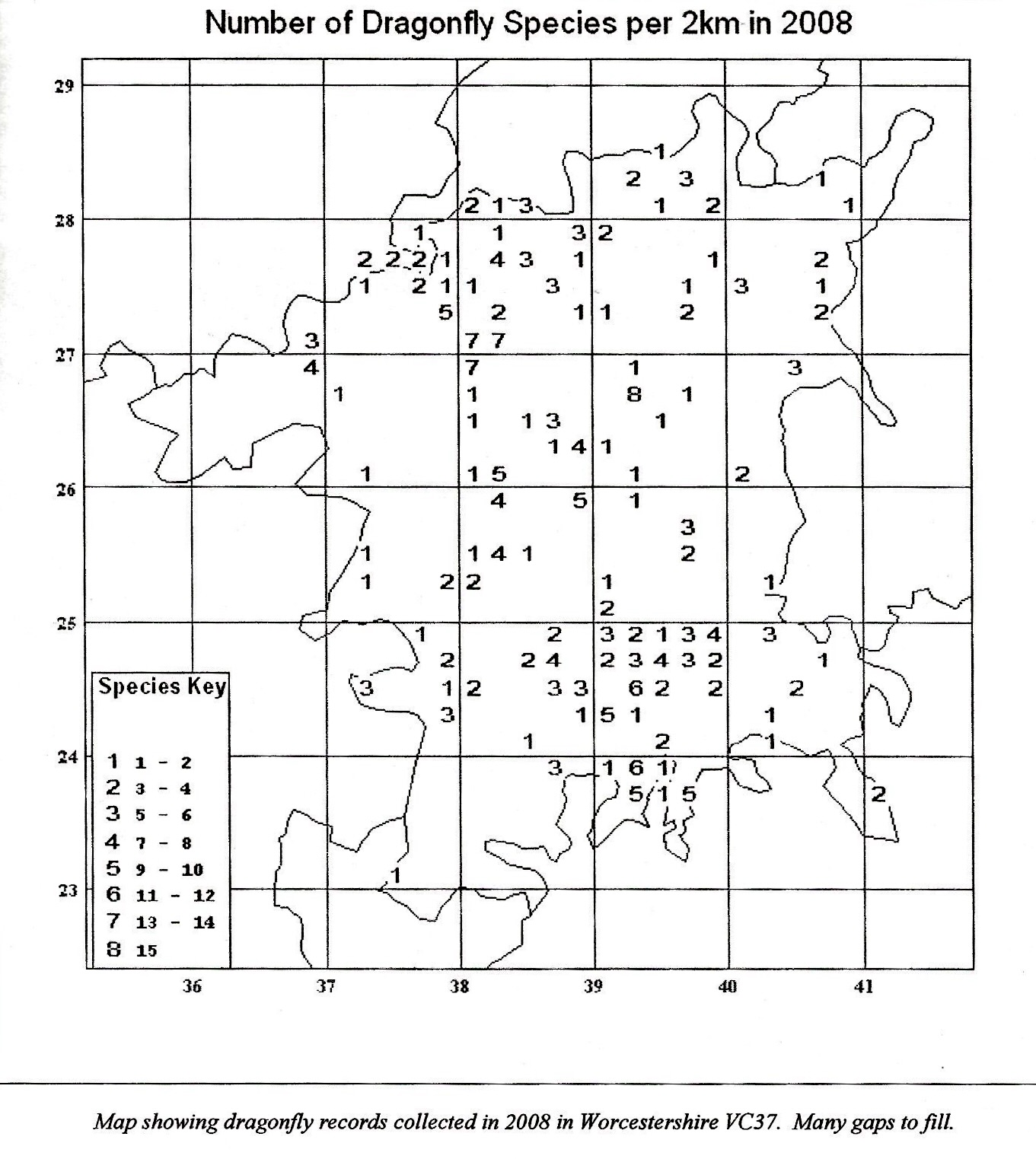
The map shows the number of species that have been recorded at various locations and clearly show the gaps where there are no records as yet and also where there are only a few records so far. Please send your records to me, mike.averill@environment-agency.gov.uk As usual a simple e-mail containing date, NGR, location and species are the minimum but any breeding activity adds a lot to the record, particularly emergence, pairing or egg laying. Number estimates are useful as well. If you would prefer to use a spreadsheet I can send you one.
Coming soon is web based recording system so have a look at the British dragonfly Society recording web page for news of recording on line at http://www.dragonflysoc.org.uk/recording.html
If you are wondering how to get a good representative species list for a site then usually three visits, one in late May, one in late June/early July and August get a good coverage.
Map showing dragonfly records collected in 2008 in Worcestershire VC37. Many gaps to fill.
Worcestershire Record No. 26 April 2009 p. 30
ALERT FOR CYBISTER LATERALIMARGINALIS
John Baker
Cybister lateralimarginalis (the peardrop) is a large dytiscid water beetle found in continental Europe and historically from a handful of sites in Essex early in the 19th Century. Speculation that this species may re-colonise Britain has been proven correct with the recent discovery of Cybister in Lancashire. It would be interesting to find out whether it occurs elsewhere in Britain, so newt surveyors and trappers, please take a closer look at any large dystiscids you may find.
Cybister is a little larger than the familiar great diving beetle, Dytiscus marginalis. However, it doesn´t have the pale border all the way around the pronotum – just around the lateral margins, and it is a smoother shape, and often with a beautiful green sheen. The back legs are very muscular and the beetle can move more rapidly than Dytiscus. Some useful photographs can be seen at www.microcosmos.nl/beet1gal.htm
Please send any records or photos to Professor Garth Foster, Balfour-Browne Club, latissimus@btinternet.com. Even records of “ordinary” Dytiscus would be appreciated so your efforts will be valued whatever the species. If you are just sending photographs, please send some of both the dorsal and the ventral sides as it is the upper part of the rear leg that provides the best characters.
Now and again people send in living beetles expecting them to be sent back. This is possible, but Garth cannot guarantee a good outcome if he is away for a week when the post arrives!
Yours sincerely,
John Baker
Widespread Amphibian and Reptile Project
ARG UK/The HCT
The Herpetological Conservation Trust,
655A Christchurch Road, Boscombe, Bournemouth, Dorset, BH1 4AP.
01986 872016, 07884 441521
www.arguk.org
www.herpconstrust.org.uk
Worcestershire Record No. 26 April 2009 p. pp. 15-17
FUNGAL CHANGES IN WORCESTERSHIRE
John Bingham
Fungi consist of over 12,000 species in Britain, possibly more, and who knows how many in Worcestershire? Normally accepted fungi outnumber plants by a factor of between 5 or 7 times. So in Worcestershire at least 8,000 are possible, although for the larger fungi we might expect to find 2,000-3,000 species?
Fungi are not like insects that spread north in response to a warmer climate. Or like plants that tend appear at a point source and spread steadily outwards along roads or railways. We don’t really know what species we have in Worcestershire. New species may not be new just not recorded for years. Some fungi fruit only once in 30 or even 50 years and even then you need to at the right place at the right time – a matter of a few days to catch many fruiting? Even if you can name a fungus the name will have changed from older records – so it may not be obvious.
Books – you need lots. General guides such as that by Roger Phillips or a single Genus such as David Boertmann on waxcaps Hygrocybe in the Fungi of Northern Europe.
The British Mycological Society on line Fungal Records Database is useful source of up to date information and also Kew has the online Basidomycota checklist. The names in most books are old and may have been updated.
www.fieldmycology.net/FRDBI/FRDBI.esp
www.basidocheck.info/
An ongoing process with new species appearing;
Non native plant introductions will have fungal associations. Exotic trees introduced since 1700 have brought in new fungal species. Extensive conifer planting by Forestry Commission has introduced hundreds of fungi associated with trees. Global trade brings in new species and also spores can drift globally, only needing suitable habitat and substrate. They are normally out-competed by native species but sterile habitats offer opportunity for development, such as wood chip. Global warming is allowing new fungi to colonise, mild winters and hotter summers all help, most need a warm summer for the mycelium to grow well.
The larch bolete Suillus grevillei a common example of an introduced species on conifer trees. Note the dark capped form found in some Forestry Commission plantations – how common is this in Worcestershire?
The oldrose bolete Boletus rhodopurpureus on mature oak in hedgerows or parkland, found in the recent hot summer of 2005 in Herefordshire, is this in Worcestershire and increasing?
Wood chip is now common in many places especially supermarket car parks and similar areas. Look out for native species such as the butter cap Collybia butyrace, magpie Coprinus picaeus, field blewit Lepista saeva and possibly the very poisonous false morel Gyromitra esculenta, a species new to Worcestershire first found near Astley in 2008 on bare sandy soil.
New species for Worcestershire may appear on wood chip and details can be found in British Wildlife Volume 18(2) p.103. Look out for the red Stropharia aurantiaca from Australia or Agrocybe putaminum first described in 1986 at Kew and A. rivulosa from Holland. And finally on wood chip it just might be possible to find the exotic looking Devil’s fingers Clathrus archeri, but please phone me if you do!
Apparently new fungi include the sandy stilt puffball Battarraea phalloides found recently near Bewdley on a sandstone cutting, this could appear on similar habitats around Kidderminster?
Salmon salad Guepina helvelloides an introduction has spread and is scattered in conifer woodlands in Herefordshire and Shropshire but very rare in Worcestershire, it likes forest rides on formerly disturbed ride verges.
The tiered tooth Hericium cirrhatum has appeared at Pipershill Common on the ends of recently felled beech trunks. A southern species that may be here as a result of hot summers or management work at Pipershill?
The stinkhorn var. Phallus impudicus var togatus has not been seen in Worcestershire since 1987, but how many times do people check out the fruitbody from the smell of the stinkhorn fungus. Could climate change provide more veiled stinkhorns?
The powdercap strangler Squamanita paradoxa is a rare parasite on a common grassland fungus – the earthy powdercap Cystoderma amianthinum. It has been rarely recorded in Britain but more records are appearing. I recorded it on the Shropshire side of Wyre Forest in 2007. The acid grasslands of the Malvern Hills commons look ideal habitat.
Less obvious species include red thread fungus Laetisaria fuciformis on grasslands. This appeared in the hot summer of 2007. Could this or similar species affect more grassland if we have hotter summers?
Mild damp winters might give rise to more fungi on insects such as Hymenostible muscaria that occurs on Diptera?
If we have a changing climate the first species to make a serious impact on our flora could be the various rusts, smuts and mildews. These species could become problems especially on sites with a monoculture that would be very prone to attack.
The worst fungi are the unwelcome pathogens that we have already seen at work such as Crayfish Plague, Oak Wilt, Dutch Elm Disease, Horse Chestnut Wilt and Sudden Oak Death, all a result of man’s activities. The Sudden Oak Death Phytophera ramorum and related species are particularly worrying if they take hold in Worcestershire.
Finally; Don’t Panic! Most fungi are harmless or actually quite useful: just remember the useful fungal mychorrizal associations with many of our trees.

- Larch Bolete, Suillus grevillei ©John Bingham

- Oldrose Bolete, Boletus rhodopurpureus ©John Bingham

- Sandy stilt Puffball Battarraea phalloides ©John Bingham

- Tiered Tooth, Hericium cirrhatum ©John Bingham

- Powdered Strangler Squamanita paradoxa ©John Bingham
Worcestershire Record No. 26 April 2009 p. 31
TACHINA URSINA. MEIGEN, 1824. (LOCAL), IN WYRE FOREST
John Bingham
Further to Kevin McGee’s record in the Worcestershire Record No. 23 November 2007 pp. 42-46 of Tachina ursina in Wyre Forest, on the Shropshire side of Dowles Brook on 27 March 2007. I can now report a Worcestershire site for this Tachinid fly within Wyre Forest. This was largely thanks to a chance meeting with Brett Westwood on 15 March 2009 who was out looking for this fly. We both walked to Pound Green Common where I managed to locate one in an open glade. Later on Brett spotted another specimen nearby at Pound Green Coppice.
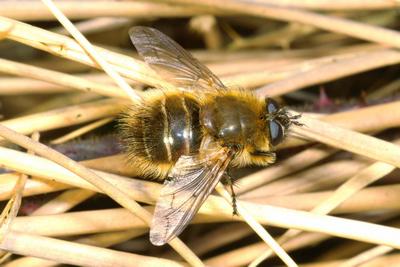
Tachina ursina, picture ©John Bingham
Worcestershire Record No. 26 April 2009 p. 48
KEMERTON CUTTINGS – OCTOBER 2008 – MARCH 2009
John Clarke
Kemerton Lake
In October up to 14 Little Grebe were recorded. 30 Shoveler on 30 and 35 on 31st – along with 2 female Goosander. On 6th October c.100 Coot were present.
Up to 180 Lapwing were present on occasions. Siskin and Redpoll were also recorded with highest counts of 20 Siskin and 8 redpoll on 31st.
On 4th November two Jack Snipe had joined other Snipe – highest counts of six Jack Snipe on 25th and 46 Snipe on 14th. A Green sandpiper was seen on 25th.
Regular sightings of Kingfisher throughout October and November
November/December saw high counts of Wigeon peaking at 1080 on 29th November.
10 Little Grebe on 10th December.
December peak counts of 28 Tufted, Pochard, 650 Wigeon, 9 Teal, 10 Gadwall, 21 Mute Swan, 97 Greylag, three Shoveler, 45 Snipe, four Jack Snipe, 60 Siskin and 20 Redpoll.
An immature female Peregrine was there on 10th December
In January up to 14 Little Grebe were recorded, with numbers of duck dropping sharply.
Raven regular visitor – four on 5th Jan. three Jack Snipe on 13th, 11 Snipe on 16th.
135 Coot were counted on 29th, with 228 Tufted Duck, 19 Pochard, 40 Mallard, 120 Wigeon, 22 Teal,16 Gadwall & four Lapwing.
On 23rd there were 102 Coot, 269 Wigeon, 20 Siskin, Mistle Thrush, 3 Bullfinch and a Jack snipe.
2 Great Black-backed gull on 22nd February
First frog spawn reported on 2nd March and a large frog/toad migration reported across the road towards the lake on 3rd.
On 2nd March 2 Great-crested Grebe, 18 Redwing, five Shoveler and seven Lapwing were present.
two Sand Martins were there on 10th March – also one Jack Snipe.
On 17th there were 42 Tufted Duck, 4 Gadwall, 2 prospecting Oystercatcher, 12 Pochard, 2 Great-crested Grebe, 65 Coot, 92 Wigeon, 14 Shoveler. Water Rail calling. An early Comma butterfly. A female Sparrowhawk was seen to take a Green Woodpecker.
On 19th March there were very large numbers of toad. Small Tortoiseshell and Comma butterflies were seen.
Elsewhere on the estate
A polecat was seen in or near Daffurns Orchard on 11th October
25 Mallard on a pool near Westmancote on 23rd October
20th November – a Marsh Tit and two Redpoll were reported feeding at a bird table in Kinsham.
A dead Water Shrew at Ivy Cottage on 21st December
2nd February 2 Woodcock flushed from a dry ditch in Kemerton.
On 6th February c100 Fieldfare in Daffurns Orchard
16th February Brimstone Butterfly at Ivy Cottage.
!5th March – Comma butterfly plus mating 7-spot ladybirds at Ivy Cottage
19th March Chiffchaff calling in John Moore Reserve.
On 21st March Orange Tip, Peacock and Brimstone Butterflies on wing.
22nd March saw this year’s first Swallow – in Stable Orchard.
Around the area
A pair of Raven was watched displaying in and around a Cedar of Lebanon in Kemerton.
26th December – c.50 Golden Plover in arable field on Bredon Hill.
On 19th March three Wheatear and a Red Kite were seen on the summit of Bredon Hill.
Kemerton Conservation Trust is grateful to all contributors – in particular Rob Prudden.
Worcestershire Record No. 26 April 2009 p. 39
SPOTTED FLYCATCHER – CAN YOU HELP?
An appeal for help from John Clarke
For the past eight years John Clarke has been studying Spotted Flycatchers in villages in south Worcestershire. The bird is in serious decline in Britain – the population has crashed by more than 70% in the past 20 years or so. In Worcestershire this endearing small migrant from southern Africa is now mainly confined to a few villages and the situation is similar in many other counties.
The British Trust for Ornithology receives records of breeding birds from volunteers around the country but there are not enough to provide detailed information about all species. This is particularly true for the Spotted Flycatcher, which in many areas is now breeding almost exclusively in private gardens and orchards where there is no public access.
John’s survey has enlisted the help and cooperation of local communities to locate pairs in the villages and the project has been very successful. Now he would like to find out more about the distribution of the Spotted Flycatcher further afield and he is asking for your help. He would like people to watch for the birds from early May onwards and to see if they are nesting in their garden or local area. They would almost certainly be breeding if you saw evidence of a pair regularly – they have quite a small territory, rarely feeding more than 25-50 metres from the nest site. Their habit of sitting on prominent perches from where they hunt flying insects makes them easier to see than hear as they have a very week song.
John has set up an email address or you can send information by post (see below). Once you have located a pair all that he requires is that you tell him the 6-figure Ordnance Survey grid reference for your sighting, the date that you found the pair and your name and address so that he can produce a distribution map – for example:
Spotted Flycatcher record
Joe Bloggs – The Granary, Goddlethorpe, Worcs. – OS ref BC765 432 – 6/6/09.
If you can watch your nest without disturbing the birds and note the outcome – how many young fledge, how many broods etc – John will always be interested in extra information and observations but the above details are the critical requirement. If you have two or more pairs in your area it would be good to get separate records – Spotted Flycatchers often nest in ‘clusters’ in one area of a village so where there is one pair you may find others. Perhaps your neighbours have another pair? Have they nested near you in the past two years – that would also be important information. You could also help by putting a small note about the survey, with details of what is required, in your local Parish Magazine.
John hopes to use the information to gain a better understanding of where the remaining population of birds choose to breed. He is hoping that people from several counties will take part and would appreciate your help.
Email address: flycatcherdata@googlemail.com
Postal address: Ivy Cottage, Kemerton, Tewkesbury, GL20 7HY

Spotted flycatchers not infrequently use old nests of other birds. John Clarke has found they readily use half-coconut shells as shown above. A shell fixed in a suitable place in a creeper may well be used. |
 |
| Spotted Flycatcher nest © John Clarke | Spotted Flycatcher © John Robinson |
Worcestershire Record No. 26 April 2009 p. 35
JACKDAWS AND WALNUTS
Dave Cunliffe
I watched two Jackdaws (presumably a pair) with a walnut yesterday (18th March 2009). There is a walnut tree in a garden not far away and we frequently have empty walnut shells on our lawn. I thought it was due to grey squirrels, which we occasionally see. One Jackdaw flew down onto our lawn (in Hanley Swan) with a walnut in its beak. The second remained on a branch about six feet away, watching. The first bird positioned the nut on the grass with the “seam” uppermost and then, holding the nut with one foot, bashed it with its beak until the shell began to split. Meanwhile, the blows were forcing the nut into the lawn surface, perhaps making the nut easier to manage. Once the nut had split sufficiently, the bird inserted its beak and forced the shell open with further blows and leverages until the nut fell into two halves. It then began to eat the nut from one half while its “partner” flew down alongside and ate the other half quite amicably.
[Editor’s note. When I read the original of Dave’s comment on the Malvern bird egroup I was intrigued and after a little research wrote to him as follows: “I’ve look at BWPi and British Birds (100 years on disc, BBi) and have not found any direct reference to the behaviour you describe. In the vast collection of Notes published for many years in British Birds there is almost always reference to something you have seen and think is new! Not this time! However under the section on Food BWP does list walnuts and Jackdaws are well-known for holding food with a foot while they attack it. Also walnuts are now germinating or will be soon and presumably easier to break open when this happens”.Worcestershire Record No. 26 April 2009 pp. 45-46
SOME BREEDING LOCATIONS OF CORN BUNTING EMBERIZA CALANDRA IN WORCESTERSHIRE
Steve Davies
As my interest in this species has developed, I have visited any areas that I suspect may still hold breeding Corn Buntings. Some of the sites listed in Table 1 are well-known to subscribers to the Worcesterbirding website which receives regular reports on this species presence at Shenstone. Other sites may not be so well-known. Some of these records have come from my study site at Wick, while a few have been picked up on Timed Tetrad Visits (TTVs) during BTO Atlas fieldwork.
| Year | No. of singing males | Grid Reference | Location | W or w/s |
| 2006 | 1 | SO865748 | Harvington | w |
| 2007 | 1 | SO871743 | Harvington | w |
| 2007 | 1 | SO968464 | Glenmore Farm, Wick | w |
| 2007 | 8 | SO971454 | Wick Grange Farm, Wick | w |
| 2007 | 2 | SO898506 | Near Littleworth | w |
| 2008 | 2 | SO826625 | Holt Heath | w |
| 2008 | 7 | SO971454 | Wick Grange Farm, Wick | w |
| 2008 | 1 | SO968458 | Glenmore Farm, Wick | w |
| 2008 | 1 | SO898507 | Near Littleworth | w |
| 2008 | SO934466 | Allesborough Hill | w | |
| 2008 | 6 | SO856737 | Shenstone | w |
| 2008 | 4 | SO986434 | Bricklehampton | w |
| 2008 | 1 | SO893816 | Iverley | w/s |
| 2008 | 3 | SO862818 | Turbine Cottage | w/s |
| 2008 | 1 | SO875851 | Stourton | w/s |
| 2008 | 1 | SO972480 | Throckmorton Landfill | w |
Table 1. Locations of singing male Corn Buntings.
Key: (w) Worcestershire, (w/s) Worcestershire/Staffordshire border
Interestingly, while enjoying the song of the male Corn Bunting as detailed in the first registration of the above list, I also recorded the song of a Wood Warbler Phylloscopos sibilatrix in Fenny Rough (SO867751). There can’t be many locations where hearing songs from these two species could be possible. I digress!
Appeal for information
How many Corn Buntings are there still breeding in Worcestershire? Clearly there is a need to know. I would very much like to formulate an accurate status for the species. If you know of any remaining breeding populations or areas where they are known to overwinter I’d be extremely grateful if you could please pass on the information. Or maybe you could increase the numbers at the locations that I have mentioned above. I would also welcome records from the past and any anecdotal accounts of their presence on farmland.
Worcestershire Record No. 26 April 2009 pp. 43-44
WINTER FARMLAND BIRD COUNTS AT WICK GRANGE FARM AND GLENMORE FARM IN 2007/8 – A TALE OF TWO METHODS
Steve Davies
Introduction
Following territory mapping for Corn Buntings and breeding season bird counts carried out at Wick Grange Farm at Wick near Pershore in 2007, we wanted to know more about the numbers and species of birds that used the habitat during the winter period October to March. Overwinter stubbles were available on both farms, weed seeds were available in the wildflower margins, and well established hedgerows were present at Wick Grange Farm. There were good areas of game crop on Glenmore land. We were optimistic that the counts would give good returns. Additionally, following my (SD) comments made on the capture and colour ringing of Corn Buntings to identify individual males within the population, and the possibility of tracking their movements in Worcestershire Record 23 (Davies 2007), I was very pleased to receive a response from Peter Holmes offering to set up a ringing scheme at the study site. Peter has a keen interest in farmland birds and has other farmland sites on which he has a ringing scheme. He was also most enthusiastic at the opportunity to ring Corn Buntings. There were now two methods available to us to monitor use of the habitat by birds. Once permission was granted by Tom Meikle, Wick Grange Farm (WGF), and Rob Kings, Glenmore Farm (GF), to carry out these operations on their holdings, we went to work.
Method
Counts made on farmland walks
Steve Davies
The bird counts would be made in the period October –March avoiding the first and last hour of daylight to reduce the risk of counting birds moving to and from roost sites. Survey visits could be of as long a duration as I had the energy to continue! I would aim to make a walk at least once a fortnight throughout this period. Similar to BTO Atlas methodology I would not have to stick to the same route on each visit, sampling each habitat type was to be the order of the day in a “look-see” type of methodology. Due to the dynamic movements of flocks as resources become depleted, birds could potentially be in different locations on each visit.
Counts were recorded in a field notebook with the location of large concentrations of birds noted so that Peter could make a well-informed choice for placement of his mist nets in areas where there were good concentrations of birds. At the end of the winter period I would be able to highlight the maximum numbers of each species encountered at Wick. Because both farms share a common boundary (see other articles in this issue of Worcestershire Record) and birds will use resources of food and shelter either side of this I have not given a separate treatment to each individual farm but combined counts for the two. After all birds do not recognise such boundaries and seek to find forage and safe refuge wherever it is to be found.
A total of 10 farmland walks to make bird counts were made, including both early and late visits required for the BTO Atlas, during the winter period 2007/8. The duration of visits ranged from one hour twenty minutes and six and a quarter hours, giving a total observer effort of 27 hours and 45 minutes. The longer sessions were on days when ringing was in progress.
The ringing scheme
Peter Holmes
After an initial assessment, I opened up some existing gaps in the hedge, just wide enough to allow a 6 metre long mist net through. These gaps were in areas where farmland birds, and particularly Corn Buntings, had been congregating. However the first couple of visits in February trapped no individuals of the key farmland species, although I did catch several tits, Robins, Dunnocks and Blackbirds.
 |
| Figure 1. Corn Bunting trapped for ringing |
Following a re-think, and some e-mail correspondence with groups who had success in catching Corn Buntings, I started to bait two 120 metre sections of hedge bottom with white millet. This was exceptionally successful for Yellowhammers, Reed Buntings and Chaffinches (see totals), but not Corn Buntings. Several male Corn Buntings were singing nearby, but they showed no interest in the bait.
Having had no success trapping Corn Buntings in the winter, I got a permit to try tape-luring males in the summer. This was marginally more successful – many days of trying led to a single Corn Bunting captured and colour-ringed! (see Fig. 1)
I again tried baiting in the autumn to see if Corn Buntings were more responsive then. They weren’t! although many Yellowhammers were caught, including several returns from spring 2008.
After a full year of trying, I am no nearer a successful method of catching numbers of Corn Buntings. But the number of other farmland birds, especially Yellowhammers, Linnets and Chaffinches, makes it worth continuing the ringing operation. Linnet numbers are particularly high, and I will more specifically target them next winter. Any Corn Buntings caught will be incidental!
Results
Table 1. Maximum counts of birds derived from winter farmland walks in 2007/8. Maximum counts of individuals from ringing data – bold in parentheses.
| Little Grebe |
Tachybaptus ruficollis |
2 |
| Cormorant |
Phalacracorax carbo |
2 |
| Grey Heron |
Ardea cinerea |
1 |
| Mute Swan |
Cygnus olor |
8 |
| Greylag Goose |
Anser anser |
2 |
| Canada Goose |
Branta canadensis |
150 |
| Mallard |
Anas platyrynchos |
2 |
| Buzzard |
Buteo buteo |
1 |
| Sparrowhawk |
Accipiter nisus |
1 |
| Kestrel |
Falco tinnunculus |
1 |
| Peregrine Falcon |
Falco peregrinus |
1 |
| Red legged Partridge |
Alectoris rufa |
2 |
| Pheasant |
Phasianus colchicus |
2 |
| Moorhen |
Gallinula chloropus |
5 |
| Golden Plover |
Pluvialis apricaria |
6 |
| Lapwing |
Vanellus vanellus |
500 |
| Black headed Gull |
Larus ridibundus |
6 |
| Lesser Black backed Gull |
Larus fuscus |
57 |
| Woodpigeon |
Columba palumbus |
55 |
| Stock Dove |
Columba oenas |
15 |
| Collared Dove |
Streptopelia decaocto |
2 |
| Green Woodpecker |
Picus viridis |
3(1) |
| Great Spotted Woodpecker |
Dendrocopus major |
2 |
| Skylark |
Alauda arvensis |
104 |
| Meadow Pipit |
Anthus pratensis |
44 (8) |
| Pied Wagtail |
Motacilla alba |
3 (1) |
| Dunnock |
Prunella modularis |
5 (13) |
| Wren |
Troglodytes troglodytes |
6 (6) |
| Robin |
Erithacus rubecula |
8 (9) |
| Stonechat |
Saxicola torquata |
2 |
| Fieldfare |
Turdus pilaris |
300 (4) |
| Blackbird |
Turdus merula |
1230(8) |
| Song Thrush |
Turdus philomelos |
7 (2) |
| Mistle Thrush |
Turdus viscivorus |
2 |
| Redwing |
Turdus iliacus |
120 (3) |
| Long tailed Tit |
Aegithalos caudatus |
8 (3) |
| Coal Tit |
Periparus ater |
1 |
| Blue Tit |
Cyanistes caeruleus |
13(12) |
| Marsh Tit |
Poecile palustris |
1 |
| Great Tit |
Parus major |
9 (9) |
| Treecreeper |
Certhia familiaris |
1 |
| Jay |
Garrulus glandarius |
1 |
| Magpie |
Pica pica |
10 |
| Jackdaw |
Corvus monedula |
100 |
| Rook |
Corvus frugilegus |
159 |
| Carrion Crow |
Corvus corone |
28 |
| Raven |
Corvus corax |
2 |
| Starling |
Sturnus vulgaris |
100 (10) |
| House Sparrow |
Passer domesticus |
47 |
| Chaffinch |
Fringilla coelebs |
30 (38) |
| Brambling |
Fringilla montifringilla |
2 |
| Greenfinch |
Carduelis chloris |
17 |
| Goldfinch |
Carduelis carduelis |
48 (2) |
| Linnet |
Carduelis cannabina |
100 (12) |
| Yellowhammer |
Emberiza citrinella |
40 (115) |
| Reed Bunting |
Emberiza schoeniclus |
5 (37) |
| Corn Bunting |
Emberiza calandra |
12 |
|
Total species seen |
57 |
|
|
Total species ringed |
19 |
Discussion
The larger species of birds such as wildfowl, raptors, corvids, waders and gulls can be counted on walks with confidence as they are of low population density or are easily detectable due to their size or their foraging behaviour. Therefore, “look-see” counts can be considered accurate for these species.
Conspicuous by their absence from the above list, are nocturnal species: Barn Owl Tyto alba, Tawny Owl Strix aluco, Woodcock Scalopax rusticola. Future winter recording visits will incorporate nocturnal forays to encounter these species.
In the ringing scheme the approach must be tailored to the group of species that you wish to target. Corn Buntings proved to be difficult despite the species being found in flocks of up to 12 individuals and observed associating with other bunting species. It is unlikely that you will trap Skylarks in a net set up through a gap in a hedgerow, although another bird of open grassland, Meadow Pipit, was represented in the dataset by eight individuals.
While farmland bird counts can give a series of “snapshots” of the birds present on each visit, they can never tell us how many birds actually use the habitat throughout the survey period. Here the ringing data can give some quite staggering returns. Peter was surprised at the number of Yellowhammers (see table 1.) he succeeded in capturing and ringing. The same was to be said for Reed Bunting (see Table 1.), both species were more accurately monitored by ringing than by counts. This is almost certainly true for all small graminivorous passerines of flocking habit. These figures could potentially have been a lot higher if the ringing scheme had been started in October.
Conclusion
Both methods on their own merits provide a huge amount of information on farmland birds, but both have obvious limitations. When observer counts and an intensive ringing scheme are used in conjunction at a study site we begin to gain a much more accurate insight into what movements are going on there. These figures at the local level also reinforce the importance of overwinter stubbles, set-aside and game crop as overwinter food resources for farmland gramivores. The habitat quality for wintering birds is quite obvious at this site and is thanks to the efforts of Tom and Rob farming sympathetically for farmland birds. If more landowners could also engage with similar practice surely these “islands” of great biodiversity could expand into the wider countryside and encourage greater dispersal of these species. Will the loss of set-aside in 2008 in the surrounding farmland habitat have a deleterious effect on the birds at this site? We shall have to continue monitoring over the next couple of years to see. Add to this the possibility of future retraps of surviving adults, the value of ringing birds to aid conservation strategy and policy making must never be underestimated.
Worcestershire Record No. 26 April 2009 pp. 44-45
WINTER FARMLAND BIRD COUNTS AT WICK GRANGE FARM AND GLENMORE FARM IN 2008/9
Steve Davies & Peter Holmes
Introduction
Repeating the methodology employed in the winter of 2007/8 walks making counts of birds using the habitat at these two farms were made between October and March. The winter ringing scheme commenced earlier than 2007/8 in October. Table 1 shows the results of this winter’s efforts.
A total of nine farmland walks were made to count birds over the winter period 2008/9. The duration of visits ranged from one hour to four hours, giving a total observer effort of 18 hours and 20 minutes.
Results
Table 1. Maximum counts of birds derived from winter farmland walks in 2008/9. Maximum counts of individuals from ringing data bold in parentheses. “Retraps” indicate the number of birds previously ringed in 2007/8 and recaptured.
| Mute Swan | 17 |
| Greylag Goose | 34 |
| Canada Goose | 72 |
| Barnacle Goose Branta leucopsis | 1 |
| Shelduck Tadorna tadorna | 1 |
| Teal Anas crecca | 24 |
| Mallard | 15 |
| Shoveler Anas clypeata | 4 |
| Red legged Partridge | 30 |
| Pheasant | 7 |
| Cormorant | 2 |
| Grey Heron | 2 |
| Hen Harrier Circus cyaneus | 1 |
| Sparrowhawk | 2 |
| Buzzard | 3 |
| Kestrel | 2 |
| Moorhen | 3 |
| Lapwing | 21 |
| Snipe Gallinago gallingo | 1 |
| Curlew Numenius arquata | 1 |
| Black headed Gull | 20 |
| Lesser Black backed Gull | 20 |
| Feral Pigeon Columbia livia | 10 |
| Stock Dove | 28 |
| Woodpigeon | 338 |
| Collared Dove | 8 |
| Barn Owl Tyto alba | 1 |
| Litle Owl Athene noctua | 2 |
| Kingfisher Alcedo atthis | 1 |
| Green Woodpecker | 2 (retraps 1) |
| Great Spotted Woodpecker | 2 |
| Skylark | 26 (1) |
| Meadow Pipit | 20 (9) |
| Pied Wagtail | 11 |
| Wren | 5 (1) |
| Dunnock | 20 (36/retraps 2) |
| Robin | 18 (6) |
| Stonechat | 2 (1) |
| Blackbird | 22 (10/retraps 1) |
| Fieldfare | 100 (1) |
| Song Thrush | 9 (2) |
| Redwing | 30 (9) |
| Mistle Thrush | 3 |
| Chiffchaff Phylloscopus collybita | 1 |
| Goldcrest Regulus regulus | 1 |
| Long tailed Tit | 3 (13) |
| Coal Tit | 1 |
| Blue Tit | 10 (4) |
| Great Tit | 6 (2) |
| Jay | 1 |
| Magpie | 5 |
| Jackdaw | 41 |
| Rook | 400 |
| Carrion Crow | 42 |
| Raven | 2 |
| Starling | 30 (2) |
| House Sparrow | 32 (1) |
| Chaffinch | 300 (87) |
| Greenfinch | 33 (24) |
| Goldfinch | 28 (1) |
| Siskin Carduelis spinus | 1 |
| Linnet | 600 (42) |
| Bullfinch Pyrrhula pyrrhula | 1 |
| Yellowhammer | 40 (81/retraps 11) |
| Reed Bunting | 3 (22/retraps 7) |
| Corn Bunting | 6 |
Total species seen – 66 Total species ringed – 22
Discussion
Farmland walk counts
High counts of swans, ducks and geese were recorded on 03/01/2009. These were typical cold weather movements as waterbirds sought waterbodies that were free from ice which affected still waters such as those at Lower Moor on the other side of the river. Swans and geese grazed on the riverside grassland and ducks loafed on the riverbank or dabbled at the waters edge.
Barn Owl was included because of the presence of freshly deposited pellets below a known roost site. PH was fortunate enough to see the Hen Harrier that had stayed in the area for a short time on one of his ringing visits, this scarce species hunting at the study site was duly added to the list.
Huge numbers of Linnets and Chaffinches (see Table 1) were recorded chiefly in the area of game crop next to Glenmore Farm house but these numbers decreased towards the end of the recording period. Yellowhammers continued to find the hedgerows on Wick Grange Farm to their liking, but Corn Bunting proved to be elusive only showing twice during survey visits.
Conclusion
To summarise, another winter of healthy numbers of farmland indicator bird species must surely bode well for them at Wick Grange Farm and Glenmore Farm.
Worcestershire Record No. 26 April 2009 pp. 40-42
HOW MANY MALE CORN BUNTINGS EMBERIZA CALANDRA HOLDING TERRITORY ON WICK GRANGE FARM AND GLENMORE FARM IN 2008?
Steve Davies
Introduction
During the breeding season of 2007, I conducted a territory mapping study of Corn Buntings at Wick Grange Farm near Pershore (Davies 2007) in order to attempt to ascertain the number of male Corn Buntings holding territory on this intensive farm. A total of 8 males were assigned to territories on Wick Grange Farm, with an additional single male holding territory on neighbouring Glenmore Farm.
With the kind permission of wildlife friendly farmer Tom Meikle, who runs Wick Grange Farm, I was able to make a repeat study in 2008 to identify any decline or increase in the number of Corn Bunting territories between years using the results from 2007 as an index. Rob Kings from Glenmore Farm was also keen to know if Corn Buntings were present on his farm in 2008 and also allowed me access to his land.
Due to the rotation of crops within the study site I expected the locations of territories to differ between years. It was fortunate that I had recorded the territorial males on Glenmore Farm in 2007 because I had a datum point from which to monitor a larger sample of the local population. This would also allow for any movement of birds between farms due to changes in cropping/stock regimes. I would be able to record birds present on both farms. As long as I followed the same survey route as in 2007 (see Fig.1) this would be valid.

Population trends calculated for this species by the British Trust for Ornithology (BTO) suggest a drastic long-term population decline of 89% between 1970-2005. Of great concern is the short-term trend, again derived from BTO sources, of 39% between 1994-2006 (RSPB 2007). These trends highlight the continuing decline of Corn Buntings on UK farmland, despite the species being in the UK Biodiversity Action Plan (BAP) to reverse the declines of lowland farmland birds.
Method
Consistency of methodology is the key to making accurate comparative studies between two sets of data. Therefore, the same survey techniques were employed as in 2007, with territory mapping using song registrations of male Corn Buntings to assign territory. Simultaneous song registrations would again be the strongest evidence of individual territories. I recorded the songpost type and its location as this would aid my recognition of individual territories on each visit and would prove to be a valuable tool when assigning territories.
All other Corn Bunting activities were also recorded on a simple map of the study area according to BTO Common Bird Census (CBC) protocol. The methodology requires five visits for a single target species (Bibby et.al) made during the breeding season. The route taken in both years is shown in Fig.1.
Duplicating last year’s recording visits, four territory mapping sessions were carried out between 7 and 11 am in the morning during the peak period of bird activity and were of 2-2½ hours duration. One evening visit was made commensurate with last breeding seasons study (see Table 1). Each visit consisted of a walk around the study site following the same route taken in 2007 which gave good audio and visual acuity, ensuring all areas of the study site were covered. The open nature of the fields alongside the farmtracks allowed an adequate field of view to pinpoint the source of any song registrations with the aid of a good quality pair of 8×42 binoculars. This was proven last year by the registration of the singing male on Glenmore Farm at a distance of approximately 300m (Davies 2007). Windy, wet weather was avoided, as this reduces bird activity.
| Visit | Date | Time (hrs BST) |
| A | 18/05/2008 | 07.30-10.00 |
| B | 02/06/2008 | 08.30-10.30 |
| C | 01/07/2008 | 07.30-10.00 |
| D | 26/07/2008 | 16.30-19.00 |
| E | 04/08/2008 | 07.30-10.00 |
Table 1.The dates and times of the recording visits
All territory mapping visits were to be made during the peak period of breeding activity between the end of May and the middle of August. This may seem to contradict CBC methodology which advises that territory mapping should be completed no later than the middle of July (Bibby et.al 2000). The methodology has to be tweeked slightly owing to the breeding biology of Corn Buntings. They nest late in the season and are known to be double or treble brooded(Harrison 1975), with young still in the nest as late as September.
I have dispensed with a description of the species in this article and advise the reader to look up my article in No. 23 of Worcestershire Record (Davies 2007) or Mullarney et.al (1999) should you need to know what a Corn Bunting looks and sounds like!
Results
The data from all five mapping visits were transferred onto a master copy for analysis. Each Corn Bunting song activity was designated a visit letter: A, B, C, D, or E. Once transfer of data was completed, clusters of registrations were used to assign territories according to CBC conventions (Bibby et.al 2000).See Fig.2.

Clusters of registrations suggest that there were a minimum of seven male Corn Buntings holding territory in the study area, with the single registration near Hopney Cottages making a tentative eighth
A variety of songpost types selected by males were noted; telegraph wires, isolated trees, hedgerows, hedgerow trees, concrete fence posts and wooden stumps.
The majority of song registrations were recorded from areas where the principal habitat components were wheat, barley, hedgerows and field margins. Brown & Grice (2005) consider wheat and barley to be the optimal crop types for nesting Corn Buntings in the U.K. Comparison of territories in relation to crop types can be made between the two years of the study by comparing the summary of territories (see Fig.2) and crop map (see Fig.3) for 2008 with their counterparts from 2007 (see Figs. 4&5).


Discussion
I will reiterate the criteria to apply when assigning territoriality.
- The incidence of simultaneous registrations (on visit B simultaneous registrations were recorded of two and four males respectively, giving a total of 6).
- Those birds that were of sufficient distance from other singing males as to be considered holding separate territory.
- The use of a particular songpost on more than one occasion.
- The consistency of the route taken on each survey visit.
It would appear that there has been a decline of one Corn Bunting territory in 2008. One less male may seem small beer, but when you consider that this is a Red-listed species of conservation concern (RSPB 2007), and when the results compared with those of 2007 an 11% decline is shown we must be very concerned indeed. No comprehensive mapping study of the site for Corn Buntings has been carried out before the 2007 study other than a representative from the RSPB taking a walk around Wick Grange Farm some years ago, and reported four males singing. On a cautious note I would say that numbers have increased since the RSPB visit due to the planting of wildflower field margins on Wick Grange Farm which provide nest sites and the vital resource of plentiful invertebrates for provisioning nestlings. The Recorders field visit in June 2007(Worcestershire Record 2007) produced an extensive list of grassland Lepidoptera from the wildflower margins, and from my own observations over the past two years Lycaniidae and Satyridae butterflies are present in large numbers.
Rob Kings at Glenmore Farm has entered the Countryside Stewardship Scheme and has created beetle banks. Rob also intends to leave field margins to improve the farmland habitat for the species. With game crop present in some of his fields, an additional resource benefits farmland granivores during winter enhancing overwinter survival. This is good news for Corn Buntings given their small population size and their sedentary behaviour. Donald (2002) gives a mean natal dispersal of just 2.4km from an albeit small sample of recovered UK ringed birds, therefore it is vital to expand these isolated islands of optimal habitat to prevent the disappearance of this species so that they do not follow the depressing trend found throughout the U.K and Ireland.
Conclusion
As I have completed my second breeding season study of Corn Buntings at these farm sites, I am pleased to report the continuing presence of “the fat bird of the barley”. It is difficult for somebody born in the 1960s, such as myself, to comprehend the scale of the decline of Corn Buntings, a species once considered a farmland pest (Shrubb 2003). The most similar decline that I have physically been aware of is that of Tree Sparrow Passer montanus (long-term trend 1970-2005 decline of 93%/short-term trend 1994-2006 decline of 97%(RSPB 2007)) once a ubiquitous bird of farmland habitats in Worcestershire and suffering a more disastrous population crash than the subject of this study. It’s not all doom and gloom: if Corn Buntings keep a toehold in this part of the county there is always the chance of a recovery, thanks to the sympathetic farming practices going on. I look forward to recording Corn Buntings again in 2009.
Acknowledgements
I would like to thank Tom Meikle and Rob Kings for allowing me to carry out this study on their farms, and for their keen interest in farmland birds.
References
 |
BIBBY,C.J.,BURGESS,N.D.,HILL,D.A.,MUSTOE,S.H. 2000. Bird Census Techniques.2nd ed.Academic Press. |
|
BROWN,P.,GRICE,A. 2005.Birds in England.T&A.D.Poyser,London, U.K. |
|
DAVIES, S 2007.How many male Corn Buntings (Emberiza calandra) holding territory on Wick Grange Farm? Worcestershire Record 23:28-30. |
|
DONALD,P.F.2002.Corn Bunting Millaria calandra. In: The Migration Atlas: The Movements of the Birds of Britain and Ireland. Eds.Wernham,C., Toms,M., Marchant,J., Clark,J. &Baillie,S.T. A.D.Poyser, London,U.K. |
|
HARRISON,C 1975. A field Guide to the Nests, Eggs and Nestlings of British and European Birds.Collins, London, U.K. |
|
MULLARNEY,K.,SVENSSON,L.,ZETTERSTROM,D & GRANT,P.1999.Collins Bird Guide.Harper Collins, U.K. |
|
RSPB 2007.The State of the Nations Birds 2006. RSPB, Sandy, Beds, U.K. |
|
SHRUBB,M.,2003. Birds, Scythes and Combines: A History of Birds and Agricultural Change. Cambridge University Press. |
Worcestershire Record No. 26 April 2009 p. 8
WHICH WILL BE THE NEXT SPECIES OF ORTHOPTERA TO HOP OVER THE BORDER INTO WORCESTERSHIRE?
Gary Farmer
Of the established (native) species the most likely candidate for range expansion into our county is one of the country’s most spectacular insects, the Great Green Bushcricket Tettigonia viridissima. This species is large and noisy and in recent years has been spreading northwards and inland from its south coast strongholds. It is a common insect along the south coast of England and parts of South Wales but is known to be spreading through Gloucestershire and so will hopefully reach the south of Worcestershire in the near future.
Another species to look out for and a recent addition to the British list is the Southern Oak Bushcricket Meconema meridionale. This species is very similar to the common Oak Bushcricket Meconema thalassinum but it has short wings. Because of its inability to fly it is likely to take some time to reach Worcestershire but it is heading this way so keep an eye out for short-winged Oak Bushcrickets in the Autumn.
Identification:
Great Green Bushcricket
Dark green with a brown dorsal stripe. Wings extend well beyond the tip of the abdomen in adults. The female’s large size (around 50mm long) is exaggerated by her long straight ovipositor. The male’s song is a loud harsh rattle that can be heard some way off.
Southern Oak Bushcricket
Pale green with a yellow dorsal stripe. Wings are very short and there are no hard pads for producing song. Like its relative the Oak Bush Cricket this insect sings by stamping on a leaf producing a barely audible ‘drum-role’.
Photographs and more information can be found at www.orthoptera.org.uk

- Great Green Bushcricket ©Gary Farmer

- Great Green Bushcricket which arrived in Worcestershire on the front of a car from Devon! Picture ©Harry Green
Worcestershire Record No. 26 April 2009 p. 21
RAVENS AND CEDAR OF LEBANON
Harry Green
 |
| Raven’s nest on radio mast © Shaun Micklewright |
In recent years the numbers of Ravens seen throughout Worcestershire has increased dramatically. But where are they nesting? In a few quarries no doubt but there are so many Ravens about that they must, presumably, be nesting in trees or on buildings. But where? Ravens are often very early nesters and in the fastnesses of Wales are known to nest on cliffs and in trees with snow on the backs of incubating birds!
I am now fairly sure they nest in woodlands throughout the county. For instance they are seen regularly in the Drakes Broughton woods and in Tiddesley Wood, near Pershore, and I have seen them moving between these two woodland blocks. A good few years ago we were fairly sure they nested in the very tall Wellingtonias Sequoiadendron giganteum in Shrawley Wood.
Ravens are now seen quite often around villages and John Clarke has suggested they may be using the big Cedars of Lebanon Cedrus libani which often occur in churchyards, the grounds of large country houses, and in parklands (there is a famous avenue at Madresfield Court). As far as I know we do not have proof of this (although John may have secrets!) so I suggest a bit of lurking in these places to try and find proof of nesting would be interesting. The great flat ‘table tops’ of some of the old trees may appeal to Ravens
I write this partly because Ravens are certainly one of my favourite birds but also because it would be very useful to have confirmation of breeding for the BTO Atlas for which we are all collecting data. So if any reader finds evidence of breeding of Ravens I would be very pleased to hear from them.
Amongst my files I found this picture sent to me several years ago by Shaun Micklewright. Expand your searches to pylons and mobile phone masts!
Worcestershire Record No. 26 April 2009 p. 34
HORNET STORIES
Compiled by Harry Green
[This collection of notes should have appeared in Worcestershire Record No 23 November 2007. I re-found the files on my computer after Roger Umpelby recently enquired about its fate! How it got missed is a mystery – many apologies. Updates and hornet stories welcome! Ed]We have been collecting information about hornets and have published a variety of accounts in Worcestershire Record in recent years. Hornets have increased in numbers and extended distribution in the last five years or so and can now be seen regularly throughout Worcestershire. They may perhaps face a shortage of suitable nest sites which are naturally hollows and holes in trees though the often use building and they are not unusual in house roof spaces. There have been an increasing number of instances of hornets nesting in tit nest boxes and bat boxes. These sites are far too small for a typical hornet nest and the insects quite often build extensions on the outside of the box exposed to weather conditions which does seem odd behaviour.
The majority of hornets are peaceful and pay no attention to people. Nests can usually be approached closely and observed – the hornets simply fly round the observer. However we did publish a report of a maverick nest in Trench Wood where the workers developed a habit of attacking any person who approached the nest (Tilt). Also Simon Walker, who works for Natural England in Wyre Forest, was badly stung a few years ago and needed urgent hospital treatment. (Sadly Simon died recently from cancer – long after this note was written). This year (2007) I have heard of another nest of aggressive hornets in Monkwood near Grimley but to date have no confirmatory evidence apart from a comment from Hamish Tompson at the Worcestershire Wildlife Trust along the lines of “I ran like hell down the track away from the nest!). I think he did get stung.
I have received a few reports of queen hornets over-wintering in bird nest boxes so if you are clearing boxes in winter it would be advisable to wear gloves and look carefully because hornet stings do hurt like a bad wasp string.
What follows is first a report on very specific hornet behaviour from Roger Umpelby followed by more information on the use of nest boxes by hornets. I shall be pleased to receive more hornet stories. If nest boxes are used it would be useful to know how many were used and whether a brood of tits fledged successfully before the hornets took over the box
HORNETS – WHAT DO THEY DRINK?
Roger Umpelby
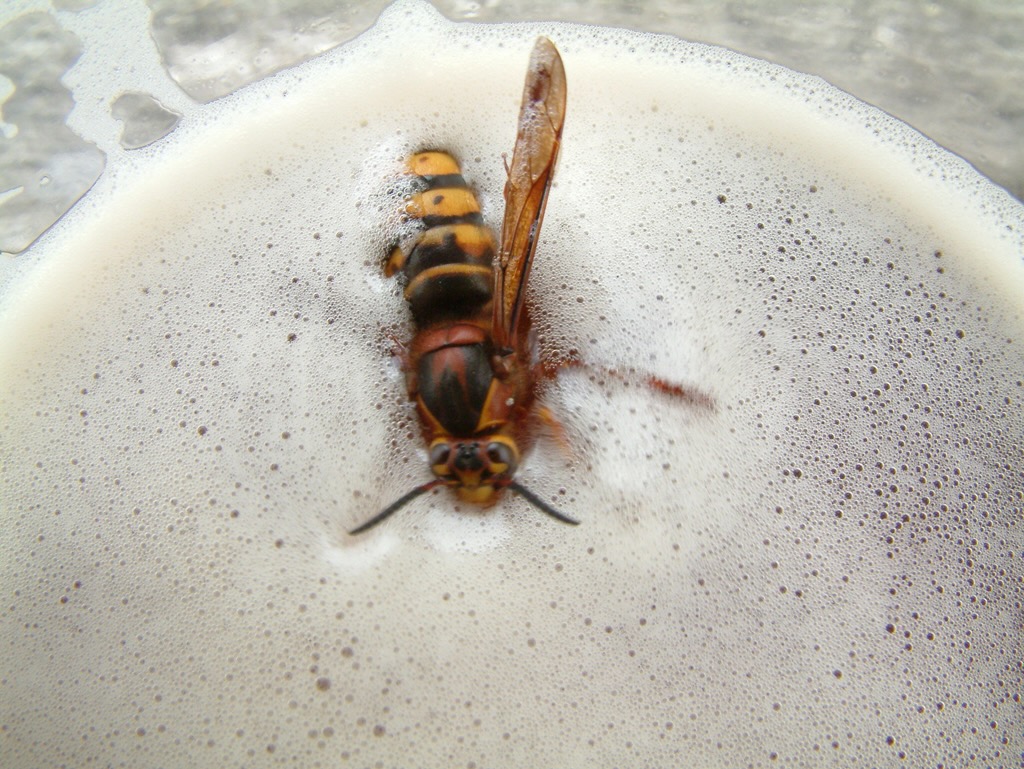
Hornets obviously have very discerning taste as the two photographs below show. The first hornet found Donnington SBA totally irresistible; the second one was more cautious, but returned time and again to check the Youngs’ bottle-conditioned Kew Ale. They clearly prefer real ale because I’ve never seen them anywhere near lager! An idea for a survey perhaps?

HORNETS IN NEST BOXES
Jennifer Smith wrote:
Hornets in Chaddesley Wood, near Bromsgrove.
One of my PhD supervisors recently brought my attention to the article you wrote concerning hornets in nest boxes. My PhD involves 288 nest boxes in Chaddesley Wood, Worcestershire (a Worcestershire Wildlife Trust Reserve), and some recent inspections have revealed hornets using them. This year so far I have only seen one queen hornet using a nest box (a couple of weeks ago) and said box, when checked last week, no longer contained the hornet. However, when clearing the nests of last year’s season earlier in February, I came across two hornet nests which I collected out of interest. I knew they were hornet’s nests as there were dead hornets in them. I hope this information is useful, if you wish to know any more details I’d be happy to help!
Centre for Ornithology , School of Biosciences , The University of Birmingham, Edgbaston, Birmingham, B15 2TT
Peter Holmes maintains typical tit nest boxes near Malvern to collect data on annual nesting success. To add to his note in Worcestershire Record no 22 April 2007 pages 28-29 he wrote:
Hornets in nest boxes:
2006 2 boxes with hornet nests (77 boxes)
2005 5 boxes with hornet nests (77 boxes)
2004 2 boxes with hornet nests (77 boxes)
2003 no hornets (only 47 boxes)
Mike Stephens wrote:
Hornets at Chateau Impney
On reading Worcestershire Record No 22 I noticed you are requesting information on hornets in nest boxes. I look after 16 boxes of various sizes in the grounds of the Chateau Impney at Droitwich and one of the tit boxes had hornets in when inspected during September 2006. I did not disturb them! On a further inspection in May 2007 I was able to remove the hornet nest which completely filled the box but did not overflow it. There were no sign of any hornets.
References:
Hornet notes have appeared in Worcestershire Record as follows:
|
No 15 2003, pages 40-42 |
|
No 17 2004 pages 28-29 |
|
No 22 April 2007 pages 28-29 |
|
No 25 page 11 |
Worcestershire Record No. 26 April 2009 pp. 14-15
NEW OAK GALL IN WORCESTERSHIRE
John Meiklejohn
Many of the galls on oak trees are caused by the egg laying activities of small wasps of the family Cynipidae. In their life histories these wasps have alternating sexual and asexual, or agamic, generations at different times of the year. The females of the agamic generation overwinter and the sexual galls that they cause to develop the following spring produce male and female wasps later in the year. A well known example is the Knopper gall on acorns. This is the agamic stage of the gall wasp Andricus quercuscalicis which spread rapidly over the country in the early 1970’s from the Exeter area.
New to Worcestershire is another distinctive acorn cup gall, the Gooseberry gall, Andricus grossulariae. First seen in Britain in Berkshire in 2000, it appeared on young oak trees at Lower Smite Farm in 2008. Its sexual gall, not so obvious, develops on the catkins of Turkey Oak in the spring.
Another gall not yet found in Worcestershire that was first recorded in Britain in 1997 near Maidenhead has begun to spread further afield. This is the Rams-horn gall, Andricus aries. It is not an acorn gall but develops in a variety of noticeable forms on a bud on a twig. The differing forms are due to the activities of parasites and inquilines. Its sexual stage is found on the catkins of Evergreen Oak.
There is a number of other Oak galls recently found in the U.K. that have not yet been recorded in Worcestershire. Most of these were first recorded in the S.E. of England and are now spreading further afield. Do let the WBRC have details of your findings.


- Three pictures of the Knopper Gall Andricus quercuscalicis on acorn cups ©John Meiklejohn

- Gooseberry Gall, Andricus grossulariae – an acorn cup gall

- Rams-horn Gall, Andricus aries which forms on oak buds on twigs
Worcestershire Record No. 26 April 2009 pp. 13-14
SPIDERS, A HARVESTMAN, AND HOMOPTERA
John Partridge
Good afternoon. Did you know that 33% of women and 25% of men are arachnophobic, according to a survey recently carried out in Germany? I would suggest that the figure is actually higher, judging by the numbers that stay away from any talk involving spiders. So I shall not mind too much if that percentage of you have your eyes closed.
I’m going to look at nine species this afternoon.
The first ought to be in the Guinness Book of records as the most hoovered-up spider in Britain. That ought to have given enough of a clue that I’m introducing one of the most common household spiders – the cobweb spider, alias the Daddy Longlegs Spiders aka Pholcus phalangioides, and probably many other words as well.
Why put this one in? Well I’m sure that its numbers have increased in the 12 years that I have been collecting records. There is little doubt that it is not found in pub toilets to the extent that it used to be, presumably because they are cleaned better, but the incidence in houses, and the northwards spread, both seem to be increasing.
The reasons for this include higher temperatures generally, and increased incidence of central heating in houses. There has been a knock-on effect, at least according to anecdotal evidence, in a reduction in the Big Hairy House Spider, otherwise known as the Tegenarias, and usually represented round here by Tegenaria gigantea. Alan Shepherd has a photograph of Pholcus eating Tegenaria in the former Consultancy building here at Smite.
Moving outdoors, and not really a spider, there has been an even greater growth in both numbers and distribution of Dicranopalpus ramosus – the double headed palp harvestman, shown here in its typical resting pose, with all four legs sticking out almost parallel with each other. The other distinguishing feature is the double palp, with the female having the longer spare part. No English name seems to have been produced for this yet, but no doubt BugLife will produce one soon. This species was first recorded in the Bournemouth area in 1957, appeared in Worcestershire in 1985, and is now found on almost every recording trip that is made. It tends to live up in trees and bushes, but I have seen it on my front door frame. As far as I know, there have been no knock-on effects – the Leiobonums which keep to similar habitats do not seem to have reduced in numbers.
Moving on to some newer arrivals still, this one will not be recognisable to most people without a close up view. Some of you will know that in the family money spiders – the Linyphiids – some of the adult males have strangely deformed heads, and this could be called the hole-in-the-head spider. Trematocephalus cristatus . I first came across it as a juvenile that looked odd when spidering in Ockeridge Wood. I sent it off to Dr. Peter Merrett, who just happened to be the first to find it in Britain, and he gave a reasonably certain identification. Later I found several more specimens around the county; they are redder than most linyphiids, and a dark line down the centre of he head can be seen with the naked eye. After I had mentioned this to a few people, more turned up in the south of England. I am dedicating the distribution map to Harry. As you may know, he likes a little moan occasionally, and we get it at the Records Centre when a distribution map is published with Worcestershire as white space. The map shown has Worcestershire well-dotted, with white space all around
That is genuine – taken off the BAS website. The spider is 2–2.5 mm tip to tail. It is still a rare species, and its origins are obscure. At one time it was thought to have come from New Zealand in potted plants, but there is now a theory that we exported it to them, and I don’t see how anyone is ever going to know.
The second enigmatic species Xysticus acerbus turned up in a small meadow off the green lane that runs from Bentley down to almost opposite Eades Meadow. I have made some attempt to have the site investigated and classified, but had no effect so far. This is a seemingly un-managed field, with a stream running through it, and so with a variety of vegetation.
The list of habitats for this species in the Spider Atlas is rather varied – chalk or limestone grassland in Dorset, Hampshire and Gloucestershire, short meadow grassland in Sussex and Glamorgan, and sand Dunes in Devon – so producing an Action Plan for this may prove rather problematic.
My next species of spider are three that have got themselves into the news recently, with the journalists trying to scare people about alien invaders. The first is one of those which been labelled a False Widow – in this case Steatoda grossa. This is in Worcestershire – so far there are two records from the Malvern area – and it can bite, with an effect likened to a wasp sting. However, it is not aggressive, and is only likely to bite if severely aggravated. It is most often found in and around buildings, and seems to be discovered when people tidy up the bit behind the shed, the garage or the outhouse.
The next Argiope bruennichi has yet to appear in the county as far as I know. You would think that it would be unmissable as a large brightly coloured spider, but I am told that it is quite good at concealing itself in the long grass where it builds its web. The web itself is noticeable as the only large web in this country with this extra piece added – the stabilimentum. No-one seems to know the function of this bit, although there are theories that it help to hide the spider when the spider is in the centre of the web. I would suspect that as we supposedly have a climate similar to that of Essex, that it could spread quite rapidly once it arrive here.
The last of the spider species Segestria florentina is another journalist’s nasty, and some of the ‘phone calls that I got last autumn suggest that some people find them threatening, but I suspect that they find any spider that moves to be threatening. It has been called the tube-web spider, which of course immediately gets associated with the funnel-web spider. We have a Segestria species – Segestria senoculata – which is common in the county, often found in holes in dead wood, which never seems to cause any problems, but this one has been known to bite. There is a suggestion that it is moving around the country in building materials, particularly bricks, so it could turn up almost anywhere. Its temperature requirements appear to be unknown.
Arachnophobes can now open their eyes, and we’ll see who has actually nodded off.
I’m going to finish with a couple of Homoptera, or Auchenorhyncha as we are calling them at present – the leaf and plant hoppers. Although there is a national recording scheme, it has a long way to go before it is publishing distribution maps on the NBN Gateway, and so it is difficult to nail down the spread of this group. However, a book published in 2000 did have a few maps which I have made use of.
This is the first species Athysanus argentarius which is fairly readily identifiable in the field if it stays still long enough to look at and if your eye sight is good – the black line around the front of the head being the key feature.
The map is reconstructed from the book, with the Worcestershire records added.
The second of the hoppers is the Rhododendron leaf hopper Graphocephalus fennahi, found by Gary Farmer in 2007 and again in 2008 at Witley Court. The other dot is Arley Arboretum, in 2007. Perhaps it will be able to spread a little further before all the Rhododendrons are cut down to stop the spread of one of the new plant diseases coming in – Phytophthora ramorun I think.
Well that’s all, apart from acknowledging where I pinched all the material from. Thank you and thank them.
Please note that the majority of the images used were taken from the internet and so copyright reasons preclude me reproducing them here, but using Google images will soon find pictures. Spider distribution maps can be found by visiting www.britishspiders.org.uk, and using the search engine. The Homoptera maps and images were used in Worcestershire Record Issue 23, and can be found at TWO SPREADING PLANT HOPPERS
Worcestershire Record No. 26 April 2009 p. 47
BIRDS IN WORCESTERSHIRE – November 2008 to April 2009
by Gavin Peplow
This winter has been colder than the recent average, with greater snowfall than has been seen for more than ten years. Nonetheless a good range of bird species have been found and enjoyed by many, with some notable highlights particularly during the late autumn and early spring migration periods.
November began with a first winter Ring-billed Gull being found at Bredon’s Hardwick. It then moved north and was seen briefly at Lower Moor and then Throckmorton Tip on the same day before disappearing. Whilst this bird was being looked for, an adult Glaucous Gull was a surprisingly early winter find at this last site. Sea Duck often pause in the County during this month so a drake Common Scoter at Bittell wasn’t unexpected, though it proved unusual in staying into December. Two further birds joined it on a single date later in the month, whilst single Red-breasted Mergansers were found both there and at Lower Moor.
A Slavonian Grebe that visited Westwood on a single date early in the month was the first in the County for several years. Passage Geese included a lone Pink-foot that wandered between Grimley and Clifton before settling down to winter in the Lower Moor area. A further four birds of this species also paused a short while at Clifton mid month and two Brent Geese were seen one afternoon at Grimley. Two Whooper Swans were found at Longdon Marsh but didn’t linger.
A Snow Bunting proved elusive on the North Malverns as did a Firecrest a little further south along the hills. The month concluded with an immature Hen Harrier being found near Hinton-on-the-Green and a Smew at Bittell.
A Water Pipit, perhaps the same bird as last winter, was found at Grimley New Workings early in December and remained well into the New Year. Also seen during the month were up to three Bitterns at Upton Warren, a Black Redstart at Malvern Wells, up to five Hawfinches in Croome Park and at least four Short-eared Owls at various sites.
After good numbers of Waxwing had turned up in eastern Scotland earlier in the autumn, a few birds reached the County in the second half of the month, with a small flock at Upton Warren, increasing to 21 just after Christmas and a further 13 birds feeding in a large apple orchard at Suckley amongst a few thousand Fieldfares and Redwing. Good numbers of Waxwing were then seen through into the New Year and even up to mid-March at a range of widely scattered sites, with the peak count being 43 at Avoncroft Museum near Bromsgrove.
January began with a Twite at Lineholt, an increasingly rare winter visitor in the County. It failed to oblige however and was only seen briefly one afternoon. A Black-necked Grebe at Clifton Pits was the first seen at the site and constituted a somewhat scarce winter record. Three Pink-footed Geese paused briefly at Bredon’s Hardwick, whilst a White-fronted Goose lingered a week or two at Upton Warren. Another Firecrest, initially trapped and ringed at Upton-upon-Severn Sewage Works, remained for several weeks whilst several Crossbills were noted at Hurcott Wood and in the Wyre Forest, but remained generally very elusive.
The early part of 2009 may best be remembered for the number of records of scarce Gulls. In particular, following a couple of Iceland Gulls before Christmas, multiple sightings of this species were recorded at Westwood Pool and more particularly at Throckmorton Tip. With no previous record of more than two birds together, up to four were seen on several dates right through the early part of the year to April. It was believed that at least 15 different individuals were involved – completely unprecedented for any species of ‘white-winged’ Gull which normally number one or two a winter in the County! Additionally a Kumlein’s Gull, currently recognised as a sub-species of Iceland Gull, was also found at Wildmoor Quarry. Glaucous Gulls in comparison were fairly scarce, though again three separate juveniles were reported at Throckmorton on a single date in mid-February – an excellent record by normal standards! Several Caspian Gulls were also seen as many observers became more familiar with the suite of features that need to be checked to identify this newly recognised species.
March began with a very early Little-ringed Plover at Bredon’s Hardwick and the first returning Avocet to Upton Warren. Five Scaup at Bittell were exceptional and the first record of the species for a couple of years, though they only remained one day. Early migrants included one or two Ring Ouzels, and House Martins, whilst presumably the same Twite that was seen in January was relocated at Grimley in the last week. The month ended with a Hoopoe being reported at Chase End Hill briefly.
Migration gathered pace as April progressed with the highlight being a Red-rumped Swallow at Bittell – only the third County record, though sadly only remaining on view for less than an hour. A Corncrake was belatedly reported calling near Libbery mid-month, hopefully a species that might become again more regular with the various re-introduction programmes that are currently underway to support conservation of this species. Rough weather in the third week saw a good passage of Little Gulls with at least eight at Bredon’s Hardwick, along with several Arctic Terns. The second Black-necked Grebe of the year, this time in summer plumage, was seen again at Clifton Pits and could conceivably have been the same bird that visited there at the start of the year. Two Common Cranes were reported at Longdon Marsh early one morning and a Brent Goose paused briefly at Holt.
Wader passage was rather poor with the exception of Whimbrel – about 20 passing through Bredon’s Hardwick. The month concluded with Worcestershire Wildlife Trust Reserves hosting larger raptors in the form of an Osprey over Upton Warren and then a male Marsh Harrier visiting firstly the Gwen Finch Reserve at Nafford and then Feckenham Wylde Moor on consecutive days.
Records compiled from reports received by Birdline Midlands. Please phone through details of all your interesting sightings to the 24-hour Hotline on 01905-754154 (free on application to regular callers). For all the latest information on birds currently within Worcestershire and the Midlands Region, call 09068-700247 (calls charged at 60p per minute).
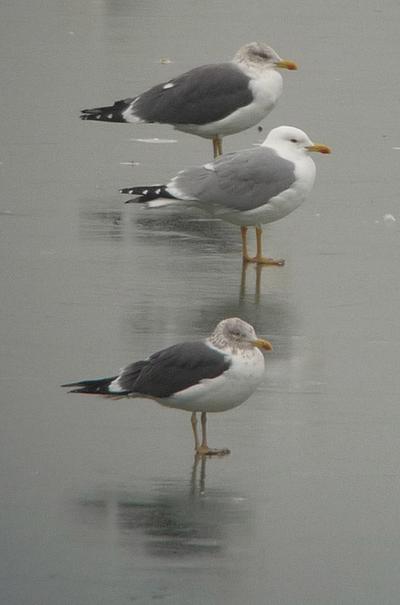
Lesser black-backed Gulls and Yellow-legged Gull (centre) on ice at Throckmorton 1st Jan. 2009 ©Harry Green
Worcestershire Record No. 26 April 2009 p. 36
THE LARGE TIMBERWORM BEETLE HYLECOETUS DERMESTOIDES IN SHRAWLEY WOOD
Ross Piper
If you are visiting Shrawley Wood between late April and late June look for out a cylindrical orange beetle about 2cms long (Figure 1). Hylecoetus dermestoides is the creature in question and if you manage to spot one then you have been lucky enough to see one of the few animals, besides humans, leaf-cutter ants and a few others, which ‘farms’ another organism for food.
The story of this fascinating beetle begins with a female depositing her eggs in crevices and cracks in the bark of mature trees, usually no more than 2m above ground level. She lays her eggs on a variety of diseased and dead trees, but avoids pines, larches and hornbeams. Birch is a favourite and a large, diseased birch with the correct conditions (warm and no less than 30–40% moisture content) is perfect.
Lots of beetles use dead wood as a food source for their young, but this species has some remarkable differences. On the female’s ovipositor there is a small pocket, the mycangium, which is filled with fungal spores and every egg she lays gets coated with spores from this pocket. After a few days the eggs hatch and small, whitish larvae wriggle out in to the world and loiter around their empty egg-shells for a while to pick up some of the fungal spores left by their mother. After a while they begin to tunnel into the wood using their powerful mandibles, carrying some of the fungal spores with them. Initially, the tunnels are very narrow as the larvae are small, but as they grow, the tunnel must also increase in width to accommodate them. The tunnel may run for over 30 cm, snaking into the wood, but it is not the wood the larva is eating. The tunnel is, in fact, a sheltered fungus farm.
The spores provisioned by the female and carried by the larvae infect the wood until the walls of the tunnels are lined with a white layer of fungus. The fungus Endomyces hylecoeti is a type of yeast that has struck up a symbiotic relationship with the beetle. The fungus gets access to wood in the safety of tunnels and in return the larvae get something to eat. The larva takes excellent care of its fungus garden doing everything it can to keep the conditions just right for the fungi so that it will have enough food to complete its development. The fungus requires oxygen to thrive, so the larva must rid the tunnel of any debris to maintain a good flow of air. The larva shuffles along the confines of its tunnel pushing any wood dust and waste to the outside, where it falls to the base of the tree (Figure 2).
By the winter, the larva will not be fully grown, so it will have to retreat to the deepest reaches of its tunnel and enter a resting state to survive the cold, harsh conditions. Come the spring, the larva reawakens and continues to feed on whatever fungi survived the winter. Soon, it is ready to pupate and it wriggles to the tunnel entrance and enlarges its width to form a chamber for its imminent metamorphosis.
H. dermestoides and its relatives are commonly known as ship timber beetles. They are sometimes regarded as forestry pests because of the damage they do to timber, affecting high quality wood that today is destined for construction, but was once used for ship building. In actual fact, their effects on commercial timber operations are minimal, as they tend to go for diseased or dead trees.
Although this species is widespread the adults are rarely to be seen in significant numbers. Look out for the adults flying in warm, calm conditions. The flight of the female, heavy with eggs, is very laboured. The male is around half the size of his mate, with the same general body shape and the addition of feathery palps on his head (Figure 3). A suitable brood tree will be home to many larvae, which give their presence away by the sawdust that accumulates at tree’s base after it has been ejected from their tunnels.
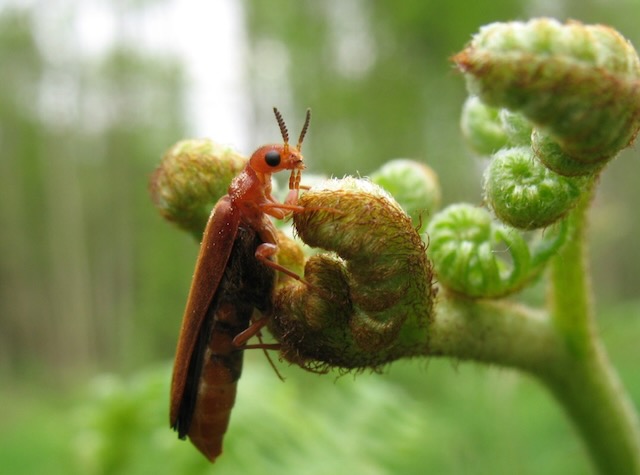
Figure 1. Female Hylecoetus dermestoides photographed in Shrawley Wood on the 9th May, 2008. This was probably a freshly emerged specimen as indicated by the wood dust on the thorax and elytra © Ross Piper

- Figure 2. Hylecoetus dermestoides larva inside its burrow showing the characteristic pointed ‘tail’ © Mike Shanahan
-
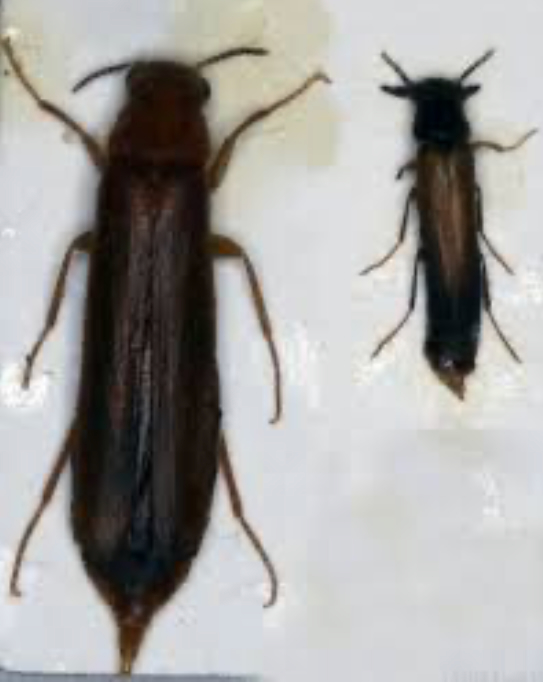

- Figure 3. Female (left) and male (right) Hylecoetus dermestoides to show size difference. Female was collected from Wybunbury Moss, Cheshire in June 2000 and male was collected from Shrawley Wood on May 15th, 2002 © Ross Piper
-1.bmp)
Worcestershire Record No. 26 April 2009 pp. 17-19
INCREASING PLANTS
Bert Reid
When botanists talk about change, the emphasis is normally on plants or semi-natural habitats that have been lost or are in serious decline. There are many examples in Worcestershire of local extinctions or once common plants becoming rarities in unimproved grasslands, woodland, heathland, wetlands and arable areas. When discussion turns to plant increases the tone is still usually negative, with worries about the effect of about invasive aliens like Indian Balsam Impatiens glandulifera, Rhododendron Rhododendron ponticum, New Zealand Pigmyweed Crassula helmsii and Japanese Knotweed Fallopia japonica. But not all news is bad news, and while the damage to our tradition flora is undeniable it is important to recognise the positives. There are now more species “in the wild” in Worcestershire than ever before, and this is a good opportunity to welcome the newcomers and to celebrate their contribution to our flora now and in the future.
The gains and increases in our flora far outweigh the losses and decreases and it has been very difficult to select the species to cover here. Those I mention are a personal selection of those which have changed the expectations of local plant recorders since the start of the Flora Project in 1987 or that I think may do so in the near future. Other botanists would certainly produce different lists and I could easily have tripled the number of species included or selected different examples.
I have split the selected plants into six groups, and for each species give indications of the rate of increase by showing the number of tetrads recorded up to the end of 1986, 1997 and 2008. The groups are not natural groupings based on geology, soils, history and land use but are more related to the sources and causes of increase. A number of plants could have appeared in more than one group and some have been forced into a group when they could have had a group to themselves.
|
Salted Roadsides |
1986 |
1997 |
2008 |
|
| Cochlearia danica | Danish Scurvygrass | 1 | 55 | 231 |
| Puccinellia distans | Reflexed Saltmarsh-grass | 6 | 32 | 79 |
| Spergularia marina | Lesser Sea-spurrey | 4 | 13 | 63 |
| Atriplex littoralis | Grass-leaved Orache | 0 | 0 | 3 |
| Catapodium marinum | Sea Fern-grass | 0 | 0 | 2 |
In Worcestershire, as in many areas of the country, the large-scale use of salt on roads in winter has created an inland habitat with conditions similar to the upper levels of coastal saltmarshes. Although this new inland habitat is very narrow, it stretches for great distances as a connected ribbon, allowing newcomers to spread across the country and the county. The first three plants listed here show the most extraordinary change in our flora since 1987. Danish Scurvygrass was first at Stoke Works in 1977 as a casual, but from 1989 it appeared on the M50 motorway and from 1990 rapidly spread to M5 and major trunk roads. It next reached other main roads and finally even minor roads – a recent record was from a house drive in a small urban cul-de-sac. Reflexed Saltmarsh-grass and Lesser Sea-spurrey both had earlier records from salty areas around Droitwich but have since followed much the same pattern as Danish Scurvygrass, although not yet reaching many minor roads. The Grass-leaved Orache and Sea Fern-grass have not taken off yet but might. Other plants have appeared in this habitat outside the county and should be sought for here. Common Scurvygrass Cochleria officinalis may already be here on the M5, but collecting a specimen for checking here is both illegal and dangerous! Sea Barley Hordeum marinum, Hard-grass Parapholis strigosa and Sea Pearlwort Sagina maritima are all potential newcomers apparently increasing on inland roadsides elsewhere.
|
Other Roadsides |
1986 |
1997 |
2008 |
|
| Plantago coronopus | Buck’s-horn Plantain | 22 | 52 | 106 |
| Lepidium ruderale | Narrow-leaved Pepperwort | 24 | 47 | 90 |
| Valerianella carinata | Keel-fruited Cornsalad | 2 | 21 | 46 |
| Bassia scoparia | Summer-cypress | 0 | 2 | 4 |
| Poa infirma | Early meadow-grass | 0 | 0 | 4 |
These are a rather mixed bunch of plants, only connected by their appearance on road verges that are not necessarily salted. Buck’s-horn Plantain does appear on salted roads, but the early records were mainly on sandy commons. The recent increase is on road verges both salted and not salted, and it is not clear why the increase has occurred. Narrow-leaved Pepperwort was previously found on wasteland, railways and by canals, especially Droitwich area . It is now becoming much more widespread on roadsides. Keel-fruited Cornsalad was known only as a rare casual but is now our most common Cornsalad, by roads and is still spreading. Cornsalads can only be safely identified in fruit, and this plant could have been mis-recorded earlier, but the increase is nevertheless clear. The earliest records for Summer-cypress were as casuals, presumably garden escapes but for a number of years we have been aware of a northward spread along the M5 towards our area. In 2007 it reached a slip lane to Strensham Sevices and I will be surprised if it stops there. Early Meadow-grass has long been well known as a native plant on the south coast; it is now being found more generally and we have four recent records between Pershore to Evesham. As with several other plants, the mild winters associated with climate change may have facilitated the spread of this little grass.
|
Urban / Wasteground |
1986 |
1997 |
2008 |
|
| Conyza sumatrensis | Guernsey Fleabane | 0 | 1 | 30 |
| Conyza bilbaoana | Bilbao’s Fleabane | 0 | 0 | 2 |
| Senecio inaequidens | Narrow-leaved Ragwort | 1 | 2 | 5 |
| Hirschfeldia incana | Hoary Mustard | 3 | 16 | 26 |
| Amaranthus retroflexus | Common Amaranth | 1 | 13 | 29 |
| Geranium rotundifolium | Round-leaved Crane’s-bill | 8 | 63 | 91 |
| Papaver dubium lecoquii | Yellow-juiced Poppy | 7 | 106 | 139 |
| Galinsoga quadriradiata | Shaggy-soldier | 5 | 20 | 44 |
| Mercurialis annua | Annual Mercury | 26 | 72 | 114 |
| Echinochloa crus-galli | Cockspur | 2 | 5 | 25 |
| Panicum miliaceum | Common Millet | 3 | 22 | 51 |
In this man-made habitat a great many plants have increased. Guernsey Fleabane spread from the London area, reached Worcester in 1995, and is now increasing explosively. The related Bilboa’s Fleabane was found in Worcester in 1999 and 2005 and Yardley Wood in 2007. It may well spread. Other Conyza species such as C. bonariensis are perhaps even more thermophilic but may follow later. Narrow-leaved Ragwort is now starting to take off in Birmingham and could easily spread from the urban environment along man-made corridors of roads, railways etc. Hoary Mustard has show a significant national spread on wasteground and this spread has been mirrored in Worcestershire. Common Amaranth is much increased on nutrient-rich waste ground: increasing eutrophication may be a cause here. Round-leaved Cranesbill was rare but is now relatively common and widespread as part of a national northward expansion. Climate change seems a likely reason. Yellow-juiced Poppy shows a similar pattern but better recording may have had an effect. Shaggy-soldier only flowers after long hot summers but can persist as tubers. The steady increase on wasteland, arable etc. is surely due to the recent run of hot summers. Annual Mercury has shown no great change in overall distribution but has become much more common, filling in the gaps. Cockspur and Common Millet are just two of many possible examples of plants originating from bird-seed. This pair persist and spread more effectively than many of the other bird-seed plants.
|
Arable |
1986 |
1997 |
2008 |
|
| Bromus secalinus | Rye Brome | 16 | 29 | 98 |
| Phalaris paradoxa | Awned Canary-grass | 4 | 23 | 49 |
| Borago officinalis | Borage | 20 | 49 | 106 |
| Echium plantagineum | Purple Viper’s-bugloss | 1 | 2 | 8 |
Arable plants have suffered badly over the last fifty years from improved seed screening and ever more effective herbicides. Many of our arable plants are highly threatened. Rye Brome was a local plant of arable but almost disappeared in Britain post 1950. We re-found it in wheat fields by 1993 and it is now quite widespread in arable areas. The pattern of increase suggests introduction with crop-seed but our experience is not general nationally with few other areas showing the same sort of increase. Awned Canary –grass has also increased but is used in game-bird seed mixes and now seems established in Worcestershire. Borage comes from many sources – garden escape, bird-seed constituent and minor crop and now seems much more persistent for poorly understood reasons. Purple Viper’s-bugloss was only a casual but there are a few recent records of good quantities in arable.
|
Garden Escapes |
1986 |
1997 |
2008 |
|
| Oxalis corniculata | Procumbent Yellow-sorrel | 9 | 62 | 195 |
| Oxalis exilis | Least Yellow-sorrel | 0 | 30 | 70 |
| Campanula portenschlagiana | Adria Bellflower | 0 | 1 | 76 |
| Campanula poscharskyana | Trailing Bellflower | 0 | 10 | 108 |
| Lobelia erinus | Garden Lobelia | 0 | 25 | 102 |
Almost any plant grown in gardens has the potential to escape into the wild by seed, vegetative spread or from throw-outs. An ever increasing number of plants are readily available to the gardener and each year provide new county records. I have just selected five plants out of many: garden plants that have become common and widespread in recent times. The Yellow-sorrels are both warmth-loving plants escaping from rockeries to lawns and then pavement cracks, wasteland, churchyards, other mown grasslands etc. They both show surprisingly explosive increases. The Bellflowers are commonly grown on garden walls and escape to pavements and wasteland but more slowly and less far. The Garden Lobelia is an example of seeds dropped from hanging baskets to germinate in pavement cracks and wall bases. This plant is now often persistent.
|
Water and Wetlands |
1986 |
1997 |
2008 |
|
| Lemna minuta | Least Duckweed | 1 | 37 | 127 |
| Elodea nuttallii | Nuttall’s Waterweed | 3 | 85 | 130 |
| Crassula helmsii | New Zealand Pigmyweed | 3 | 22 | 47 |
| Cuscuta europaea | Greater Dodder | 7 | 21 | 24 |
Least Duckweed is a recent addition to the British Flora, being first recorded in 1977. The first Worcestershire record was in 1982 and there has been a great spread since 1988. It competes well with other Duckweeds and is clearly going to become a common and widespread plant. Nuttall’s Waterweed is also showing major spread, in part replacing Canadian Waterweed. It is tolerant of eutrophic water and spreads vegetatively with great efficiency. Only female plants are found in Britain. The Pigmyweed is a more serious worry since it increasing distribution threatens good habitats such as pond vegetation on commons. Greater Dodder was apparently only a casual with scattered sites until discovered over good stretches of the Avon and small part of the Severn. It is rare example of a native wetland plant that has done well locally over the last 20 years.
Although most of the newcomers are non-native plants, on balance they should be welcomed. For better or worse, the mankind’s activities have become the main driver of change within our flora. The constant stream of new arrivals has brought many unusual plants from around the world to our doorsteps, adding much interest to plant recording in the county, especially in the towns and cities where most of us live. We must treasure and protect our semi-natural habitats and long-standing native plants, but we should also rejoice when new arrivals take over our ruderal environment.
Worcestershire Record No. 26 April 2009 pp. 24-26
CHANGES IN MOTH FAUNA OF THE COUNTY SINCE 2004
Tony Simpson
Since publication of the Lepidoptera Atlases in 2002-2004 for Herefordshire and Worcestershire by Michael Harper and myself there have been a lot of new species recorded and significant changes in the status of a considerable number of previously recorded species.
In Worcestershire there have been 15 new species of the larger moths (Macros) and 28 new species of the smaller moths (Micros), and significant increase in records for 23 Macros and 25 Micros. Some of the new records have been migrants, mostly in the remarkable migrant year of 2006; others have been species which have suddenly started to increase their range and/or become much commoner in the U.K. This I feel must be because of increasing temperatures; especially the continuing increase in average winter temperatures. Some migrants have been able to start and maintain resident populations.
It is necessary to make allowance for the huge increase in recording effort over the past 5-10 years in the county. There has been a big increase in recorders, mostly just recording the larger moths in light-traps but also some recorders now becoming increasingly interested and expert in the smaller moths. This has resulted in a much better overall coverage of our fauna, and no doubt accounts for some of the new species recorded. However a lot of changes have been seen by this recording group over the past five years, especially in terms of increase in status and range , and therefore I am sure most of these changes are genuine and not just recording bias.
The increase in recorders may be one reason however for the increase in migrant records of such species as Scarce Bordered Straw Helicoverpa armigera, Bordered Straw Helicoverpa peltigera, and Small Mottled Willow Spodoptera exigua, but also the wonderful migration in the hot summer of 2006 certainly must have skewed the figures (there were over 100 records of armigera where before there had been less than 10) and caused some other rarer species to be recorded ( including a Striped Hawkmoth Hyles livornica larva found in the car park of the Fox and Hounds in Lulsley by Cherry Greenway).
The availability of pheromone lures for the Clearwings has resulted in a big increase in records of these previously difficult to record species. It is now apparent that Red-belted Synanthedon tipuliformis, Currant S. tipuliformis, and Yellow-legged S. vespifomis are fairly common and widespread, and Red-tipped Clearwing S. formicaeformis has now been recorded at two sites in south Worcestershire
Macromoth species which have shown the biggest increase in numbers and range. These include the species of the “Footman” family whose larvae feed on Lichens and Algae on trees which have dramatically increased over the past six years. The Orange Footman Eilema sororcula was last recorded in 1904; the Buff Footman Eilema depressa had only a few records in the county; and the Red-necked Footman Atolmis rubricollis was only an occasional migrant; but since 2002 they have become fairly common and widespread.
The Scarlet Tiger Callimorpha dominula, The Pine Hawkmoth Hyloicus pinastri, The Dotted Chestnut Conistra rubiginea, and the Sycamore Acronicta aceris for example have moved into the county and become much more widespread.
There have been some species which have been introduced to the U.K. in foodplants (e.g. some of the Conifer feeding species), or arrived otherwise, probably in human transport such as lorries, and then have spread rapidly from their point of origin (e.g. the Horse Chestnut Miner Cameraria ohridella.) If the continuing warming trend continues then I am sure we will see other species arriving and spreading.
Conversely there have been some 20 species of Macromoth which seem to have declined in numbers and range, or of which there are no recent records. The reasons for this decline are usually uncertain, but some cases are due to loss or degradation of habitat (e.g. some grassland and open habitat specialist species).

- Striped Hawkmoth, Hyles livornica, larva found at Lulsley

- Striped Hawkmoth, Hyles livornica

- The Scarlet Tiger, Callimorpha dominula, has moved into the county and become much more widespread

- The Dotted Chestnut, Conistra rubiginea, has moved into the county and become much more widespread

- Vine’s Rustic, Hoplodrina ambigua, over the past five years has entered the county and become a fairly common and widespread resident
Worcestershire Record No. 26 April 2009 pp. 48-56
NOTES ON BIRDS IN THE SEVERN AND AVON VALES (THE “SEVERN HAMS”), GLOUCESTERSHIRE AND SOUTH WORCESTERSHIRE. JULY – SEPTEMBER 2008
(This edited version concentrates on birds associated with wetlands. Most other records have been removed leaving only species of particular interest, for example: rarity, population change)
Mike Smart
General introduction
The main sites are (from the north):
Along the Severn in Worcestershire, a series of well-watched gravel workings attract many water birds, notably waders; these are (from the north): Holt and Grimley (on the west bank just north of Worcester), Clifton (on the east bank just south of Kempsey); Ryall (on the east bank opposite Upton); new pits just south of the M50 at Ripple; and Mythe Hook, just in Gloucestershire. Upton Warren Nature reserve, north of Droitwich, is outside the area covered by the present report, but is occasionally mentioned as it attracts many significant birds.
Powick Ham, just south of Worcester, the flood meadows where the Teme flows into the Severn.
Upton Ham (Worcs), the Upper Ham, a hay meadow south of the town, is an SSSI and is the best conserved of the riverside hams in botanical terms; south of the old railway embankment is the Lower Ham.
Longdon Marsh (Worcs), a nearly enclosed basin north of the M50 motorway, flowing via the Longdon Brook to the Severn, just above the Mythe north of Tewkesbury; the Worcestershire Wildlife Trust has a major reserve south of Marsh Lane.
Avon Meadows (on either side of the Avon, going north from Tewkesbury), along the border between Gloucestershire and Worcestershire, and including: the restored gravel pits at Bredon’s Hardwick (Worcs); Upham Meadow (sometimes called the “Great Hay Meadow”) and Summer Leasow at Twyning (Glos); Rectory Farm Meadows, across the Avon from Upham Meadow (Worcs); Strensham Pits, sludge pools below the waterworks at Strensham (Worcs); further north along the Worcestershire Avon is the Gwen Finch Worcestershire Wildlife Trust Reserve near Nafford (Worcs), an area of shallow lakes by the Avon; between Pershore and Fladbury is Lower Moor, and just to the north Throckmorton tip, where the lagoons sometimes attract water birds. Just to the east of Bredon is Kemerton Lake (Worcs), a restored gravel pit in the valley of the Carrant Brook, which flows through Cowfield Marsh into the Avon just above Tewkesbury.
The “Severn Hams” between Tewkesbury and Gloucester, in which the main wetland areas are: Ashleworth and Hasfield Hams; Coombe Hill Canal and Meadows, including Cobney Meadows at the western end (Coombe Hill Canal is a long disused and overgrown canal, which runs through the centre of Coombe Hill Meadows); and the Leigh Meadows alongside the River Chelt and Leigh Brook above Wainlodes; Barrow Ponds are created by the artificial damming of a small tributary of the Chelt, east of the A 38. Ashleworth Ham and Coombe Hill are Gloucestershire Wildlife Trust reserves, and are particularly well-watched. This area also includes: the Severn Ham at Tewkesbury; the Severn between Lower Lode and Haw Bridge; and the Severn from Wainlodes, past Ashleworth Quay and Sandhurst, to Gloucester. The River Leadon flows into the Severn just above Gloucester, and its valley extends north past Newent. At Sandhurst, Maisemore and at Walham Pools near Gloucester there are a number of abandoned overgrown riverside brick-pits, artificial excavations in the floodplain.
Maisemore Ham is now largely converted to arable farming.
Sites on the edge of urban Gloucester, once flood meadow: Port Ham, Castlemeads and Over Ponds on Alney Island, Sudmeadow, and the Gloucester Landfill Site (GLS). Port Ham has recently been restored and some shallow scrapes dug; at the southern end of Port Ham is Lower Parting where the two arms of the Severn meet again; Sudmeadow is immediately south of Lower Parting; GLS attracts large numbers of gulls, and has a pond attractive to passage and some resident waterbirds; a little further south, near the Gloucester-Sharpness Canal, is the small Quedgeley Local Nature Reserve.
Minsterworth Ham, on the west bank of the Severn below Gloucester.
Walmore Common, on the west bank of the Severn below Gloucester; also the little marsh at Rodley (Wilmore Common), west of Walmore, along the stream west of Boxbush Farm.
Elmore Back, on the east bank of the Severn below Gloucester, opposite Walmore.
Most of these sites are marshes which flood when the level of the Severn is high (either because of water coming down from North Wales, or because of high tides downstream; or more often a combination of both), thus preventing local streams from reaching the Severn, so that they back flood. When there is a major Severn flood, with water coming over the flood-banks along the river (a “river flood”), there may be extensive floods over the whole floodplain area. The major Severn tributary, the Avon, does not have flood-banks in many places and so floods easily above Tewkesbury. The River Chelt holds running water, and is small enough to have muddy edges and mud banks.
Weather and flooding: general
All areas of UK experienced a second successive wet summer; July and August were very wet, though not as rainy as summer 2007, and the summer rains culminated in serious flooding in Wales, the West Country and north-east England during the first week of September.
July opened dull, with constant cool fronts coming in from the west; there were fairly heavy showers from 3-8 July and rain all day on 9 July; then cool cloudy weather followed with odd showers and bright periods from 15 July onwards; summer weather at last broke out from 21 July as the European high pressure zone extended over the British Isles, preventing the arrival of Atlantic fronts, with light easterly winds and temperatures in the mid and upper twenties. Nationally August was remarkable for its rainfall (65% above average at national level, 79% above normal in SW England and South Wales) but also for the amount of cloud; nationally it was the second dullest August on record. The weather for the first three weeks was dominated by a series of fronts coming in from the Atlantic and bringing constant wet, unsettled weather; rainfall was unusually high, though the rain was steady rather than torrential. Just for a few days, especially from 28-30 August, the European high pressure zone gained the ascendancy and winds went light and south-easterly; but Atlantic fronts and rain returned on 31 August, and cyclonic weather in the first ten days of September (especially September 5 & 6) brought more Atlantic fronts with heavy rain, so that September rainfall totals were above average, even though there was little rain later in the month (average for SW England and S Wales 111% of the average 1971-2000); from 10-16 September, rainfall decreased and there were ridges of high pressure between the fronts, bringing high cloud and some sunshine; an Indian summer occurred in the second half of September, as a more permanent area of high pressure extended from Europe to the Azores, briefly interrupted on 22-23 September by a front moving through (but not bringing much rain) from the northwest; anticyclone strengthening from 25 September with thick autumnal fog in the mornings of 27 & 28 September; cooler and clearer with westerly winds on 29-30 September.
Though there was no repeat of the July 2007 summer flood, there was a river flood (with the Severn and its tributaries breaking their banks) in early September, an altogether unaccustomed time and more reminiscent of February; this is the fifth river flood in 18 months: March, June and July 2007, January and September 2008. The latest September flood looks like being just as damaging as the summer 2007 floods, with flooded grassland causing waters to become black and anaerobic, and a smell of rotting vegetation everywhere, with mats of dead vegetation and of unbaled hay covering the fields after the flood receded.
As there were very few lengthy periods of fine weather, apart from the short spell in the second half of July, hay-making was very difficult; in August there were few periods of settled dry weather so that little of the hay remaining uncut from July could be brought in. The ground was saturated, and river and ditch levels were quite high in late August; following the heavy rain in the first week of September, the Severn threatened to break its banks on 6 September and did so from 7-10 September, as rainwater from North Wales moved down the catchment; with river levels high, levels in the meadows also rose (because of water spilling over the flood banks and inflow coming from tributaries like the Chelt) from 8 September onwards (level of 11.00m at Haw Bridge); from 11 September the Severn dropped rapidly (9.40 at Haw Bridge on 14 September, 7.74 on 18 September, 7.02 on 25 September); but flood levels dropped more slowly in the meadows, because of the limited number of outlets to the Severn.
Conditions at the main sites
Upham Meadow, Twyning: Hay cutting was no more advanced on 11 July than in late June; a little more hay cut by 18 July, but much grass still remaining uncut.
Longdon Marsh: Moderate flooding on 13 September provided a refuge for some water birds from heavy flooding elsewhere.
Ashleworth/Hasfield Hams: Still very little hay cut on the SSSI had been by 8 July; some cutting of better hay on higher fields of the reserve was done by 15 July, when SSSI fields at Hasfield were being cut. Hay on most of the rest of the GWT reserve was cut in early August, but could not be collected because water levels rose in the second half of August; on the Hasfield section of the SSSI even the very wettest field on Hasfield Ham was cut in mid August. Sheep were grazing many of the fields in late August and early September, but most had to be removed when the fields started to flood on 6 September. With the Severn breaking its banks on the west bank from 7/8 September, water levels in the meadows rose rapidly and the Ham Road was closed from 8-13 September, with the hide inaccessible. The Ham Road was open again from 18 September, but waters dropped much more slowly on the meadows, because of the limited number of outlets (inland ditch at Haw Bridge on 10.08 on 13 September, 10.02 on 14 September, 8.63 on 18 September, 8.22 on 20 September, 7.70 on 25 September); the dropping flood left mats of dead grass, smell of rotting vegetation and stretches of shallow water with an oily film on the surface and some dead worms in puddles till the end of September.
Coombe Hill: No hay was cut on the GWT reserve and surrounding farms before 8 July, but all higher GWT fields north of the canal were cut on 13 July, and lower fields on 22 July; in late July and early August these were grazed by cows, which had to be removed because of the wet ground in late August. The hay on the Southern Meadows was not cut at all. Water levels had increased sharply by 6 September, when water was over the board walk; with both the Severn and Chelt breaking their banks, water poured into the meadows from 7/8 September, and the flooding almost reached the Wharf car park; water levels on the meadows were much higher on 9 September and dropped only slowly (9.65 at Parish Drain outlet on 8 September, 10.10 on 9 September, 10.30 on 10 September, 9.28 on 16 September, 6.98 on 25 September); the towpath was still impassable on 16 September, the towpath was open but hides were inaccessible from 18 September, when grass on fields free of water was brown and dead; water flowing out to the river was black and lacking oxygen; hides accessible from 22 September.
Leigh Meadows: No new hay cut between 29 June and 10 July, but hay had just been cut on 23 July. With the Chelt at a very high level, it began to break its banks and flood riverside meadows on 6 September; by 8 September, with the Chelt still overflowing its banks, flooding was more extensive; by 9 September water levels on the meadows were at the same level as the Chelt, and on 10 September the course of the Chelt could no longer be seen; levels dropping on 16 September, sharply down on 18 September. Red Lion road closed from 7-17 September.
Walmore Common: Light flooding on Common and agricultural land on 8 September, more extensive on 14 September, dropping on 19 September with long grass showing through; floods completely gone by 29 September.
Bird records
Observations in July confirmed the impression from earlier months that numbers of breeding waders and Sedge Warblers were very low; the June and July 2007 floods had clearly affected the waders, but the drop in Sedge Warblers may reflect a more long-term decline. From July to September, there was a small but steady movement of migrants through the Vale (moving from the Wash or Humber to the Severn?), particularly waders (the highlight being a Stilt Sandpiper at Coombe Hill in mid-August) but also two records of Spoonbill; and there were strong movements of several tern species in early September. The early September flooding attracted large numbers of passage hirundines, and from about 20-27 September, there was a fine spectacle of water birds, including up to 1,000 ducks, mainly Wigeon and Teal, plus a variety of waders, notably Black-tailed Godwits, on the falling flood in Gloucestershire, perhaps coming up from the estuary. Huge numbers of Black-headed Gulls appeared on the flooded meadows, apparently gorging on worms and invertebrates drowned by floodwater – not a good sign for next year’s breeding season.
Little Grebe: at Kemerton, where they had bred, 14 were seen on 2 September and 16 on 26 September.
At Ashleworth, one on several dates in the last ten days of September. No sign of nesting on the scrapes at Coombe Hill this year; one from 12 July onwards, probably a juvenile which had moved in from outside; one on 9 August and one or two from 22 to 30 September. On Alney Island, Gloucester, they did however breed successfully: four (with two juveniles) on 9 July, a single on 8 August.
Great Crested Grebe: At Bredon’s Hardwick, four on 17 August.
At Coombe Hill a juvenile on floodwater on 20 September.
Red-necked Grebe: Extremely rarely recorded in the area, even in winter; but one in summer plumage was noted at Clifton Pits on 30 August.
Cormorant: Most records refer to birds moving up and down the Severn and Avon, to and from their preferred loafing and fishing site at Bredon’s Hardwick, where 16 were noted on 17 August, though up to seven also stayed throughout the period to loaf at Gwen Finch reserve, a little further up the Avon. But there was no repeat of the large numbers recorded in summer 2007 on electric pylons, looking for stranded dead fish as the floods receded. At Upham Meadow, one flew north along the Avon on 18 July. At Ashleworth, one in flight on 23 August; two perched on pylons in floodwater on 18 September, and two, one on the water, on 21 September. At Coombe Hill, one landed briefly on the scrapes on 19 July; one flying over on 19, 26 August; one landed on scrape and fished actively on 4 September, one on floodwater on 16 September. At Wainlodes, one flew over on 17 July. At Barrow Ponds, three perched on trees on 10 September. At Alney Island, 11 on 29 September.
Little Egret: This species is now recorded almost daily at sites such as Grimley, Bredon’s Hardwick and Coombe Hill, but at many other sites too, with the highest number of records and individuals in August, numbers dropping off in September.
In Worcestershire: at Grimley, a juvenile from 7-17 July; then practically every day from 24 July, with maxima of seven (one colour-ringed) on 30 August and five on 31 August, numbers a little lower in September, maximum of three from 20 to 22 September. At Clifton GP, there was a single on 3 August, but five on 30 August. At Ryall GP, singles on 18 July, 7 & 20 September. At Longdon Marsh, one was present on 3 & 20 August. At Lower Moor, one on 25 September. On the Avon at Gwen Finch reserve, one flew past on 12 August, while one flew south over Strensham Lock on 20 July. At Bredon’s Hardwick, an adult and a juvenile were present on 10 July, with records for the rest of the month, with a maximum of six (roosting in willows on the evening of 27 July); the August maximum was seven on 19 August, with roosting birds noted on two occasions, and less regular records in September (maximum of two on 5 & 6 September). At Kemerton Lake, one to five birds were present on many dates from 12 July to 2 September.
In Gloucestershire: several birds were seen regularly throughout July at Coombe Hill, with a maximum of nine (one adult and eight juveniles) on 29 July; throughout August, with a maximum of 13 on 9 August; and throughout September, with a maximum of nine on 23 September. There were fewer records from Ashleworth, just singles on 16 July and 23 September. On Alney Island, Gloucester, singles were noted on 8 & 13 August and on 3 September. At Walmore, one on 23 & 29 September.
Great White Egret: One reported in error from Coombe Hill on 14 July.
Grey Heron: A heron chick, marked at the nest with a wing tag carrying the letters GA, ringed at Frampton in May 2007, had been seen at Ashleworth in July 2007, in the Cotswold Water Park in September 2007 and February 2008, before being recorded through April and May at Kemerton, then from June to September at Bredon’s Hardwick.
At Upham Meadow, two on 18 July. Higher numbers round dropping flood in late September (e.g. nine feasting on marooned fish at Lower Moor on 13 September), but no concentrations of 50 or more as in June 2007. At Longdon, seven on 13 September. At Ashleworth, singles in late August and September, three on 18 September, eight on 21 September, two on 25 & 27 September. At Coombe Hill, the July maximum was five on 24 July; singles in August, but seven on 20 September and 20 on 25 September, suggesting a concentration to search for prey on drooping flood. Singles at Leigh Meadows in July and September. At Walmore two were present on 8 September, but nine on 13 September at the height of the flood.
Spoonbill: At Coombe Hill, a single bird appeared briefly on 28 July, but was disturbed by hay making activities and did not stay. There was a second record on 3 September, when an adult and a near adult were seen, both present until midday on 4 September; one of them remaining until 6 September.
Mute Swan: Pairs which had bred remained with their cygnets, usually asserting precedence over any autumn gatherings of non-breeders that began to form. On the Avon by Upham Meadow, a pair (ringed G91 & G 30) had five cygnets on 11 July, four on 18 July, when a second adult was present with four cygnets. At Ashleworth, a pair on the scrape had five cygnets on 10 July, while another pair had two cygnets on the Hasfield side on 26 August and 6 September; both pairs present on dropping floodwater in late September (one of the four cygnets had disappeared on 25 September). At Coombe Hill, the breeding pair of 3AY and mate from the Wharf was on the canal with seven cygnets from 8 July to 25 September; four non breeders were on the scrapes in July, nine on 20 September. At Wainlodes on 17 July, 3OJ and mate with three cygnets were on the Parish Drain. At Leigh Meadows, one on the Chelt on 10 July, three on 8 September. At Walmore, nine (one cygnet) in September.
Geese
Greylag Goose: Small numbers in midsummer, though increasing numbers breeding in Worcestershire; but by mid-August, a flock of up to 70 was in residence (generally roosting) in the Ashleworth / Coombe Hill area, moving about quite widely in North Gloucestershire and south Worcestershire and increasing to 150 in late September.
At Longdon ten or more through the morning mist on 13 September. At Kemerton, 101 were noted on 2 September. At Coombe Hill (in addition to the pair of broken winged birds noted throughout the summer), four were seen on 23 July, 25 on 7 August, 64 on 19 August (one carrying a plastic ring J16), 119 on 20 September, 150 on 23 September. At Barrow Ponds, 70 (no doubt birds from Coombe Hill) were present on 10 September.
Greylag x Barhead hybrid: At Coombe Hill, one in Greylag flock on 19 & 26 August and 25 September
Greylag x Canada hybrid: Two throughout the period with the roaming Canada flock in Worcestershire.
Canada Goose: As for Greylag, small numbers bred, but there was an influx from mid-August, the flock ranging widely, but often roosting at Coombe Hill.
At Longdon Marsh, 12 on 13 September. At Kemerton, 285 on 2 September. At Bredon’s Hardwick, 55 on 8 September.
At Upham Meadow, 25 non-breeding adults on 18 July. At Coombe Hill, a single adult with a brood of five nearly full grown young on Long Pool on 8 July; three broods with flying goslings on 19 & 23 July, two of which must have flown in from outside. Flocks began to grow in August: 80 on 7 August; 89 on 19 August, 135 on 26 August, 156 on 6 September, 290 on 20 September, 325 on 22 September, 350 on 23 September; the September birds perhaps the same as the ones from Kemerton?
Brent Goose: A (lost!) juvenile of the Pale-bellied subspecies (which normally winters in Ireland) was near Clifton on 21 & 22 September, found again on 27 & 28 September. A first record for Worcestershire.
Barnacle Goose: A group of about 12 seems to be centred at Tirley Court Lake (where several pairs bred last year) and to wander in small groups about north Gloucestershire and southern Worcestershire.
At Tirley Court, eleven moulting and one on lake on 19 July; on 19 August, 12 adults moulting and no sign of young birds, so they clearly have not nested this year; none on 8 September. A single was seen with the Canada Goose flock in August and September at Coombe Hill and at Ashleworth. At Bredon’s Hardwick, eight were noted on 23 August, five on 25 August, seven on 30 August and three in mid-13 September, while all 12 were at Kemerton on 2 September. At Lower Moor, one or two throughout the period.
Egyptian Goose: Two noted at Bredon’s Hardwick (but nowhere else!) on many dates between 15 July and 10 September, were no doubt the birds seen several times at a variety of sites last winter.
Ducks
Shelduck: At Longdon, where ducklings had been seen in late June, the pair amazingly hatched eleven young ten of which fledged in August; five (including three in juvenile plumage) were seen there on 13 September. Other odd juveniles noted at various sites (e.g. one at Lower Moor on 12 August) were perhaps from this brood, as breeding was not proved at any other sites. At Grimley, a juvenile on 11 July, three (age unclear) recorded on 30 August. At Ashleworth, an immature on 28 September.
Adults (which do not usually occur on floodwater until the New Year) appeared on the September flood: at Coombe Hill, six on 18 September, apparently adults, seven on 23 September. At Walmore too, an early bird on 19 September.
Mandarin Duck: At Longdon Marsh, one on 24 August. On the Avon at Birlingham a female on several dates from 12 to 27 July.
Surface-feeding ducks
At the height of the September flood, many ducks moved – as they often do – to Longdon Marsh because floodwater lower down the Severn was too deep. Numbers of ducks were unusually high in late September; the main species were Wigeon and Teal, which (no doubt attracted from the estuary by the rich feeding on the declining flood) increased sharply from about 20 September, moving back and forth between Coombe Hill and Ashleworth, but departed as quickly when the floods dropped.
Wigeon: A single female summered at Ashleworth and was present throughout July and until 19 August; at Kemerton, the first returning bird appeared on 14 July; an eclipse male was at Coombe Hill on 30 August and five there on 3 September. The first autumn flock of any size was of 30 on floodwater on 13 September at Longdon, where they seemed to be taking refuge from deep flooding elsewhere. At Kemerton there were ten on 15 September. At Ashleworth 140 were recorded on 21 September and 20 on 28 September. At Coombe Hill, the first sizeable flocks appeared as the floods dropped: 60 on 18 September, 220 (no doubt the same birds as at Ashleworth) on 20 September, 335 on 22 September, 430 on 23 September, 271 grazing by the scrapes on 25 September. At Walmore, two on 10 September, 25 on 23 September, just one on 29 September.
Gadwall: Worcestershire: At Longdon, three on 13 September. At Kemerton, two on 28 September.
Gloucestershire: At Ashleworth, an eclipse male on 19 August; then eight on 21 September. At Coombe Hill, one throughout July, three on 4 September, 16 on 22 September. At Walmore, two on 8 September.
Teal: Worcestershire: At Longdon Marsh, 62 on 20 September, 200 on 22 & 26 September as the floods dropped. At Kemerton, nine on 2 September.
Gloucestershire: At Coombe Hill (where a couple of birds had been seen throughout June), there were seven on 8 July, then one to four for the rest of the month; numbers increased to 45 on 19 August, 60 on 4 September, 103 on 6 September. Unusually large numbers for the time of year were moving between Ashleworth and Coombe Hill as the floods dropped from 20-25 September: at Ashleworth, 620 on floodwater on 21 September, at Coombe Hill 400 on 22 September, 735+ on 25 September, 420 on 27 September. At Walmore, 10 on 8 September, 12 on 13 September, 80 on 23 September, 20 on 29 September.
Mallard: At Longdon Marsh, 30 on 13 September.
At Hasfield, a female with seven ducklings on 10 July. On the Avon near Upham Meadow, about 30 in eclipse on 11 July. At Ashleworth, monthly maxima reached 128 on 23 August, 125 on 23 September. At Coombe Hill, 15 on 23 July; numbers increased to 150 in late August; unusually high numbers occurred in September: 615 feeding on flooded grassland on 4 September, 550 on 6 September, down to 100 on 25 September. At Walmore, 80 on 8 September, 300 on 10 September, 80 on 19 September.
Pintail: Worcestershire: Along the Severn – at Clifton Pits, up to six in the last ten days of September, and at Longdon Marsh, 18 on 22 September. Along the Avon: at Throckmorton Lagoons, one on 17 September; at Lower Moor one on 20 September; at Bredon’s Hardwick, an eclipse drake on 10 September; at Kemerton, two on 26 September.
Rather larger numbers in Gloucestershire, birds appearing as usual on the dropping flood: at Ashleworth 12 on 21 September, at Coombe Hill: 22 on 20 September, 40 on 22 September; five on 25 September.
Garganey: At Coombe Hill, among the big flocks of Teal, two from 22 to 26 September, one on 27 September. At Walmore, one on 23 September.
Shoveler: At Kemerton, the first four returning birds were seen on 24 July; five on 15 September, 20 on 26 September.
At Coombe Hill, some birds returned early: one on 8 and 29 July, four on 19 & 23 August, two on 28 August, 20 on 4 September, 25 on 20 September and 15 on 25 September. At Ashleworth, 35 on 21 September. At Walmore, one on 8 September, six on 10 September, 15 on 13 September, five on 23 September.
Diving ducks
Pochard: A pair bred successfully at Kemerton, raising a family of six by 15 August. A few were recorded on floodwater in Gloucestershire during September: at Ashleworth, two on 21 September; at Coombe Hill, eight on 18 September, one on 20 September, up to four from 22 to 24 September.
Tufted Duck: Breeding was confirmed at three Worcestershire sites: three pairs at Kemerton, five at Throckmorton, three at Lower Moor. At Longdon Marsh, one female on floodwater on 13 September, one on 30 September.
Gloucestershire: Once again, breeding was confirmed at Coombe Hill, where up to four adults had been seen throughout July; a female with five tiny ducklings was at last seen on 23 July and on many dates until 26 August, by which time the young were full grown; 12+ on floodwater on 18 September, as many as 51 on 20 September, 26 on 23 September. At Ashleworth, four on 23 September. At Port Ham, three on 8 August.
Red-crested Pochard: The group of 12 that appeared at Clifton GP on 17 August dispersed over several Worcestershire sites in the following weeks, though none reached Gloucestershire: at Grimley, one on 12 September; at Clifton at least one female on 19 August, two on 23 & 24 August, three on 30 & 31 August, one on 7 September. At Throckmorton Lagoons, one on 9 September. On Kemerton Lake, two on 2 September.
Ruddy Duck: A male on floodwater at Longdon on 13 September.
Raptors
Red Kite: All records from Worcestershire: at Grimley, one on 10 July; near Kemerton, one over Beckford on 12 July; one flew over Holt on 24 August; at Clifton GP, one on 27 September.
Osprey: Of several autumn records of birds moving south in Worcestershire, the only one in the area covered by this report flew south over Clifton Pits on 21 September.
Merlin: One Worcestershire record of a returning bird: at Clifton GP, one on 27 September.
Hobby: The large number of records suggests that this summering falcon must have bred fairly widely: there are records of adults, and of flying juveniles, which generally call very noisily for food after leaving the nest.
In Worcestershire: at Holt, one on 6 September; at Grimley, singles recorded on three days in July (with two on 26 July), on three days in August and five in September (a definite adult on two days), last date 20 September; at Severn Stoke, one on 24 August; at Clifton GP, one on 13 July, 17 August and three days in September; at Hanley Swan, one on 29 August; at Ryall GP, one or two on several dates in July and August and on 14 September; three on 20 September included a juvenile, which was seen again on 27 and 28 September; at Throckmorton Lagoons, singles on five days in the second half of July (two on 24 July) and on three dates in August, last on 17 September; at Lower Moor, singles on 8 July, 15 & 23 August and on six dates from 1 to 15 September; at Birlingham, singles over the Avon on many dates in July (two on 26 July), one on 27 July, four on 15 August and three on 26 August: at Gwen Finch, one on 6 & 11 August; near Eckington, one on 20 August; finally at Bredon’s Hardwick, one on four days until 14 September.
In Gloucestershire: a nest had been suspected from mid June in the Ashleworth area; one or two adults were well seen on several dates in July, the nest was found and three young ringed on 2 August; up to four birds (adults and young) were seen and heard (they were very noisy) through August and until 23 September (last date). At Coombe Hill, singles were seen on 12 July, 6 & 21 August. At Longford, one took a House Martin on 2 August. One flew across Port Ham towards Sudmeadow on 1 July. At Walmore a juvenile was seen on 10 September.
Gamebirds and Rails
Grey Partridge: At Ryall Pits, one on 21 July.
Quail: Following a spate of May and June records, one was still singing at Ashleworth/Hasfield (probably because of the late hay cut) on the evening of 2 July, and on 8 & 15 July; heard briefly early in the morning of 22 July. No records from other sites where the species had been heard earlier this year
Water Rail: At Gwen Finch birds were calling throughout the period and juveniles seen between 24 July and 7 August; at Lower Moor, the first returning bird on 28 September; at Kemerton, males calling throughout July; one on 15 September.
At Ashleworth, one heard on 27 September. At Coombe Hill, one on 2 & 13 July; one calling on 25 September. At Alney Island one on 1 August (Port Ham), one on 3 September (Over Ponds).
Waders
Following a poor breeding season, most nesting waders (Oystercatcher, Little Ringed Plover, Lapwing, Redshank and Curlew) had departed by the end of June. As usual, the return passage of waders through the vales was noticeable, even though numbers were small; the most numerous species was Green Sandpiper (which had already begun to show in late June), with smaller numbers of Greenshank and Common Sandpiper and the much scarcer Wood Sandpiper, plus a steady trickle of Ringed Plover, Dunlin and Black-tailed Godwits, and a few Little Stint and Ruff, with some species more characteristic of the estuary such as Grey Plover, Knot and even (most unusually) two American waders, Pectoral and Stilt Sandpiper. In Gloucestershire, there was a rush of records in July (probably reflecting passage of adults which had finished breeding); in Worcestershire (especially at gravel pits like Grimley, Clifton and Ryall) the birds were also present in August, reflecting passage of birds of the year; the movements tailed off in September.
Avocet: In addition to records at Upton Warren where the species again bred successfully, one flew over Lower Moor on 7 July.
Oystercatcher: In Worcestershire there had been June records of (at least attempted) breeding at Grimley, Throckmorton, Kemerton, Rectory Farm and Bredon’s Hardwick, though no breeding reports from Gloucestershire. Most records seem to relate to breeding birds lingering in the nesting area, as there are practically no records after mid-July: at Grimley, two on 15 July; at Clifton GP, one on 20 July; at Throckmorton Lagoon (where three young were fledged) four on 2, 8 July, five on 15 July; at Bredon’s Hardwick (where two young fledged) three on 10 July, two on 13-15 July. At Coombe Hill, one flew over, calling on 8 July, and one late migrant at first light on 25 September.
Little Ringed Plover: Following nesting attempts in Worcestershire at Grimley, Ryall (where several pairs bred successfully) and Lower Moor, there was a series of records in July but fewer records in August and practically none in September. Along the Severn: at Grimley, nine on 6 July, two (one juvenile) on 15 July, one on 20 July, two on 30 July, one on 31 July; at Clifton GP, three on 13 July, two on 16 July, one on 20 July, then a single on 7 September; a juvenile (probably not locally bred) at both Lickmoor and Longdon Marsh on 11 July; post breeding birds at Ryall GP till mid-August, with maxima of 18 on 4 July and 16 on 1 August. Along the Avon: one at Gwen Finch on 22 July; at Bredon’s Hardwick, singles on 16, 17 & 22 July, a juvenile from 16 to 19 August.
In Gloucestershire: at Coombe Hill, where they had not bred this year, after a couple of records of returning migrants already in late June, a steady stream occurred throughout July, with differing numbers of adults and juveniles, and a maximum of six (only one adult) on 23 July; up to four (both adults and juveniles) on many dates in August. No September records.
Ringed Plover: A fairly marked passage occurred in both counties, mainly in the second half of August and to the end of September, usually numbering ones and twos but with one flock of ten in late September.
Worcestershire: at Grimley, a juvenile on 12 August, a single on 20 August; at Clifton GP, an adult on 17 August, two on 7 September, singles on 14 & 27 September; at Ryall GP, a juvenile on 1 August, a single on 17 August, two juveniles on 24 August, four on 31 August; one on 7 September, two on 13, 14 September, four on 18 September; at Throckmorton Lagoons, two on 5 August; at Lower Moor, three on 10 August; at Bredon’s Hardwick, two on 12 August, one on 16 August.
Gloucestershire: at Coombe Hill, the first migrants were noted on 16 August, with two on 19 August, four on 21 August and singles on 23, 25 & 28 August; then a flock of ten, seen with stints at Coombe Hill on 22 September and the next couple of days, moved with the stints to the edge of a flooded field at Ashleworth on 25 September; two at Coombe Hill on 27 September.
Golden Plover: Most were seen in late September, either passing migrants or arriving winter visitors. Singles flew over Ryall Pits on 21 September and Throckmorton Lagoons on 28 September, when 25+ also flew over Clifton GP, and 13 over Church Lench; at Lower Moor the first two returning birds appeared on 1 September, building up to 28 on 25 September. In Gloucestershire, an early adult was still in summer plumage when seen at Coombe Hill on 22 July; also at Coombe Hill, three flew south, calling after the mist had cleared, on 27 September.
Grey Plover. An estuarine species rarely recorded in the vales (though there had been one in April). One flew south over Lower Moor on 14 September, the first autumn record for some years.
Lapwing: From July, since breeding birds have already left in late June, all records of Lapwings may be assumed to be post-breeding concentrations or passing migrants. At Ryall GP 120 passage migrants on 11 July; at Throckmorton 70 on 19 July, 80 on 7 August; a leucistic bird at Gwen Finch from 25 July to 11 August; at Kemerton, post-breeding flocks of 150 on 14 & 25 July; 180 on 2 September.
At Coombe Hill, a non-breeding flock of up to 65 from 18 July, increasing to 110 by 24 July, 135 on 12 August, 120 on 23 September. At Ashleworth, a flock of 100 around the falling flood on 18 September, 240 on 21 September. At Walmore, 100 on receding flood on 19 September.
Dunlin: A steady trickle in both counties, rather more in Gloucestershire in July (presumably adult birds); a lull in late August and early September, then another series of records in the late September.
Worcestershire: at Grimley, one on 3 August, one or two from 7-11 August, one on 24 September; at Clifton GP, one on 3 August; at Ryall GP, one on 18 July; one on 7 September, two on 13 & 14 September, one from 18-21 September; at Longdon Marsh, one on 4 August and two on 20 August; at Throckmorton, two on 19 July, one on 25 July; at Bredon’s Hardwick, one on 16 & 17 July, one to three on many dates from 4-19 August, a single on 29 August and five on 5 September.
All Gloucestershire records were from at Coombe Hill, where there had already been a couple of early records in late June: two on 13 July, one on 17 & 18 July, one in summer plumage on 19 July, one on 2 August and two on 9 August; two from 22 to 25 September, five on 27 September.
Little Stint: At Grimley old workings an adult on 20 & 21 July. All other records were of juveniles in the second half of September: at Ryall GP, a juvenile from 18-20 September; at Coombe Hill, three from 22-24 September had moved to Hasfield Ham on 25 September; one at Coombe Hill on 27 and 30 September.
Pectoral Sandpiper: An American species, recorded most years on the estuary but most unusual inland: two juveniles at Lower Moor on 19 September.
Knot: Like Grey Plover, an estuarine species rarely recorded inland: after a bird in summer plumage at Clifton in May, one there on 16 August; and at Coombe Hill, one on 22 September, two (one a lame juvenile) on 23 September, one still present on 27 September.
Stilt Sandpiper: The first ever Gloucestershire record of this North American species, very rarely noted in Europe, was at Coombe Hill; the bird was first seen on 15 August, was definitely identified on 19 August and stayed until 21 August.
Ruff: One July and one August record, then a series of late September records of birds on the falling flood: at Coombe Hill, a male on 2 July; two females on 9 August. Then at Ryall GP, there were two juveniles on 20 September, while at Upton one was on the southern Ham on 21 September. At Ashleworth, a ruff and a reeve on 21 September; at Coombe Hill as the floods dropped: two juveniles on 20 September, seven on 22 September, 13 (!) on 23 September, two on 24 September, six on 25 September and five on 27 September. At Walmore, one on receding flood on 19 September.
Jack Snipe: A few early records in late September of this widespread but elusive wintering species: at Ryall GP, three on 27 September, two on 28 September; at Kemerton, the first of the autumn on 26 September; at Ashleworth, an early bird (with Common Snipe) on 27 & 30 September.
Snipe: Some records (mainly in Gloucestershire) of birds reappearing as early as the end of June, with frequent records from July onwards. At Ryall, singles on 2, 10 & 16 July. At Gwen Finch, one on 1 July. In Gloucestershire, after some very early return migrants at Coombe Hill in June, singles there in early July, three on 22 July, five on 26 July, seven on 31 July, up to seven on several dates in August, seven on 6 September. At Ashleworth, three on 4 September.
Numbers then increased after the flood event of mid September: at Longdon, one on 13 September, but 150 on 26 September; at Kemerton, a first autumn record of on 10 September, three on 26 September; at Ashleworth 31 on an old set-aside field on 21 September and 20+ noisy birds on the meadows early on 27 & 28 September; at Coombe Hill, four on 18 September round flood, three on 20 September, 20 on 24 September, at least 45 on 25 September; and at Walmore, 21 on 29 September.
Black-tailed Godwit: Good indications of small migrant flocks passing through in July on their way back from the breeding grounds in Iceland (also at Upton Warren where there were 4+ on 6 July, 11 on 24 July, three from 25 – 27 July and one on 2 August). Then good numbers were attracted (like Ruff) by good feeding conditions in late September.
At Grimley a single on 6 July flew off high to the southeast; two briefly on 5 August. At Lower Moor, seven arrived in a rain shower on 10 August and were still present at dusk; one more on 13 August. At Bredon’s Hardwick, three on 20 August. At Coombe Hill, one on 5 & 7 July; an excited flock of 15 was chased off by a Peregrine on the evening of 8 July; another flock of seven dropped in on 24 July; ones and twos in the second half of August, and from 3 to 6 September.
Then as the September flood dropped, higher numbers were recorded at Walmore, Coombe Hill and Ashleworth: at Walmore, 14 on receding flood on 19 September; at Coombe Hill, 19 on 20 September; at Ashleworth, a flock of 40 on 21 September and no doubt the same 40 birds at Coombe Hill on 22 September, with 63 on 23 September, decreasing to two on 25 September; these high figures in the Severn Hams may well have been birds from Slimbridge (where up to 150 were recorded up to the middle of September but smaller numbers later in the month), moving upriver to feed on the falling flood.
Curlew: The suspicion in June that, despite generally late cutting of hay provoked by poor weather conditions, most Curlews had failed in their attempts to breed and had departed early was confirmed. At Upham Meadow, absolutely none on 11 or 18 July, indicating early departure and failed breeding. At Severn Ham, Tewkesbury, none on 18 July, though little hay cut as yet. At Ashleworth, none noted in the middle of the day on 8 July, nor in the evening of 10 July, nor during a long session from dawn to midday on 15 July; none in the afternoon or evening of 16 July. At Coombe Hill, none noted on territories (occupied in May and June) on 8 July and none coming to roost on scrapes, but one heard in flight giving its normal flight call rather than the breeding bubbling display song. At Leigh Meadows, absolutely none found on 10 July, when young should have been approaching fledging.
One pair however, succeeded in raising young; near Haw Bridge on the evening of 16 July, an adult accompanying two non-flying chicks was found in a field where the hay had been cut a month before, so they must have come from neighbouring fields; they were extremely mobile, having moved across the (very deep) Parish Drain on 17 July, when the chicks were caught and ringed; not present there on 19 July, but the adult was on a cut hayfield at least a mile away and across several deep ditches, still extremely agitated; the adult with one young, still not flying, was seen again even further off on 21 July; not clear whether the young reached the flying stage, or whether the later single at Coombe Hill was the adult which had lost its offspring.
At Coombe Hill, few records in the second half of July, but singles on 18, 23 July (coming to roost in the evening) and 1 & 7 August; a single several times from 21 August to 6 September.
Whimbrel: As is often the case, no records on return passage.
Spotted Redshank: The only record was of two juveniles at Coombe Hill from 3 to 6 September.
Redshank: Most breeding birds had departed by mid- or late June. The pair that bred successfully at Lickmoor was last seen with two fledged juveniles on 7 July. At Gwen Finch the breeding pair was last seen with three fledged juveniles on 3 July. Three passage birds at Ryall GP on 11 July; a single migrant passed through Lower Moor on 14 September. The sole Gloucestershire record was of one at Coombe Hill from 2 to 18 July.
Greenshank: An appreciable number of birds passed through, in Gloucestershire mainly in July but with more August and September records in Worcestershire.
Worcestershire: at Grimley, singles on 20 July, from 8 to 21 August, with two on 4 September; at Clifton GP singles on three dates in August and on 25 September; at Ryall GP singles on five dates from 6 to 31 August; at Ripple Pits one on 16 August; at Longdon Marsh singles on 29 August and 13 September; at Lower Moor, one on 10 August; at Gwen Finch reserve, one from 29 July to 5 August; and at Bredon’s Hardwick one on 14 August.
In Gloucestershire, All records were on the scrapes at Coombe Hill; the first returning migrants seen were two on 4 July, with ones and twos regularly until 19 July; fewer records after this date, just singles on 31 July, 9 August, and 3 September.
Green Sandpiper: The first return migrants had already been seen at several sites from mid-June in both Gloucestershire and Worcestershire. This species was continuously present at most of the major sites from the beginning of July until the end of September.
Along the Severn in Worcestershire: at Grimley, recorded practically every day in July, with a maximum of five from 19 – 21 July; likewise in August, monthly maximum of five on 17 August; seen on most days in September, numbers slightly lower, never more than two. At Clifton GP, up to four from 13 July to the end of the month; many records in August, with a maximum of eleven on 30 August; recorded throughout September, with a maximum of five on 20 – 21 September. At Ryall GP, good numbers throughout July with a maximum of 13 on 29 July; up to seven in August, up to five in September. At Lickmoor, recorded only in July with a maximum of 13 on 18 July. At Longdon, three on 11 July; six or seven on several dates in August, five on 22 & 26 September. At Ripple Pits, four on 16 August, two on 21 September. Along the Worcestershire Avon: at Throckmorton one on 2 July, two on 8 & 25 July; at Gwen Finch Reserve, a single on 29 July, up to seven on many dates in the first half of August; at Lower Moor, singles on 4 & 13 August, five on 26 August and one on 25 September; finally at Bredon’s Hardwick, one on 5, 16 August.
In Gloucestershire: At Ashleworth, singles on 9 August and 21 September. Several birds present throughout July at Coombe Hill with as many as eleven on 8 July, five on 17 July, at least seven on 24 July and 12 on 31 July; present throughout August, with maxima of seven on 1 August, six on 19 August, eight on 20 August; four on 4 September, but mainly just one or two through September; at Cobney Meadows, one on 18 September. At a newly created pond near at Blackwells End near Hartpury, two on 4 July, three on 24 July. At Port Ham, singles on 13 August and 17 & 18 September.
Wood Sandpiper: In Worcestershire: at Clifton GP, one on 30 & 31 August, and on 11 September; at Ryall GP, one on 31 August, and on 21 September. In Gloucestershire: at Coombe Hill, an adult on 2 July; two birds reported on 13 July; a juvenile from 16 to 30 August; a late one from 25-27 September. At Blackwells End, Hartpury, one on 24 July.
Common Sandpiper: Again, the first returning migrants had already appeared in late June. Plenty of records in July, fewer in August, a reprise in September (mainly in Worcestershire).
Along the Worcestershire Severn: at Grimley ones and twos throughout July, no August records, then ones and twos in a second wave from 10 to 28 September. At Clifton GP, there were up to six in the second half of July, then two on 2 August and five on 24 August, followed by ones and two on many dates from 7 to 28 September. At Ryall GP, two on 1 August, one on 21 September. At Ripple Pits, one on 21 September. Along the Avon in Worcestershire: at Throckmorton singles from 2 to 23 July, none noted later; at Strensham Lock, seven on 20 July; at Bredon’s Hardwick, four on 10 July, then singles from 16 to 20 July; at Kemerton, regular in late July/early August.
In Gloucestershire: singles at Coombe Hill on many dates in July, but the only August records were singles on 1 and 2 August; no September records. On Alney Island, two on 28 July (along the Severn in Gloucester), one on 29 September (Lower Parting).
Gulls and Terns
Overland southward movements of terns, crossing England and following the Avon and Severn southwards, no doubt occur most years in autumn, but observers were more successful picking them up this year than in most years, especially from 5-7 September.
Mediterranean Gull: At Grimley, a juvenile with a white ring on 9 August.
Black-headed Gull: At Ashleworth, 500 on the edge of the flood on 18 September, 1,000 on 21 September. At Coombe Hill, 1,000 on 18 September, 400 on dropping floodwater on 20 September, decrease to 20 on 25 September as flood dropped. At Leigh Meadows, 1,000 on falling flood on 16 & 18 September. At Walmore, 30 over floodwater on 8 September; 1,200 on 16 September. These large concentrations of Black-headed Gulls appear to have been feeding on large numbers of earthworms, leatherjackets and other invertebrates floating on the floodwater.
Lesser Black-backed Gull: At Ashleworth, 35 on floodwater on 21 September. At Leigh Meadows, 20 over floodwater on 8 September, 200 on falling flood on 16 September.
Yellow-legged Gull: At Throckmorton lagoon, seven on 20 July
Sandwich Tern: Two appeared briefly at Bredon’s Hardwick on 4 September, and one at Clifton GP on 13 September.
Common Tern: In Worcestershire: at Grimley, nine passed over early in the morning of 30 August, presumably migrants. At Clifton GP, two flew south on 24 August, one on 30 August. At Throckmorton Lagoon, one or two from 15 to 23 July. At Bredon’s Hardwick the resident pair successfully raised one chick; three adults and one juvenile on 17 August, up to six on many dates in late August, seven on 2, 5 & 6 September, 16 on 7 September; the larger numbers in late August and September were clearly migrants.
In Gloucestershire, breeding was proved at Coombe Hill, two adults still breeding and chasing off all passing potential predators (including Peregrine) throughout July; young suspected from 8 July and at least one young bird finally seen on 29 July. Then one adult, no doubt a migrant, on 6 September, a day of heavy tern passage elsewhere. At Walmore (where they are rarely recorded) an adult and juvenile on floodwater from 8-13 September.
Common/Arctic Tern: At Haw Bridge, on 6 September a day when terns had been recorded in numbers at Bredon’s Hardwick and skuas were seen on the estuary, a flock of 40 Common or Arctic (unusual numbers inland in Gloucestershire), clearly migrants, flying resolutely down river. At Bredon’s Hardwick 31 flew high to the south on 7 September between 09h00 and 09h10.
Arctic Tern: At Throckmorton Lagoons, two on 25 July. At Bredon’s Hardwick, a flock of 32 (26 adults and six juveniles) on 5 September circled high up in a tight pack, then appeared to fly southwest; 55 there over flooded fields on 6 September before flying south, while 33 flew south through Clifton GP and a juvenile was at Throckmorton on the same day.
Black Tern: In Worcestershire: at Grimley, a juvenile from 15 to 17 September; at Clifton GP, two flew south on 30 August; at Bredon’s Hardwick, a juvenile on 18 August, an adult on 5 & 6 September; eight passed through early on 7 September, a juvenile on 17 September.
In Gloucestershire: at Coombe Hill, an adult and a juvenile on 6 September. At Walmore (the second ever record!), two juveniles on 8 September, joined by an adult on 10 September, all three still present on 12 September, but gone by 13 September.
Pigeons and Doves
Turtle Dove: A number of records in July suggest that this sharply decreasing species may have nested in both counties. In Worcestershire: at Holt (near Grimley) one or two on many dates from 13 July to 13 August, heard singing on many occasions. Near Castlemorton Common, two (an adult male and a juvenile) on 7 July. Along the Avon: at Throckmorton Outer Lagoon, one or two from 2 July to 18 August, then four (with two fledged juveniles) on 10 September; at Lower Moor, one on 3 & 4 July and at Atch Lench, near Evesham, one on 24 July.
There had been no spring records in Gloucestershire, but several appeared (for the first time for several years) at Coombe Hill, one singing on several dates from 7 to 26 July (displaying on 7 July; on 19 July, two singing).
Cuckoo
A few late records from Worcestershire: at Grimley, an adult on 5 July; at Lower Moor, a juvenile on 5 August; and at Gwen Finch, a juvenile on 5 & 8 August.
Owls
Barn Owl: In Worcestershire: at Grimley, one on 18 July; two hunting at Castlemorton Common on 14 August (evening); a single bird hunting at Lower Moor on 7 July and 21 August; at Kinsham village, one on 8 and 14 July; and at Sheriffs Lench one on 22 September.
The only Gloucestershire records are of singles at Coombe Hill on 13 July and 21 August.
Little Owl: Remarkably few records of this species, once widespread and common, but which seems to have undergone a catastrophic decrease in recent years. In Worcestershire: At Clifton GP, one on three dates in July. Resident at Lower Moor and Kemerton Lake throughout the period.
Short-eared Owl: A very early record of this species which winters sparingly in the vales: at Clifton GP on 13 September was mobbed by a Peregrine and landed across the Severn.
Passerines
In general, quite heavy passage of passerines (notably hirundines, Yellow Wagtails, Wheatears, Whinchats and warblers) in the last ten days of August and the first week of September. When the floods rose (from about 7 September), the shallow waters seemed to attract large numbers of passing hirundines which fed on dung beetles and other invertebrates.
Skylark: About five pairs had young at Throckmorton Lagoons in early July. At Upham Meadow, ten or more singing on 11 July. At Ashleworth, some song on 15 July; minimal visible migration, only singles on 27 & 28 September. At Coombe Hill, 10+ singing on 8 July; none in late August, but one or two on 4 September; at Cobney Meadows, one on 18 September round edge of flood. At Leigh Meadows, several singing on 10 July. At Walmore, one or two on 29 September.
Sand Martin: At the Lower Lode colony in the banks of the Severn, only about five birds were present, with few occupied nests, on 16 July (summer flooding in 2007 had caused a slight landslip). The riverbank colony just south of Haw Bridge was well established and two ringing sessions were held there in August with about 50 birds (including a few ringed last year) caught; by 22 August the colony was largely abandoned, with just one or two juveniles still present.
At Tirley, two or three passing on 10 September. At Ashleworth, 25+ with Swallows on 3 September; five with migrant Swallows on 6 September. At Coombe Hill, 50+ on 7 July, at least 30 hawking insects over scrapes on 8 July, five on 19 July, all no doubt birds from the Haw Bridge colony, only a couple of miles off. On 19 August, 100+ early in the morning were clearly migrants, on 26 August only two or three, but steady passage of 150+ on 4 & 6 September.
Meadow Pipit: Surprisingly (since the Migration Atlas says that passage begins in mid-July), no sign of passage at Ashleworth, Coombe Hill or Walmore in August or early September, despite use of recordings of song to attract passing migrants. Southward passage was noted over Bredon Hill on 18 September, when 200 birds were seen. At Longdon, two on 13 September. At Ashleworth, two on 3 September, slight passage of five or so on 21 September; about 30 (nine caught) on 27 September, 20 present but none caught on 28 September because of fog. At Coombe Hill, three on 3 September, just five on 25 September. At Leigh Meadows, just one on 16 September, none on 18 September. At Wainlodes, two flying over high on 8 September ten on 29 September.
Yellow Wagtail: Following very limited records of breeding (mostly in arable crops) earlier in the year, the following records are assumed to be of migrants: at Grimley, one or two on many dates from 16 August to 28 September. Near Kempsey, one on 22 September. At Clifton GP, one or two on many dates from 13 July to 13 September, with four (two juveniles) on 17 August. At Ryall GP, two on 14 July, one on 20 July. At Lower Moor, one on 9 September. At Kemerton, two juveniles on 7 August. At Bredon’s Hardwick, one on 20 July, three on 7 & 16 August; then a flock numbering 20 on 17 August.
In Gloucestershire: at Staunton, where breeding had previously been suspected, none found in July. At Tirley, one on 10 September. At Ashleworth, one flew over to south on 23 August. At Coombe Hill four on 2 July, one on 7 July and one flying over on 24 July must have been migrants that had bred elsewhere; one on 19 & 21 August and three on 6 September.
Grey Wagtail: Bred at Lower Moor and Nafford Lock. At Ashleworth, one flew over on 15 July, one on 30 September. At Port Ham, one on 18 September.
Redstart: One of the local specialities of the Severn and Avon Vales is the Redstarts that nest in the boles of pollarded willows, instead of the oak trees generally favoured elsewhere. In Worcestershire, they do not appear to nest in the Lower Moor area, but post-breeding birds appear in the river meadows in the first week of July; 10-20 birds at a conservative estimate remained in the old hawthorn hedges until the first week of September. This habit is also noted in other old riverside hedges at places like Longdon Marsh, Gwen Finch and Bredon’s Hardwick.
At Holt near Grimley, two adults on 13 July; at Grimley, a juvenile on 14 July, two adults on 20 July, a juvenile on 21 July, one on 23 July, adult on 31 July; one or two from 6 to 30 August; at Ryall GP, two on 11 July; a male on 2 August, singles on 16 & 25 August; at Castlemorton Common, one on 12 September; at Longdon Marsh, as many as ten on 29 August. At Bredon’s Hardwick, a juvenile on 21 July, five (including three juveniles) on 22 July; one on 24 July; up to five on many dates between 1 and 27 August.
In Gloucestershire, breeding in willows is well established at Ashleworth through ringing operations: a juvenile seen on 13 July; one adult caught and four juveniles on 15 July; on 23 August four caught, one on 30 August, two on 6 September; also at Coombe Hill, one seen on 31 July, four on 25 & 28 August; at Sudmeadow, the first of the year caught on 8 September; at Walmore, two on 10 September.
Stonechat: No records of breeding, but many records of arriving wintering birds in September: at Holt four on 21 September; at Grimley a male on 26 September; at Clifton GP one on 14 & 21 September; at Hollybed Common five on 8 September, two on 19 September, three on 28 September. Post breeding build up of 14 along the slopes of Bredon Hill on 29 September. In Gloucestershire, A single record of one at Walmore on 29 September.
Whinchat: As usual, more records in autumn than in spring: at Grimley, one on 30 August; at Clifton GP, one on 11 & 17 September; at Ryall GP, an early juvenile (presumably a migrant rather than a locally bred bird) on 23 July and one on 13 September; at Longdon Marsh, two on 29 August and three on 26 September. At Gwen Finch, one on 27 August; on Bredon Hill, one on 25 September.
In Gloucestershire; at Hasfield, two on 6 September; at Coombe Hill, one or two from 3 to 6 September; and at Walmore, an early bird on 13 July, two more on 10 September.
Cetti’s Warbler: A male of this Mediterranean species present throughout the period at Eckington.
Sedge Warbler: Late birds at Kemerton on 15 September and Gwen Finch on 22 September..
At Upham Meadow, one or two singing on 11 July, only one on 18 July. At Ashleworth some song on 15 July, but only seven caught (five juveniles) which indicates that local production has been very poor; unusually, none caught on 23, 30 August, but one juvenile, last of year, on 6 September. Production of young in summer 2007 was very low because of the June and July flooding. However analysis of the results of the Constant Effort Site ringing at Ashleworth since 1998 suggests that there has been a steady and continuous decline in numbers of adult Sedge Warblers caught at Ashleworth from 60 in 2004 to less than 20 in 2008; numbers of juveniles caught have also declined steadily. The decline noted this year seems therefore to stem more from a continuous decrease than from the effects of summer floods in 2007.
At Coombe Hill, still some song on 8 & 16 July, one or two singing on 19 July; one seen on 4 September. At Walmore, one seen on 23 September.
Reed Warbler: Late birds on 26 September at Grimley and Kemerton, and another on 28 September at Gwen Finch.
At Upham Meadow, one was still singing on 18 July. At Coombe Hill, two singing by day on 8 July, and one at dusk. Near Abloads Court, Sandhurst, one singing on 2 July.
Spotted Flycatcher: Indications, through July records (including juveniles), of breeding at many sites in Worcestershire (though none in Gloucestershire). The eighth year of John Clarke’s study of the nesting of this species in Bredon Hill villages located 22 pairs and 37 nests (including replacements and second broods), the last two broods fledging on 16 and 18 August. Distinct through passage in late August and September. Other records of possible breeding: at Grimley, two adults with two juveniles on 1 & 2 July; two on 26 July. At Lickmoor, three on 11 July. At Birlingham, seven along the Avon on 25 July.
Migrants in Worcestershire: at Grimley, one on four dates from 8 August to 9 September; two juveniles on 10 September. Near Clifton village, one on 25 August. At Hollybed Common, two on 19 September. At Longdon Marsh, two on 29 August. At Gwen Finch, five on 1 August, one on 8 August, three on 14 August, two on 22 August. At Bredon’s Hardwick, two on 7 August.
And in Gloucestershire, some birds on passage: at Coombe Hill, two on 28 August, two on 4 September, one on 6 September. At Upper Rea Farm, Hempsted, below Gloucester, two on 29 August.
Great Grey Shrike: At Ashleworth, an adult in fine plumage on 30 September, recalling the one recorded there at the same time last year.
Raven: In Worcestershire, small numbers can be seen in the Severn and Avon areas on most days; twenty in the area of the Throckmorton tip on 28 September. In Gloucestershire they are also widespread: at Tirley, two on 10 & 20 September. At Ashleworth two on 25 September, nine flew over on 27 September, two on 28 & 30 September. At Coombe Hill, one on 29 July, 12 August; three (including two juveniles) on 23 August; two on 6 September, nine (here too) on 27 September. At Walmore, one on 8 September.
Reed Bunting: At Upham Meadow, five on 11 July, one still singing on 18 July. At Ashleworth, this species seems (unlike Sedge Warbler) to have had a good breeding season following the wash-out in the June and July floods of 2007; over the whole of the season of ringing at the Constant Effort Site, a record number of just over 100 juveniles was caught (previous maximum of just under 60 in 2004). Good numbers caught in July, with 35 (nearly all juveniles, presumably locally produced) on 15 July; as usual numbers caught decreased after the breeding season: a single new juvenile on 23 August, three on 30 August, three (two retraps) on 6 September; four or five seen on 21 September; 15 caught, only one adult, on 27 September; 21 caught, again only one adult, on 28 September. At Coombe Hill, good numbers, some singing, on 8 July; still one singing on 24 July; two or three on 20, 25 September. At Leigh Meadows, odd few on 10 July. At Sudmeadow, one still singing on 8 July. At Walmore, one on 29 September.
Corn Bunting: At Ryall GP, two on 2 August. At Throckmorton lagoon, one on 19 July, singing on 20 July, one on 23 July.
At Upham Meadow, usually a stronghold, none found on 11 or 18 July. At Severn Ham, Tewkesbury, a pair with two fledged juveniles on 2 July, three singing on 18 July.
These are unconfirmed records, compiled by M. Smart from his own observations and those of David Anderson, Gordon Avery, Les Brown, Colin Butters, John Clarke, Mervyn Greening, Andy Jayne Rob Prudden and Lawrence Skipp, with some cherries picked from the Gloster Birder and Worcester Birding websites, and from the Worcestershire Record No 25 (November 2008).
Worcestershire Record No. 26 April 2009 pp. 11-13
THE TIMES THEY ARE A CHANGING
Geoff Trevis
Populations of many species are in a constant state of flux and it is often difficult to assign a cause to increases, decreases or complete changes of range, all of which may be short or long term phenomena. Very occasionally beneficial genetic mutations may allow a species to extend its range but the more usual causes are habitat change, climate, parasites, predators or disease. For the bees and wasps I have selected five species which have appeared in Worcestershire in relatively recent years and for which the evidence would suggest that climate change is the main driver of their range expansion. They are also reasonably easy to identify so that we should be able to monitor their spread in this and future years. The species are a bumblebee, Bombus hypnorum, a solitary wasp, Philanthus triangulum (the bee wolf), two social wasps, Dolichvespula media and D. saxonica and finally a solitary bee, Osmia bicolor.
B. hypnorum is the most recent arrival having been first recorded in Britain in Wiltshire, on the north edge of the New Forest, in 2001. It has since established strong colonies in the south-east of England and has been recorded as far north as Northumberland. In Worcestershire the first record came last year from a garden in Worcester and this was quickly followed by another in Redditch. The Redditch specimen was from a nest in a nest box put up in a garden and this seems a common choice of nesting site for the species. Identification of the workers and queens is easy as there are no other similar bumblebees or cuckoo bees. The thorax is reddish to ginger and the abdomen mainly black with a white tail. The ginger from the thorax does extend onto the first segment of the abdomen. This species is the one we would most like to monitor and any records should be sent to the Worcestershire BRC with the usual details of date, location, name of the recorder and any other information you might like to add, for example the flowers on which the bee was foraging.
P. triangulum has been around for many years and for most of that time has been regarded as rare and its status given as vulnerable, RDB2. Currently the NBN Gateway shows the population concentrated in the south-east with a scattered distribution north to Lancashire and Yorkshire with no records in Cumbria or Northumberland or in Scotland. I suspect this may under estimate the true situation. In Worcestershire the species was well known from the heaths near Bewdley and Kidderminster and in recent years the population seems to have increased substantially with extension onto farmland on sandy soils such as at Norchard Farm. An interesting feature is that both Kevin McGee and I have recorded individuals well away from the core sites, on normal agricultural land. This could be the first sign of a significant range expansion and all records, whether on the heaths or elsewhere, will be very welcome. The photographs illustrating the talk show P triangulum to be a large, black and yellow wasp with a very broad head. As the common name, bee wolf, indicates the main prey is honey bees which the females can carry to the nest in flight.
The two social wasps can be considered together. Both were first recorded in Britain in the 1980’s, Dolichovespula media in the first half of the decade and D. saxonica in the second. Both species have since spread across the country though, as with other climate dependent species, the concentration remains in the south-east. They are fairly easy to distinguish from the other native social wasps though separating the two is less easy. They can be identified by the greater amount of yellow on the face of D. media and, generally, the black bands on D. saxonica have a shape intermediate between the other social wasps and D. media. D. media also has a dark form with broad black bands on the abdomen which cannot be confused with other species. However, if the nests can be found they will provide a better guide. D. media constructs a nest hanging from the branches of shrubs or trees whilst D. saxonica builds its nest in sheds, nest boxes, under the eaves of buildings or in cavity walls. There few records of either in Worcestershire and it is almost certain that they are seriously under recorded.
The final species, Osmia bicolor, is different from the preceding examples of spread due to climate change in that it appears to be a native British species. It nests in empty snail shells and is thus common in chalk and limestone areas where snails are abundant. Indeed, it was confined almost exclusively to sites with this geology in the south and south-east of England, the nearest colonies to Worcestershire being in the Cotswolds. In recent years it has started to spread and it was first recorded in Worcestershire at Kemerton Lakes in 2006 with subsequent records on Bredon Hill and at Hipton Hill Orchard in 2008. It is well worth looking for anywhere that larger snails are abundant as, like the other species discussed in this article, it is probably under recorded. The female is most easily recognised. It is a medium sized bee, being smaller than a bumble bee, with a black head and thorax and an abdomen covered in bright red hairs.
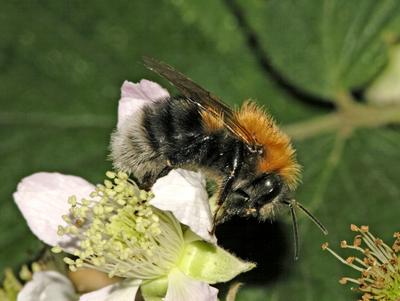

Philanthus triangulum (the bee wolf), female © Jeremy Early

Philanthus triangulum (the bee wolf), with captured honey bee © Jeremy Early

Dolichovespula media male © Jeremy Early

Dolichovespula media worker © Jeremy Early

- Dolichovespula saxonica © Jeremy Early

- Dolichovespula saxonica © Jeremy Early

- Osmia bicolor female © Jeremy Early
Worcestershire Record No. 26 April 2009 p. 31
LONGHORN BEETLE PYRRHIDIUM SANGUINEUM – LITERALLY COMING OUT OF THE WOODWORK
Roger Umpelby
This small (6-15mm long) bright red species seems to be establishing itself across the county with the latest record coming from the south-eastern corner of the county in Ashton-under-Hill in April 2009. As with several previous records the beetles emerged from cut logs both inside and outside. The original source of the logs is not known, but the timber had been stored in the wood yard in the village for well over a year, and since the beetle has a one-year life cycle, it must be established and breeding here. Previous county records are from March 2006 at Defford, Wyre Forest in 2008 and Drakes Broughton in May 2008.
This species is distributed throughout Europe and North Africa and into the Middle East. In central Europe it is one of the commonest longhorn beetles, but in the UK it is rare (RDB2). The larvae feed under bark of dead branches and trunks but, unlike some other longhorn species, eggs are readily laid in newly cut timber. Although oak is the favoured host, other deciduous trees are also hosts.
Sadly like other red beetles in the UK it frequently suffers from ‘mistaken identity’, as most gardeners assume any all-red beetle is a lily beetle Lilioceris lilii and kill them.
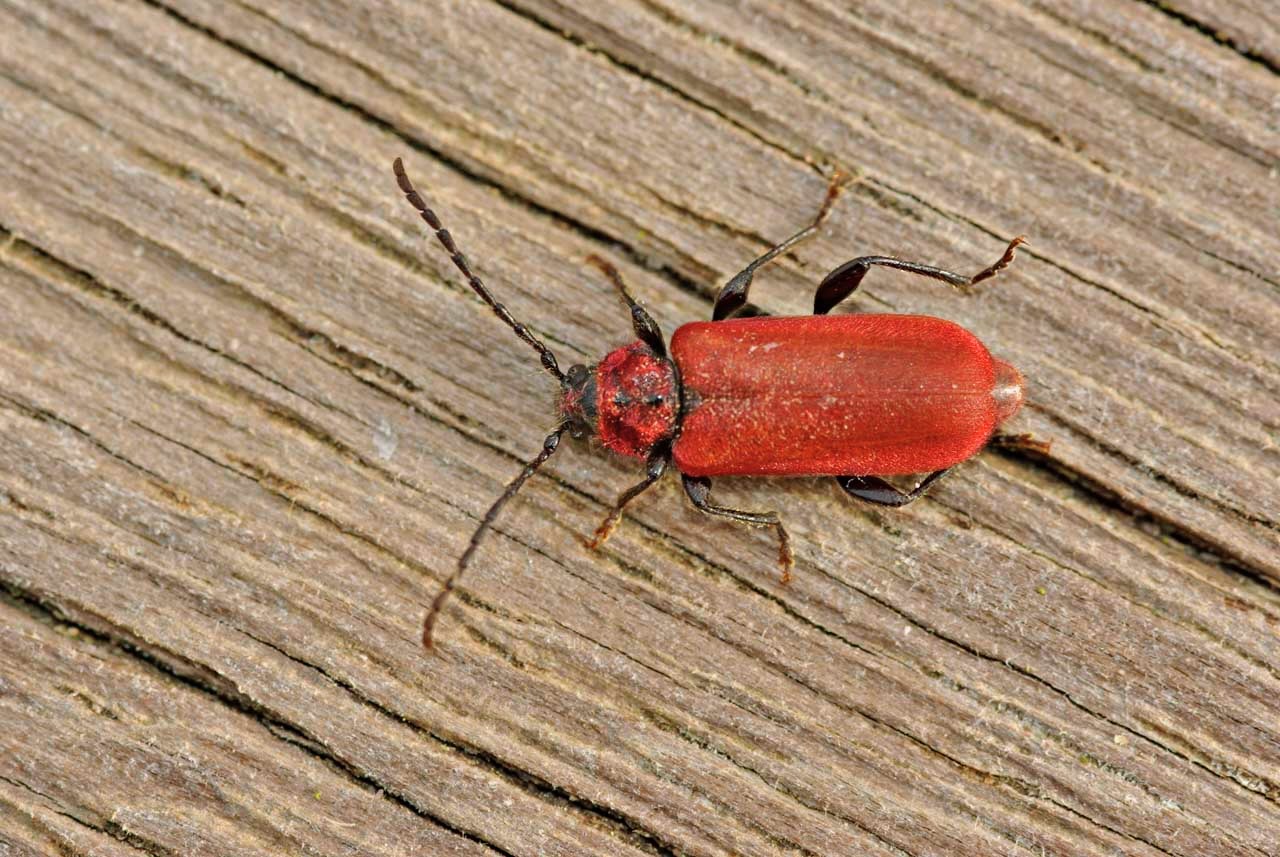
Longhorn beetle Pyrrhidium sanguineum, female ©Roger Umpelby
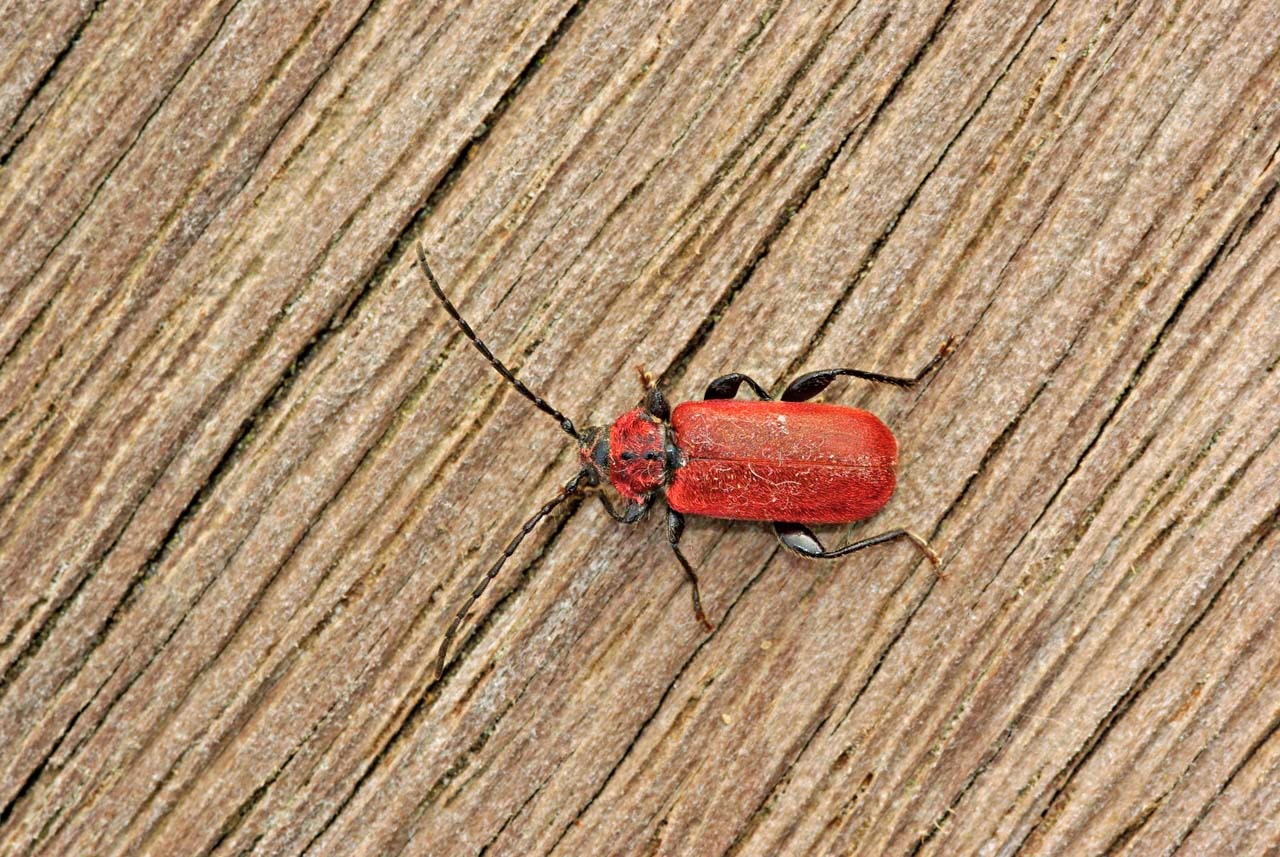
Longhorn beetle Pyrrhidium sanguineum, male ©Roger Umpelby
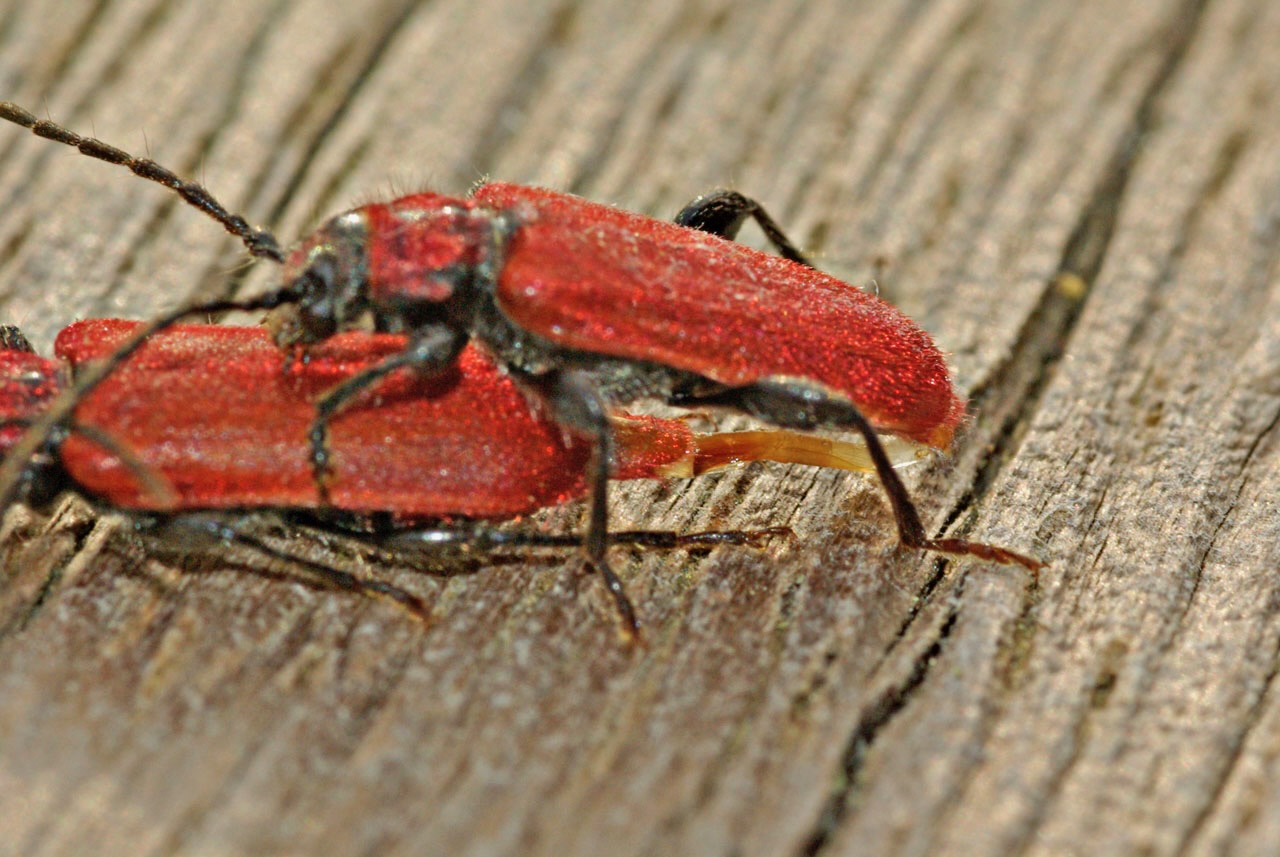
Longhorn beetle Pyrrhidium sanguineum, mating pair ©Roger Umpelby
References
|
MEIKLEJOHN, JOHN. Yet another RDB2 beetle in Defford. 2007 Worcestershire Record No 20 April 2007 p8 |
|
BINGHAM, J 2008 Interesting Records 2008. Wyre Forest Study Group Review 2008 p19-20 |
|
McGEE, KEVIN 2008 Records of note 2008. Worcestershire Record No 25 November 2008 p12-14 |
Worcestershire Record No. 26 April 2009 pp. 7-8
RECORDERS MEETING: NEW ARRIVALS
Introduction
Brett Westwood (who chaired the Annual Meeting)
If like me you take British Wildlife … and if not, why not …. I’ll bet you skim through the main articles first, then head straight for the wildlife reports section. Mainly I suspect to see what’s new. Will it be an obscure weevil, a new cricket that’s escaped from a nursery, or even a bird that’s never bred here before, like the cattle egrets in Somerset in 2008?
Whatever it is, we naturalists like a change of scene. When the dreaded harlequin ladybird was first heralded a few years back as the “fourth Horse-beetle of the Apocalypse” whose coming would bring dire consequences, how many of us secretly welcomed it as an exciting new addition to the county, however destructive? And who would find the first one? Well since you ask, it was me actually in 2005. Now they’re everywhere and reportedly chomping their way through aphids and their relatives. While we’re on the subject of harlequin ladybirds, isn’t it interesting that we despise the new beetle because we had a hand in its arrival in the UK, whereas the other native ladybirds are venerated. Is that what psychologists call transference?
But whatever its origin or intent, the new is always fascinating. Worcestershire wildlife is changing so fast that Harlequins are already so ‘last year’, as they say in the fashion industry.
It’s quite stirring to think back to when I was born nearly 50 years ago. Collared doves were the new kids on the block then, noone had heard of Guernsey Fleabane and we’d never have dreamed of being vocally mugged by Cetti’s warblers every time we went to Upton Warren. Essex Skippers weren’t around …. or if they were we never noticed them, and Danish Scurvy-grass didn’t line our motorways and main roads with a tidemark of white. Buzzards and ravens were rare birds. So were hobbies, and dragonfly fans would drool over pictures of migrant hawkers in the hope that one would turn up one late-summer day. Nowadays it’s quite common in late summer to see one making a meal of the other.
Even within our county there are subtleties of distribution so that creatures newly arrived in one area are still local or rare in others. Way up north in Stourbridge in Worcestershire’s Ultima Thule, the unexpected still happens, even on the doorstep. Last autumn stepping out of the front door, I caught sight of an unfamiliar shape on the wall of the house which turned out to be a new harvestman, Dicranopalpus ramosus splayed out against the brickwork …
So what makes a new plant or animal?
The first and most blameless method of arrival is to fly in naturally as a result of adventurous frolics brought on by population pressures or more favourable climatic conditions. The Little Egret is a good example, or the bumblebee Bombus hypnorum or crickets such as the coneheads and Roesels’s Bush cricket. These aren’t all from abroad either … warmer winters have encouraged a few residents to spread their wings. Bees and wasps and crickets all fall into this category and it’s an exciting time.
Then there are those species that we’ve introduced, and there are a lot of these! As well as the harlequin ladybird, in the past we have brought in little owls, Canada geese, mandarin ducks, ruddy ducks (though we’re setting the balance right there at some expense). Will we see what the ornithologist Derek Goodwin described as the patent absurdity of a parrot on the British List, the Ring-necked Parakeet , become established in Worcestershire? There are a multitude of insects that we’ve introduced hitch-hiking from Southern Oak Bush Crickets to the dreaded harlequin. Insects include the newly arrived oak processionary moth in London and the pine tree lappet in Scotland, both suspected stowaways. Or are they?
Garden escapes are a very special group. I’m not sure what proportion of our wild flowers are non-native, but it’s a large fraction, maybe over half. Furthermore the plants that we dump from our gardens have a climatic advantage nowadays, so that they’re ready to romp away or hybridise with native flora at the flick of an anther.
Some new species sidle out of the shadows as they’re re-classified. Birders are a particularly fickle bunch and spend a lot of time manufacturing armchair ticks based on complex DNA components. So we now have the privilege of being able to look for Yellow-legged and Caspian gulls at the local tip and search for Water Pipits and Rock Pipits on passage at the local gravel pit. Insects have their cryptic species too … look out for fun and games with the White-tailed Bumblebee Bombus lucorum, which may conceal two other hidden species. As we spend more time under the microscope, expect more species to make themselves known.
It’s an exciting time … what will be next? Harry Green has asked me to urge everyone who reads this to record, record, record … so that’s what I just did .
Worcestershire Record No. 26 April 2009 p. 8
TWO SLUGS AND TWO SNAILS: Malacolimax (Limax) tenellus, Boettgerilla pallens, Hygromia cinctella, Hygromia limbata
Brett Westwood & Harry Green
Slugs
Malacolimax (Limax) tenellus
A striking yellow slug with black antennae. According to Kerney (1999) this species is restricted to ancient woodland, both deciduous and coniferous, occasionally on chalk and limestone but more commonly in old woodland on poor acid soils. Despite its lemon yellow colouration this slug is not always easy to find as it tends to hide during the day and emerge at night to feed, usually on fungi. There are few records in Worcestershire but recent searches in Wyre Forest suggest they are not uncommon in that area. It has usually been found in rather damp conditions in shaded woodland. Doubtless it exists in many other of our ancient woodlands and further records welcome. The classic wildlife photographer’s picture of this species is a yellow slug on a red fungus such as fly agaric.
The Worm slug Boettgerilla pallens commonly nicknamed Bert-the-gorilla
This slug has a wormlike extensible body 35-55mm long (Kerney 1999) adapted to life hidden beneath things or in the soil where it moves through worm burrows and similar channels. It is an introduced species from Georgia and the Caucasus first recorded in Britain 1972. It has spread widely assisted by human activities. May be found in gardens and untidy places under stones and bricks especially on moist clay soils, but it has invaded more natural areas including woodlands. We have few records. Take care examining this slug as they seem to be somewhat fragile.
In appearance this slug is very narrow and slender, almost worm-like and sharply keeled, pale greyish or with bluish hue, head and keel slightly darker, mantle pointed at its posterior end and equipped with fine concentric grooves. Sole pale yellow. Mucus colourless. Juveniles yellowish to dirty white. (http://www.animalbase.uni-goettingen.de/zooweb/servlet/AnimalBase/home/species?id=1272)
Snails
The Girdled Snail Hygromia cinctella
This is a common Mediterranean species first recorded in Britain in Devon in 1950 (Kerney1999). In subsequent years it was found in other gardens in Devon and Cornwall and in southern England. The first record for Worcestershire was reported by David Green (1998) in a Little Comberton garden: a discovery broadcast somewhat astonishingly on BBC1 TV Midlands Today! A healthy population is still present in the same garden and it has been found in other gardens throughout the county. It is probably quite widespread but with few reports to the WBRC so we should like to receive records. It is a very distinctive snail and easy to identify. David Green’s description is useful and follows:
Shell brown to very pale brown, except usually for a single thin pale (often pale yellow) band around the outer rim of the shell. The outer whorl often appears generally darker owing to blackish splodges. A careful look from different angles reveals (a hand lens is useful) that the outer rim is also strongly keeled (the rim is a pale outward ridge, not a more rounded shape like other snails in the garden). Size much smaller than the garden snail and hedge snails. Shell widest width about 10-12mm adult, but you might find a smaller juvenile. Shell height 7mm. Despite being smallish, Hygromia cinctella is quite distinctive with the rounded pyramidal shape above, the somewhat flattened whorl below the rim, and lighter coloured keel at the rim. Mouth viewed-head on is oval as a general shape, not round. Underneath, the umbilicus (hole in centre) is minute, partly covered by lip. The big pair of antennae are particularly long when fully extended.
Hygromia limbata
This is a SW European species (Kerney 1999) first discovered in Britain in Devon in 1917, and is now well-established in that area. In 1965 it was found near Little Malvern in Worcestershire. Paul Whitehead (2008) found the species in a garden in Upton-on-Severn in 1980 and 26 years later found them in the lower part of Malvern town. By chance, later in 1980, we (Brett Westwood and Harry Green personal observations) decided to look for this snail at Malvern and found many in woodlands on the hills above Little Malvern. In 2008 Brett found them again in an adjacent wood. Paul Whitehead has also reported the species from Evesham and Stanton in Gloucestershire. These observations suggest the species is spreading in the Worcestershire area. When the present authors were searching for the species near Little Malvern we noted an apparent association with ivy both on the ground and also hanging over walls. Paul Whitehead (2008) has noticed the same thing and he suggests that tangles of ivy provide a stable environment which suits this species and has also observed the snails visiting ivy flowers and eating pollen. These observation perhaps give a clue of where we should search for the species and Kerney(1999) states that it is found moist grassy places amongst herbage and ground litter on roadside banks, on overgrown ditches, quarries and gardens. The species is probably more active in poor light conditions.
This snail is somewhat globular in form and up to 15 mm in diameter. The shell is creamy white to dark brown, often with white or dark colour bands near the periphery, translucent, 5-6 weakly convex whorls with shallow suture, aperture with white lip inside, margin reflected, umbilicus very narrow, partly covered by the reflected columellar margin.
http://www.animalbase.uni-goettingen.de/zooweb/servlet/AnimalBase/home/species?id=3153
The live snails we have seen have translucent shells and often show pigment spots inside which move when the body of the snail moves in the shell. The mottling apparent in the two pictures is made by such spots and not shell pigmentation
References:
- GREEN David M 1998 New snail to Worcestershire – Hygromia cinctella. Worcestershire Record No. 4 May 1998 p.5
- KERNEY M 1999. Atlas of the land and freshwater molluscs of Britain and Ireland. Harley Books
- WHITEHEAD PF 2008. Observations on Hygromia limbata (Draparnaud, 1905) (Pulmonata:S Helicidae) in cereal England. Journal of Conchology 39:607-608.

- Above and below: Malacolimax (Limax) tenellus © Rosemary Winnall


- Worm Slug, Boettgerilla pallens

- Girdled Snail, Hygromia cinctella © David M Green

- Girdled Snail, Hygromia cinctella © Harry Green
Hygromia limbata © Harry Green

- Hygromia limbata © Harry Green
Worcestershire Record No. 26 April 2009 p. 30
FROG RANA TEMPORARIA L., 1758 SPAWNING TERRESTRIALLY
P. F. Whitehead
On 22 April 2009 I had reason to examine a bed of cultivated hellebores, Helleborus orientalis Monnet de la Marck, in a garden at Broadway, Worcestershire (VC37 SP13). The garden is enclosed. The hellebore bed extends over some 12 m2 and is backed by a high wall running north to south; the arrangement and nature of the other boundaries is such that it is more or less permanently shaded. I was amazed to find a mass of frog spawn amounting to some 140 individual eggs fixed between the horizontal lower leaves of one plant. The leaves of H. orientalis are palmate; over time they incline towards the ground and it was one of these larger leaves that had been selected by the frog as a spawn depository. The female frog was present in the plant bed, like many garden frogs being rather tame and reluctant to move from the spot.
This evidently very rare observation raises some questions. The embryos were of normal size but some were smaller than average. Presumably they had not been fertilised but that cannot be proven; in global terms some frog genera are not aquatic and do not have aquatic tadpoles. However, such discussion is largely academic because there would be no ultimate prospect of survival in this case. In a completely enclosed garden lacking aquatic habitat did the female frog have no option but to spawn in an ornamental plant bed? This seems a likely explanation but a further question surrounds the spawning site. When found on 22 April the spawn was in reasonable shape, the capsules being largely gelatinous. In the period 14-17 April rain fell each day in south Worcestershire amounting to 20mm in total. The continuous and closed canopy of hellebore foliage would have fed rainwater downwards as a continuous cascade, the lower leaves no doubt retaining water superficially. Was this the best a maternal frog could do under the circumstances?
Enshrined in this observation is much of the story of animals and man; the versatile, adaptable and enormously successful frog and the abundant niches and opportunities man has provided for it. The opportunism of the frog should not be underestimated. On 19 March 2009 an emaciated R. temporaria was found at 610 m on Cadair Idris, Merionethshire (VC48 SN71). Its spawn was found in a depression on dry ground in fully insolated montane moorland, which just a few days earlier would have been a shallow peat pool. This is a near-analogue for the Broadway situation, but one in which the outcome would have been quite different.
| WBRC Home | Worcs Record Listing by Issue | Worcs Record Listing by Subject |
Worcestershire Record No. 26 April 2009 pp. 28-30
KNAPPED GLASS FROM THE BREDON HILL AREA OF WORCESTERSHIRE
P. F. Whitehead
This paper stems from the discovery on 12 April 2009 of a fragment of bottle glass (Fig. 1) in combe woodland on Bredon Hill in the parish of Elmley Castle. It is a basal fragment of a ‘black glass’ onion bottle, or sack bottle, dating from circa AD1700. The glass is 16mm thick and the base is characteristically ‘kicked-up’.
 |
| Fig. 1. Bredon Hill, Elmley Castle, Worcestershire, VC37 SO94, 12 April 2009. Knapped fragment of ‘black-glass onion’ bottle circa AD1700 © Paul Whitehead |
Fig. 1 illustrates the straight cutting edge that has been applied to one side of the fragment, firstly by invasive percussive removals, and then evidently by pressure, the latter producing as many as 20 minute flake scars, reducing the profile to a thin knife-like edge. At the top of the cutting edge, small, more recent, ‘natural’ removals have produced the indentation which shows up clearly on the shadow.
Discussion
One of the more interesting aspects of this find is the extension of knapping technology into post-medieval time for the purpose of tool creation on glass, which has been undertaken with the same degree of comprehension that was applied to prehistoric lithic tools. This brings with it an implication that the practice may have been more widespread than is presently recognised, especially in the more rural, thinly populated parts of England. I discussed the matter with Dr Nicholas Ashton, a specialist at the British Museum, but he could provide little supporting data; it may be that evidence for this technology is rare, scattered or overlooked. Fortunately, I am able to locate some parallels from my own experience, and I now formally bring these forward.
Fig. 2 depicts two fragments of Romano-celtic window glass from Aston Mill (Dinn & Evans, 1990; Reynolds, 1971), Kemerton, Worcestershire (VC33) found in organic pit-fill dating to circa AD200 (Whitehead, 1989) during January 1972. One edge of the 3.1 mm thick fragment shown as Fig. 2:1 (the base of the triangle) has been uniformly retouched at an angle of c45 degrees to form a scraping tool; the other edges are clean breaks which do not post-date the retouch. Fig. 2:2 is shallowly and more invasively retouched to form a knife-like edge which shows clear traces of utilisation; it is 2.1 mm thick. I originally considered whether the retouching of this window glass could have been for purposes of shaping the glass for its primary function. I rule this out because contra-directional retouch extends in a curve around the edge of Fig.2:1 (at ‘x’) providing it with an effective and comfortable forefinger rest. This scraping edge shows traces of utilisation, and there is also evidence of very minor rubbing along the longest broken edge; in that case the retouch would have been used as backing to protect the finger. Today, after the passage of 1800 years of time, this edge is capable of removing hairs from the arm. The original fabricated edge of Roman window glass, at least in the examples seen, is rounded in profile as visible evidence of its past viscosity.
 |
| Fig.2. Aston Mill, Kemerton, Worcestershire, VC33 SO93, January 1972. Knapped Romano-celtic moulded window glass, circa AD200 © Paul Whitehead |
Fig. 3 illustrates an application of bottle glass knapping to the everted mouth-rim of a late eighteenth-early nineteenth century apothecary’s bottle, dated by associated ceramic, also from Aston Mill in Worcestershire. This has removed the rim around half of its circumference, and produced linear parallel flake scars extending down the neck of the bottle. Many minute removals along the worked edge attest to some form of rubbing, possibly on wood, the bottle itself forming a handle for the tool.
 |
| Fig.3. Aston Mill, Kemerton, Worcestershire, VC33 SO93, 23 December 1972. Apothecary’s bottle with knapped and utilised mouth edge, circa AD1790 © Paul Whitehead |
Conclusions
The limited evidence provided here demonstrates that glass-knapping for the purposes of tool production persisted from the Later Prehistoric/early Historic Periods through to relatively recent post-medieval time in the Bredon Hill area of Worcestershire. The ‘black glass’ artefact from Elmley Castle and the window glass artefacts from Kemerton closely replicate stone tool fabrication techniques; this is no great surprise since flint and manufactured glass are both silica-rich, permitting controlled removals with conchoidal fracture patterns. In addition, flint-knapping methodology would be well within the social cognizance of the Romanised peoples of the Kemerton Carrant Valley, even if it was not actively practised in AD200. How much of the technology applied to the Elmley Castle artefact stems from continuity of practice over time is a key question which seems unanswerable at present, although scarcity of medieval glassware must render it doubtful. In that case the black glass artefact could demonstrate technological convergence over time. Its find site shows no evidence of occupation, and it was presumably taken into the field on a hunting trip, the consumption of wild feather and fur, and rabbits, being a human mainstay on Bredon Hill even up to post-war times. It may well be a classic example of resource reutilisation in a marginal economy.
The Aston Mill bottle tool may reflect spontaneous workmanship for a specific domestic purpose. Nevertheless, the confirmed practice of glass-knapping over 1500 years of time in one place is intriguing and novel. There is no recent use of knapped flint in building construction in the Bredon Hill. The conclusions given are not ‘cast-in-glass’ and further findings would be helpful.
References:
|
DINN, J. & EVANS, J., 1990. Aston Mill Farm, Kemerton: excavation of a Ring-ditch, Middle Iron Age enclosures and a Grubenhaus. Transactions Worcestershire Archaeological Society 12:5-66. |
|
REYNOLDS, P.J., 1971. Aston Mill Farm. Vale of Evesham Historical Society Research Papers 3:1-10. |
|
WHITEHEAD, P.F., 1989. Changing environments and Coleoptera faunas from Aston Mill, Worcestershire, England. Entomologist’s Monthly Magazine 125:187-198. |
Worcestershire Record No. 26 April 2009 p. 37-38
OTTERS IN KIDDERMINSTER
Rosemary Winnall
For the past year I have been mapping tracks and signs of otters in the Wyre Forest, so I was intrigued when Wendy Larmour showed me a photograph of animal tracks alongside the River Stour in Kidderminster. Wendy wanted confirmation that these were otter prints, so off I went to Morrison’s car park to investigate.
During February and March 2009 there has been a long spell of dry weather, and this made conditions ideal for checking watercourses for animal tracks and droppings. Silty banks had been exposed on which tracks could be found, and rocks used as sprainting sites could be checked regularly with no danger of the droppings being washed off by heavy rain between times.
When I examined the exposed sandy ledge below Morrison’s car park (see Photo 1), I could see both obvious otter prints (see Photo 2) plus the characteristic sandy mounds that otters sometimes make to deposit their droppings, called spraints (see Photos 3 and 4). I was very surprised to see evidence of such recent and regular usage of this waterway by otters, and was determined to find out more.
I set out to follow the river and its backwaters through Kidderminster with my binoculars and GPS and I was fascinated with what I found.
As you may know, part of the fast-flowing River Stour was long ago diverted in two places in Kidderminster so that water could be taken through the carpet factories, originally power this industry but also to supply water for cleaning the wool and washing after dyeing. As I was peering over a bridge in the heart of the town I started chatting to an elderly gentleman who asked what I was looking for. He subsequently described what the River Stour used to be like years ago when it ran out through the industrial Black Country and down through the carpet factories in the town. He said that it was so heavily polluted that nothing could live in it and he related how you could tell what colour dyes the carpet factory upstream was using by looking at the river! The water was polluted with chemicals from the dyes, sheep dip and pesticides from the moth proofing process and if you fell into the River Stour, you had to be taken to hospital! He said he was thrilled to see clear water running through Kidderminster again!
I crept through barriers and lurked under bridges in my search for sandy bars and stones with telltale droppings. I found tracks and spraints under the main bridge leading into Tesco’s car park! This was interesting because the whole river was moved across when this area was redeveloped in 2001. There were even otter prints on a small sandy riverside edge behind the shop T. J. Hughes! I then knocked on the door of the Kidderminster Fire Station as I had heard stories of fireman seeing otters when they were on night duty. Although the fireman I spoke to could not elaborate, he kindly took me on a tour of their riverside land and sure enough, I found tracks there too!
Kidderminster is between two important wetland areas – Puxton Marsh to the north and Wilden Marsh south of the town. It is obvious that otters are using the waterways through the town on a regular basis. They are probably using the canals too, but it is harder to find field signs there. Paul Allen, Countryside and Conservation Officer, Wyre Forest District Council, has known about the otters in Kidderminster for some time and has been working with local businesses and schools to ensure that riverbanks are improved for otters to use. Many artificial holts have been put in and trees planted.
- Photo 1. River Stour below Morrison’s car park 18.03.2009
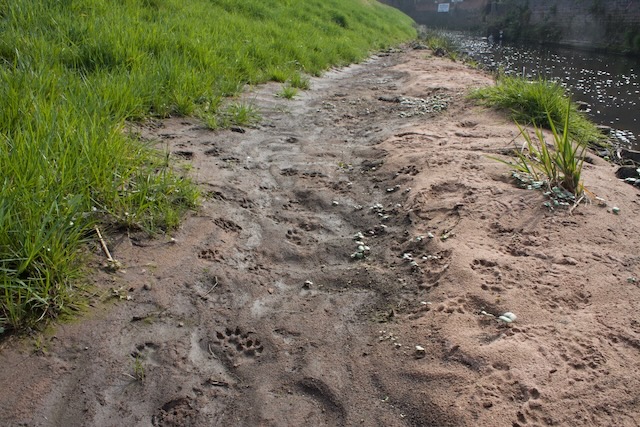
- Photo 2. Otter tracks in sand, Morrison’s 18.03.2009

- Photos 3 (above) and 4 (below). Otter spraint on sandy mound, Morrison’s 18.03.2009